

Best AWS Solutions Architect Associate Courses Are Wrong
Most training programs focus on memorization, but the SAA-C03 exam tests architectural thinking and problem-solving.
The most popular and highly-rated SAA-C03 prep courses may be the primary reason candidates fail the exam. These courses excel at delivering a comprehensive overview of individual AWS services. However, they often fail to teach the single most critical skill the exam actually measures: the ability to analyze complex scenarios and make architectural trade-off decisions. This guide deconstructs this fundamental gap and provides a framework for true exam readiness.
Key Takeaways
- Most courses teach AWS services in isolation, which encourages fact-based memorization.
- The SAA-C03 exam uses scenario-based questions that require you to compare and contrast multiple valid services to find the optimal solution.
- True exam preparation involves understanding the AWS Well-Architected Framework as a decision-making model.
- Effective study requires moving beyond video lectures and into hands-on labs and high-quality practice exams that mirror the exam's complexity.
- Knowing service limits and features is foundational, but applying that knowledge to solve business problems is what the exam validates.
- Candidates often fail not from a lack of knowledge, but from an inability to interpret nuanced questions and identify key constraints.
- A successful strategy involves deconstructing practice questions to understand the "why" behind the correct answer, not just the "what."
At a Glance
| Dimension | Typical Course Focus | Actual Exam Requirement |
|---|---|---|
| Learning Style | Passive (Watching Videos) | Active (Problem-Solving) |
| Content Focus | Service Features & Limits | Service Integration & Trade-offs |
| Core Skill | Information Recall | Critical Thinking & Analysis |
| Question Type | "What is Amazon S3?" | "When should you use S3 vs. EFS?" |
| Guiding Principle | Service-by-Service Catalog | AWS Well-Architected Framework |
| Measure of Success | Course Completion Certificate | Passing Score on SAA-C03 |
What Are AWS Solutions Architect Associate Courses?
SAA-C03 prep courses are structured training programs designed to help IT professionals prepare for the AWS Certified Solutions Architect – Associate (SAA-C03) exam. These programs are offered by numerous independent instructors and official training partners. They typically consist of video lectures, slide decks, quizzes, and sometimes hands-on lab exercises.
The primary goal of these courses is to provide a comprehensive survey of the core AWS services covered in the official exam blueprint. This includes foundational services across compute, storage, networking, and databases. The popularity of these courses has surged as the SAA-C03 certification has become a benchmark credential for cloud professionals, validating their ability to design secure, resilient, and cost-effective solutions on the AWS platform.
Framework Overview
Understanding the disconnect between course content and exam reality requires a clear framework. The problem can be broken down into three distinct parts that build upon one another. Recognizing this structure is the first step toward adjusting your study strategy for success.
The Course Structure: A Service Catalog Approach. Most courses are organized service-by-service. You will watch a module on EC2, then S3, then VPC. This is logical for introducing a vast ecosystem, but it implicitly teaches you to think about services in isolation.
The Exam Structure: A Scenario-Based Approach. This is where the fundamental limitations of many SAA-C03 prep courses come into sharp focus. While a course might effectively teach you the definition of EC2, the SAA-C03 exam won't ask for it. Instead, it presents a business problem—like deploying a highly available web application with specific performance and cost requirements—and asks you to architect a complete solution. The exam tests your ability to weigh trade-offs between multiple services, a critical skill that the isolated, service-by-service format of typical online courses fails to cultivate.
The Gap: From Knowledge to Application. The critical gap is the bridge between knowing what a service does and knowing how to apply it in a complex, multi-service architecture. This is where the AWS Well-Architected Framework becomes more important than any single service's documentation.
Key Terms
| Term | Plain-English Meaning | Why It Matters |
|---|---|---|
| SAA-C03 | The current exam code for the AWS Certified Solutions Architect – Associate certification. | This is the specific exam you are preparing for; its format dictates your study method. |
| Well-Architected Framework | AWS's official set of best practices for designing cloud architectures, based on six pillars. | This is the mental model the exam uses to evaluate solutions; it is your true study guide. |
| Architectural Trade-off | The process of making a design choice that prioritizes one benefit (e.g., cost) over another (e.g., performance). | Nearly every exam question is a test of your ability to make the correct trade-off. |
| Rote Memorization | Learning facts by repetition without understanding the underlying concepts. | This is the primary failure mode for candidates who rely only on courses. |
| Scenario-Based Question | An exam question that describes a problem and asks for the best solution among several options. | This is the format of the vast majority of SAA-C03 questions. |
| VPC | Virtual Private Cloud; your private, isolated section of the AWS cloud. | Networking is a foundational topic, and VPC design is central to many exam scenarios. |
| IAM | Identity and Access Management; the service that controls access to AWS resources securely. | Security is a key pillar of the Well-Architected Framework and is tested extensively. |
The Memorization Trap: How Courses Build the Wrong Foundation
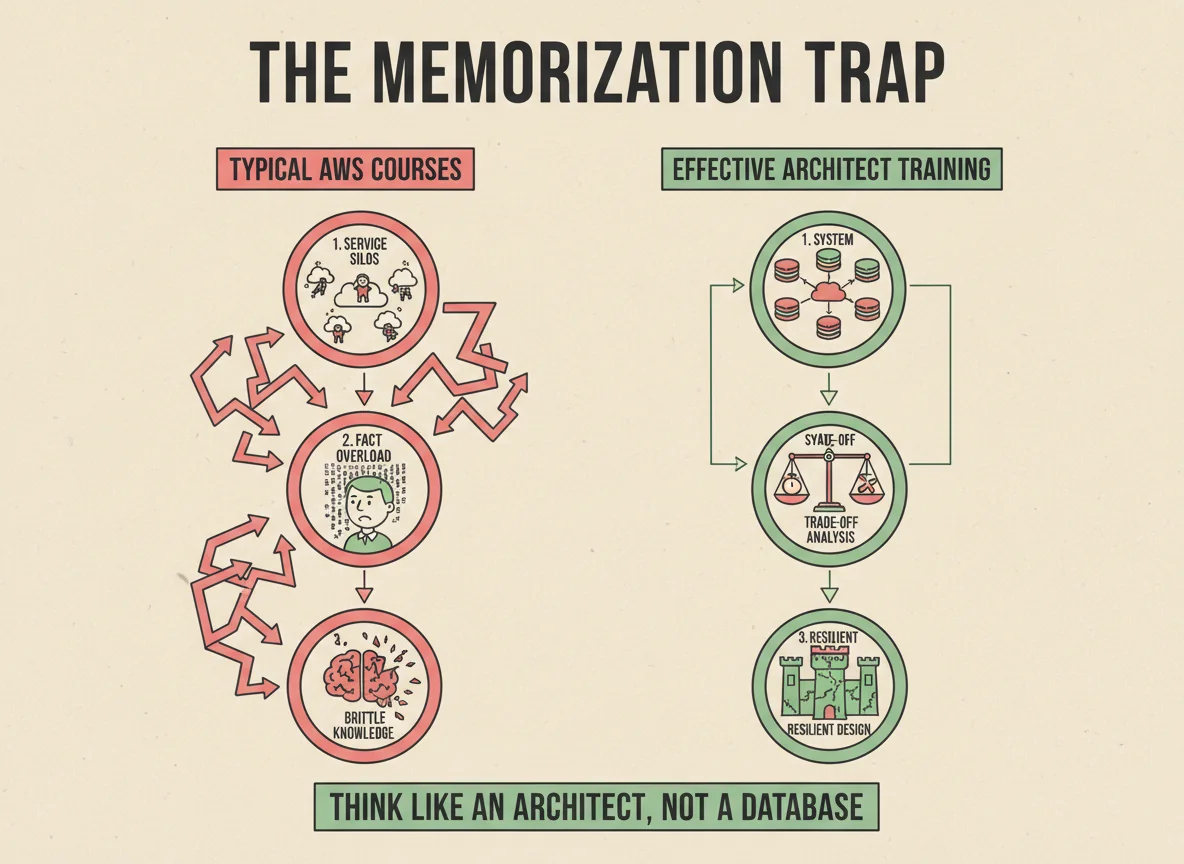
The fundamental flaw in many AWS certification prep courses is not the information they present, but how they present it. By organizing content into discrete, service-specific modules, they inadvertently train students for a knowledge-recall test that AWS does not administer. This creates a dangerous "memorization trap" that leaves candidates unprepared for the reality of the exam.
Teaching Services in a Vacuum
A typical course curriculum walks through AWS services one by one. You will spend hours learning the intricate details of Amazon S3 storage classes, their durability figures, and minimum storage durations. Then, you will move to a separate module on Amazon EFS, learning its performance modes and throughput capabilities. While this information is essential, it is taught in a vacuum.
The course has taught you what S3 is and what EFS is. The exam, however, will ask a question like: "A company needs to store and share large media files for a video processing workflow that runs on a fleet of EC2 instances. The solution must be highly available and provide low-latency file access. Which storage solution should be used?" The answer requires comparing S3 and EFS based on the scenario's requirements, a skill rarely taught in the service-specific modules.
Prioritizing Facts Over Frameworks
This service-catalog approach leads students to create flashcards of facts: EC2 instance types, DynamoDB read/write capacity units, or the maximum size of an SQS message. This is a classic example of prioritizing facts over frameworks. The SAA-C03 is built entirely around a framework: the AWS Well-Architected Framework.
Instead of memorizing the maximum IOPS of an io2 Block Express EBS volume, a successful candidate understands the Performance Efficiency pillar. They know to ask, "Does this application's workload require the highest possible IOPS, or would a more cost-effective volume type meet the requirements?" The courses often provide the technical specifications but fail to embed them within this decision-making context. This is a critical reason why real exam questions are vital for certification success.
The "Firehose" Problem: Information Overload Without Context
A secondary issue stemming from the service-catalog approach is information overload. To appear comprehensive, courses often attempt to cover every feature of every service on the exam blueprint. This "firehose" of information makes it nearly impossible for a student to distinguish between core concepts and esoteric details.
What Is Signal vs. What Is Noise?
Does a Solutions Architect Associate need to memorize every single AWS Budgets alert option? No, but they absolutely need to understand the concept of cost optimization and how to use services like AWS Cost Explorer and Budgets to implement it. The course may spend equal time on both, leaving the student to guess what is truly important.
This lack of prioritization is exhausting and inefficient. It leads to study plans that are miles wide and an inch deep. Candidates finish a 50-hour course feeling overwhelmed with facts but unable to articulate a simple architectural pattern, such as how to design a decoupled, three-tier web application. A structured study plan for tech certification exams is necessary to filter this noise.
Architectural Trade-offs: What AWS Actually Tests
The AWS SAA-C03 exam is not a test of knowledge; it is a test of judgment. Every challenging question is designed to assess your ability to make sound architectural trade-offs. AWS wants to certify architects who can listen to a customer's needs and design a solution that is not just functional, but also secure, reliable, performant, and cost-effective.
A Language of Constraints
Consider a typical exam scenario. A company wants to migrate a database to AWS. The question will include several constraints: the database is relational, it requires high availability across multiple Availability Zones, it must support read replicas to handle reporting queries, and the company wants to minimize operational overhead.
The answer options might include: A. Deploying the database on an EC2 instance. B. Using Amazon RDS. C. Using Amazon DynamoDB. D. Using Amazon Redshift.
A candidate who only memorized service definitions might struggle. They know what each service is, but not how to choose. A candidate trained in architectural thinking will immediately eliminate C and D because the database is relational. They will then compare A and B against the "minimize operational overhead" constraint and correctly choose B, Amazon RDS, as it is a managed service.
Every Choice Is a Trade-off
This process of elimination and selection based on constraints is the core loop of the exam. You are constantly making trade-offs. Do you choose a more expensive, fully managed service like RDS to reduce operational burden? Or do you opt for a self-managed database on EC2 to gain more control at the cost of increased management responsibility? The "right" answer always depends on the scenario's specific requirements.
The Well-Architected Framework: The True Exam Blueprint
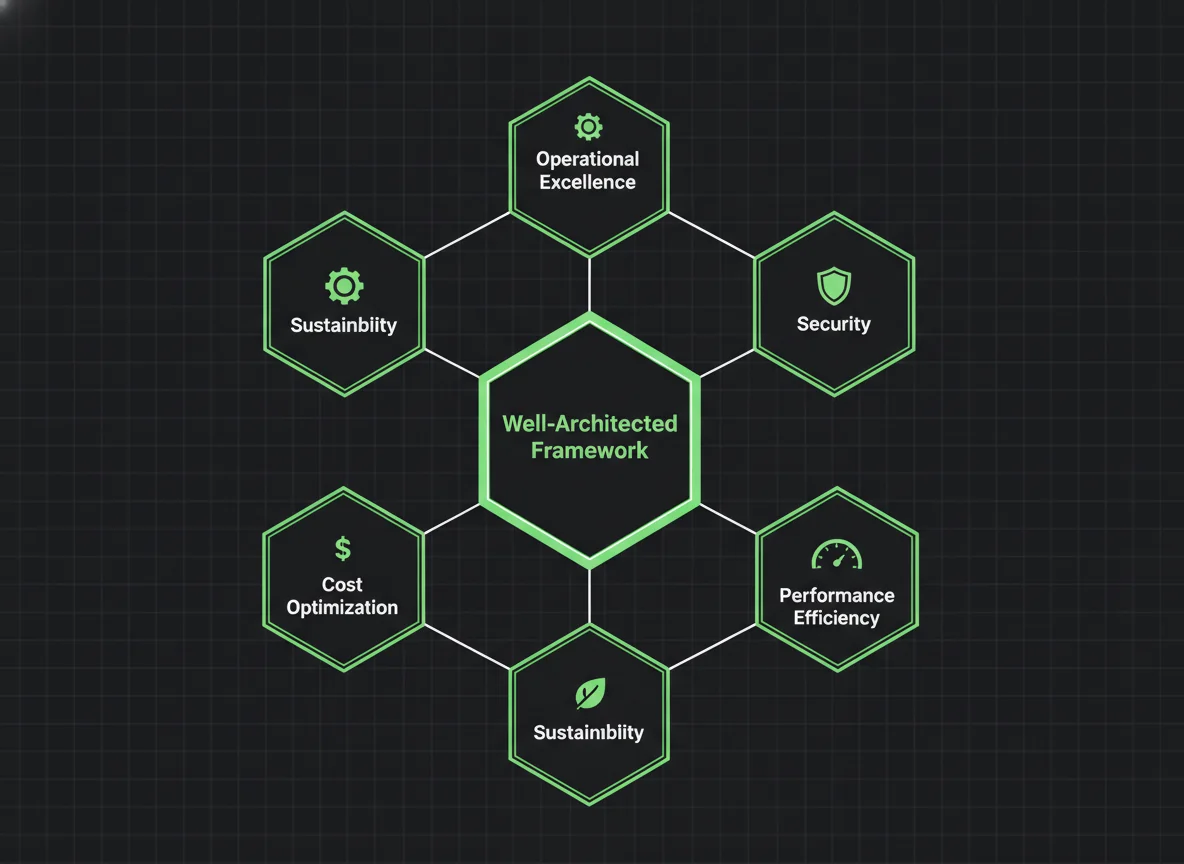
The single most valuable resource for SAA-C03 preparation is not a third-party course, but the official AWS Well-Architected Framework. This framework is the philosophical foundation of the exam. It provides the criteria AWS uses to define a "good" architecture. Mastering its six pillars is the key to developing the mindset needed to pass.
The Six Pillars of Decision-Making
The framework is built on six pillars. For every exam question, you should be thinking about which pillars are being tested.
- Operational Excellence: The ability to run and monitor systems to deliver business value. Think automation, monitoring, and responding to events.
- Security: Protecting information and systems. This includes confidentiality, integrity, IAM, and detective controls.
- Reliability: Ensuring a workload performs its intended function correctly and consistently. This covers fault tolerance and disaster recovery.
- Performance Efficiency: Using computing resources efficiently to meet system requirements. This involves selecting the right resource types and sizes.
- Cost Optimization: Avoiding unnecessary costs. This is about understanding spending, using managed services, and eliminating over-provisioning.
- Sustainability: Minimizing the environmental impacts of running cloud workloads. This is the newest pillar and focuses on efficiency and managed services.
Instead of asking "What does AWS Shield do?", the exam asks you to design a solution that is resilient to DDoS attacks (Security and Reliability pillars). The answer might involve AWS Shield, but also WAF, CloudFront, and security groups. Understanding the pillars provides the context to build these multi-service solutions.
Expert Tips
Moving from a passive, course-based learning model to an active, problem-solving one requires a deliberate shift in strategy. Here are five expert tips to bridge the gap and prepare for the real SAA-C03 exam.
Study the "Why," Not Just the "What." For every service, your primary goal should be to understand its ideal use case and the problems it solves. Create a mental map of which services compete or complement each other. For example, when should you use Application Load Balancer versus Network Load Balancer?
Use Courses for Foundation, Not Final Prep. Treat video courses as your initial introduction to the AWS ecosystem. Use them to build a broad understanding of the available services. But once that foundation is laid, your focus must shift to hands-on practice and scenario analysis.
Practice Deconstructing Scenario Questions. When using a practice exam, do not just answer the questions. For each one, identify the key constraints, the business goal, and the architectural pillars being tested. Explain to yourself why the incorrect answers are wrong for this specific scenario.
Whiteboard Solutions Before Looking at Options. Read a practice question's scenario and, without looking at the multiple-choice options, try to sketch out a solution on a whiteboard or piece of paper. This forces you to think like an architect rather than just trying to pattern-match the answer.
Read the Official AWS FAQ and Whitepapers. The official documentation is an underutilized resource. The FAQ pages for core services like EC2, S3, and VPC often contain clear, concise explanations of use cases and trade-offs that are directly relevant to exam questions.
Real-World Scenarios
To illustrate the difference between memorization and architectural thinking, consider these two scenarios, which reflect the logic of the SAA-C03 exam.
Scenario 1: The E-commerce Product Catalog
A candidate, Maria, has diligently studied for the exam. She memorized that DynamoDB is a NoSQL database that provides low-latency key-value access. An exam question describes an e-commerce site that needs a database for its product catalog. The catalog requires flexible schemas and must scale to handle millions of items with single-digit millisecond latency.
Maria sees "low-latency" and "flexible schema" and immediately selects DynamoDB. This is the correct answer. However, a follow-up question might ask how to implement a search feature for product descriptions. A candidate who only memorized DynamoDB features would be stuck. An architect would know to integrate DynamoDB with a service like Amazon OpenSearch Service to handle the search requirement, demonstrating an understanding of multi-service architecture.
Scenario 2: The Lift-and-Shift Migration
Another candidate, David, is faced with a migration question. A company wants to move its on-premises, three-tier web application to AWS with minimal changes. The primary goal is to improve reliability and reduce the physical data center footprint. The application relies on a specific version of a relational database that is not available on RDS.
A course-focused student might incorrectly choose RDS because it is the "standard" managed database solution. David, however, identifies the "minimal changes" and "specific version" constraints. He correctly chooses to deploy the database on an EC2 instance, preserving the exact version while still leveraging AWS infrastructure for improved reliability through Multi-AZ deployments. He made the right trade-off based on the scenario's unique needs.
Common Mistakes to Avoid
Many well-prepared candidates fail the SAA-C03 due to common strategic errors. Avoiding these pitfalls is just as important as learning the technical content.
Relying Solely on a Single Video Course. No single course can perfectly prepare you. Supplement your primary course with hands-on labs, official AWS documentation, and high-quality practice tests.
Ignoring the Official Exam Guide. The official SAA-C03 exam guide from AWS is your ground truth. It details the domains, weightings, and in-scope services. Always cross-reference your study materials against this document.
Using Low-Quality Practice Questions. Many sources offer practice questions that are simple definition checks. These create a false sense of confidence. Invest in practice exams known for their realistic, scenario-based questions and detailed explanations. The importance of real exam questions cannot be overstated.
Not Reading the Question Carefully. AWS questions are notoriously verbose and specific. Every word matters. Read each question twice. Identify the keywords related to cost, performance, security, and reliability before you even look at the answers.
Poor Time Management. The exam gives you 130 minutes for 65 questions, averaging two minutes per question. If you are stuck on a question for more than two minutes, flag it for review and move on. Answering all questions is critical.
How to Prepare with PlanetCert
Traditional AWS Solutions Architect Associate courses provide the foundational knowledge, but they often leave a critical gap in practical application and exam-style thinking. PlanetCert is designed specifically to bridge that gap. Our platform moves you from passive learning to active problem-solving, conditioning you for the realities of the SAA-C03 exam.
Our practice exams are not simple knowledge checks. They are meticulously crafted to simulate the complex, scenario-based questions you will face on exam day. Each question forces you to analyze constraints, evaluate trade-offs, and think like a true solutions architect. We focus on the "why," providing detailed explanations for both correct and incorrect answers, which helps you internalize the decision-making logic of the AWS Well-Architected Framework. By integrating PlanetCert's Service Cloud Consultant sample questions or other relevant practice tests into your study plan, you can effectively test your ability to apply knowledge under pressure.
Frequently Asked Questions
Is the SAA-C03 exam difficult? Yes, the exam is considered challenging, not because of the breadth of knowledge required, but because of the critical thinking and analysis skills it tests. Candidates who only memorize facts will find it very difficult, while those who practice applying their knowledge to scenarios will be better prepared.
How long should I study for the AWS Solutions Architect Associate exam? This varies greatly depending on your prior experience with AWS. For those with no experience, 100-120 hours of study over two to three months is a common recommendation. For experienced professionals, 40-60 hours over one month may be sufficient to focus on exam-specific topics.
Are hands-on labs necessary to pass the SAA-C03? While not strictly mandatory, hands-on experience is highly recommended. Building solutions in the AWS Management Console solidifies your understanding of how services connect and interact. This practical knowledge is invaluable for answering scenario-based questions with confidence.
Can I pass the AWS exam with just one course? It is possible but not recommended. A successful preparation strategy is multi-faceted, combining a primary video course for foundational knowledge, hands-on labs for practical skills, and high-quality practice exams like those from PlanetCert to develop exam-specific critical thinking.
What is the passing score for the SAA-C03? The exam is scored on a scale of 100 to 1,000, with a passing score of 720. The scoring is not linear, and some questions may be unscored as AWS gathers data on them for future exams.
Which AWS services are most important for the exam? Core services like IAM, VPC, EC2, S3, RDS, and DynamoDB are foundational. You must also have a strong understanding of how to connect services using tools like SQS, SNS, Lambda, and API Gateway to build decoupled and scalable architectures.
Do I need programming skills for the SAA-C03 exam? No, you do not need to write code during the exam. The focus is on architectural principles and service selection. However, a basic understanding of concepts from JSON or YAML can be helpful for interpreting questions related to IAM policies or AWS CloudFormation templates.
How long is the AWS Solutions Architect Associate certification valid? The certification is valid for three years. To maintain your certified status, you must recertify by either passing the latest version of the Associate exam or by passing the Professional-level Solutions Architect exam before your current certification expires.
Next Steps: Applying Architectural Principles
Once you have a solid grasp of the core services discussed in your course, the next phase of your preparation involves moving beyond theory and into application. This is where you truly start thinking like an architect. To bridge this gap, focus on resources that force you to analyze trade-offs and design decisions. Start with the official AWS whitepapers, but don't just read them—deconstruct them. Pay close attention to the "Well-Architected Framework" papers, as they are the blueprint for the exam's scoring. Also, explore whitepapers on disaster recovery, high availability, and specific storage solutions to see how principles are applied in practice. Supplement this with AWS re:Invent session recordings on YouTube, where AWS architects often break down complex real-world customer scenarios and the solutions they built.
The Bottom Line
The path to passing the AWS Certified Solutions Architect – Associate exam is not about finding the single "best" course. It is about adopting the right study methodology. The exam validates your ability to think like an architect, and no amount of passive video-watching can teach that skill. Shift your focus from memorizing facts to analyzing problems. Use courses to build your vocabulary of services, but use hands-on labs and realistic practice exams to build your fluency in the language of architecture.
Related Blog Posts

Discussion
Question Comments
0 comments·0 participantsSign in to leave a comment and access more free questions.