

CompTIA Security+ SY0-701: Zero Trust and Cloud Skills
CompTIA launched Security+ SY0-701 on November 7, 2023 as the current Security+ exam version. CompTIA lists the exam at up to 90 questions in 90 minutes with a passing score of 750 on a 100 to 900 scale.[1] This guide focuses on the parts of the blueprint that matter most for modern security work: zero trust thinking, cloud and hybrid-environment security, and how to translate the official objectives into a practical study plan.
Last verified: March 10, 2026. PlanetCert reviewed this article against CompTIA's Security+ certification page, CompTIA's partner/objectives material, NIST zero trust guidance, and CISA hybrid-identity guidance so the terminology and exam framing stay tied to the official entities behind the topic.[2][3][4]
Table of Contents
- What Is Security+ SY0-701 Certification?
- Major Changes From SY0-601 to SY0-701
- Zero Trust, Cloud Security, and Hybrid Identity
- Exam Domains and Real-World Applications
- Common Pitfalls and Effective Study Tactics
| Official SY0-701 quick facts | Current details |
|---|---|
| Exam code / version | SY0-701 / Security+ V7[1] |
| Question format | Up to 90 multiple-choice and performance-based questions[1] |
| Time / passing score | 90 minutes / 750 scaled score[1] |
| Recommended experience | CompTIA Network+ plus about two years in a security or systems administrator role[1] |
Key Takeaways
| Point | Details |
|---|---|
| Security+ SY0-701 Certification Overview | SY0-701 is the live Security+ version and validates baseline cybersecurity skills across hybrid environments, cloud-adjacent security work, and modern access-control decisions.[1] |
| Key Changes From SY0-601 | The current blueprint is organized into five refreshed domains with the most weight on Security Operations, followed by Threats, Vulnerabilities, and Mitigations and Security Program Management and Oversight.[2] |
| Practical Exam Domains | Zero trust, cloud security, and hybrid identity are easier to study when you map them to official domains instead of treating them as isolated buzzwords.[3][4] |
| Effective Study Strategies | Best results come from using the official objectives first, then reinforcing weak areas with labs, scenario review, and timed practice rather than rote memorization. |
What Is Security+ SY0-701 Certification?
Security+ is CompTIA's baseline cybersecurity certification and SY0-701 is the live exam code for the current version.[1] CompTIA describes the exam as validating the ability to assess an enterprise security posture, recommend and implement security solutions, monitor and secure hybrid environments including cloud, mobile, and IoT, and identify and respond to security incidents.[2]
That scope matters because it explains why this version feels more operational than older Security+ study guides. Candidates are expected to connect core security concepts to real environments: identity controls, cloud services, hybrid infrastructure, incident response, and governance. To turn that scope into exam-day execution, pair this overview with our Security+ practice test workflow.
For most learners, the right mindset is not "memorize every acronym." It is "map each objective to a control, misconfiguration, or response action." That is especially true for zero trust, where NIST defines the model as granting no implicit trust based solely on physical or network location and requiring explicit authorization and authentication before resource access is established.[3] For topic order, use our Security+ study-first priority map.
Pro Tip: Study the exam objectives systematically and focus on understanding practical application of zero trust principles rather than merely memorizing theoretical concepts.
Major Changes From SY0-601 to SY0-701
The biggest practical difference between SY0-601 and SY0-701 is that CompTIA reorganized the blueprint around five updated domains: General Security Concepts (12%), Threats, Vulnerabilities, and Mitigations (22%), Security Architecture (18%), Security Operations (28%), and Security Program Management and Oversight (20%).[2]
That weighting tells you how to study. SY0-701 still expects broad security knowledge, but it leans harder into operations, modern architecture, and protecting hybrid environments instead of treating cloud or identity as side topics. CompTIA also frames the exam around securing cloud, mobile, and IoT environments and responding to current threats, which is why zero trust and practical access-control decisions show up so often in strong study plans.[1][2]
In practical terms, spend extra time on these transition areas:
- Identity and access decisions in hybrid environments
- Cloud and SaaS security controls
- Security operations and incident handling
- Threat detection and mitigation workflows
- Governance, risk, and oversight language used in real organizations
The updated exam structure is easier to manage when you study by domain weight, then map each weak domain to scenarios you can explain in plain language. That turns the blueprint into something usable instead of something you only recognize on a flashcard.

Here is the official SY0-701 domain weighting that should shape your study time:
| Official SY0-701 domain | Weight |
|---|---|
| General Security Concepts | 12% |
| Threats, Vulnerabilities, and Mitigations | 22% |
| Security Architecture | 18% |
| Security Operations | 28% |
| Security Program Management and Oversight | 20% |
Pro Tip: Focus on understanding the practical implementation of zero trust principles and cloud security concepts rather than memorizing isolated technical details.
Zero Trust, Cloud Security, and Hybrid Identity
Zero trust architecture is not just a buzzword for Security+. NIST defines zero trust as an approach that grants no implicit trust based solely on physical or network location and requires explicit authorization and authentication before resource access is established.[3] That definition is useful for SY0-701 because it turns a vague idea into concrete exam behavior: verify identity, limit privilege, evaluate context, and protect the resource rather than assuming the network itself is trusted.
Cloud and hybrid environments are where this becomes practical. CompTIA explicitly frames Security+ around monitoring and securing hybrid environments including cloud, mobile, and IoT,[2] and CISA's hybrid identity guidance explains why identity management becomes more complex when on-premises systems are integrated with cloud services.[4] In other words, learners should expect scenario questions that mix users, devices, identity, SaaS, and conditional access rather than clean perimeter-only examples.
For exam prep, focus on the operating principles behind the terminology:
- Continuous authentication and authorization decisions
- Granular access control and least privilege
- Risk-based or context-aware access decisions
- Logging, monitoring, and rapid incident response in cloud or hybrid environments
- Clear separation between identity, device, network, and data controls
Pro Tip: When a Security+ question mentions zero trust, ask yourself what should be explicitly verified, what access should be minimized, and which control actually protects the resource.
Exam Domains and Real-World Applications
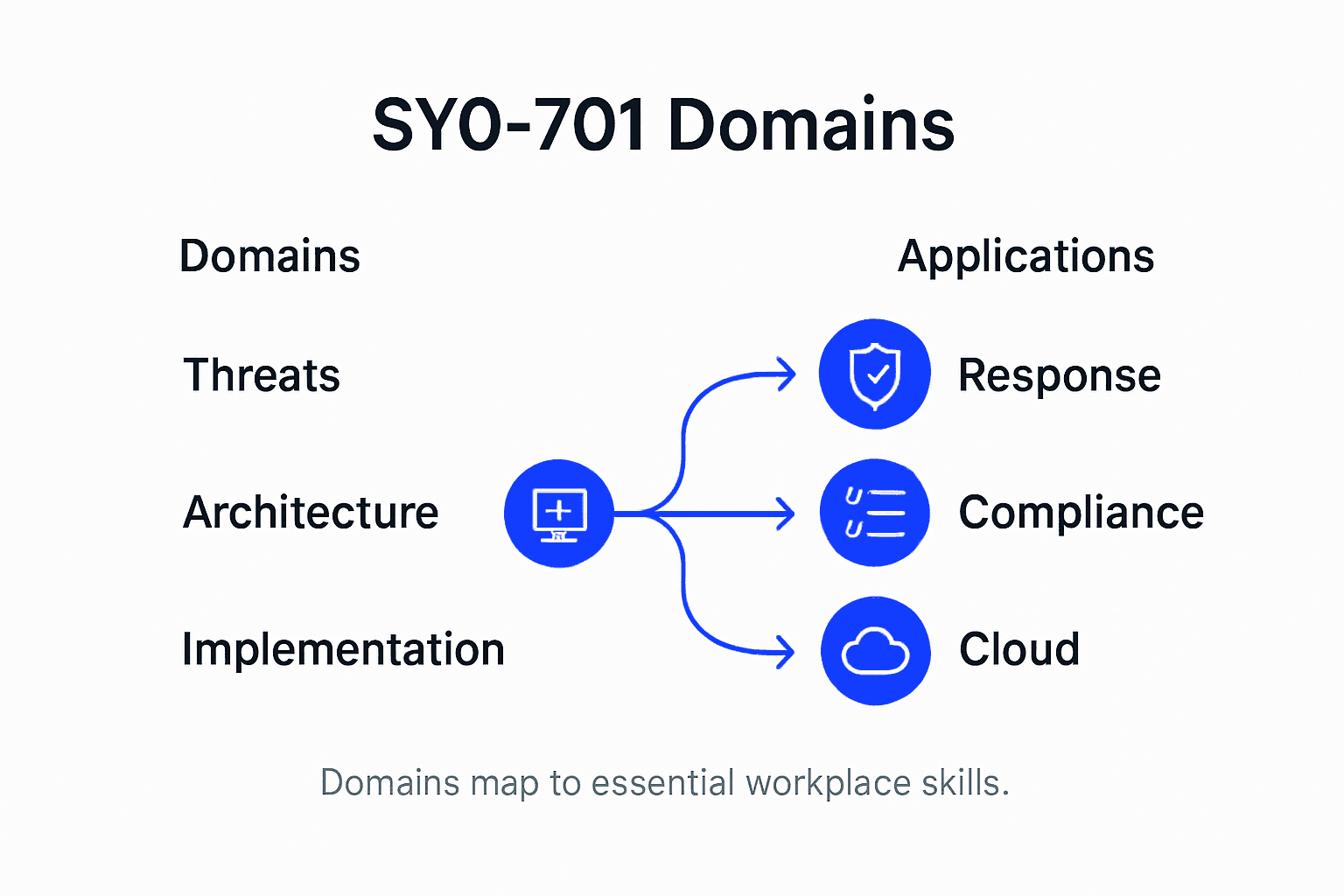
SY0-701 is measured across five official domains, and those labels matter because CompTIA uses them to organize the blueprint and the questions you will see on test day.[2] If you study by the real domain names, it becomes easier to understand where zero trust, cloud, identity, and incident response actually belong.
The official domains are:
-
General Security Concepts (12%)
- Foundational security principles
- Control types and security concepts
- Baseline terminology that appears across the rest of the exam
-
Threats, Vulnerabilities, and Mitigations (22%)
- Threat categories and attack methods
- Vulnerability identification and mitigation choices
- Risk reduction in real operating environments
-
Security Architecture (18%)
- Secure enterprise and cloud design decisions
- Network segmentation and zero trust concepts
- Identity, device, and resource protection patterns
-
Security Operations (28%)
- Monitoring, alerting, and incident handling
- Operational security controls and investigations
- The largest weighted domain in the current exam version
-
Security Program Management and Oversight (20%)
- Governance, risk, compliance, and vendor oversight
- Security awareness and policy alignment
- Business-facing security decisions, not just technical controls
Professionals who can explain these domains in plain language usually perform better than those who memorize isolated terms. That is because the exam keeps asking you to connect controls, risks, and operational context across cloud, hybrid, and traditional environments.
Pro Tip: Focus on understanding the interconnections between exam domains rather than studying them in isolation, as real-world cybersecurity challenges rarely fit neatly into single categories.
Common Pitfalls and Effective Study Tactics
Successfully navigating the CompTIA Security+ SY0-701 certification requires a strategic approach that goes beyond traditional memorization techniques. Many candidates stumble by attempting to learn isolated facts rather than developing a comprehensive understanding of cybersecurity principles and their interconnected nature.
Common pitfalls that cybersecurity professionals must avoid during their exam preparation include:
- Over-relying on practice tests: While practice exams are valuable, they should not be the sole study method
- Neglecting hands-on experience: Theoretical knowledge must be complemented by practical skills
- Ignoring emerging technological trends: Cybersecurity is a rapidly evolving field requiring continuous learning
- Failing to understand context: Memorizing technical details without comprehending their broader implications
- Insufficient time management: Not allocating adequate study time across different exam domains
Effective study tactics involve a multifaceted approach that combines official objectives, practical experience, and strategic preparation. A reliable workflow is: read the official objective, explain it in your own words, connect it to a tool or control, then test yourself under time pressure.
Candidates should develop a structured study plan that includes:
- Comprehensive review of official exam objectives
- Hands-on lab environments and practical exercises
- Consistent engagement with current cybersecurity news and trends
- Collaborative study groups and knowledge sharing
- Regular self-assessment and performance tracking
That process works especially well for SY0-701 because the exam rewards applied reasoning. A learner who can explain why least privilege, conditional access, or segmentation is the right response will usually outperform someone who only recognizes the vocabulary.
The table below summarizes common exam preparation mistakes versus recommended strategies:
| Common Mistake | Effective Alternative |
|---|---|
| Relying only on practice tests | Combine with hands-on labs |
| Ignoring new tech trends | Follow cybersecurity industry updates |
| Studying details in isolation | Connect topics across exam domains |
| Memorizing facts | Focus on real-world application |
| Poor time allocation | Use structured study schedules |
Pro Tip: Create a dynamic study environment that simulates real-world scenarios, focusing on understanding underlying security concepts rather than simply memorizing technical specifications.
Master Zero Trust and Cloud Security with Proven Practice Resources
The CompTIA Security+ SY0-701 certification challenges you to understand complex concepts like zero trust architecture, cloud security, and hybrid-environment security. If you want to overcome common study pitfalls and build real-world skills in these domains, you need more than theory. You need targeted practice that mirrors the exam's emphasis on practical decision-making and operational tradeoffs.
Prepare smart with PlanetCert by pairing this overview with our Security+ practice test workflow, targeted review on weak domains, and simulator sessions that help you move from objective familiarity to scenario readiness. The goal is simple: identify the right control, explain why it fits, and stay calm when the question changes the environment.
Sources Used in This Refresh
- [1] CompTIA Security+ certification page
- [2] CompTIA Security+ partner/objectives overview
- [3] NIST SP 800-207: Zero Trust Architecture
- [4] CISA Hybrid Identity Solutions Guidance
Frequently Asked Questions
What is the CompTIA Security+ SY0-701 certification?
The CompTIA Security+ SY0-701 certification is CompTIA's current Security+ exam version and validates baseline cybersecurity skills across modern enterprise security work, including hybrid environments, incident response, and security operations.[1]
What are the major changes from SY0-601 to SY0-701?
The clearest change is the updated five-domain blueprint, with more explicit weighting around Security Operations, Threats, Vulnerabilities, and Mitigations, and Security Program Management and Oversight, plus stronger emphasis on hybrid-environment security and operational decision-making.[2]
How does zero trust architecture improve cybersecurity?
Zero trust architecture improves cybersecurity by removing implicit trust based on network location and requiring explicit authentication and authorization before access is granted, which makes it better suited to cloud, hybrid, and remote-access environments.[3]
What are the five exam domains covered in the SY0-701 certification?
The five official SY0-701 domains are General Security Concepts, Threats, Vulnerabilities, and Mitigations, Security Architecture, Security Operations, and Security Program Management and Oversight.[2]
Recommended

Discussion
Question Comments
0 comments·0 participantsSign in to leave a comment and access more free questions.