

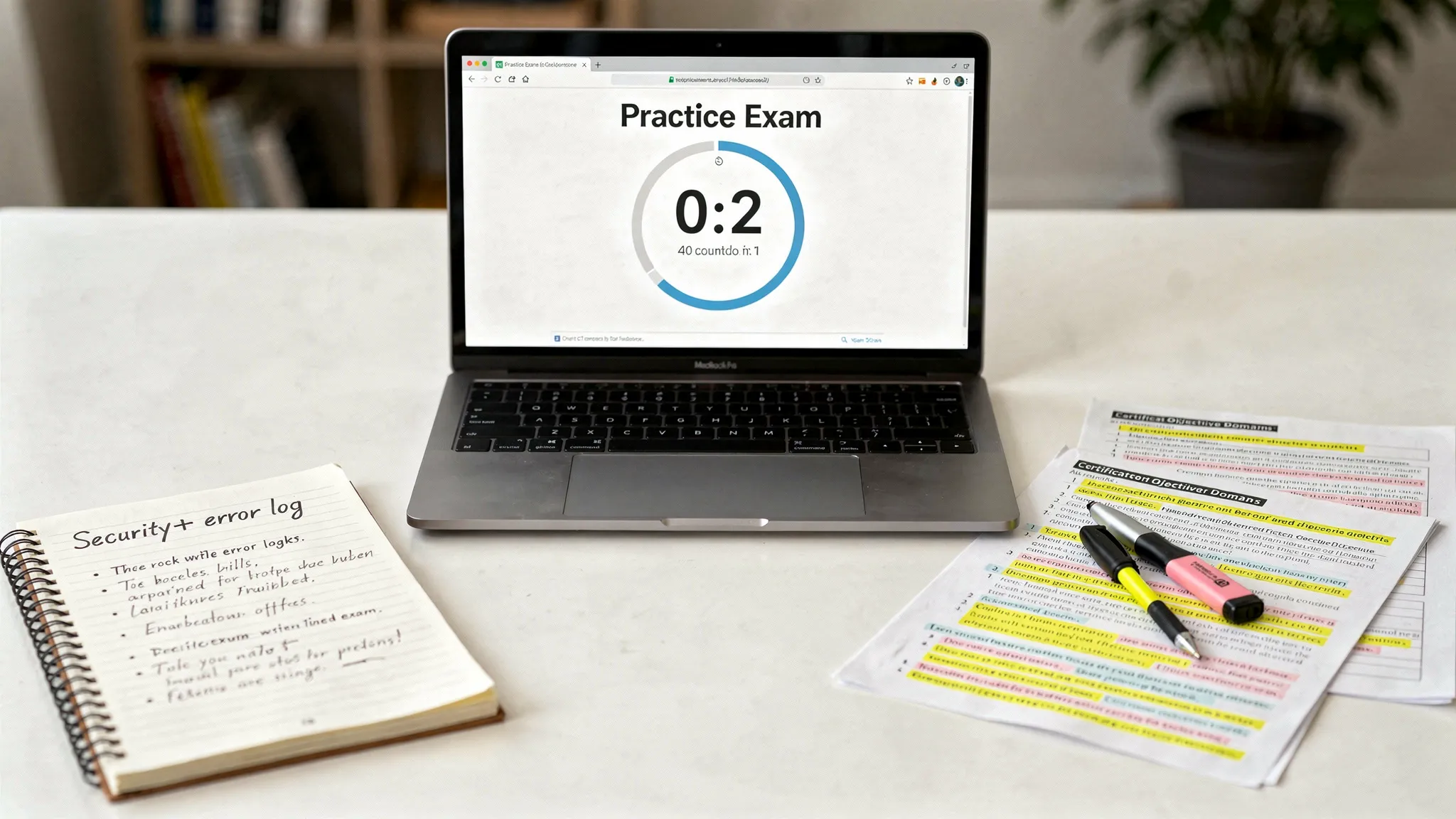
If you are using a CompTIA Security+ practice test the right way, the biggest score jump usually happens when you stop treating questions like “topic drills” and start treating them like a real exam. The timing of that switch matters. Switch too early and you waste full exams on content you have not learned yet. Switch too late and you enter exam week without the pacing, stamina, and decision-making habits the test actually demands.
This guide shows exactly when to switch to full exams, what benchmarks to use (beyond just a percentage score), and how to transition without burning through your best practice sets.
Why the switch to full exams is a turning point
Topic quizzes are great for learning. Full exams are great for performing.
In Security+ (SY0-701), performance depends on more than recalling definitions. You need to:
- Maintain pace for up to 90 minutes.
- Context switch across domains (threats, architecture, operations, governance, incident response).
- Handle uncertainty and choose the “best” answer, not just a true statement.
- Recover quickly after a tough performance-based question (PBQ) instead of spiraling.
CompTIA’s own exam overview is clear about the structure: up to 90 questions in 90 minutes, including multiple-choice and PBQs, with a passing score of 750 (on a 100–900 scale). You can verify the latest details in CompTIA’s official exam page for Security+ (SY0-701).
Full-length simulations are where these skills are built.
Topic quizzes vs full exams: what each mode is for
A clean way to know when to switch is to understand the purpose of each phase.
| Practice mode | Best for | What “good” looks like | Common trap |
|---|---|---|---|
| Topic quizzes (10–25 Q) | Learning and fixing weak areas | You can explain why each wrong answer is wrong | You overfit to a narrow pattern and feel ready too soon |
| Mixed quizzes (25–50 Q) | Integration across domains | Fewer “silly misses,” better judgment calls | You ignore timing and endurance |
| Full exams (75–90 Q, timed) | Exam performance and pacing | Stable scores across attempts and strong review habits | You do full exams but barely review (scores stall) |
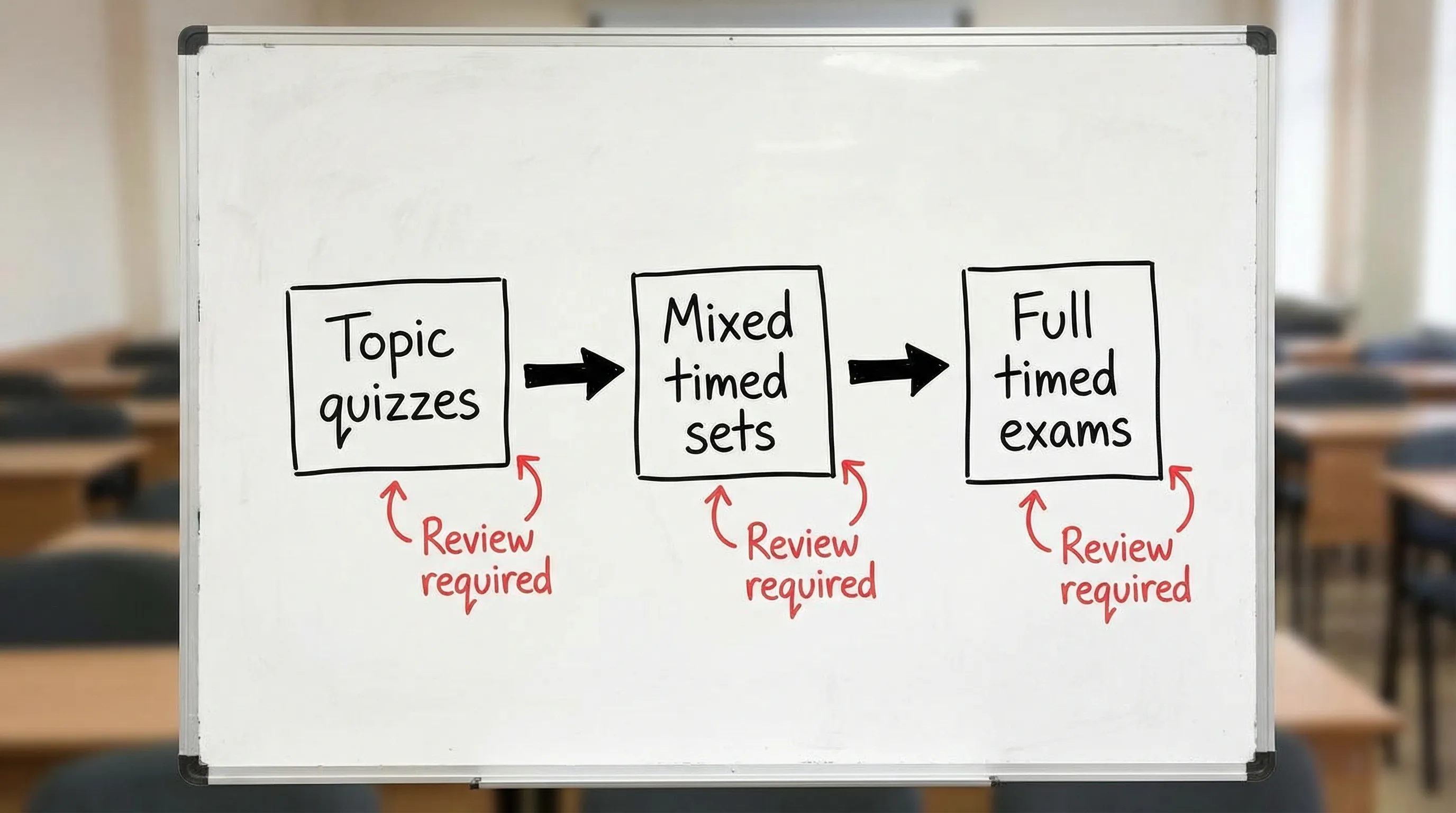
The switch is not a cliff. Think of it as a ramp: topic quizzes → mixed sets → full exams.
The 6 signals you are ready to switch to full exams
If you are hitting 4 or more of the signals below, you should start running full exams regularly.
1) Your weak areas are “named,” not vague
“Cryptography is hard” is not a usable weakness.
A usable weakness sounds like:
- “I confuse when to use ECDHE vs RSA in key exchange questions.”
- “I miss log-based questions because I do not read the prompt constraints.”
- “I choose the right control type, but not the best one for the scenario.”
If your error log is specific, you are ready to pressure test it with full exams.
2) Your accuracy is stable across mixed domains
If your quiz scores swing wildly depending on the topic, stay in topic mode longer.
A practical benchmark: on mixed-domain sets (25–50 questions), you should be able to stay within a tight band across attempts. Stability beats a single high score.
3) You can explain answers without guessing language
When you review, listen to your own reasoning.
You want to hear:
- “The prompt indicates an integrity problem, so hashing fits better than encryption.”
You do not want to hear:
- “This one felt right.”
Full exams amplify flawed intuition, so build explainable reasoning first.
4) You are making fewer “process errors”
Content gaps are normal. Process errors are avoidable and costly on full exams.
Common process errors:
- Not reading qualifiers (most likely, best, first, next).
- Ignoring the role (admin vs analyst vs manager) implied by the scenario.
- Missing a constraint (legacy system, budget, time, cloud-managed limitations).
If your misses are increasingly content-based rather than process-based, it is time to go full exam.
5) Your timing is naturally improving
If you are consistently rushing even on 25-question sets, full exams will feel chaotic.
A simple check: on a 25-question mixed set, you should finish with time to spare and still feel mentally sharp. That indicates you can handle a 90-minute run.
6) You have enough question volume left to “spend” on full exams
Full exams are a premium resource because you remember patterns.
If you only have a small number of high-quality exams available, do not burn them all early. Instead, build with mixed sets until you are ready to benefit from the full simulation.
If you are using a large, regularly updated bank of realistic items, you have more flexibility to introduce full exams earlier.
Score targets: what numbers actually mean
Raw percentage scores can be misleading because difficulty varies by set and the real exam includes PBQs.
Use score targets as a trend, not a verdict.
| Your timed full-exam score trend | What it usually means | What to do next |
|---|---|---|
| Below 70% | Still building core coverage | Return to targeted quizzes on top 2 weak domains, then reattempt a full exam |
| 70–78% | Transitional zone (close, but not stable) | Run full exams weekly, plus mixed-domain sets and heavy review |
| 78–85% | Strong readiness if consistent | Shift focus to pacing, PBQ strategy, and “best answer” judgment |
| 85%+ | Buffer zone (not a guarantee) | Keep 1–2 full exams for final week, avoid overtraining |
These ranges are intentionally conservative. Your goal is not a perfect practice score. Your goal is repeatable performance under time pressure.
A practical switch plan (without wasting full exams)
If you are unsure, use this 3-stage progression over 10–21 days (depending on how many hours you can study per week).
Stage A: Finish the learning loop (topic quizzes)
Stay here until your review is fast and specific.
A good loop looks like:
- Answer questions in a focused domain.
- Log misses with the reason (knowledge gap, misread, overthinking, guessed).
- Fix the cause (one concept, one note, one quick re-test).
Stage B: Prove integration (mixed sets)
Run mixed-domain sets (25–50 Q) timed.
Your goal is to:
- Reduce context switching fatigue.
- Identify domains that collapse under mixed pressure.
- Build a repeatable pacing rhythm.
Stage C: Switch to full exams (performance training)
Once you start full exams, treat them like an event:
- Sit for the entire block.
- Remove distractions.
- Use one pass through questions (mark and move on, do not wrestle).
- Do a deep review session after.
If you want a structured framework that pairs well with this switch, you can also adapt your schedule using the ideas from PlanetCert’s study resource on Security+ pacing and practice cycles: Planet Cert practice tests study plan for Security+.
How many full exams should you take?
Most candidates do best with 3 to 6 timed full exams, depending on time and question bank size.
Less than 3 can leave you underprepared for pacing and PBQs. More than 6 can be counterproductive if you are repeating items and memorizing patterns.
A balanced approach:
- 1 diagnostic full exam (once you have baseline coverage)
- 2–4 performance full exams (timed, strict conditions)
- 1 final confidence full exam (about 5–7 days before test day)
Then spend the last days on review, not marathon testing.
What to do after each full exam (the review method that actually moves the score)
The value of a full exam is not the score, it is the diagnosis.
After each attempt, sort every missed (and guessed) question into one of these buckets:
| Miss type | What it indicates | Fix action |
|---|---|---|
| Knowledge gap | You did not know the concept | Learn the concept, then do a short re-quiz on that subtopic |
| Misread / missed constraint | You processed the prompt poorly | Practice “qualifier scanning” (best, first, most likely), slow down on stems |
| Two-good-answers problem | Judgment issue | Study why CompTIA prefers one option (risk, feasibility, order of operations) |
| Time pressure | Pacing problem | Train with timed mixed sets and strict per-question limits |
If you are using Planet Cert practice tests and exam questions, make the review part as serious as the test attempt. The simulator and explanations are where you convert mistakes into points.
PBQs: another reason to switch earlier than you think
Many people delay full exams because they are “still learning content,” then get surprised by PBQs and scenario density.
Full exams expose whether you can:
- Interpret logs and outputs quickly.
- Prioritize steps in incident response.
- Choose controls that match the environment described.
Even if your content is decent, PBQs punish slow decision-making. That is a performance skill, so it needs timed practice.
Signs you switched too early (and how to recover)
Switching too early is not fatal, but it wastes high-quality exams.
You likely switched too early if:
- You score low and cannot tell why (everything feels wrong).
- Review takes forever because you are relearning basics.
- You are missing many questions per domain, not just a few weak areas.
Recovery plan:
- Pause full exams for 5–10 study sessions.
- Return to domain quizzes on the two worst objectives.
- Reintroduce mixed-domain sets.
- Restart full exams once your misses are more “surgical.”
Signs you switched too late
Switching too late is more dangerous because it leaves you unprepared for real test conditions.
You likely switched too late if:
- You ace topic quizzes but drop 10–20 points on full exams.
- You run out of time.
- Your accuracy collapses in the last third of the exam.
If this is you, prioritize full exams immediately, even if it feels uncomfortable. You need pacing and endurance practice more than additional notes.
Using AI responsibly to speed up your review loop
If your biggest bottleneck is review (not test-taking), AI can help you summarize misses, generate quick explanations in your own words, and turn errors into flashcards. If you are doing this at a team level (for example, an internal cohort preparing for Security+), it can be worth getting an AI audit and custom automation roadmap so your study workflows, tracking, and content operations are streamlined and secure.
AI should not replace understanding, but it can reduce the friction between “I missed it” and “I fixed it.”
Bringing it all together: the switch checklist
You are ready to move from topic quizzes to full exams when:
- Your weaknesses are specific and repeatable.
- Mixed-domain scores are stable.
- You are missing fewer questions due to misreads.
- Your timing is improving under pressure.
- You have enough question volume left to benefit from full simulations.
When you do switch, commit to the full cycle: simulate, review deeply, re-test weak areas, then simulate again.
If you want one place to run those simulations with realistic timing and explanations, use Planet Cert Security+ practice exams and test questions as your performance layer, and treat every full exam like a rehearsal for test day.

Discussion
Question Comments
0 comments·0 participantsSign in to leave a comment and access more free questions.