

Examining Cisco Certifications: Boost Your IT Career
Sorting fact from fiction about Cisco certifications can be a real challenge for IT professionals preparing for the next exam. Cisco certifications are respected worldwide and prove more than just networking skills—they open opportunities across cloud, security, and automation. Whether you are eyeing the CCNA or moving toward the CCNP in 2025, understanding the true value and flexibility of these credentials helps you select smarter study resources and plan for real career growth.
Key Takeaways
| Point | Details |
|---|---|
| Broad Applicability | Cisco certifications validate skills across multiple IT roles, not just networking. |
| Structured Pathways | Certifications range from entry-level to expert, providing clear career advancement opportunities. |
| Emerging Technologies Focus | Cisco continuously adapts certifications to include emerging fields like cybersecurity and cloud computing. |
| Practical Focus | Certification exams emphasize hands-on skills and real-world problem-solving over theoretical knowledge. |
Cisco certifications defined and common myths
Cisco certifications represent globally recognized credentials that validate IT professionals’ technical skills and networking expertise across multiple technology domains. These certifications serve as critical benchmarks in the technology industry, offering professionals verifiable proof of their capabilities in managing complex networking infrastructures and emerging technological solutions.

The Cisco certification ecosystem spans multiple levels and specialties, providing professionals with diverse pathways for career development. Certification programs range from entry-level credentials to advanced professional and specialist tracks, enabling IT professionals to demonstrate their competence in areas like networking, cybersecurity, cloud computing, and emerging technologies such as artificial intelligence.
Common myths about Cisco certifications often misrepresent their true value and accessibility. Contrary to popular misconceptions, these credentials are not exclusively for networking professionals or prohibitively expensive. Instead, they offer broad applicability across various IT roles and provide structured learning paths that can significantly enhance career prospects.
Key myths about Cisco certifications include:
- Myth: Cisco certifications are only for networking professionals
- Reality: Certifications cover multiple technology domains including security, cloud, data center, and collaboration
- Myth: Certifications are too expensive and time-consuming
- Reality: Cisco offers flexible learning options and affordable study resources
- Myth: Certifications have limited career value
- Reality: These credentials can substantially increase earning potential and job opportunities
Pro tip: Research specific certification tracks that align with your career goals and create a strategic learning plan to maximize your professional development.
Certification levels and popular 2025 exams
Cisco certifications are strategically structured across five progressive levels, providing IT professionals with a comprehensive pathway for skill development and career advancement. Professional certification tracks range from entry-level credentials to the most advanced expert and architect designations, each designed to validate increasingly sophisticated technical competencies.
The certification hierarchy includes five distinct levels:
- Entry Level: Initial certifications for newcomers to networking
- Associate Level: Foundational credentials demonstrating basic networking skills
- Professional Level: Advanced certifications for experienced IT professionals
- Expert Level: High-level credentials for technical specialists
- Architect Level: The most advanced certification representing elite networking expertise
Popular 2025 Cisco certification exams reflect the rapidly evolving technology landscape, with a strong emphasis on emerging domains like automation, cybersecurity, and cloud computing. Key exam tracks include:
- CCNP Enterprise: Validates advanced enterprise networking skills
- CCNP Security: Focuses on comprehensive network security expertise
- DevNet Professional: Emphasizes software development and automation skills
- CyberOps Professional: Concentrates on cybersecurity operations
- Data Center Networking Professional: Covers complex data center infrastructure technologies
Each certification requires candidates to pass multiple exams, typically combining core knowledge assessments with specialized concentration tests, ensuring comprehensive skill validation.
Moreover, Cisco continues to adapt its certification pathways to address the dynamic technological landscape. The 2025 exam tracks are specifically designed to validate practical skills in emerging technologies like artificial intelligence, network automation, and cloud-native architectures, ensuring professionals remain competitive in a rapidly changing IT environment.
Here is a summary of Cisco certification levels and their typical candidate profiles:
| Certification Level | Typical Candidate Profile | Skill Focus | Advancement Potential |
|---|---|---|---|
| Entry | Newcomer, career starter | Basic networking concepts | Foundation for IT careers |
| Associate | Junior IT professional | Core networking skills | Entry to mid-level roles |
| Professional | Experienced specialist | Advanced technologies | Lead technical positions |
| Expert | Senior technical expert | Specialized, complex skills | Consultant, architect roles |
| Architect | Elite network designer | Enterprise architecture | Strategic leadership |
Pro tip: Map your current skills against Cisco certification requirements and strategically select exams that align with your career trajectory and emerging technology trends.
Exam structure, content areas, and formats
Cisco certification exams are meticulously designed to validate comprehensive technical knowledge and practical skills across multiple technology domains. Exam topics explained systematically assess candidates’ abilities through a sophisticated multi-stage testing approach that combines theoretical knowledge with hands-on technical proficiency.
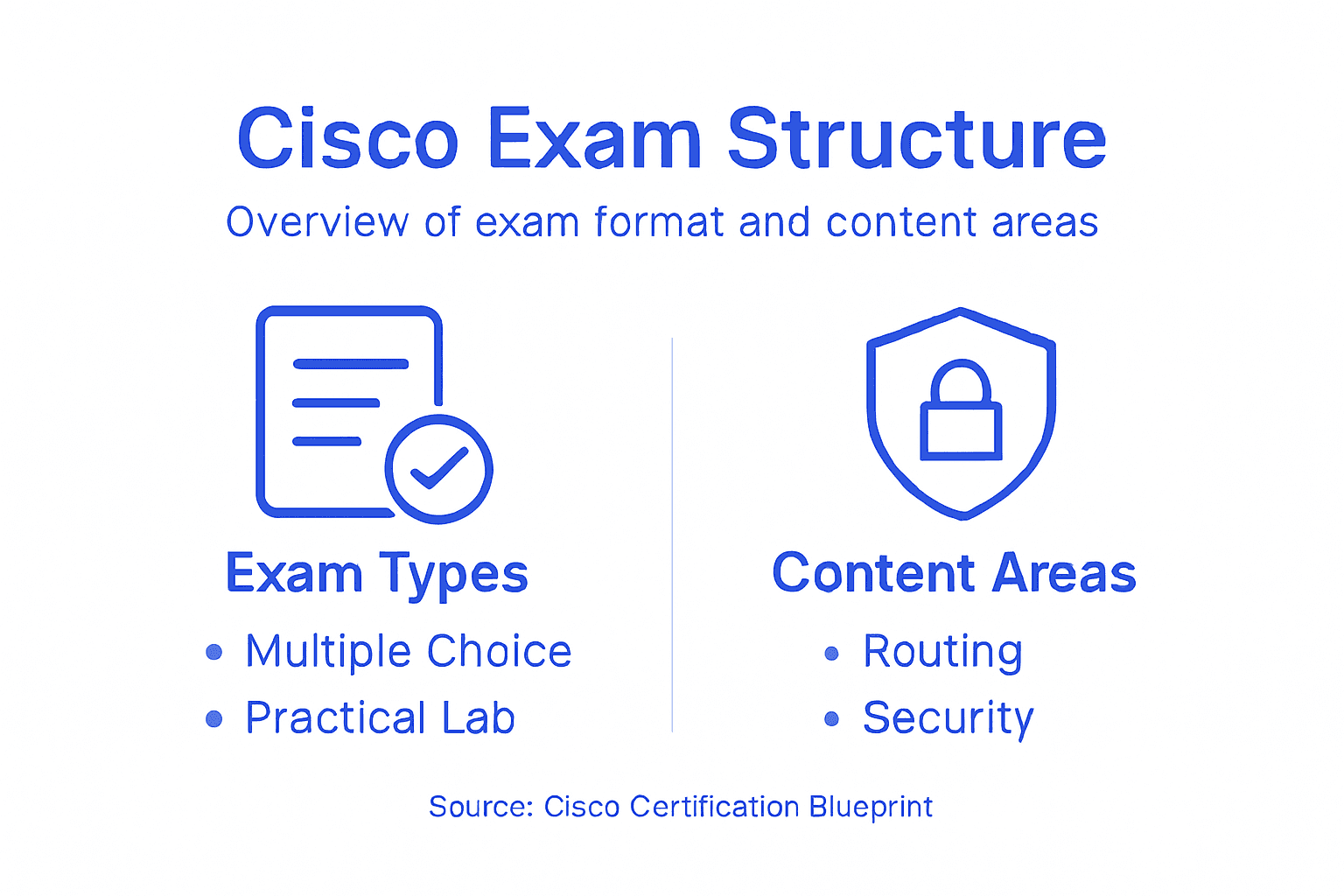
Typical Cisco certification exams feature a structured format with key components:
- Written Examinations: Comprehensive theoretical assessments testing core networking concepts
- Practical Labs: Hands-on scenarios demonstrating real-world technical problem-solving skills
- Simulation Questions: Complex scenarios requiring strategic technological decision-making
- Multiple-Choice Assessments: Evaluating foundational understanding of networking principles
- Performance-Based Testing: Practical exercises simulating actual network engineering challenges
The content areas for Cisco certification exams typically span critical technological domains:
- Network Infrastructure
- Security Architecture
- Network Automation
- Cloud Technologies
- Collaboration Systems
- Data Center Technologies
- Software-Defined Networking
Successful candidates must demonstrate not just theoretical knowledge, but practical application of complex networking technologies across interconnected systems.
Each certification exam is carefully calibrated to test candidates’ skills at their specific certification level, ranging from foundational associate-level knowledge to advanced expert-level technological expertise. The exams integrate cutting-edge technological concepts, ensuring that certified professionals are prepared for the most current and emerging networking challenges.
Pro tip: Develop a comprehensive study strategy that balances theoretical learning with hands-on practical experience to maximize your exam preparation effectiveness.
Requirements, prerequisites, and eligibility
Cisco certification paths offer remarkable flexibility, with certification requirements varying across different levels and specialized tracks. While formal prerequisites are minimal, candidates are expected to demonstrate technical aptitude and relevant practical experience matching each certification’s complexity.
Eligibility considerations for Cisco certifications typically include:
- Technical Background: Foundational understanding of networking principles
- Practical Experience: Hands-on networking or IT infrastructure work
- Study Preparation: Comprehensive training and self-study
- Professional Goals: Career advancement or technological specialization
- Knowledge Domains: Specific technical skills relevant to chosen certification track
Certification level requirements range across different tracks:
-
Entry-Level Certifications:
- Minimal technical background required
- Ideal for beginners and career transitioners
- Focus on fundamental networking concepts
-
Associate-Level Certifications:
- Basic networking knowledge recommended
- Some practical experience preferred
- More complex theoretical understanding
-
Professional-Level Certifications:
- Substantial networking experience required
- Advanced technical skills
- Deeper technological comprehension
Professional certification tracks demand not just theoretical knowledge, but demonstrable technical expertise and problem-solving capabilities.
Cisco’s certification framework emphasizes practical skills over rigid academic requirements, enabling professionals from diverse backgrounds to pursue technological credentials. The evaluation process focuses on candidates’ ability to demonstrate real-world technological competence rather than exclusively academic achievements.
Pro tip: Conduct a thorough self-assessment of your current technical skills and choose certification tracks that strategically align with your professional development goals.
Risks of outdated study resources
Navigating Cisco certification preparation requires critically evaluating study materials, as outdated resources can significantly compromise exam success and professional credibility. Certification study strategies demand continuous updating to align with rapidly evolving technological landscapes and changing exam requirements.
Key risks associated with using obsolete study resources include:
- Technological Irrelevance: Studying deprecated networking technologies
- Exam Format Misalignment: Preparing with outdated question structures
- Skill Gaps: Missing critical contemporary networking concepts
- Reduced Competitiveness: Falling behind current industry standards
- Potential Exam Failure: Preparing with incorrect or incomplete information
Critical areas where outdated resources can create significant preparation challenges:
-
Networking Protocols
- Rapid evolution of network communication standards
- Continuous technological innovations
- Emerging security and performance requirements
-
Technological Infrastructure
- Cloud computing transformations
- Software-defined networking developments
- Cybersecurity landscape shifts
-
Exam Methodology
- Changes in testing approaches
- Updated performance-based testing scenarios
- New question design and complexity levels
Successful certification candidates recognize that technological learning is a continuous journey, not a static destination.
Professionals must adopt a proactive approach to study resource selection, regularly verifying the currency and relevance of their preparation materials. This involves consulting official Cisco resources, engaging with current professional networks, and maintaining awareness of technological trends that might impact certification requirements.
Pro tip: Continuously cross-reference your study materials with the most recent Cisco certification blueprint and official exam guides to ensure comprehensive and current preparation.
Comparing Cisco tracks with industry alternatives
The landscape of IT certification tracks is diverse and competitive, with industry certification alternatives offering professionals multiple pathways to validate their technological expertise. Cisco certifications stand out for their comprehensive approach, global recognition, and deep networking focus compared to other industry credentials.
Key certification tracks for comparison include:
-
Cisco Certifications
- Strong networking and infrastructure emphasis
- Comprehensive practical and theoretical testing
- Global industry standard for networking professionals
-
CompTIA Certifications
- Broad IT fundamentals coverage
- Vendor-neutral approach
- Entry-level technology skill validation
-
Microsoft Certifications
- Focus on cloud and enterprise solutions
- Strong emphasis on Microsoft technology ecosystems
- Advanced cloud and software infrastructure credentials
Comparative analysis of certification tracks reveals distinctive strengths:
-
Networking Depth
- Cisco: Most comprehensive networking expertise
- CompTIA: Foundational networking knowledge
- Microsoft: Enterprise and cloud networking focus
-
Industry Recognition
- Cisco: Highest global networking credential value
- CompTIA: Strong entry-level credibility
- Microsoft: Significant enterprise technology recognition
-
Career Advancement Potential
- Cisco: Superior networking career progression
- CompTIA: Broader IT skill validation
- Microsoft: Strong cloud and enterprise opportunities
Professional certifications are strategic investments in technological career development, each offering unique pathways to professional growth.
While alternative certification tracks provide valuable credentials, Cisco’s extensive practical components, continuous curriculum updates, and deep networking focus make them particularly attractive for professionals seeking specialized infrastructure and networking expertise.
Quickly compare Cisco certification tracks with top industry alternatives:
| Provider | Main Technology Focus | Exam Approach | Career Impact |
|---|---|---|---|
| Cisco | Networking, security, automation | Hands-on labs, theory | High networking credibility |
| CompTIA | Broad IT fundamentals | Multiple-choice, vendor-neutral | Entry-level job access |
| Microsoft | Cloud, enterprise solutions | Microsoft technologies, scenarios | Enterprise/cloud career prospects |
Pro tip: Evaluate certification tracks by aligning their specific technological focus with your long-term career objectives and current skill landscape.
Advance Your Cisco Certification Journey with Confidence
Facing the challenge of mastering complex Cisco certification exams like CCNP Enterprise, DevNet Professional, or CyberOps Professional demands not only dedication but the right preparation tools. This article highlights critical pain points such as outdated study resources, exam structure complexity, and the need to align certifications with your career goals. To overcome these obstacles and boost your IT career in 2025, leverage proven resources that combine real exam questions, practical simulators, and updated study guides.

PlanetCert.com offers precisely what you need to conquer Cisco and other top industry certifications with a higher first-attempt success rate. Our extensive library of verified real exam questions and test simulators for Cisco, CCNA, cybersecurity, cloud, and enterprise technologies is continually refreshed to reflect the latest exam changes. Don’t let obsolete materials hold you back. Explore trusted preparation tools on PlanetCert.com and take decisive steps toward securing your Cisco credentials and advancing your professional path today.
Frequently Asked Questions
What are Cisco certifications?
Cisco certifications are globally recognized credentials that validate IT professionals’ technical skills and networking expertise across various technology domains, serving as benchmarks in the technology industry.
How many levels of Cisco certifications are there?
Cisco certifications are structured across five levels: Entry, Associate, Professional, Expert, and Architect, each designed to validate progressively advanced technical competencies.
What are some popular Cisco certification exams for 2025?
Popular Cisco certification exams for 2025 include CCNP Enterprise, CCNP Security, DevNet Professional, CyberOps Professional, and Data Center Networking Professional, focusing on networking, cybersecurity, and emerging technologies.
What are the risks of using outdated study resources for Cisco certification exams?
Using outdated study resources can lead to technological irrelevance, misalignment with current exam formats, skill gaps in critical networking concepts, and potentially failing the exam due to incorrect or incomplete information.
Recommended

Discussion
Question Comments
0 comments·0 participantsSign in to leave a comment and access more free questions.