

Choosing an AWS practice test sounds simple until you see how wide the quality gap is. Some products feel like they were built by people who actually understand AWS architecture and how AWS exams test decision making. Others are just recycled questions with thin explanations, outdated services, and “gotcha” wording that trains bad habits.
This guide walks you through a practical way to pick AWS practice tests that improve your score and your on-the-job skills, without wasting weeks on low-signal question banks. If you want the broader platform landscape first, read our AWS practice test comparison.
1) Start by confirming your exact AWS exam (and whether it is still active)
Before you compare practice tests, lock in the exam name and code you are truly taking. AWS updates exams, introduces new versions, and sometimes retires certifications.
A common example is people searching for aws certified data analytics specialty practice exams long after the specialty exam has been retired. If you are in that situation, the key is not to “find any DAS-C01 practice questions.” The key is to confirm:
- Is the exam still offered by AWS?
- If it is retired, what is the current replacement certification you should target?
Use the official AWS Certification site to validate the current exam lineup and your exam’s current status: AWS Certification and the exam catalog at AWS Certification exams.
If the exam has a newer version or a different successor credential, choose practice tests built specifically for the current exam code. Otherwise you risk studying services and patterns the exam no longer emphasizes.
2) Know what a “good” AWS practice test is supposed to do
High-quality AWS practice tests do two jobs:
Measure readiness (assessment): Do you score well under timed conditions across all domains, or are you only strong in a couple areas?
Build exam skill (training): Do the questions teach you how AWS expects you to think, especially for scenario-based items where multiple answers look plausible?
A practice test that only measures (or worse, only “tricks”) is not enough. You want a product that actively improves your judgment: tradeoffs, best practices, service limits, and cost-aware design.
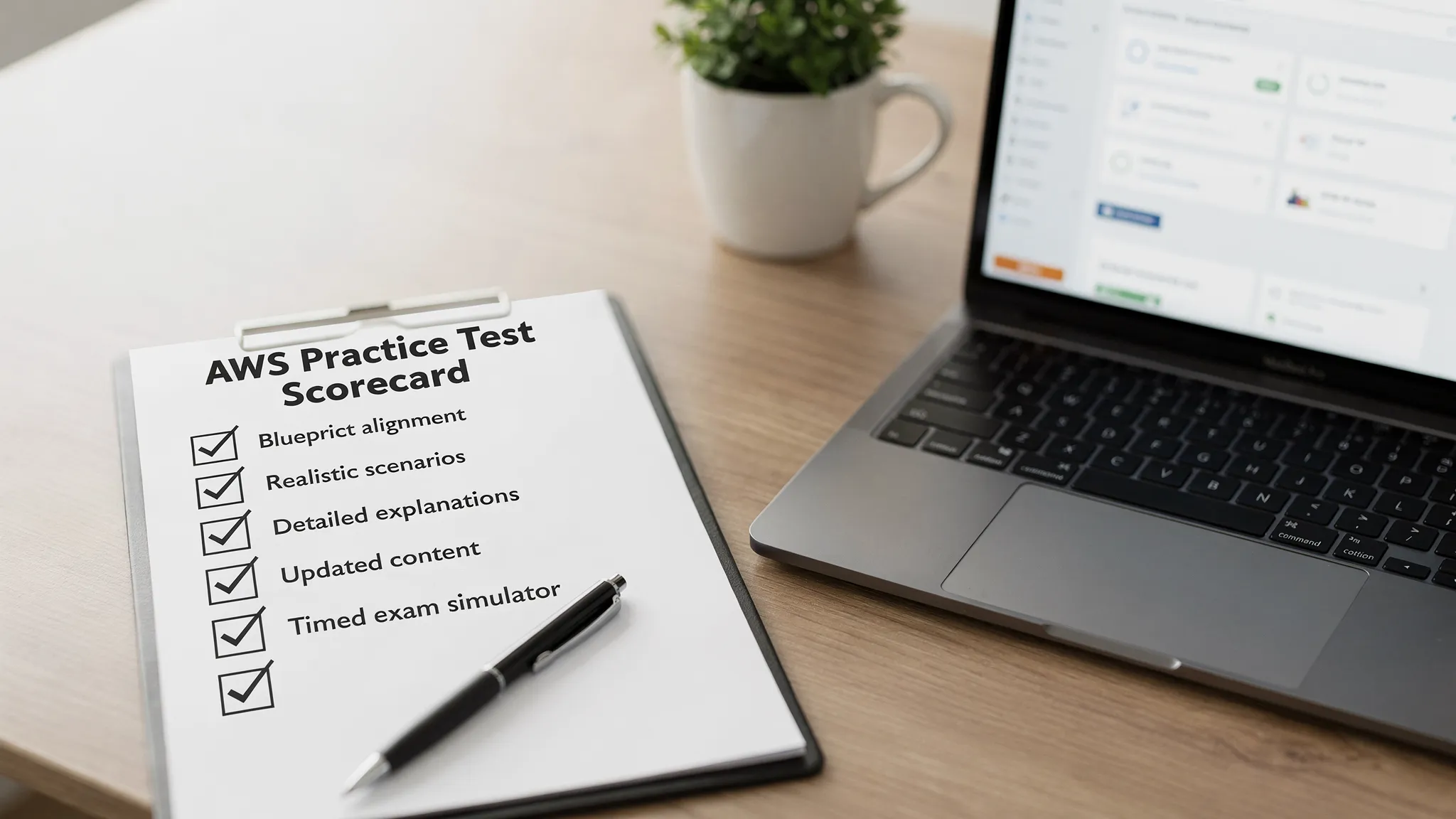
3) A scorecard for choosing the right AWS practice tests
When you evaluate practice tests, don’t ask “How many questions do they have?” first. Ask “Will this question bank reliably train the same decisions the real exam expects?”
Here is a practical scorecard you can use.
| What to check | Why it matters for AWS exams | How to verify quickly | Red flags |
|---|---|---|---|
| Alignment to the exam guide and domains | AWS exams are blueprint-driven. Weak domain coverage creates “surprise” gaps. | Compare the product’s domain breakdown to the official exam guide domains listed by AWS. | No domain mapping, vague “covers everything” claims. |
| Scenario realism (not trivia) | AWS questions often test architecture decisions, not definitions. | Try a small set: are questions framed as customer scenarios with constraints? | Too many pure definition questions, lots of “What is X?” style items only. |
| Answer explanations that teach tradeoffs | Explanations should clarify why one option is best, and why others are not. | Review 10 explanations: do they reference concepts like HA, durability, cost, latency, security boundaries? | One-line explanations, or explanations that simply restate the correct option. |
| Update cadence | AWS services evolve quickly, and exams follow. | Look for “regularly updated” language and visible versioning, and check if newer services and patterns appear. | Obvious outdated service names/features, repeated legacy patterns that modern AWS discourages. |
| Ethical sourcing (not brain dumps) | Brain dumps can violate program rules and do not build real skill. | Check whether the provider positions content as “practice tests” with expert verification, not “exact exam.” | “Real exam leaks,” “100% guaranteed exact questions,” suspiciously identical wording to recalled questions. |
| Realistic simulator and timing | Practicing under realistic conditions improves pacing and reduces anxiety. | Confirm there is a web-based timed mode, review mode, and the ability to retake. | Only PDF questions, or no timed mode at all. |
| Quality control and expert review | SMEs catch ambiguous items and incorrect reasoning. | Look for expert-verified claims and consistent, accurate terminology. | Frequent errors, contradictory explanations, unclear or arguable “best” answers. |
| Meaningful analytics for review | You improve fastest when you can see patterns in mistakes. | Check whether you can review missed/flagged questions and retest weak areas. | No way to isolate weak domains or track progress over time. |
| Right-sized volume and variety | You need enough variety to avoid memorization and cover edge cases. | Ensure there are multiple full-length exams plus topic-level sets. | Extremely small bank, or a huge bank that is mostly duplicates and paraphrases. |
4) Match the practice test format to your stage of prep
People often buy the “best” AWS practice tests and still get mediocre results because they use them in the wrong order.
Here is the simplest way to match format to where you are:
Diagnostic set (early)
Use a shorter diagnostic or a mixed set early to identify your weak domains. The goal is not a high score. The goal is to discover what you keep getting wrong (data storage choices, IAM boundaries, networking patterns, event-driven options, cost controls).
Topic-level drills (middle)
Once you know your weak areas, switch to targeted drills. This is where the best question banks pay off, because they help you practice the exam’s decision patterns repeatedly.
Full timed simulations (late)
When your topic-level accuracy stabilizes, move to full-length timed simulations. This is where pacing, endurance, and careful reading start to matter as much as raw knowledge.
If you only do full exams from day one, you can burn through questions without actually fixing the underlying reasoning mistakes.
5) How to validate an AWS practice test in about 60 minutes
If you are deciding between providers, you can run a quick “trial audit” even without completing a full exam.
Step A: Do a timed mini-set
Take 20 to 30 questions timed. Don’t pause to research. Treat it like the real thing.
Step B: Review explanations like an engineer
Check whether explanations teach you:
- Why the correct answer fits the constraints
- Why each wrong option fails (cost, scaling limits, operational overhead, security gaps)
- What AWS service or design principle the question is really testing
If explanations do not improve your judgment, the practice test is not pulling its weight.
Step C: Look for ambiguous wording and “arguable” answers
AWS can have multiple workable architectures, but exams usually want the best option given explicit constraints.
If you find yourself thinking “two answers are equally correct” repeatedly, that can be a sign of poorly written items rather than your lack of knowledge.
Step D: Check whether the platform supports a tight review loop
Even basic features like flagged questions, missed-question review, and retakes matter because the learning happens in the review.
6) Signs you should avoid a practice test (even if it is popular)
Some warning signs are subtle, but they matter.
- It overemphasizes trivia. AWS exams reward applied design thinking more than memorized definitions.
- It feels outdated. If the content doesn’t reflect modern AWS defaults and patterns, it can train you into wrong instincts.
- It promises “exact real exam questions.” That is usually a compliance red flag and often correlates with poor learning value.
- Explanations are too thin. You need to learn the reasoning, not just the letter choice.
For exam integrity expectations and rules, you can review AWS program policies here: AWS Certification policies.
7) What “realistic” means for AWS practice tests
Realistic is not about being brutally hard. It is about matching the shape of the real exam:
- Scenario-based questions with constraints (budget, latency, ops effort, compliance)
- Distractors that are plausible AWS services, but not best-fit for the scenario
- Emphasis on well-architected thinking (reliability, security, performance efficiency, cost optimization, operational excellence)
If you want a north star for how AWS frames good decisions, the AWS Well-Architected Framework is a useful reference when reviewing why an answer is best.
8) Where PlanetCert fits if you want practice tests that are built for review and simulation
If your goal is to get exam-ready efficiently, prioritize practice tests that combine credible questions with a strong practice experience.
PlanetCert positions its library around expert-verified practice tests, a web-based exam simulator (no extra software), regularly updated materials, and supporting resources like study guides. If you want a single place to run diagnostics, drill weak areas, and then take realistic timed simulations, you can start with PlanetCert practice tests and use the simulator as your “exam conditions” environment.
If you are pursuing a niche or newly updated certification and cannot find it yet, PlanetCert also notes an option to request an exam they do not currently list, with a stated turnaround time.
9) A simple buying decision: choose the test that improves your reasoning, not your memorization
The right AWS practice tests do more than tell you what you got wrong. They help you build repeatable decision-making under pressure.
When in doubt, pick the provider that is strongest on:
- Clear domain coverage tied to the current exam
- High-signal explanations that teach tradeoffs
- A realistic simulator with retakes and review flow
- Regular updates as AWS evolves
That combination is what turns practice time into passing performance.
If you want to compare options quickly, open your scorecard table from above, run the 60-minute validation, then commit to one question bank and use it consistently instead of constantly switching sources. Consistency plus high-quality review is usually what separates “almost ready” from “first-attempt pass.”

Discussion
Question Comments
0 comments·0 participantsSign in to leave a comment and access more free questions.