

MCSA Is Retired: What Microsoft Actually Tests Now
The credential you studied for no longer exists. Here is how to move forward with a current Microsoft certification that matches your skills and career goals.
If you earned an MCSA in Windows Server, SQL Server, or Office 365 between 2012 and 2020, that badge still shows on your Microsoft transcript. But the exams that produced it are gone. Microsoft retired every MCSA, MCSE, and MCSD exam on January 31, 2021, as confirmed in the company's official retirement announcement. Since then, Microsoft has continued reshaping its certification portfolio, retiring additional fundamentals exams through early 2026 and introducing new AI-focused credentials. This guide walks you through what actually replaced MCSA, how to map your old specialty to a current exam, and how to build a focused study plan so you're certified on technology employers still need in 2026.
Why Microsoft Killed the MCSA
The MCSA validated product knowledge. You passed two or three exams covering a specific Microsoft product, like Windows Server 2016 or SQL Server 2016, and earned the credential. Microsoft announced in 2018 that this model no longer reflected how IT professionals actually work. Cloud services change quarterly, not every three years, and a cert tied to a single product version couldn't keep up.
Microsoft moved to role-based certifications. Instead of asking "Do you know Windows Server 2016?", the new exams ask "Can you administer identity and access in a hybrid Azure environment?" The shift forces candidates to prove they can perform a job function, not just recall product settings. As the official Windows Server 2016 page now states, that certification has been retired and candidates should browse current options.
For certification holders, nothing was taken away. Your MCSA still appears on your transcript. Employers can verify it. But Microsoft won't issue new MCSA credentials, and no study material or exam updates will follow. If you want a current, renewable Microsoft certification, you need one of the role-based alternatives covered below.
What Replaced MCSA: The Role-Based Credential Map
Microsoft now organizes certifications by job role across three cloud platforms: Azure, Microsoft 365, and Dynamics 365. Each certification earns a Fundamentals, Associate, or Expert badge. Here is how the most common MCSA tracks map to current exams.
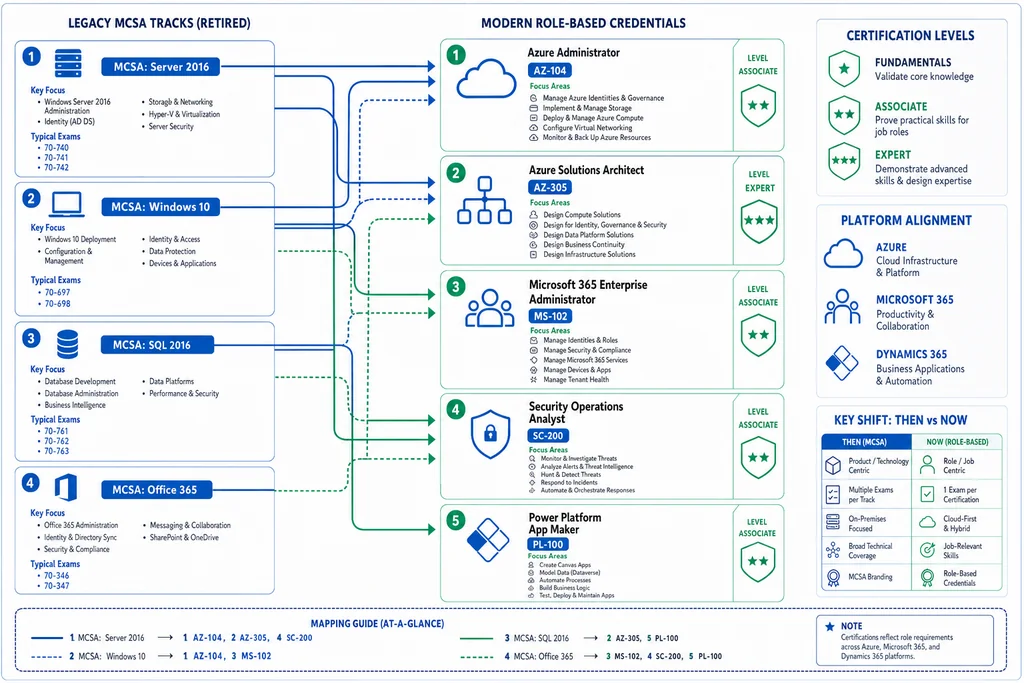
MCSA: Windows Server 2016 focused on installation, storage, networking, and identity on Windows Server. The closest current equivalents are the AZ-800 (Administering Windows Server Hybrid Core Infrastructure) and AZ-801 (Configuring Windows Server Hybrid Advanced Services). Passing both earns the Windows Server Hybrid Administrator Associate credential. These exams test on-premises Windows Server skills alongside Azure hybrid integration, which reflects how most enterprises actually run infrastructure today.
MCSA: SQL Server validated database administration and development skills. Current replacements depend on your role. Database administrators should look at DP-300 (Administering Relational Databases on Microsoft Azure), which earns the Azure Database Administrator Associate badge. Developers working with data pipelines and analytics would target DP-203 (Data Engineering on Microsoft Azure) for the Azure Data Engineer Associate credential.
MCSA: Office 365 covered Exchange Online, SharePoint Online, and related services. The successor is MS-102 (Microsoft 365 Administrator), which earns the Microsoft 365 Certified: Administrator Expert credential. Note that the entry-level MS-900 (Microsoft 365 Fundamentals) exam retired on March 31, 2026, meaning Microsoft expects candidates to jump directly to associate-level or higher certifications.
MCSA: Machine Learning and MCSA: Data Engineering with SQL Server both feed into the DP-100 (Designing and Implementing a Data Science Solution on Azure) path, leading to the Azure Data Scientist Associate credential.
The table below summarizes the most direct mappings:
| Former MCSA | Current Replacement | Exam Code(s) | New Credential |
|---|---|---|---|
| Windows Server 2016 | Windows Server Hybrid Admin | AZ-800, AZ-801 | Windows Server Hybrid Administrator Associate |
| SQL 2016 Database Admin | Azure Database Admin | DP-300 | Azure Database Administrator Associate |
| SQL 2016 BI Development | Azure Data Engineer | DP-203 | Azure Data Engineer Associate |
| Office 365 | Microsoft 365 Admin | MS-102 | Microsoft 365 Administrator Expert |
| Machine Learning | Azure Data Scientist | DP-100 | Azure Data Scientist Associate |
How to Pick Your Replacement Path in 5 Steps
You don't need to guess which cert fits. Follow this process to match your experience to the right current exam.
Step 1: Identify your daily work, not your old exam title. Your MCSA title doesn't matter as much as what you do every day. If you manage on-premises servers and are starting to connect them to Azure, the AZ-800/AZ-801 path is the right fit. If you spend most of your time writing SQL queries and managing database performance, DP-300 is more relevant.
Step 2: Check the exam objectives on Microsoft Learn. Every current Microsoft certification page lists the exact skills measured, weighted by percentage. Download the skills outline and compare it to your work experience. If more than 60 percent of the objectives align with tasks you already perform, that exam is a strong match.
Step 3: Note the renewal requirement. Unlike the MCSA, which never expired, current Microsoft certifications require renewal every 12 months through a free online assessment. This means your investment stays current, but it also means you need to stay engaged with the platform. Build this into your career plan.
Step 4: Find a realistic practice source. Once you know your target exam, start with sample questions that mirror the real question format. PlanetCert offers Microsoft practice tests with explanations for each answer choice, which helps you understand why the correct answer is right and why the distractors are wrong. This is especially useful for role-based exams, where questions often present multi-step scenarios rather than isolated facts.
Step 5: Set a 3-4 week study window. Most candidates preparing for a single associate-level exam need 15-25 hours of focused study. Spread that over three to four weeks with daily 45-minute sessions. Use the first week to review objectives, the second and third weeks to study and practice, and the final week to run timed practice exams and close remaining gaps.
What Microsoft Added in 2026 That You Should Know About
The certification landscape didn't freeze after MCSA retired. Microsoft has continued reshaping its portfolio through early 2026. A February 2026 credentials roundup announced four new AI-focused certifications and six Applied Skills credentials. Meanwhile, three fundamentals exams were retired: MB-910 (Dynamics 365 CRM), MB-920 (Dynamics 365 ERP), and MS-900 (Microsoft 365 Fundamentals).
For anyone coming from an MCSA background, the most significant trend is Microsoft's push to embed AI skills into existing role-based paths. The Azure Administrator, Azure Developer, and security-focused certifications now include objectives related to AI services, responsible AI governance, and Copilot integration. This doesn't mean you need to become an AI specialist. It means your role-based cert exam will include a few questions about AI tools that are now part of everyday Microsoft workloads.
If you want to add an AI credential to your existing path, the AI-900 (Azure AI Fundamentals) remains available as a low-barrier entry point. For more depth, look at the newer AI Engineer Associate certification, which covers designing and implementing Azure AI solutions.
Common Mistakes When Transitioning From MCSA
Mistake 1: Trying to "upgrade" your old MCSA. There is no upgrade path. The 70-743 (Upgrading Your Skills to MCSA Windows Server 2016) exam and similar bridge exams are retired. You start fresh with the current exam objectives. Don't assume that passing an MCSA exam three years ago prepares you for the current role-based test format without studying.
Mistake 2: Picking the wrong level. If you have five or more years of hands-on experience with SQL Server, don't start with a fundamentals exam. Jump to the associate-level DP-300 directly. Fundamentals certifications are designed for career changers and early-career professionals, not experienced administrators.
Mistake 3: Ignoring the hybrid component. Almost every current Microsoft certification includes Azure integration. Even the Windows Server Hybrid Administrator path tests Azure Arc, Azure AD, and cloud-based management. If you've only worked with on-premises servers, budget extra study time for the Azure topics.
Mistake 4: Using outdated study materials. Exam objectives change. Study guides written for the 70-series exams cover product versions and question formats that no longer apply. Always verify that your prep materials align with the current exam code. A study planning guide can help you build a schedule around current objectives rather than legacy content.
Mistake 5: Skipping practice exams. Role-based Microsoft exams use case studies, drag-and-drop items, and multi-part scenarios that feel different from the old multiple-choice MCSA format. Running timed practice sessions before test day builds familiarity with the question types and pacing. Candidates who use structured practice tests consistently report higher first-attempt pass rates than those who rely on documentation alone.
How Long Your Old MCSA Still Matters on a Resume
Your retired MCSA still carries weight with hiring managers who held the same credential. It signals that you have a solid foundation in Microsoft technologies and that you invested in your career before role-based certs existed. Keep it on your resume and LinkedIn profile.
But don't stop there. Pair the old credential with a current one. A resume that shows "MCSA: Windows Server 2016" alongside "Windows Server Hybrid Administrator Associate (2026)" tells a complete story: you've had strong fundamentals for years, and you've kept your skills current. According to Pearson's 2026 employer report, 78% of organizations now choose professional certification as their leading upskilling investment. A current credential paired with experience makes you more competitive than either one alone.
If your MCSA covered a technology that Microsoft has fully sunset, such as SQL Server 2012/2014, the credential shows historical knowledge but won't carry the same weight as a current Azure-focused certification. In that case, prioritize earning the replacement credential as soon as possible and treat the old MCSA as background context on your resume.
Build a 4-Week Study Plan for Your Replacement Exam
Here's a practical framework you can adapt to any current Microsoft certification exam.
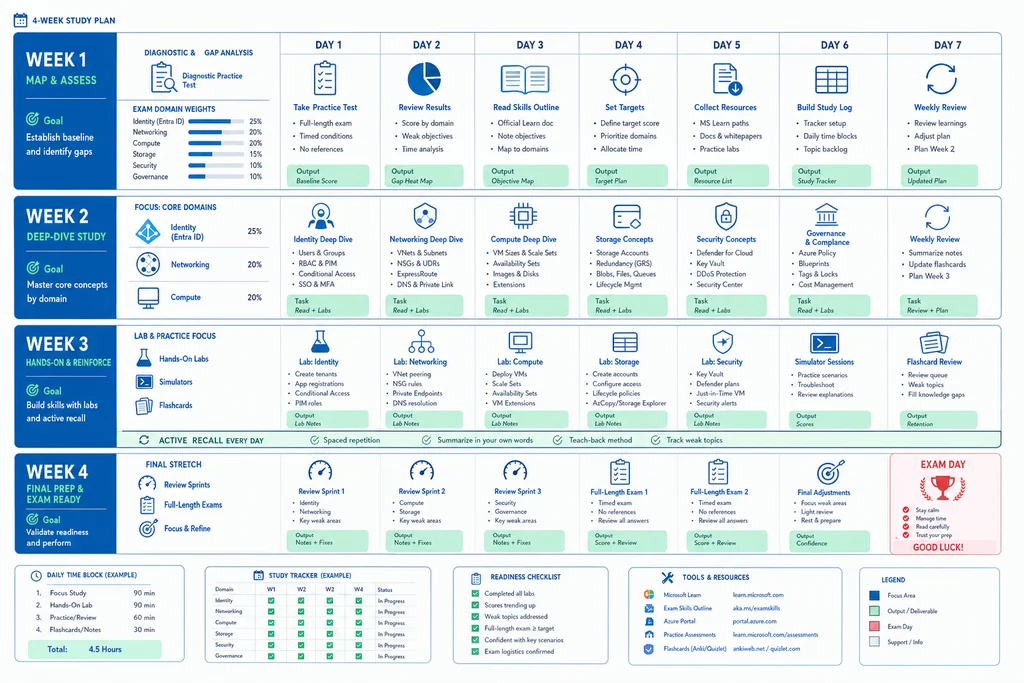
Week 1: Map and assess. Download the official skills outline from the exam's Microsoft Learn page. Mark each objective as "confident," "needs review," or "unfamiliar." Spend 2-3 hours reading through the unfamiliar topics at a high level. Don't try to master anything yet. The goal is to know where the gaps are.
Week 2: Deep study on weak areas. Focus 70 percent of your study time on "needs review" and "unfamiliar" topics. Use Microsoft Learn modules, which are free, and supplement with a structured study guide if you prefer a linear path. Take notes on key concepts, commands, and configuration steps. Spend 30 percent of your time reinforcing topics you already know to keep them sharp.
Week 3: Practice under exam conditions. Switch to practice exams and timed sessions. Start with study planning resources to structure your sessions. After each practice test, review every question, including the ones you got right. Understanding why wrong answers are wrong builds the reasoning skills you need for scenario-based questions.
Week 4: Close gaps and schedule. In the first three days, revisit any topics where your practice scores stayed below 70 percent. In the final four days, take two full-length practice exams under timed conditions. If you're scoring consistently above 75-80 percent, schedule your exam. If not, extend by one more week and focus on the weakest domain.
A few preparation shortcuts can save time. Flashcards help with memorizing specific commands, port numbers, and service limits. Explainer notes attached to practice questions help you understand the reasoning behind each answer. Both tools are available on PlanetCert's platform and can compress weeks of passive reading into focused, active recall sessions.
What to Expect on Exam Day
Current Microsoft role-based exams are 100-120 minutes long, with 40-60 questions. You'll encounter multiple-choice, drag-and-drop, build-list, and case study question formats. Case studies present a business scenario with several related questions, and you can't go back to change answers within a case study once you've moved on.
The passing score is 700 out of 1000 on all current Microsoft exams. You get your pass/fail result immediately at the testing center. If you fail, you can retake the exam after 24 hours on the first attempt, after 14 days on the second attempt, and after 14 days for each subsequent attempt, up to five times in a 12-month period.
Plan to arrive 15 minutes early. Bring two forms of ID. Leave personal items in a locker. The testing center provides a whiteboard or erasable notepad for notes during the exam. Use the first few minutes to jot down key reference information you've memorized, like specific port numbers or command syntax, before diving into questions.
FAQ
Is my MCSA certification still valid? Yes. Your MCSA remains on your Microsoft transcript permanently. Employers can verify it. However, you cannot earn a new MCSA or renew the credential. It's recognized as historical proof of your skills, not a current qualification.
What is the direct replacement for MCSA: Windows Server 2016? The Windows Server Hybrid Administrator Associate credential, earned by passing both AZ-800 and AZ-801. This tests your ability to manage Windows Server infrastructure in hybrid on-premises and Azure environments.
Do I need to start with a fundamentals exam before pursuing an associate-level cert? No. Fundamentals certifications (like AI-900) are optional entry points. If you have hands-on experience, you can go directly to associate-level exams like AZ-800, DP-300, or MS-102.
How long do current Microsoft certifications last? Every Microsoft role-based certification requires renewal once per year through a free online assessment. The renewal window opens 90 days before expiration.
Can I use MCSA study materials to prepare for the new exams? The foundational concepts overlap, but the question format, scope, and Azure integration are different. Use current study materials aligned to the specific exam code you're targeting.
Further Reading
- Role-Based Certs Are Dying: What Microsoft Tests Now
- Azure Certification Tips for 2026
- Study Planning Guide for Tech Certification Exams
browse the relevant exam page and purchase a practice test
Learn more
Discussion
Question Comments
0 comments·0 participantsSign in to leave a comment and access more free questions.