

10 Best Practice Test Strategies for Certification Success
Practice tests work best when you use them as a learning system, not just a score check. Learning-science research consistently finds that practice testing and retrieval practice are among the more reliable study techniques for durable learning, especially compared with passive rereading.[1][2]
The catch is that practice tests help most when they are mapped to the official exam blueprint and followed by serious review. That is why your first move should be checking the vendor objectives or skills-measured page, translating that into a ranked exam topics plan, and then using practice tests to measure and patch coverage against that scope.[3][4]
Last verified: March 10, 2026. This article was refreshed against current learning-science references on practice testing and retrieval practice, plus current Microsoft and CompTIA blueprint examples.[1][2][3][4]
| Practice-test quick facts | What to do |
|---|---|
| Best first step | Take a baseline test, then compare the misses to the official objectives.[3][4] |
| Best use of a score | Treat it as a coverage signal, not proof that you are ready or not ready by itself. |
| Best review method | Categorize misses by knowledge gap, misread, timing, or decision error, then patch those patterns on the next loop. |
| Biggest mistake | Taking practice tests repeatedly without mapping them back to the blueprint and explanations. |
Key strategies to maximize your prep:
- Simulate real exam conditions: No notes, no breaks - train like it’s test day.
- Start with a baseline test: Identify weak areas before diving into study materials.
- Review every answer: Understand why you got it right or wrong.
- Use spaced repetition: Study smarter, not harder, to retain knowledge longer.
- Master answering techniques: Predict answers, eliminate wrong options, and flag tough questions.
- Track progress: Analyze mistakes and focus on improving weak spots.
- Increase practice frequency: Take more tests as exam day approaches.
- Practice hands-on tasks: For performance-based questions, use labs and real-world tools.
- Choose quality resources: Use up-to-date tests with detailed explanations.
- Break down tough topics: Focus on small, specific subskills to avoid overwhelm.
Why this matters: Practice tests do more than measure what you know. When you use them in a learn-measure-review loop, they help you build recall, timing, and decision quality for the real exam.[1][2]
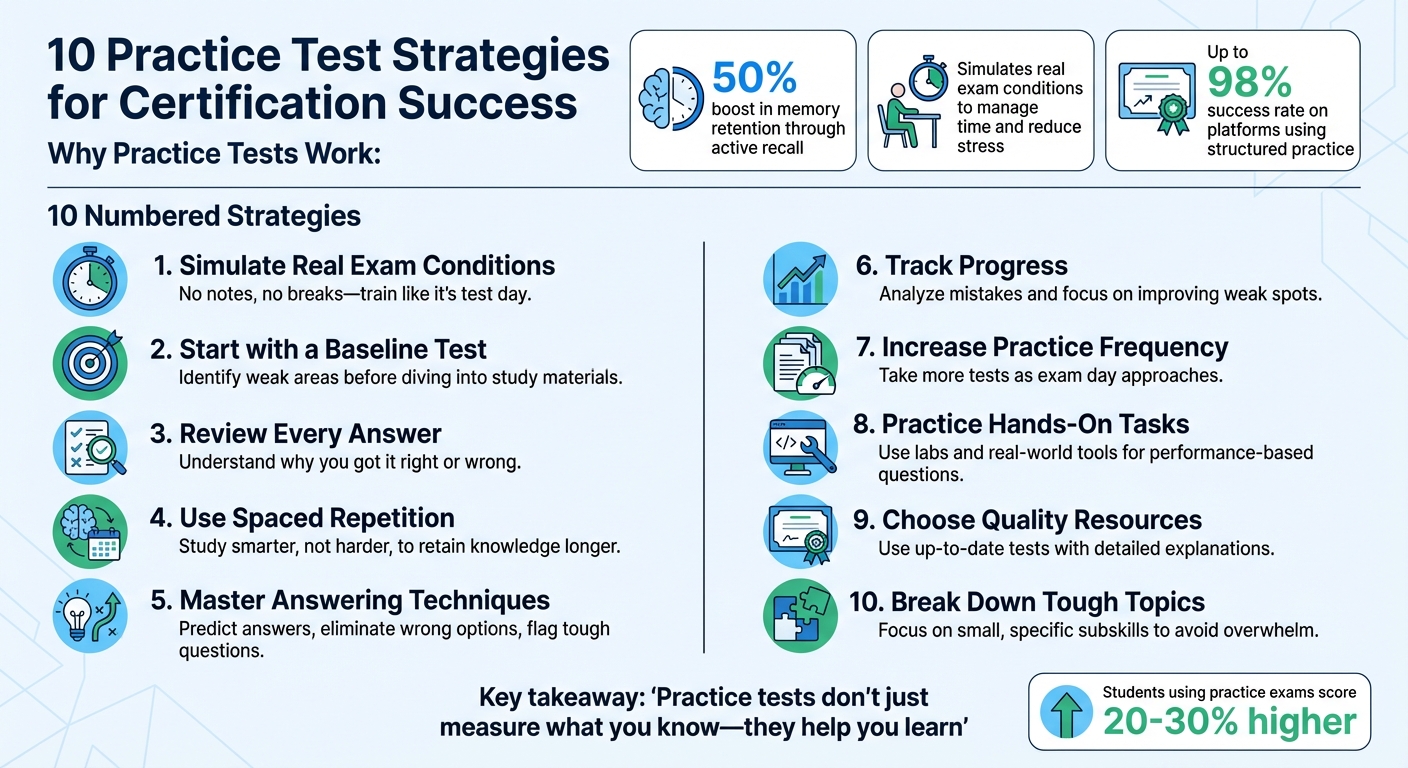
10 Practice Test Strategies for Certification Exam Success
Mastering Certification Exams
sbb-itb-b03e171
1. Replicate Actual Exam Conditions
Taking practice tests casually, like open-book quizzes, undermines your preparation. If you pause the timer to check notes or take frequent breaks, you are training for a relaxed environment instead of the one you will face on exam day. Timed, closed-book, distraction-controlled practice is what builds stamina and timing judgment.
To prepare effectively, set up your practice environment to mimic the actual exam. Find a quiet space free of distractions, remove study materials, and close unnecessary browser tabs. Use a countdown timer and complete the test without interruptions. This approach helps you build the mental stamina needed to stay focused for the entire exam. It’s not just about answering questions correctly - it’s about maintaining concentration from start to finish.
Plan to take at least a couple of full-length practice exams under these conditions so test-day pacing does not feel new. Go a step further by simulating your exam-day routine: start time, room setup, hydration, and break expectations.
Also, use the best certification exam platforms that replicate the actual exam interface. Features like flagging, navigation buttons, and review screens should feel familiar by test day. This lowers mental load so you can focus on answering questions instead of figuring out the interface. And if you are stuck, flag the question and move on rather than burning too much time on one item.
2. Take a Baseline Test Before You Start Studying
Before diving into study materials, take a full-length practice test under authentic exam conditions. This initial step gives you a clear picture of your current knowledge - not based on guesswork, but on measurable results.
Why does this matter? A baseline test helps you avoid the "illusion of competence." For example, recognizing terms like "VPC peering" or "IAM roles" is one thing, but applying them correctly under exam pressure is another. A diagnostic test highlights these gaps early on, ensuring you focus on what you need to learn instead of revisiting concepts you already understand.
The results of your test should guide your study planning. Let’s say you score 45% in Security and 75% in Compute. This breakdown shows where to focus your efforts. Instead of following a generic study schedule, zero in on your weak areas. Analyze the questions you missed - was it a lack of knowledge or a misstep like misreading a qualifier such as "MOST cost-effective" instead of just "cost-effective"? These insights will refine your entire approach.
Treat this test seriously. Take it in a quiet, timed, and distraction-free setting. Combine that baseline with the official exam-topics workflow so you can map your misses back to the actual blueprint rather than just guessing what to study next.
3. Review Every Answer - Right and Wrong
Taking the time to review every answer - not just the ones you got wrong - is a crucial step in mastering the material. Even correct answers deserve a closer look because they might stem from lucky guesses, process-of-elimination tactics, or flawed reasoning.
Start by breaking down your mistakes. Ask yourself: Why did I think this wrong answer was correct? Was it due to a gap in knowledge, or did you misinterpret the question? For instance, if you picked an answer that seemed to solve the problem but overlooked that the question asked for the least operational overhead, that’s a reading error, not a knowledge issue. Categorize your mistakes into groups like knowledge gaps, misreading qualifiers, or logical missteps. Spotting these patterns helps you sidestep similar traps in the future. This kind of detailed review strengthens your ability to handle similar questions on test day.
Next, take a hard look at the questions you got right. Note how confident you felt about each one. Pay extra attention to "underconfident hits" - those answers you got correct but weren’t sure about. These highlight areas where your understanding might still be shaky. Go over the explanation to pinpoint why the right answer is correct and why the other options were wrong. If you can’t explain the solution in your own words without checking your notes, it’s a sign you need to revisit the concept.
Give review at least as much respect as the test itself. Start your review soon after finishing the set, then circle back later to reinforce the weak spots. Keep a mistake log: a short running list of the traps you fall into, like overcomplicating, missing qualifiers, or choosing a technically valid answer that is not the best answer. This log becomes one of your highest-value study assets.
4. Use Spaced Repetition and Increase Difficulty Over Time
Cramming can feel productive in the moment, but it is weak for long-term retention. Spaced repetition and retrieval practice are more reliable because they force you to recall and use knowledge over time instead of just re-reading it.[1][2]
A practical method is to revisit new material on a simple cadence such as 1 day, 3 days, 7 days, and then a longer follow-up. The exact interval matters less than the habit of revisiting material before it fades completely.
As you progress, gradually increase the complexity of your review. Start with short factual questions if you must, but move toward scenario-based questions that force you to choose the best next step, safest change, or lowest-overhead option. If you need help decoding those question styles, use this guide to certification exam question types.
To make spaced repetition easier, tools like Anki (free for desktop and Android) or Brainscape (free basic version) use algorithms to schedule reviews based on how confident you feel about each topic. Rotate through topics until you’ve answered each correctly three times, then extend the review intervals. Keep your sessions manageable by limiting yourself to 10–20 new flashcards daily. The mental effort required to recall information just before forgetting it is what makes the learning stick.
5. Apply Question Answering Techniques
Once you've tackled realistic practice exams and thoroughly reviewed your answers, the next step is mastering question-answering techniques. These strategies are essential for navigating distractors and boosting your confidence, especially on scenario-heavy certifications such as Security+, cloud, and networking exams. If you want a concrete example, use the Security+ practice test alongside this page.
Multiple-choice exams are packed with distractors - answers that seem correct but are meant to mislead. Knowing how to approach these questions can make all the difference. By applying structured techniques, you can sift through the confusion and zero in on the correct answer, even when you're unsure.
Start with predictive answering: read the question stem (the main part of the question) and form an answer in your mind before even glancing at the options. This helps you avoid falling for distractors that might otherwise sound convincing. Then, use the process of elimination to weed out clearly wrong answers. For example, on a four-option question, random guessing gives you a 25% chance of being correct. Eliminate one wrong choice, and your odds jump to 33%. Knock out two, and you're at 50%. For exams that don’t allow on-screen notes, jot down "ABCD" on scrap paper and cross off options as you go.
Pay close attention to qualifiers like "BEST", "MOST cost-effective", "LEAST operational overhead", "NOT", or "EXCEPT." These little words can completely flip the meaning of a question. If you're stuck, flag the question and move on - your time is better spent securing easier points. Don’t linger too long on any single question; if time allows, revisit flagged items later.
After the test, take time to analyze every missed question. Identify the reason for each mistake: knowledge gap, misread qualifier, or logic error. This kind of post-mortem analysis helps you spot patterns in your thinking and avoid repeating them. Think of each question as a mental workout, not just a score event.[2]
Here’s a quick overview of these techniques and their benefits:
| Technique | Primary Benefit | Recommended Action |
|---|---|---|
| Process of Elimination | Boosts chances of guessing correctly | Cross out two obviously wrong answers immediately |
| Predictive Answering | Keeps you from falling for distractors | Think of your answer before reviewing the choices |
| Strategic Flagging | Saves time for easier questions | Mark tough questions and return to them later |
| Post-Mortem Analysis | Highlights recurring mistakes | Categorize errors (e.g., "misread" vs. "knowledge gap") |
Incorporating these techniques into your study routine will help you approach exam day with a clear strategy and greater confidence.
6. Track Your Scores and Find Weak Areas
Once you've honed your answering strategies, the next step is keeping tabs on your performance. Tracking your scores not only shows how you're doing overall but also pinpoints the areas where you're falling short. This way, you can focus your energy where it matters most.
Your total score might give you a sense of whether you're on track to pass, but the real insight comes from breaking it down. For example, scoring 70% overall might seem fine, but if you're hitting only 45% in Cloud Security while acing Networking at 85%, it's clear where you need to spend more time.
Take your mistake log to the next level by categorizing your errors. For each mistake, jot down why it happened - did you misread the question, mix up concepts, or run out of time? Group these into categories like:
- Conceptual: You didn't know the material.
- Careless: You misread or overlooked key details.
- Process: You understood the material but applied it incorrectly.
- Timing: You rushed and guessed.
This breakdown helps you see patterns and avoid repeating the same mistakes.
Another useful tactic is to track your confidence level for each answer. If you miss a question you were certain about (an "overconfident miss"), it signals a flawed assumption that needs immediate correction. On the flip side, if you get a question right but felt unsure (an "underconfident hit"), it points to shaky knowledge that could crumble under exam pressure.
To strengthen your understanding, give deliberate time to the review step and dive into each mistake to uncover its root cause. Retrieval works best when practice is paired with analysis, correction, and another attempt later.[1][2]
If you're using Planet Cert, their analytics can make this process even easier. The platform tracks your performance across different domains, highlights recurring weak spots, and shows trends over time. This gives you a clear picture of whether you're improving or just spinning your wheels. Use this data to set measurable goals. For instance, instead of vaguely deciding to "study more", aim for something specific like "Improve my IAM domain score by 10% in the next two weeks". With this focused approach, you'll be better prepared for your next round of practice tests.
7. Take More Practice Tests as Your Exam Date Approaches
As your exam date draws near, it’s time to fine-tune your preparation by increasing the frequency of your practice tests. Think of these final practice sessions as the last stretch of a marathon - crucial for building confidence and stamina.
In the last two weeks before your test, increase the frequency of realistic mixed sets and at least one or two full-length runs if your schedule allows. The goal is not just more volume. It is to confirm pacing, stamina, and weak-domain recovery under pressure.
Avoid doing a brutal full-length test right before exam day. Use the final 24 to 48 hours for light review, confidence-building refreshers, and logistics. If you have not booked yet, use the CompTIA exam schedule only after your results and weak-domain coverage are stable enough to justify the appointment.
Once you've wrapped up this intensive practice phase, it’s time to shift your focus to mastering hands-on performance tasks.
8. Practice Performance-Based Questions with Hands-On Labs
Performance-based questions (PBQs) and simulation-style tasks go beyond multiple choice by requiring you to solve, configure, or troubleshoot rather than just recognize the correct answer. That means hands-on practice matters. If your target exam includes labs, CLI output, configuration tasks, or troubleshooting flows, your prep should include those formats too.
To strengthen your skills and build confidence, set up a home lab using free or low-cost tools. VirtualBox can help you run virtual machines; pfSense is useful for firewall practice; Wireshark helps with packet analysis; and cloud free tiers can help with configuration and troubleshooting workflows. This hands-on practice helps you avoid the illusion of competence, where familiarity is mistaken for mastery.
It’s also helpful to memorize key port numbers like SSH (22), DNS (53), HTTPS (443), and RDP (3389). During the exam, read PBQ instructions twice to catch specific requirements, such as subnet configurations or port constraints, as missing these details can invalidate your work. If your simulation becomes messy, use the reset button to start fresh and stay on track.
Planet Cert’s practice exams include scenario-based questions specifically designed to prepare you for PBQs. Paired with consistent hands-on lab work, these resources will help you develop the confidence and practical expertise needed to excel in performance-based tasks.
9. Choose High-Quality Practice Exams from Trusted Providers
The quality of your practice exams can make or break your preparation. To get the most out of your study time, choose materials that align closely with the official exam blueprint. These blueprints outline the domain structure of the test, ensuring you focus on the right topics rather than whatever a provider happened to write first.[3][4]
When selecting a provider, prioritize platforms that offer detailed explanations for every question, whether you answered it correctly or not. These explanations should teach the reasoning behind the answer, not just reveal the answer key. That is what helps you transfer the lesson to unseen questions.
This approach ensures your practice exams teach you the "why" behind the answers, which is essential for long-term retention. It's equally important to confirm that your materials are up-to-date. Certification exams are frequently revised, and outdated resources may leave you unprepared for the latest requirements. Always check the version and update date of your practice tests to ensure they match the current exam objectives.
Another helpful feature to look for is realistic exam simulation. Platforms offering tools like countdown timers, question flagging, and review options can help you get comfortable with the actual testing environment. These features not only reduce test-day anxiety but also improve your time management skills.
For example, Planet Cert provides practice exams for over 1,000 certifications with timed and review-oriented modes that fit different parts of the study loop. The key question is not the headline number of questions. It is whether the provider gives you current coverage, realistic simulation, and explanations that help you fix the next attempt.
Before committing to any paid resource, use free sample questions to evaluate explanation quality, current version handling, and overall usability. The goal is to choose exams that teach, not just tests that generate a score.
10. Break Down Complex Topics Into Smaller Parts
When preparing for a certification exam, tackling a massive syllabus can feel overwhelming. Instead of cramming through endless study sessions, try breaking the material into smaller, manageable chunks. This approach not only reduces mental fatigue but also turns what feels like chaos into clear, actionable steps.
Start by pinpointing 3-5 specific subskills to focus on each week. Use your practice test results to guide you. For example, instead of tackling a broad topic like "Storage", zero in on specific areas like "S3 bucket policies" or "EBS volume encryption." This makes your study sessions more measurable and helps you patch the gaps that matter most.
To reinforce your learning, practice with micro-sets of 10–20 questions on these subtopics. After studying something new, wait at least 20 minutes before reviewing it again. This taps into the spacing effect, which helps strengthen your memory over time.
Another useful technique is to explain a tricky concept in simple language as though you were teaching it to a beginner. If you hit a wall, that is usually a sign you need to revisit the concept or the underlying workflow.
When creating study aids like flashcards, stick to one concept per card. Cramming multiple facts onto a single card can trick you into thinking you’ve mastered the material when you haven’t. Keeping each card focused ensures you truly understand the material, which builds real confidence when exam day arrives.
Conclusion
Bringing these strategies together, your certification preparation becomes a structured plan that turns practice tests into learning tools instead of stress rituals. Start with a baseline test, map the misses to the blueprint, review explanations seriously, then loop back with stronger timing and weaker-domain repair. For entry-level support tracks, an A+ practice test is a clean way to benchmark hardware, operating-system, and troubleshooting gaps before you book.
As highlighted earlier, practice tests do more than assess your knowledge. They help you retrieve, apply, and refine what you know under pressure.[1][2] The goal is not to ace your first practice test. It is to build calm competence through repeated exposure to realistic question patterns and disciplined review.
Think of practice tests as your training ground. Approach them thoughtfully, review your results with a critical eye, and trust in the process. By integrating these strategies, you’ll strengthen your preparation and head into exam day with confidence.
FAQs
What practice test score means I’m ready to schedule the exam?
There is no universal readiness score that fits every certification. A better standard is consistent performance across multiple fresh sets, stable results in your weak domains, and the ability to explain why the right answers are right. Use the scheduling guide only when those signals are stable enough to justify booking.
How do I turn missed questions into a study plan?
When you get an answer wrong, don’t just brush it off - use it as a learning opportunity. Pinpoint the topics where you struggled and focus your study time there. Break those subjects into smaller, manageable chunks, and track your progress as you go. Pay special attention to areas where your confidence is lower.
To make your study sessions more effective, try techniques like active recall (testing yourself on the material) and spaced repetition (reviewing information at increasing intervals). These methods help strengthen your memory over time. By turning mistakes into a personalized study plan, you can boost your exam preparation and feel more confident when test day comes around.
How often should I take full-length practice exams?
How often you should take full-length practice exams depends on the exam length, your timeline, and how much time you are giving to review. A practical pattern is to use shorter focused sets earlier, then add full-length runs later when timing and stamina become important. Quality of review matters more than chasing a fixed number of full mocks.
Sources used in this refresh

Discussion
Question Comments
0 comments·0 participantsSign in to leave a comment and access more free questions.