
TExES Exam Cost: How Much You'll Pay for Each Certification Area
When you're mapping out your path to a Texas teaching certificate, the fees can feel like a moving target. One question I hear over and over is, "How much does the TExES exam cost?" The short answer is $116 for most exams — but like all things in education, the details matter. Below I'll walk you through exactly what you'll pay, when extra charges kick in, how the pricing varies for special exam codes, and the line items you need to track so you don't get caught short on registration day. By the time you finish, you'll have a budget you can take straight to your payment screen.
What's the standard TExES registration fee?
For the vast majority of TExES exams, the registration fee is $116. That price covers a single attempt at one exam, whether you're sitting for Pedagogy and Professional Responsibilities (PPR), a content area test like Mathematics 7–12, or any of the dozens of other certifications Texas offers. When you register through your Pearson VUE account, you'll see that amount listed at checkout — no hidden service charges or facility fees tacked on.
The one wrinkle is the Core Subjects EC–6 (391) exam. I'll break that out separately because the pricing rules are different. For every other exam, though, you can walk in knowing your out-of-pocket cost ends at $116 per attempt.
Do all TExES exams cost the same?
Most do, but there are two sets of exam codes that break from the $116 baseline:
- Core Subjects EC–6 (391): The full exam costs $116, but each individual subject exam (taken separately) costs $58.
- Exam codes 801–809: These exams are $58 each. Some of the codes in that range belong to Bilingual Target Language Proficiency Tests (BTLPT), while others cover shorter specialty assessments. If your test code starts with an 8, double-check the fee schedule — you'll often pay half the standard price.
The BTLPT exams, for example, are frequently required for bilingual education candidates. Since those tests are narrower in scope than a full content-area exam, the lower $58 fee reflects the shorter testing time. That means a bilingual candidate who needs a BTLPT plus a content test could spend $58 + $116 = $174 just on exam fees.
How does the Core Subjects EC–6 (391) pricing work?
This is the exam where I see the most confusion, so let's make it concrete.
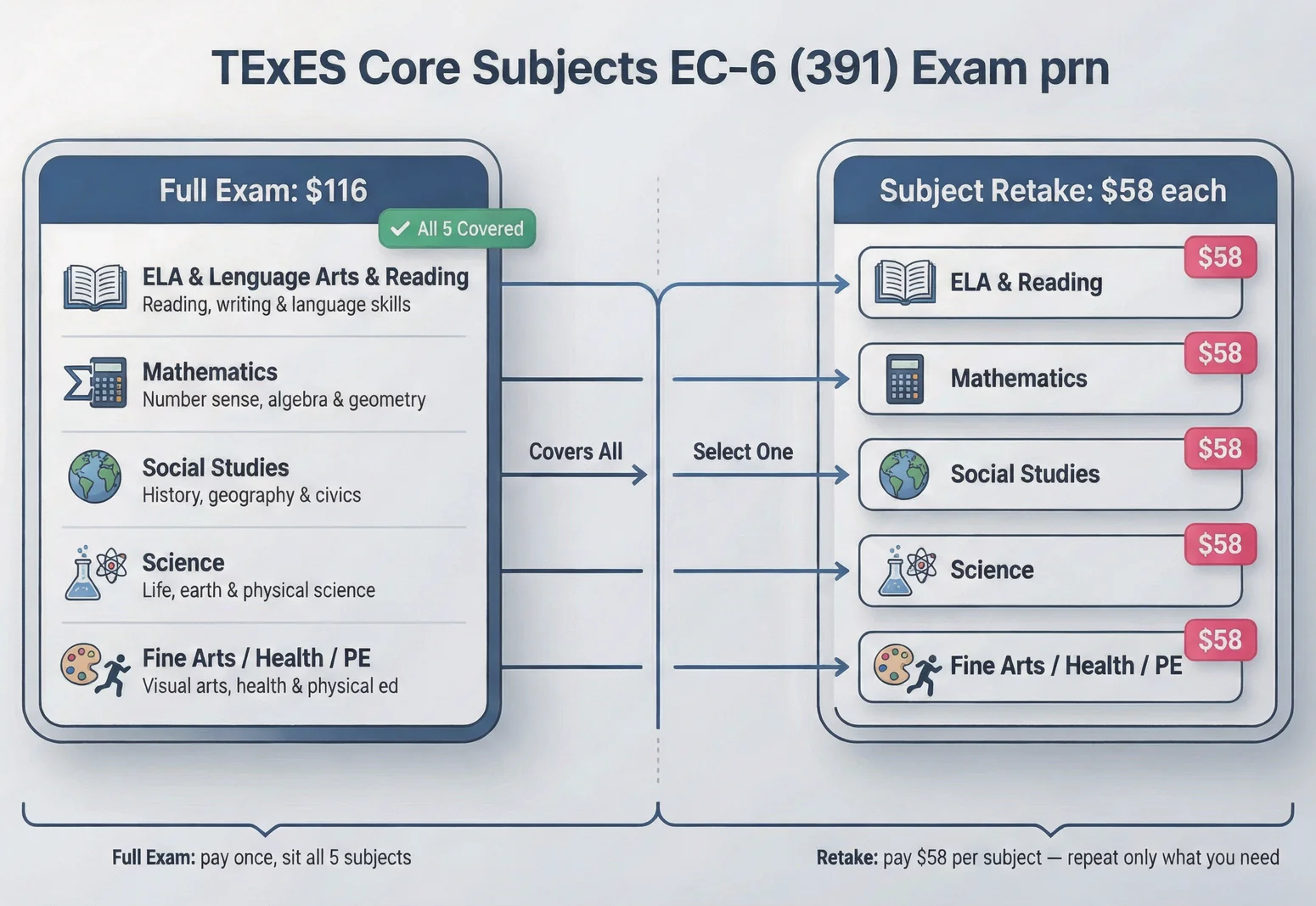
The Core Subjects EC–6 test covers five subject areas: English Language Arts and Reading (with the Science of Teaching Reading), Mathematics, Social Studies, Science, and Fine Arts/Health/Physical Education. When you register for the entire exam on one date, you'll pay $116. But if you later need to retake just a single subject — say, the mathematics subtest — you can register for that subject-only exam at $58.
I've worked with candidates who thought they'd have to retake the whole $116 exam after failing one section. That's not the case. Here's a real scenario:
Laura, an alternative certification candidate in Dallas, passed four of the five subjects on her first attempt but missed the mark on the math subtest. Rather than paying another $116 and sitting through all five sections again, she registered for the math-only retake at $58. Her total exam cost ended up being $174 — the full exam plus one subject retake — instead of $232.
Keep an eye on your score report: it will tell you which subjects you've already cleared. You only need to retake the ones you didn't pass. If you need to retake two subjects, you'll pay $58 per subject, not another full-exam fee.
A note on timing: the subject-only retake is available as long as you haven't previously passed the entire exam. Once you've passed all five subjects (either in one sitting or through separate retakes), you're certified in that area and won't need to register again unless the certificate lapses.
What extra fees should I budget for?
The registration fee is the main cost, but several other expenses can sneak into your budget if you're not careful.
Rescheduling. If you need to change your test appointment, you can do it at no charge as long as you make the change more than 24 hours before your scheduled start time. Within the 24-hour window, you'll likely forfeit your fee and have to re-register at full price. Mike, a PPR candidate in Austin, got called into work the day before his test. He rescheduled three days ahead of time — no fee — but he told me he was relieved he didn't try to switch at 11 p.m. the night before.
Cancelling. The registration fee is non-refundable. If you cancel, you won't get a refund, though you might be able to reschedule without losing the fee if you're outside that 24-hour cutoff. Some candidates assume they can cancel, get a voucher, and rebook later. In my experience, that's rarely the case — plan on losing the money if you back out last-minute.
Score verification and extra reports. You'll receive one score report automatically after your test. If you need additional copies or want a score verification (a manual regrade), expect to pay a separate processing fee. Those fees vary by service, and Pearson VUE lists them during registration, but they typically run $10 to $25 per request. Score verifications rarely change the outcome, so most candidates skip them unless they have a specific reason to suspect a scoring error.
Background check and state application fees. These aren't exam fees, but they're part of your overall certification cost, and I've seen candidates confuse them with test charges. The Texas Education Agency charges a $78 standard certificate application fee, and fingerprinting through an approved vendor adds roughly $40 to $50. That's another $120–$130 beyond your exam costs, so keep it in a separate line of your budget.
How do I pay, and what payment methods work?
Pearson VUE handles all TExES registrations, and they accept Visa or MasterCard credit cards, debit cards, and check cards. Cash, personal cheques, and digital wallets aren't options — I've seen candidates scramble when they showed up at a test centre expecting to pay with a money order. Everything goes through the online portal at the time of registration.
If your preparation programme or employer gave you an exam voucher, you can apply that code during checkout. Just make sure the voucher is still valid and matches the specific exam you're booking. Vouchers often have expiration dates, and they're usually non-transferable between exam titles. If you're relying on a voucher, register early — expired vouchers won't be accepted, and Pearson VUE doesn't reissue them.
Does it cost extra to take the TExES online?
No. Whether you sit for your exam at a Pearson VUE test centre or take it from home through the OnVUE online proctoring system, the fee stays the same. There's no premium for remote testing, no hidden proctoring add-on, and no extra equipment fee — you just need a computer that meets the system requirements, a webcam, and a quiet room.
If you're on a tight budget, you don't need to drive to a centre to save money; likewise, if you prefer a centre's controlled environment, you won't pay more for that choice.
What's the retake policy and cost?
If you don't pass on your first attempt, the retake fee mirrors the original registration fee: $116 for a full exam or $58 for a subject-only exam. There's no discount for repeat attempts, so every retake eats into your budget.
Texas also enforces a mandatory 30-day waiting period between attempts for the same exam. That means even if you're prepared to retest the following week, you'll need to wait a full month before you can schedule again. Budget that time into your certification timeline.
Here's a budget example: if you take the Core Subjects EC–6, pass three subjects, and need to retake two subjects, you'll spend $116 (initial exam) + $58 + $58 = $232. If you need to retake the entire exam later because you didn't pass any of them, you'd spend $116 + $116 = $232 as well. Either way, the costs stack up fast.
If you're taking multiple exams in different certification areas — say, PPR ($116) plus a content exam ($116) — that's $232 before any retakes. Add a subject retake and you're looking at $290. A small planning buffer, perhaps an extra $50 set aside for score reports or a last-minute reschedule, can keep the process predictable.
What if Pearson VUE cancels my test?
Occasionally, test centres close due to weather, technical issues, or other emergencies. If that happens, Pearson VUE will email you to reschedule or offer a full refund of your exam fee. You won't be charged for the new appointment, even if it's at a different date or time. Keep an eye on the email address you used to register — the notice might land in your spam folder.
If the cancellation happens less than 24 hours before your test and you can't reschedule within the allowed window, contact Pearson VUE's customer service. They usually make exceptions for centre-initiated cancellations and won't hit you with the late rescheduling penalty.
How can I keep my total certification costs under control?
The cheapest exam is the one you pass on the first attempt, so the most effective money-saving strategy is solid preparation. A $40 or $50 study resource that helps you clear the test the first time pays for itself many times over.
Start with the official preparation manual for your exam. The Texas Educator Certification Examination Program site provides free study plans and sample questions. Use those to identify your weak areas, then target them with practice exercises.
Next, consider adding a structured practice resource. While not free, products that simulate the real exam interface can make a big difference. When you work through a platform that mirrors the Pearson VUE environment — showing you timed sections, question formats, and performance breakdowns by competency — you walk into the real test more confident. Less anxiety and stronger familiarity with the pacing often mean fewer retakes, which keeps your total spend closer to that $116 base.
Also check whether your educator preparation programme or school district reimburses exam fees. Many alternative certification programmes in Texas include at least one exam attempt in your tuition. If you're already employed on a probationary certificate, ask your HR department — some districts cover the cost of content tests required for your standard certificate. In 2025, I spoke with a candidate whose district reimbursed both her PPR and content exam fees after she submitted the receipts; she ended up paying only for a single subject retake.
Finally, avoid the temptation to book multiple exams on a "maybe" schedule. Each registration ties up money, and if you have to reschedule close to the test date, you risk losing the fee. Register for one exam at a time, when you're ready.
A typical budget for a first-time candidate taking PPR and one content exam, with a study guide and one practice test platform, might look like this:
- PPR exam: $116
- Content exam: $116
- Official study guide: $30
- Practice test access (one-month subscription): $45
- State application & fingerprinting: $125
- Total: $432
If you pass both on the first try, that's your total. Add $116 for each retake. The practice materials and guide might feel like extra spending, but they often prevent a retake — a single avoided $116 retake more than offsets their cost.
Are there fee waivers or financial assistance?
The state of Texas doesn't offer income-based fee waivers directly through the TExES programme. However, some educator preparation programmes build exam costs into their tuition or offer scholarship stipends that can cover one or two attempts. Military veterans and active-duty service members may be able to use GI Bill benefits for certification exams, but you'll need to submit the appropriate paperwork to the VA beforehand.
If you're a candidate from a low-income background, check with your EPP about any internal grants or emergency funding pools. A few larger districts also run "grow your own" programmes that sponsor exams for aspiring teachers from the community. These aren't widely advertised, so it's worth asking your programme director or HR contact directly.
How does the TExES cost compare to other state exams?
If you're relocating or considering teaching in multiple states, it's useful to know the landscape. Teacher certification exam fees vary across the country, but most fall between $50 and $150 per test. For example, California's CSET exams run about $134 per subtest, while New York's teacher certification exams hover around $65 to $100 depending on the test. TExES sits firmly in the middle of that range — not the cheapest, but not unusually expensive either.
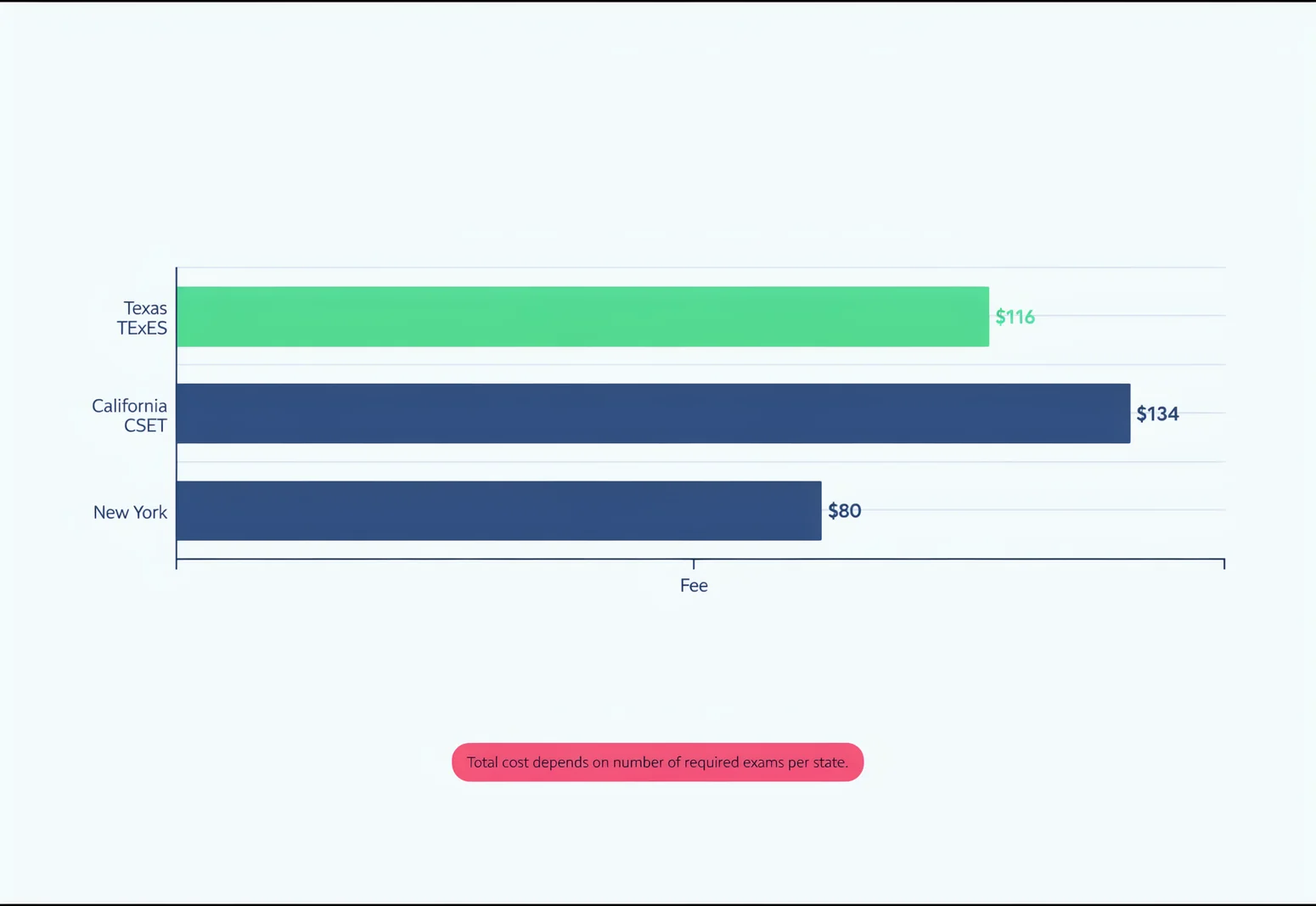
Keep in mind that some states require more exams for initial certification, so the total cost can climb quickly even if individual fees are lower. Texas often requires only a PPR plus a content test, which keeps the base total at $232, whereas a New York candidate might face three or four exams at $80–$100 each, totaling $300 or more.
When you're budgeting across states, factor in the number of attempts you might need and whether your programme covers any fees. If you're curious about how certification costs work in other fields, certification pricing in IT follows a similar pattern — for example, Adobe exam pricing and Cisco exam costs show parallels with TExES, though the subject matter is different. That cross-field perspective can help you gauge what a "fair" price looks like for a professional credential.
Cost guides for other certification exams
browse the relevant exam page and purchase a practice test

Discussion
Question Comments
0 comments·0 participantsSign in to leave a comment and access more free questions.