An 82-year-old male with a history of ischemic cardiomyopathy presents to the acute care unit with worsening dyspnea, orthopnea, bilateral coarse crackles throughout the lower lung fields, and 3+ pitting lower extremity edema. His internal jugular venous pulsation is visualized 6 cm above the sternal angle at 45 degrees. Which microvascular hemodynamic alteration is the primary mechanism driving extravasation of fluid into this patient's pulmonary and peripheral interstitium?
Answer and explanation
Correct answer: C
Elevated venous and capillary hydrostatic pressures overcome plasma oncotic pressure, driving transudative interstitial and alveolar extravasation. Decreased oncotic pressure occurs in nephrotic syndrome or severe cirrhosis, not pure heart failure.
Q2Question 2
Advanced
Core Competencies · Advanced pathophysiology
A 68-year-old female is admitted to the intensive care unit 48 hours following emergency laparotomy for perforated diverticulitis with feculent peritonitis. Over the past 6 hours, she developed severe respiratory distress, tachypnea to 38 breaths/min, and confusion. She was promptly intubated. A chest radiograph demonstrates diffuse bilateral alveolar infiltrates with air bronchograms sparing the cardiophrenic angles. Arterial blood gas on volume control ventilation (tidal volume 6 mL/kg predicted body weight, positive end-expiratory pressure 14 cm H2O, FiO2 0.80) reveals: pH 7.27, PaCO2 49 mmHg, PaO2 78 mmHg, and HCO3- 22 mEq/L.
Bedside transthoracic echocardiography demonstrates normal left ventricular systolic function with an ejection fraction of 62%, normal left ventricular filling pressures, and no valvular disease. Her calculated PaO2/FiO2 ratio is 97.5 mmHg, fulfilling Berlin criteria for severe acute respiratory distress syndrome (ARDS).
Which pathophysiologic process is the predominant mechanism causing this patient's severe, refractory hypoxemia?
flowchart LR
A[Endothelial/Epithelial Injury] --> B[Increased Permeability]
B --> C[Alveolar Flooding & Collapse]
C --> D[Intrapulmonary Shunting]
D --> E[Refractory Hypoxemia]
Answer and explanation
Correct answer: B
In severe ARDS, non-aerated and fluid-filled alveoli continue to receive perfusion without ventilation, creating true intrapulmonary right-to-left shunt that fails to fully correct with supplemental oxygen alone.
Q3Question 3
Intermediate
Core Competencies · Advanced pharmacology
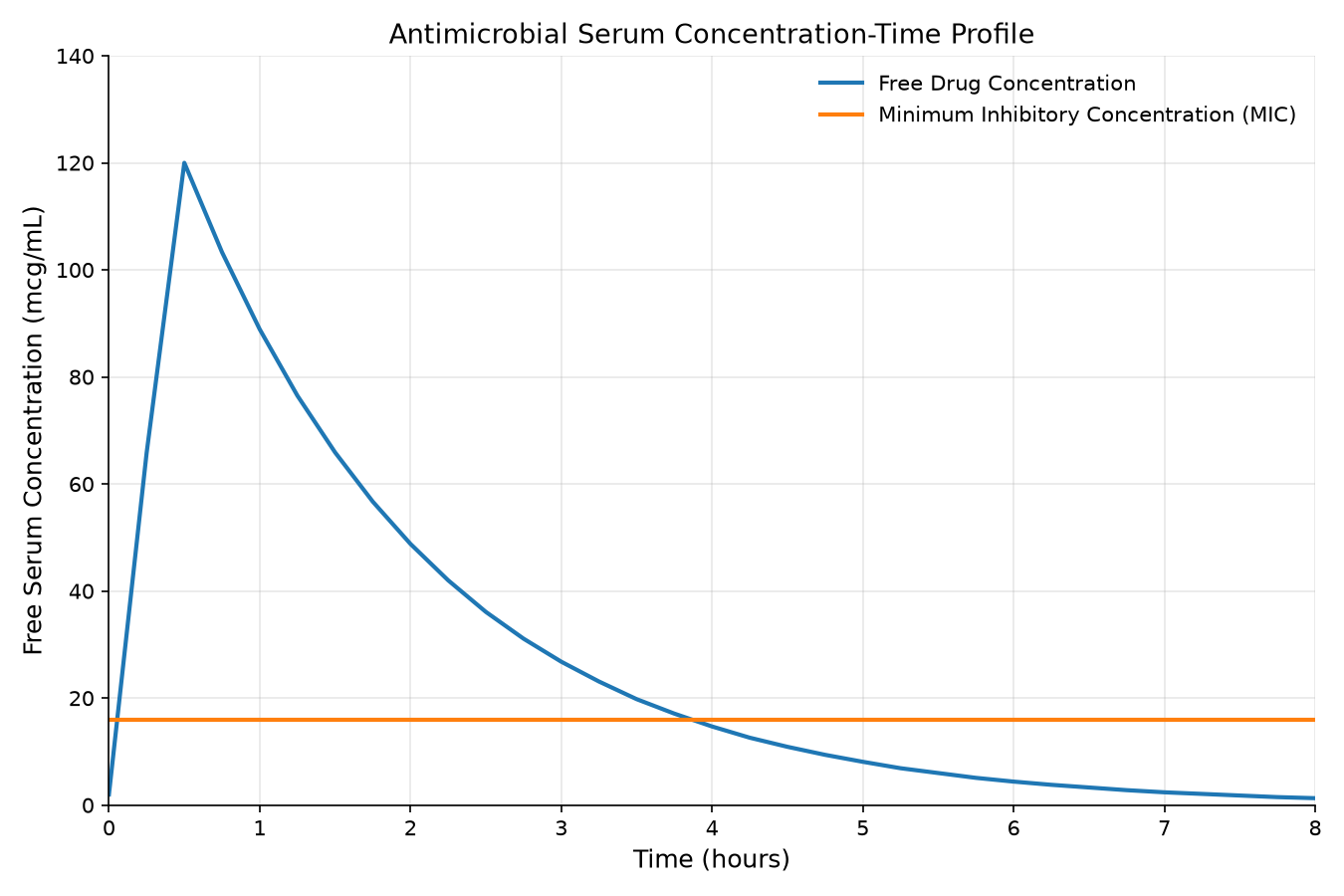
A critically ill 64-year-old male with septic shock secondary to hospital-acquired pseudomonal pneumonia is prescribed intravenous piperacillin-tazobactam. The AGACNP orders an extended infusion protocol. Which pharmacokinetic-pharmacodynamic (PK/PD) index best predicts bactericidal efficacy and clinical eradication for beta-lactam antimicrobials?
Answer and explanation
Correct answer: B
Beta-lactams exhibit time-dependent bactericidal killing. Their efficacy correlates directly with %fT > MIC. In contrast, aminoglycosides depend on Cmax/MIC, and vancomycin depends on AUC24/MIC.
Q4Question 4
AdvancedMultiple answers
Core Competencies · Advanced pharmacology
A 23-year-old male polytrauma patient with severe traumatic brain injury and multiple extremity fractures exhibits persistently subtherapeutic vancomycin troughs despite standard high-dose therapy. A 24-hour measured creatinine clearance reveals 195 mL/min/1.73 m2, confirming augmented renal clearance (ARC). Which TWO clinical factors most frequently drive augmented renal clearance in critically ill acute care patients? (Select TWO)
Answer and explanation
Correct answers: A, E
ARC is driven by hyperdynamic systemic states with increased cardiac output and renal plasma flow, commonly encountered in young trauma, burn, and sepsis patients without baseline kidney disease.
Systemic inflammation combined with aggressive crystalloid resuscitation increases glomerular filtration, accelerating elimination of hydrophilic, renally cleared antimicrobials.
Q5Question 5
Intermediate
Core Competencies · Advanced pharmacology
A 56-year-old male with decompensated alcoholic cirrhosis and spontaneous bacterial peritonitis has a serum albumin level of 1.7 g/dL. When administering highly protein-bound antimicrobials or antiepileptics (such as ceftriaxone or phenytoin), which pharmacokinetic consequence directly results from this patient's severe hypoalbuminemia?
Answer and explanation
Correct answer: B
Deficient serum albumin reduces drug binding capacity, elevating the pharmacologically active unbound fraction. This expands the volume of distribution and enhances hepatic or renal clearance.
Q6Question 6
Intermediate
Core Competencies · Advanced physical assessment
During morning rounds in the cardiac intensive care unit, an AGACNP performs a cardiovascular physical assessment on a 72-year-old patient with end-stage heart failure. Which combination of bedside physical findings most specifically reflects advanced cardiogenic hypoperfusion (the "cold" clinical phenotype)?
Answer and explanation
Correct answer: A
Physical markers of cardiogenic hypoperfusion include a narrow proportional pulse pressure, cool clammy extremities, delayed capillary refill, and resting tachycardia reflecting intense compensatory vasoconstriction.
Register free for 6 more questions
Or unlock all 143 AGACNP-BC questions with explanations, timed mode and flashcards.