In an ambulatory infusion suite, a registered nurse is preparing to administer intravenous iron sucrose to an adult patient. In accordance with The Joint Commission National Patient Safety Goal on patient identification (NPSG.01.01.01), which combination of identifiers must the nurse verify with the patient prior to initiating the infusion?
Answer and explanation
Correct answer: C
Joint Commission NPSG.01.01.01 requires two independent patient-specific identifiers like full name and date of birth. Room or bay numbers are not valid individual identifiers.
Q2Question 2
Beginner
Assess and Evaluate · Medications
True or False: Under The Joint Commission standards for ambulatory care (NPSG.03.04.01), any medication or clinical solution transferred from its original packaging into a syringe, medicine cup, or basin must be labeled immediately if it is not administered without delay.
Answer and explanation
Correct answer: A
NPSG.03.04.01 mandates immediate labeling of any medication or solution removed from its original packaging into a secondary container unless it is administered immediately and completely.
Q3Question 3
Intermediate
Assess and Evaluate · Medications
A 68-year-old patient with type 2 diabetes and stage 3 chronic kidney disease (CKD) visits an ambulatory clinic for follow-up. During medication reconciliation, the nurse discovers the patient regularly takes an over-the-counter remedy for chronic bilateral knee pain. Which medication represents the greatest nephrotoxic hazard and must be discontinued immediately?
Answer and explanation
Correct answer: D
Systemic NSAIDs like ibuprofen inhibit renal prostaglandins, producing afferent arteriolar vasoconstriction and acute renal decline, making them hazardous in diabetic nephropathy.
Q4Question 4
Intermediate
Assess and Evaluate · Preventative care/health promotion
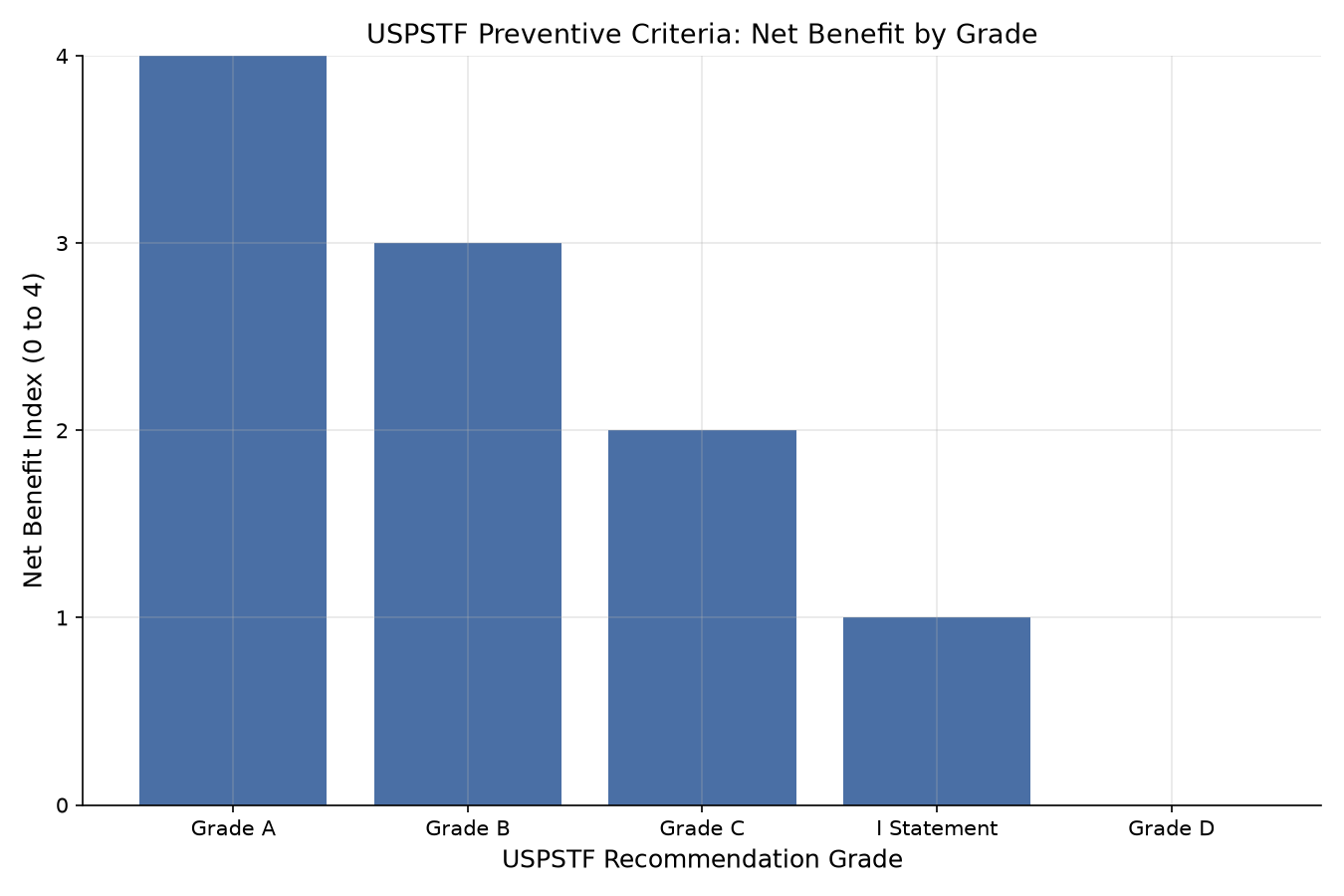
An ambulatory care nurse reviews preventive screening guidelines to identify eligible primary care patients for targeted vascular screening. Based on U.S. Preventive Services Task Force (USPSTF) Grade B recommendations as displayed in the preventive criteria chart, which individual meets the indications for a one-time screening ultrasound for abdominal aortic aneurysm (AAA)?
Answer and explanation
Correct answer: A
USPSTF recommends one-time ultrasound screening for abdominal aortic aneurysm specifically in men aged 65 to 75 who have ever smoked tobacco (Grade B).
Q5Question 5
Beginner
Assess and Evaluate · Preventative care/health promotion
During a routine 9-month well-child examination in a primary care pediatric clinic, the nurse examines an infant whose two mandibular central incisors recently erupted. According to USPSTF Grade B recommendations for oral health in infants and children up to age 5, which clinical action should the primary care team execute?
Answer and explanation
Correct answer: D
USPSTF Grade B guidelines direct primary care clinicians to apply fluoride varnish to the primary teeth of all infants and children starting at the time of initial tooth eruption.
Q6Question 6
Advanced
Assess and Evaluate · Preventative care/health promotion
A large community health center launches a comprehensive multi-tiered population health campaign across three surrounding urban neighborhoods. The health center serves over 24,000 enrolled patients across primary care, behavioral health, and occupational medicine divisions.
The ambulatory quality committee designs four simultaneous clinical initiatives to address health disparities in chronic illness: childhood immunization tracking, asymptomatic prediabetes screening at local community centers, an intensive post-cerebrovascular stroke gait re-education and constraint-induced therapy program, and annual mammography screening reminders.
The registered nurse leading the population outreach team reviews the operational taxonomy of preventive healthcare. Which of the four deployed clinical interventions represents tertiary prevention?
Answer and explanation
Correct answer: A
Tertiary prevention focuses on rehabilitation, disability reduction, and restorative care for individuals with diagnosed chronic disease or established impairment.
Register free for 6 more questions
Or unlock all 144 AMB-BC questions with explanations, timed mode and flashcards.