Assessment and Diagnosis · Cardiac-vascular assessment techniques and tools (eg, Doppler, stroke scale)
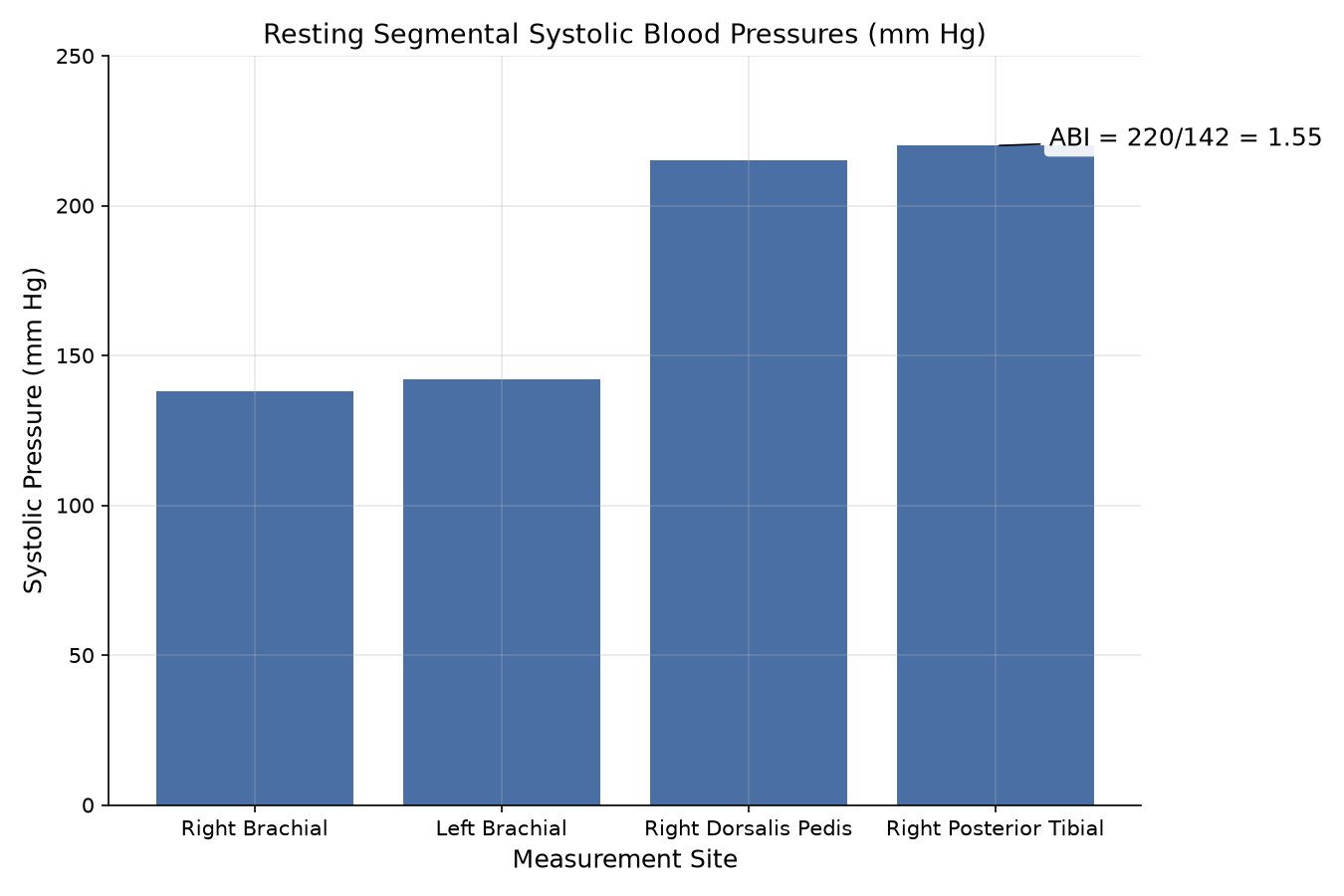
A cardiovascular nurse reviews the resting segmental systolic blood pressures shown in the figure for a 68-year-old patient with long-standing type 2 diabetes mellitus and end-stage renal disease who reports exertional calf pain. Based on these hemodynamic findings, which diagnostic assessment should the nurse anticipate next to evaluate for lower extremity peripheral artery disease?
Answer and explanation
Correct answer: C
An ABI >1.40 indicates noncompressible calcified arteries. Toe-brachial index assesses digital arteries spared from medial calcinosis to reliably evaluate for peripheral artery disease.
Q2Question 2
Intermediate
Assessment and Diagnosis · Cardiac-vascular assessment techniques and tools (eg, Doppler, stroke scale)
A 59-year-old patient presents with reproducible bilateral calf cramping after walking two blocks that resolves completely within five minutes of rest. The patient's resting ankle-brachial index is 0.94 in the right leg and 0.96 in the left leg. Which diagnostic strategy is most appropriate according to current clinical guidelines?
Answer and explanation
Correct answer: D
In patients with exertional claudication symptoms and borderline resting ABI (0.91-0.99) or normal ABI, exercise treadmill testing unmasks significant flow reduction and confirms the diagnosis.
Q3Question 3
Advanced
Assessment and Diagnosis · Cardiac-vascular assessment techniques and tools (eg, Doppler, stroke scale)
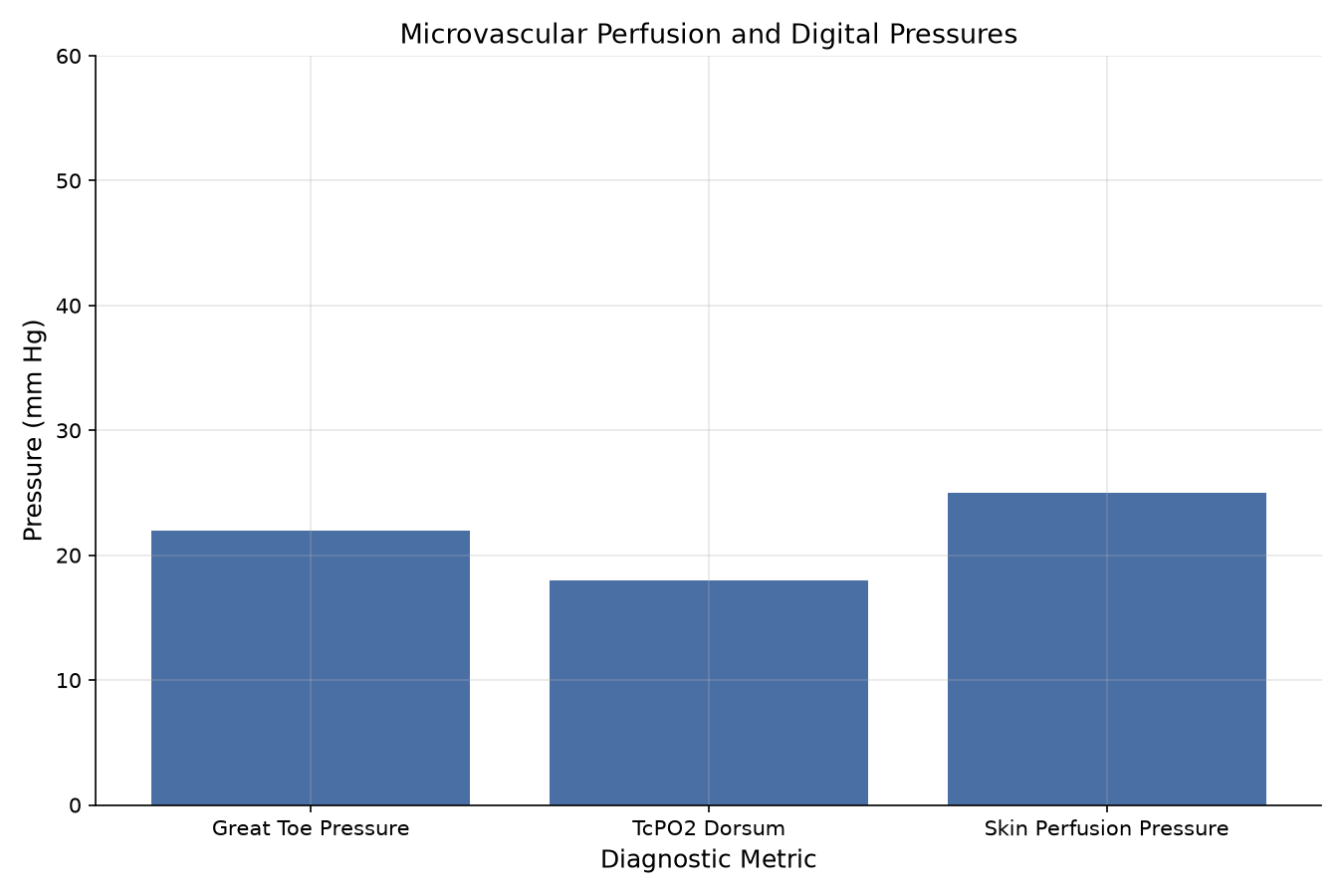
A 72-year-old patient with refractory ischemic rest pain and a non-healing dry ulcer over the right first metatarsal head is admitted to the vascular progressive care unit. Physical assessment reveals dependent rubor, pallor on limb elevation, absent palpable pedal pulses, and noncompressible tibial vessels on resting continuous-wave Doppler examination.
Microvascular physiological testing is conducted in a temperature-controlled environment. The patient's microvascular perfusion parameters and digital pressures are recorded and plotted in the accompanying diagnostic report.
Based on these diagnostic findings, which clinical interpretation should guide the multidisciplinary vascular care plan?
Answer and explanation
Correct answer: D
Toe pressure <30 mm Hg and TcPO2 <30 mm Hg define severe ischemia in chronic limb-threatening ischemia, signaling failure of spontaneous wound healing and urgent need for revascularization.
Q4Question 4
Intermediate
Assessment and Diagnosis · Data collection and interpretation (eg, diagnostic tests, laboratory results, cardiac rhythms)
A nurse evaluates an 81-year-old patient admitted with acute shortness of breath and bilateral crackles. The laboratory reports an elevated N-terminal pro-B-type natriuretic peptide (NT-proBNP) level of 3,850 pg/mL. When interpreting this laboratory result, which noncardiac clinical factor should the nurse recognize as an established cause of elevated natriuretic peptide concentrations?
Answer and explanation
Correct answer: D
Renal clearance impairment directly elevates natriuretic peptides. Advanced age, sepsis, and pulmonary embolism also raise levels, whereas severe obesity paradoxically lowers baseline concentrations.
flowchart TD
Dyspnea[Patient with Dyspnea] --> Test[Measure BNP / NT-proBNP]
Test --> NonCardiac[Evaluate Noncardiac Modifiers]
NonCardiac --> Elevates[Elevates: Renal Failure, Advanced Age, Sepsis, PE]
NonCardiac --> Lowers[Lowers: Severe Obesity]
Q5Question 5
Beginner
Assessment and Diagnosis · Data collection and interpretation (eg, diagnostic tests, laboratory results, cardiac rhythms)
During morning clinical rounds in the cardiac progressive care unit, a resident physician suggests ordering serial creatine kinase-myocardial band (CK-MB) and serum myoglobin assays alongside high-sensitivity cardiac troponin I (hs-cTnI) for a patient presenting with unstable retrosternal chest pain. Which statement reflects current evidence-based practice guidelines regarding biomarker testing for acute myocardial injury?
Answer and explanation
Correct answer: A
Guidelines designate CK-MB and myoglobin as obsolete (Class 3: No Benefit) because high-sensitivity cardiac troponins provide superior diagnostic precision and faster necrosis detection.
Q6Question 6
Beginner
Assessment and Diagnosis · Data collection and interpretation (eg, diagnostic tests, laboratory results, cardiac rhythms)
True or False: On a standard 12-lead electrocardiogram, the presence of a prolonged PR interval (first-degree atrioventricular block) and voltage criteria indicative of left ventricular hypertrophy are established independent predictors for the subsequent development of atrial fibrillation.
Answer and explanation
Correct answer: B
Structural and conduction abnormalities, including PR prolongation and left ventricular hypertrophy on 12-lead ECG, reflect atrial stretch and remodeling that predispose patients to atrial fibrillation.
Register free for 6 more questions
Or unlock all 158 CV-BC questions with explanations, timed mode and flashcards.