Patient Assessment Process · Functional assessment (eg, ADLs, IADLs, DME)
An adult-gerontology primary care nurse practitioner is evaluating an 82-year-old patient with severe progressive mobility impairment. Which four concurrent criteria must an item satisfy to qualify as Durable Medical Equipment (DME) under Medicare Part B for this patient?
Answer and explanation
Correct answer: B
Under Medicare Part B, DME must withstand repeated use, primarily and customarily serve a medical purpose, not be useful in the absence of illness or injury, and be appropriate for home use.
Q2Question 2
Beginner
Patient Assessment Process · Functional assessment (eg, ADLs, IADLs, DME)
During a home visit for a 78-year-old homebound patient managing neurogenic bladder and chronic venous insufficiency, the adult-gerontology primary care nurse practitioner reviews supply requests. Which item is classified by Medicare as a non-durable medical supply rather than durable medical equipment (DME)?
Answer and explanation
Correct answer: A
Expendable supplies such as intermittent catheter kits, incontinence pads, and elastic wraps cannot withstand repeated use and are classified as disposable supplies, not DME.
Q3Question 3
Intermediate
Patient Assessment Process · Cognitive and mental health assessment (eg, screening tools)
An adult-gerontology primary care nurse practitioner is implementing a routine cognitive screening protocol in an outpatient geriatrics clinic. Which statement accurately describes the clinical application and scope of instruments such as the Mini-Cog, AD8, and Quick Dementia Rating System (QDRS)?
Answer and explanation
Correct answer: C
Instruments like the Mini-Cog and AD8 take 10 minutes or less and detect impairment to trigger diagnostic evaluations; screening tools alone cannot establish a dementia diagnosis.
Q4Question 4
Advanced
Patient Assessment Process · Cognitive and mental health assessment (eg, screening tools)
An 81-year-old community-dwelling patient accompanied by an adult daughter presents to the primary care clinic for a routine follow-up of hypertension and type 2 diabetes. The daughter privately expresses concern, noting that the patient recently missed utility payments, misplaced essential cardiac medications, and has had increasing difficulty balancing the monthly checkbook. The patient maintains that these are normal lapses of aging and denies any memory decline.
Physical examination reveals blood pressure 138/82 mm Hg, pulse 72 bpm, and no focal neurological deficits. The patient lives alone and independently manages basic self-care activities of daily living such as dressing and bathing.
Which initial clinical action by the nurse practitioner is most appropriate?
Answer and explanation
Correct answer: D
New deficits in IADLs like handling finances or medications in an older adult are clinical triggers requiring immediate structured cognitive screening rather than reassurance or immediate drugs.
flowchart TD
A[Reported IADL Deficit] --> B[Brief Cognitive Screen]
B -->|Impaired| C[Diagnostic Workup: Labs, Neuroimaging]
B -->|Normal| D[Re-evaluate in 6-12 Months]
Q5Question 5
Beginner
Patient Assessment Process · Cognitive and mental health assessment (eg, screening tools)
True or False: In primary care geriatric assessment, a negative initial verbal screen using the two-question Patient Health Questionnaire (PHQ-2) indicates that no further full-length depression inventory (such as the PHQ-9 or Geriatric Depression Scale) is indicated at that visit.
Answer and explanation
Correct answer: B
The PHQ-2 functions as an efficient initial screening test; if negative, depression is unlikely and longer scales like the PHQ-9 are not indicated at that visit.
Q6Question 6
Intermediate
Patient Assessment Process · Psychosocial assessment (eg, health literacy, lifestyle, nutritional, caregiver/support, cultural, spiritual)
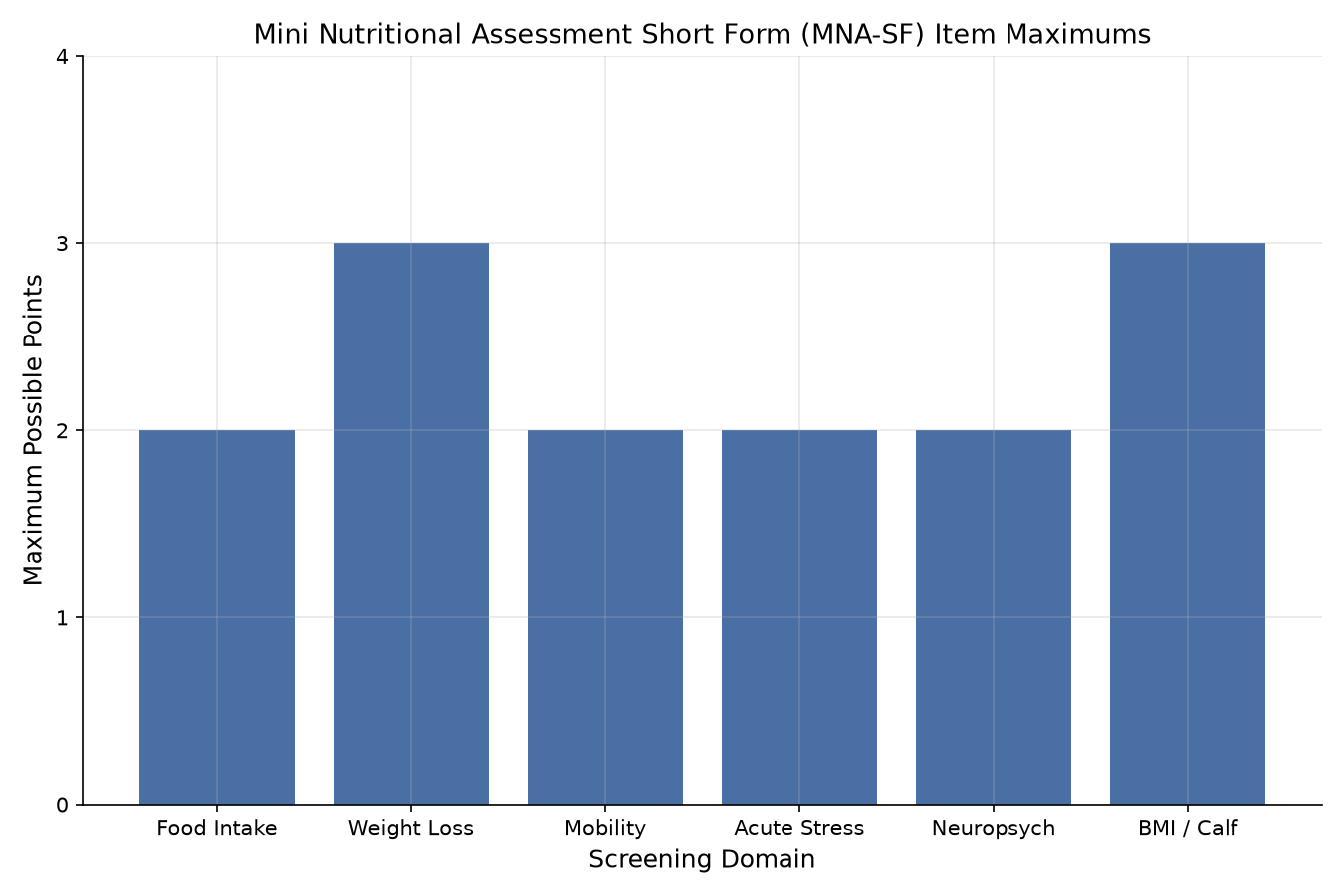
An adult-gerontology primary care nurse practitioner administers the Mini Nutritional Assessment (MNA) short form to an 84-year-old frail older adult during an annual wellness exam. Based on the scoring reference shown in the figure, which total score category places the patient in the 'at risk of malnutrition' stratum?
Answer and explanation
Correct answer: A
On the validated Mini Nutritional Assessment (MNA), a score of 12-14 reflects normal nutritional status, 8-11 indicates risk of malnutrition, and 0-7 denotes malnutrition.
Register free for 6 more questions
Or unlock all 164 AGPCNP-BC questions with explanations, timed mode and flashcards.