High-Voltage (HV) Battery System · A.1 Perform high-voltage (HV) system de-energize/disable procedure; energize/enable high-voltage system.
A technician is preparing to verify the absence of high voltage on the inverter DC bus terminals of an electrified vehicle before replacing a power electronics component. Following the Live-Dead-Live (LDL) verification protocol, which procedure correctly verifies that the system is de-energized?
Answer and explanation
Correct answer: C
The LDL method checks the meter on a known source, measures HV test points for 0 V (phase-to-phase and phase-to-ground), and re-verifies the meter on the known source before PPE removal.
flowchart LR
A[Known Voltage Source] --> B[HV Test Points: 0V] --> C[Re-verify Known Source]
Q2Question 2
Advanced
High-Voltage (HV) Battery System · A.1 Perform high-voltage (HV) system de-energize/disable procedure; energize/enable high-voltage system.
A master technician at a fleet repair facility is supervising the removal of a high-voltage traction battery pack from an electrified utility vehicle.
Before initiating mechanical unfastening of the battery assembly, the shop safety plan mandates establishing an electrically safe work condition. The vehicle has been positioned within the high-voltage repair bay with perimeter safety stanchions erected.
The technician must disable the high-voltage system, implement Lockout/Tagout (LOTO) protocols, and ensure that hazardous capacitor energy is completely dissipated before unbolting chassis enclosures.
Which sequence of procedures correctly establishes an electrically safe work area and ensures zero electrical energy before opening high-voltage enclosures?
Answer and explanation
Correct answer: D
Safety protocols require PPE, key fob isolation outside vehicle detection range, removing the MSD, observing the capacitor bleed-down interval, and verifying 0 V via Live-Dead-Live before touching HV parts.
According to official ASE L3 terminology and definitions, which statement correctly describes a high-voltage battery module?
Answer and explanation
Correct answer: B
A battery module is defined as a grouping of interconnected electrochemical cells in a single mechanical and electrical unit. Multiple modules are combined to form a complete battery pack.
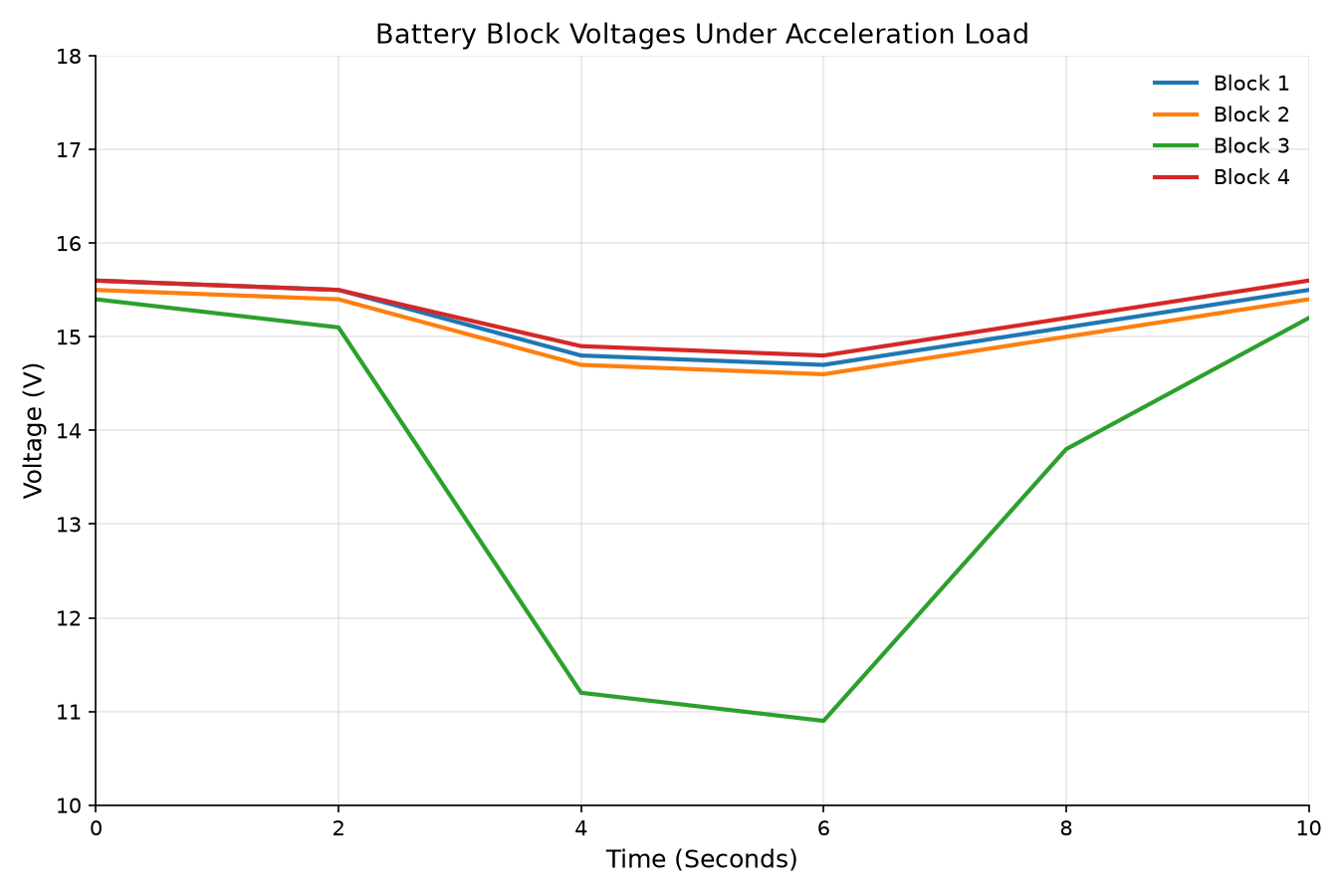
A hybrid vehicle illuminates the Electric Drive System Warning lamp and logs a battery pack deterioration fault code. During diagnostic road testing under aggressive wide-open-throttle acceleration, the technician records individual battery block voltages on a scan tool. Based on the graph shown in the figure, which condition explains the stored fault?
Answer and explanation
Correct answer: B
Block 3 shows excessive voltage drop under high discharge load compared to the other blocks, indicating degraded capacity or high internal cell resistance within that module.
True or False: In ASE electrified vehicle technical standards, any vehicle electrical circuit that operates at an electrical potential greater than 60 VDC or greater than 30 VAC is classified as high voltage.
Answer and explanation
Correct answer: A
By ASE L3 specifications, high-voltage vehicle electrical systems are defined as any circuit operating above 60 VDC or 30 VAC; systems at or below these values are low voltage.
Q6Question 6
Intermediate
High-Voltage (HV) Battery System · A.8 Test, diagnose, and repair high-voltage leaks/loss of isolation.
An electrified passenger vehicle with push-button start powers into the POWER ON operational mode without incident. However, when the driver depresses the brake pedal and presses the start button, the vehicle refuses to enter the READY TO DRIVE mode. Scan tool interrogation reveals a stored "High Voltage Loss-of-Isolation" diagnostic trouble code. Which failure is the most probable cause of this concern?
Answer and explanation
Correct answer: A
Compromised cable insulation creates a leakage path to chassis ground, triggering a loss-of-isolation DTC and blocking READY TO DRIVE. A removed MSD sets an interlock DTC; a dead 12V battery prevents POWER ON entirely.
flowchart TD
A[HV Insulation Breach] --> B[Current Leaks to Chassis]
B --> C[Loss-of-Isolation DTC]
C --> D[Blocks READY TO DRIVE]
Register free for 6 more questions
Or unlock all 164 L3 questions with explanations, timed mode and flashcards.