

AWS certifications are designed to validate real, job-relevant cloud skills, not just memorized definitions. That is great for your career, but it also means your prep has to match how the exam actually behaves: timed, scenario-driven, and full of “best answer” trade-offs. If you are still choosing the right track, see our AWS certification path overview.
This AWS exam prep guide breaks down format, scoring, and what to expect on test day, then gives you a practical prep approach that maps to how AWS questions are written.
Which AWS exam format are we talking about?
AWS offers multiple certifications (Foundational, Associate, Professional, Specialty). While each exam has its own guide, most AWS certification exams share a similar structure:
- Multiple-choice and multiple-response questions
- Scenario-based prompts (often a short architecture story plus constraints)
- A strict time limit
- A scaled scoring model
For the most accurate, up-to-date details for your exact exam code (for example, SAA-C03), always confirm in the official AWS exam guide on the AWS Certification site.
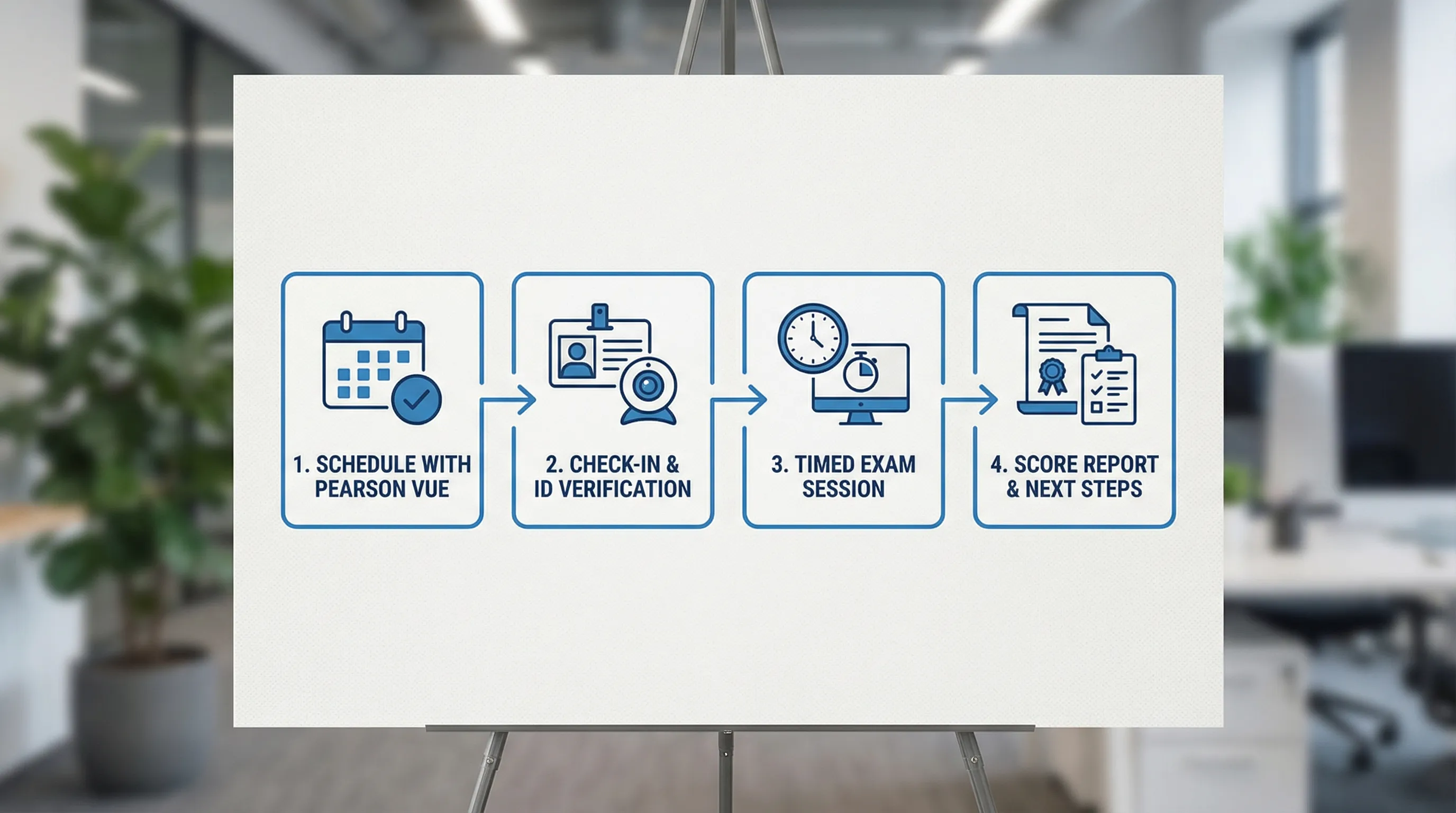
AWS exam format: question types, timing, and interface
Question types you should expect
Most AWS certification exams use:
- Multiple-choice: one correct option.
- Multiple-response: two or more correct options (you must select all correct choices to get credit).
The questions are typically written as mini case studies. You will see common patterns like:
- “Which solution is the MOST cost-effective…?”
- “Which design is MOST operationally efficient…?”
- “Which option meets the requirements with the LEAST change…?”
That wording matters because AWS questions often have several technically possible answers, but only one that best matches the constraint (cost, latency, RTO/RPO, security, operational overhead, managed services preference).
How long is the AWS exam?
Time limits vary by exam level. Many Associate-level exams are around the 2 hour range (plus additional time for non-native language accommodations if approved), while Professional and Specialty exams are often longer.
Rather than memorizing generic timings, use the exam guide for your specific certification, then train with full-length timed practice so pacing becomes automatic.
Online proctoring vs test center: what changes?
You can typically take AWS exams through Pearson VUE either:
- At a test center, or
- Online with remote proctoring
What changes is not the content, it is the environment and rules. Remote testing usually requires:
- A quiet room with a clear desk
- A webcam scan of your space
- No phone, notes, or secondary monitors
- Compliance with strict behavior rules (for example, staying in frame)
If your home setup is unpredictable (noise, interruptions, unstable internet), a test center can be the lower-stress option.
AWS scoring explained: scaled scores, pass marks, and what your score report means
Scaled score basics
AWS uses a scaled scoring model for certification exams. In practice, that means your final score is not “X out of Y questions,” it is a standardized score on a fixed scale.
AWS commonly reports scores on a 100 to 1000 scale, depending on the exam. The exam guide will also state the passing score.
Passing score: it depends on the exam
Passing scores vary by certification. The most reliable source is the exam guide for your exact exam.
Here is a quick orientation for several popular AWS exams (always verify in the latest guide before you book):
| AWS certification exam (example) | Level | Typical question style | Passing score (from exam guide) |
|---|---|---|---|
| AWS Certified Cloud Practitioner | Foundational | Broad concepts, basic AWS services | 700 |
| AWS Certified Solutions Architect Associate (SAA-C03) | Associate | Architecture scenarios, trade-offs | 720 |
| AWS Certified Developer Associate | Associate | App and AWS service integration, CI/CD concepts | 720 |
| AWS Certified SysOps Administrator Associate | Associate | Ops scenarios, monitoring, automation, troubleshooting | 720 |
| AWS Certified Solutions Architect Professional | Professional | Complex architectures, multi-account, migrations, governance | 750 |
Source: AWS Certification exam guides on the official AWS Certification site.
Are there unscored questions?
Many large testing programs include unscored (trial) questions to evaluate future items. AWS has historically included this concept in its exam programs. The takeaway is simple: do not try to guess which questions “count.” Treat every question as scored and manage time accordingly.
When do you get results?
AWS typically provides a pass/fail outcome quickly after the exam, with a detailed score report posted within a few days (often up to about five business days, depending on program processes). Use the score report to identify weak domains for your next study cycle.
What the AWS exam actually tests (and what surprises candidates)
Even well-prepared candidates get surprised by AWS exams for one main reason: AWS tests decision-making under constraints, not feature recall.
Expect these recurring “constraint” themes
Across Associate, Professional, and Specialty exams, you will see repeated pressure points:
- Cost optimization (storage classes, purchase options, rightsizing, data transfer)
- Security and least privilege (IAM design, key management, network segmentation)
- Reliability and resilience (multi-AZ vs multi-region, failover, backups)
- Performance efficiency (caching, throughput, latency, scaling)
- Operational excellence (managed services, automation, observability)
If your prep is mostly flashcards without scenario practice, you will feel the gap.
“Two answers look right” is a feature, not a bug
AWS item writers often include:
- One answer that is technically possible but violates a constraint
- One answer that is more complex than needed
- One answer that uses a service correctly, but not the best-fit managed option
Your job is to pick the best match for the stated goals.
How to prepare effectively: a practical AWS study plan that matches the exam
You do not need a perfect plan, you need a repeatable loop that builds both knowledge and exam performance.
Step 1: Anchor your prep to the official exam guide and blueprint
Start with:
- Exam guide domains and weighting
- Recommended knowledge and skills
- Sample questions
This prevents over-studying low-impact topics and missing high-frequency ones.
Step 2: Build hands-on intuition (even lightweight)
AWS exams reward candidates who understand “what happens if…”
Good hands-on options include:
- AWS Free Tier projects (simple VPC + EC2 + IAM experiments)
- AWS documentation walkthroughs (especially for IAM, networking, storage)
- Controlled labs to practice common services you see in scenarios
If you work in an environment where you also need broader implementation support (for example, digital transformation, DevOps, or security program delivery), a consulting partner like Syneo can be relevant for real-world project execution. For exam prep, translate that same mindset into thinking in requirements and constraints.
Step 3: Add practice questions early (but use them correctly)
Practice questions are not only an assessment tool, they are a learning tool if you review them the right way.
A strong rhythm looks like:
- Short topic quizzes to learn patterns (20 to 30 questions)
- Mixed sets to force recall across domains
- Full-length simulations to train pacing and stamina
To do this well, you need realistic, updated items and a test-like interface. That is exactly where Planet Cert practice tests can help, because you can train in a web-based exam simulator and review explanations the way you will think on test day.
You can start with Planet Cert practice tests and use them as your weekly diagnostic and your full exam simulator as you get closer to your test date.
How to interpret practice test scores (without fooling yourself)
Practice score interpretation is one of the fastest ways candidates either accelerate, or waste two weeks.
Use score trends, not single scores
A single score can be noisy. What you want is:
- A stable trend across mixed sets
- Fewer “process errors” (misreads, missed keywords, rushing)
- The ability to explain why wrong options are wrong
Track misses by type, not just by domain
Domain-level weakness is useful, but many AWS misses are actually:
- Misreading a constraint (for example, “no downtime,” “no public internet,” “minimize ops”)
- Confusion pairs (for example, similar-sounding storage or routing options)
- Incorrect prioritization (cost vs reliability vs performance)
If you want a deeper review workflow specifically for breaking plateaus, see PlanetCert’s resource on improving your review method (separate from this format-and-scoring guide). For platform selection, compare options in our AWS practice test comparison.
Exam-day expectations: check-in, rules, and pacing strategies
Before you start
Whether online or in-person, plan for:
- Valid ID requirements
- Check-in time buffer
- Lockers and prohibited items policies
For online exams, run the system test ahead of time and choose a room where you can control noise and interruptions.
During the exam: pacing that works for AWS scenarios
A practical pacing approach:
- Move steadily on easy questions to “bank time”
- Flag long scenarios and return if needed
- Use elimination: remove options that violate constraints first
Do not spend too long trying to recall an obscure fact. AWS exams are more often about service selection logic than deep configuration trivia.
After the exam
You will typically complete a short survey, then receive a preliminary result (timing can vary). Your detailed score report will appear in your AWS Certification account later.
A quick “what to expect” checklist
Use this the week before your AWS exam:
- You can explain core services in your exam domains in plain English
- You can answer mixed sets under timed conditions
- You have practiced multiple-response questions carefully (selecting all correct choices)
- You have a plan for exam day logistics (location, ID, check-in, rules)
- You can articulate why the best answer is best, not just why it is correct
Frequently Asked Questions
Are AWS certification exams multiple choice? Yes, AWS certification exams commonly use multiple-choice and multiple-response questions. Check your specific exam guide for the exact format.
What is a scaled score on AWS exams? A scaled score standardizes results across different question sets and difficulties. Your score is not simply the number of correct answers.
How do I find the passing score for my AWS exam? The passing score is listed in the official exam guide for your exam on the AWS Certification website.
Do AWS exams allow breaks? Policies can vary by delivery method and exam rules. Review the Pearson VUE and AWS exam policies for your specific exam before test day.
Are “AWS dumps” a good way to prepare? No. Using unauthorized exam dumps can violate exam policies and does not build real skills. Legitimate practice exams with explanations are a safer and more effective way to prepare.
Prepare with realistic AWS practice exams
If your goal is to walk into the exam knowing exactly what the interface feels like, how AWS scenarios are phrased, and how to manage time under pressure, make practice exams a core part of your plan.
Use Planet Cert practice exams to run timed simulations, drill weak domains with expert-verified explanations, and build confidence with realistic exam questions and test questions in a mobile-friendly simulator. Start here: Planet Cert practice tests.

Discussion
Question Comments
0 comments·0 participantsSign in to leave a comment and access more free questions.