

Plateaus are common with any AWS practice test, especially once you’ve memorized patterns. The fix is rarely “more questions.” It’s almost always a better review method that turns every miss into a reusable rule you can apply to new scenarios.
Below is a review workflow you can run after every mini-quiz and full simulator exam to break through stuck scores and build real exam readiness.
Why your AWS practice test score is stuck (even if you study daily)
Most score plateaus come from one of these three issues:
1) You’re practicing recognition, not decision-making
AWS questions are scenario and tradeoff driven. If your review is just “Oh right, it was KMS,” you are training recognition, not reasoning.
On the real exam, the same concept shows up with different constraints (latency, multi-account, least privilege, hybrid connectivity, RTO/RPO, cost). Recognition fails when the scenario changes.
2) Your misses don’t turn into rules
If you cannot finish review with a one sentence rule, you did not fully review.
Examples of “rules” (not facts):
- “If the requirement includes cross-account access, check resource policies, role assumption, and the account boundary before anything else.”
- “If the question asks for ‘most cost-effective’ and durability is the key, prefer managed storage options before custom replication designs.”
3) You’re mixing knowledge gaps with process errors
A score can stall even when you know the content because you’re leaking points via:
- Misreading a constraint (Region vs AZ, public vs private, at-rest vs in-transit)
- Overengineering (picking the most complex architecture instead of the simplest that meets requirements)
- Not eliminating distractors systematically
A good review method separates knowledge gaps from process errors so you fix the right thing.
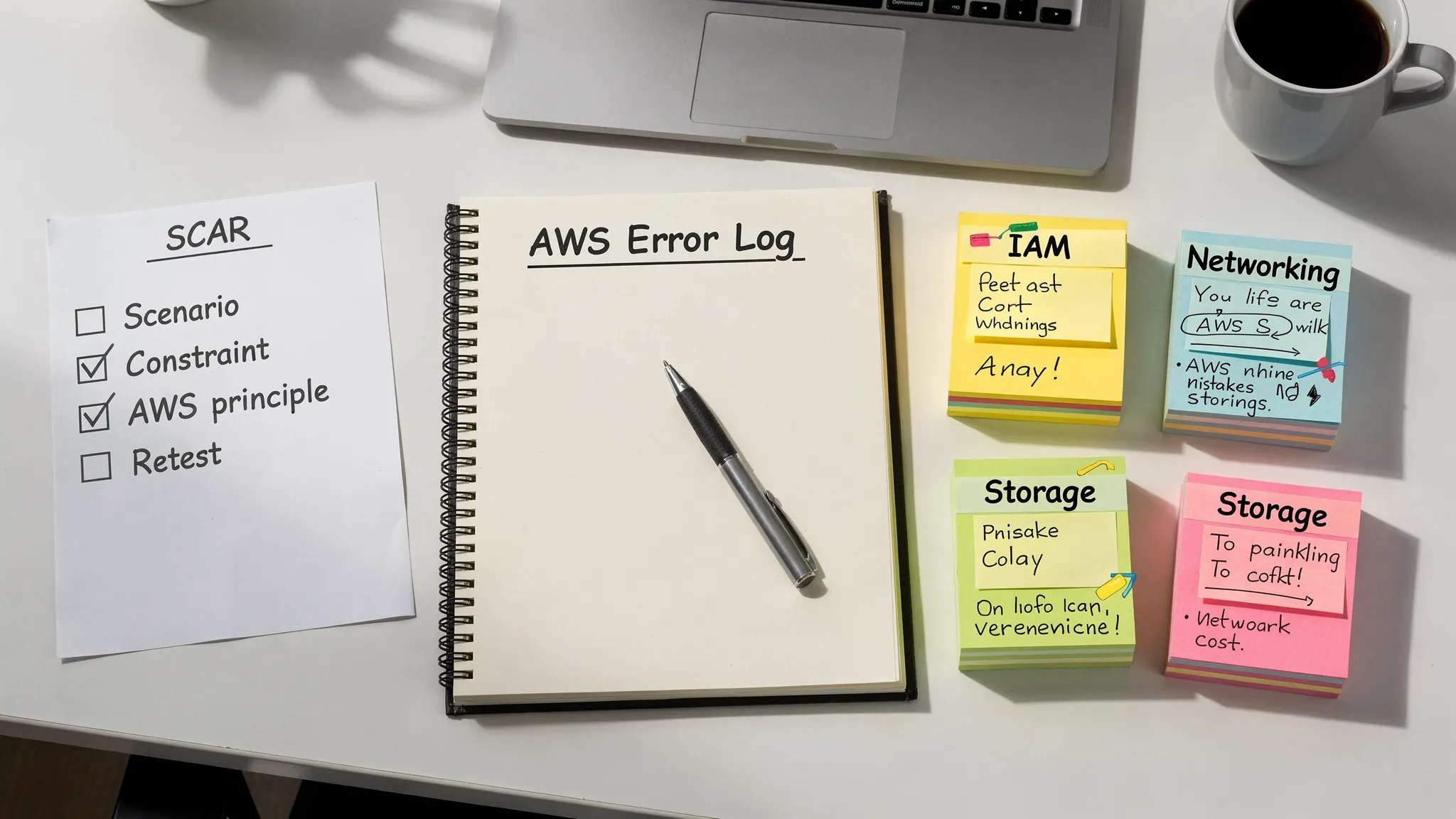
The “SCAR” review method for AWS: Scenario, Constraint, AWS principle, Retest
Use this on every incorrect question, and on any correct question you guessed.
Scenario: Rebuild the situation in 1-2 lines
Don’t restate the prompt. Summarize the system:
- Who is accessing what?
- From where?
- What is the workload type (batch, web, streaming, internal tooling)?
If you cannot summarize, you did not understand the setup.
Constraint: Extract the 2-3 decision constraints
AWS exam questions usually hide the real decision inside constraints like:
- “Without changing application code”
- “Minimize operational overhead”
- “Must be encrypted with customer managed keys”
- “Multi-Region” vs “multi-AZ”
- “Least privilege”
Write constraints as short bullet fragments in your error log.
AWS principle: Name the principle the correct answer uses
This forces transfer learning to new questions.
Common principles that drive correct AWS answers:
- Least privilege and explicit deny wins (IAM evaluation)
- Shared responsibility (what AWS secures vs what you must configure)
- Managed service bias (lower ops overhead)
- Blast radius reduction (accounts, VPC segmentation)
- Cost optimization (pay for what you use, reduce data transfer, avoid always-on)
- Resilience basics (multi-AZ, decoupling, idempotency)
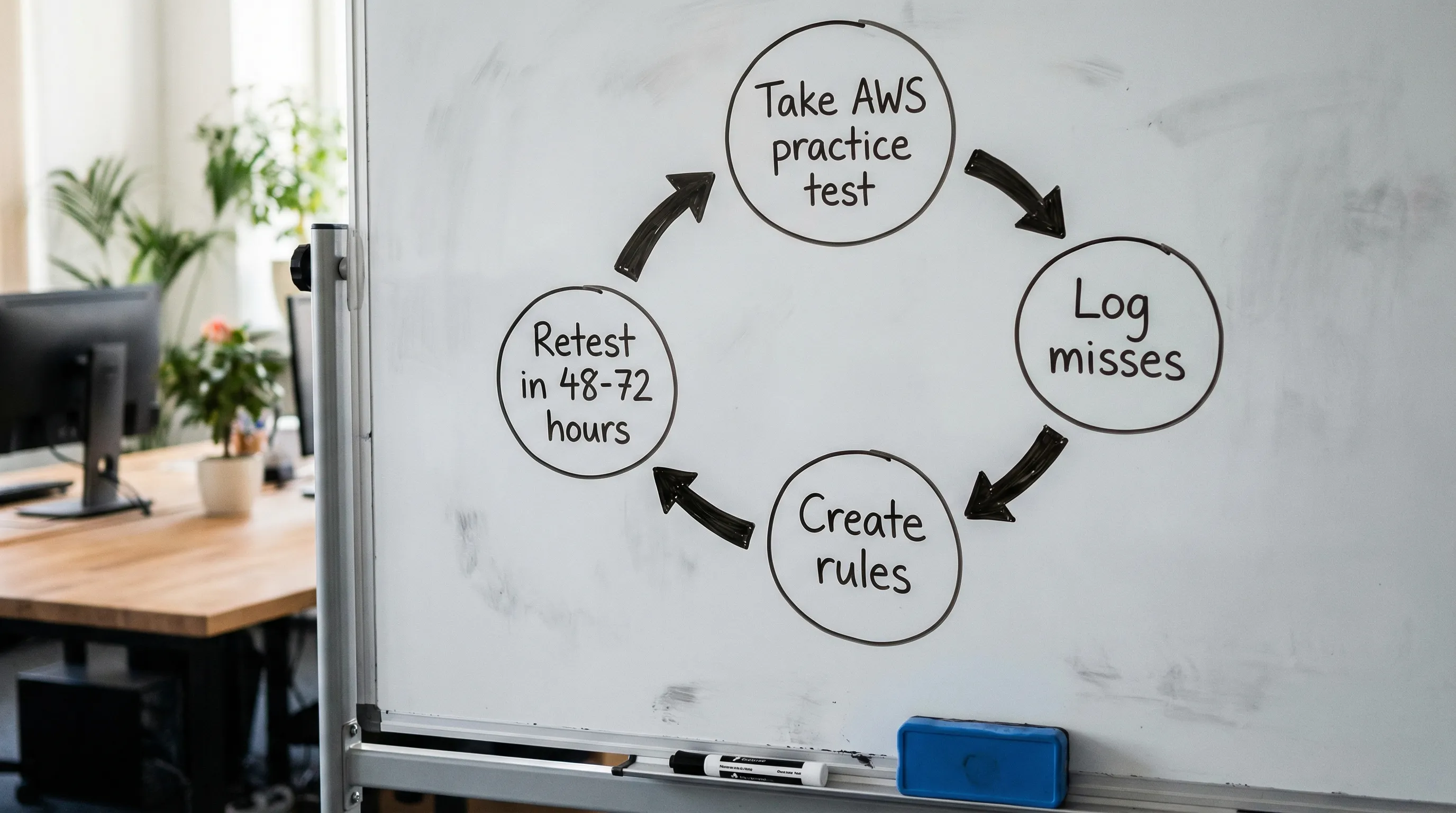
Retest: Re-answer cold within 48-72 hours
You are not done when you “understand.” You are done when you can reproduce the reasoning under time pressure.
Retest rules:
- Do it cold (no notes)
- Explain why each wrong option is wrong
- If you miss again, create a micro-drill (see below)
Build an AWS error log that actually changes your score
An error log should do two jobs:
- Diagnose patterns
- Produce a retest plan
Use a simple template like this.
| Field | What to write | Example (short) |
|---|---|---|
| Exam mode | Topic quiz or timed simulation | Timed simulation |
| Domain tag | Networking, IAM, Storage, Databases, Monitoring, Cost, etc. | IAM |
| Scenario summary | 1-2 line system summary | Cross-account app reads S3 |
| Constraints | 2-3 constraints | Least privilege, no code change |
| Your choice | Option letter + why you picked it | B, “quickest” |
| Correct choice | Option letter + why it wins | D, resource policy + role |
| Root cause | Knowledge gap or process error | Process: missed “cross-account” |
| Rule | The reusable principle | Cross-account: check role + policy |
| Retest date | 48-72 hours | Thu |
If your log is missing “root cause” and “rule,” it’s just a diary.
Identify your miss type (and fix the right thing)
AWS practice test plateaus often come from repeating the same miss type. Here’s a quick mapping.
| Miss type | What it looks like | Fix that works |
|---|---|---|
| Service confusion | Mixing similar services (or features) | Create “confusion pairs” cards (see below) |
| Constraint miss | You knew it, but missed a keyword | Add a 10-second constraint scan before answering |
| Tradeoff weakness | You pick “best tech,” not “best for requirements” | Force yourself to state the principle (ops, cost, security) |
| IAM logic errors | Wrong mental model of evaluation | Write a 5-line IAM evaluation checklist and apply it |
| Networking mental model | VPC routing, endpoints, DNS confusion | Draw the path, then pick the control point |
| Over-reliance on memorization | You do well on repeated questions only | Retest with mixed sets and new scenarios |
Turn every miss into a 10-minute micro-drill
Micro-drills are how you convert review into points.
Pick one weak area from your error log and do a focused drill:
- 5 questions only (same domain)
- Untimed, but strict reasoning
- Review immediately using SCAR
Two micro-drill formats that work well for AWS:
Confusion pairs (high ROI)
Make a running list of “I keep mixing these up” pairs and write one decisive difference.
Examples:
- Security group vs NACL (stateful vs stateless, attachment point)
- S3 bucket policy vs IAM policy vs access point policy (where it applies, cross-account patterns)
- Multi-AZ vs Multi-Region (failure scope and latency)
- KMS key policy vs IAM permissions (who can use the key vs who can administer)
Decision trigger phrases
Write trigger phrases that should force a specific direction:
- “Minimize operational overhead” often points to managed services
- “Without changing code” narrows your options fast
- “Least privilege” should push you toward scoped policies and narrow trust relationships
These triggers reduce time wasted on distractors.
Stop wasting full simulations: use a 3-block review sprint
After a timed AWS practice test, do review in three blocks. This keeps you honest and prevents 2-hour review sessions that turn into passive reading.
Block 1 (10 minutes): Triage
Sort questions into:
- Wrong
- Correct but guessed
- Correct and confident
You only deep-review the first two categories.
Block 2 (45-60 minutes): Deep review using SCAR
For each wrong or guessed question:
- Write scenario summary
- Extract constraints
- Name the AWS principle
- Write a rule
If you cannot write a rule, you are not allowed to move on.
Block 3 (15 minutes): Build tomorrow’s drill set
Create a short “next set” based on your log:
- 5 networking questions if routing keeps hurting you
- 5 IAM questions if trust policies keep showing up
This is how you turn one exam into compounding improvement.
The AWS-specific review moves most people skip
These are the review moves that tend to unlock the next score jump.
Re-solve the question without looking at the options
Options can trick you into recognition. Before you re-check answers, ask:
- “What would I do in AWS if I were responsible for this system?”
Then compare your solution to the provided options.
Explain why the top two distractors are wrong
AWS questions often include one distractor that is almost correct. Your score won’t improve until you can explain the “almost.”
A practical way to do this is to label each wrong option:
- Doesn’t meet constraint
- Higher ops overhead
- Wrong failure scope
- Security risk
- Too expensive
Write one sentence you would use to teach it
If you can teach it, you own it. If you can’t, it’s still fuzzy.
If your weak area is security and compliance, strengthen the “why”
Many AWS candidates can pick an encryption or access control option, but can’t explain the governance reason behind it. That’s risky because scenario questions often frame requirements in business language (privacy, data protection, audit readiness).
If you want real-world context on governance and privacy programs, explore what a dedicated GRC provider does, such as Privacy & Legal Management Consultants Ltd.. Connecting AWS controls to actual compliance outcomes makes scenario questions easier to reason through, not just memorize.
Practice with realistic conditions (or you’ll keep losing points to timing)
A solid review method needs realistic execution.
On at least 2 practice sessions per week:
- Use timed mode
- Remove notes
- Take a short break mid-session (just like real fatigue patterns)
- Track timing slips (questions where you spent too long)
Timing errors are often “constraint scan” failures, not content gaps.
Where PlanetCert fits: use better questions, then review them correctly
Your review method is the multiplier, but you still need high-quality questions that reflect real exam style and difficulty. If you are still evaluating providers, use our AWS practice test buyer guide.
PlanetCert is useful when you want a large, structured bank of questions plus a realistic simulator experience so you can run the SCAR loop consistently across many scenarios.
If you’re ready to apply this workflow with a proper engine, start with Planet Cert practice tests and use the simulator to run timed sets, then review using the templates above.
Frequently Asked Questions
How many AWS practice test questions should I do per day if my score is stuck? Aim for fewer questions with better review: 20 to 40 well-reviewed questions can outperform 100 rushed ones. Your goal is rules and retests, not volume.
Why do I keep scoring the same even though I review explanations? Reading explanations is passive. Convert each miss into a written rule, label the root cause (knowledge vs process), then retest cold within 48 to 72 hours.
Should I review questions I got correct? Yes, if you guessed or were unsure. “Correct by luck” behaves like an incorrect answer on exam day.
What’s the fastest way to improve AWS scenario questions? Practice extracting constraints and naming the decision principle (cost, ops overhead, resilience, security). Most wrong answers violate a constraint or pick a heavier solution than needed.
How do I stop mixing up similar AWS services? Maintain a “confusion pairs” list (for example, security groups vs NACLs) and write one decisive difference plus one common exam trap for each pair.
When should I switch from topic quizzes to full timed simulations? Switch when your topic accuracy is stable and your misses are mostly tradeoffs and wording, not basic definitions. Then use full simulations to train timing and endurance.
Apply the workflow on your next AWS practice test
If your AWS practice test scores are stuck, don’t change your study hours first. Change what happens after each test.
Run SCAR on every miss, keep an error log that produces rules, and retest on a tight 48 to 72 hour loop. Then back it with a large set of realistic questions so you can repeat the cycle enough times to make it automatic.
To practice under exam-like conditions and build momentum with consistent review, use Planet Cert practice exams and exam questions to run timed sessions, log your misses, and retest until your score trend finally moves up.

Discussion
Question Comments
0 comments·0 participantsSign in to leave a comment and access more free questions.