

AWS Services for CLF-C02: A Beginner's Essential Shortlist
When you first open the AWS Certified Cloud Practitioner (CLF-C02) exam guide, the list of services can feel like a firehose. You don't need to know how to build a serverless application — you need to know what each service does and why you'd pick it, at a conceptual level. That's a very different study task from the associate or professional exams, and it trips up plenty of candidates who try to memorise every feature of every service.
I've pulled together 10 AWS services that show up most often on the CLF-C02 exam. Each one gets a quick overview, the key concepts the exam tests, a study tip, and a warning about common traps. This is not the full in-scope list — that runs well over a hundred entries — but a focused shortlist that covers the services most likely to appear in your 65 questions. If you're looking for a manageable set of aws services for clf c02 a beginner can actually retain in a couple of weeks, this is where you start.
What the Exam Actually Tests About AWS Services
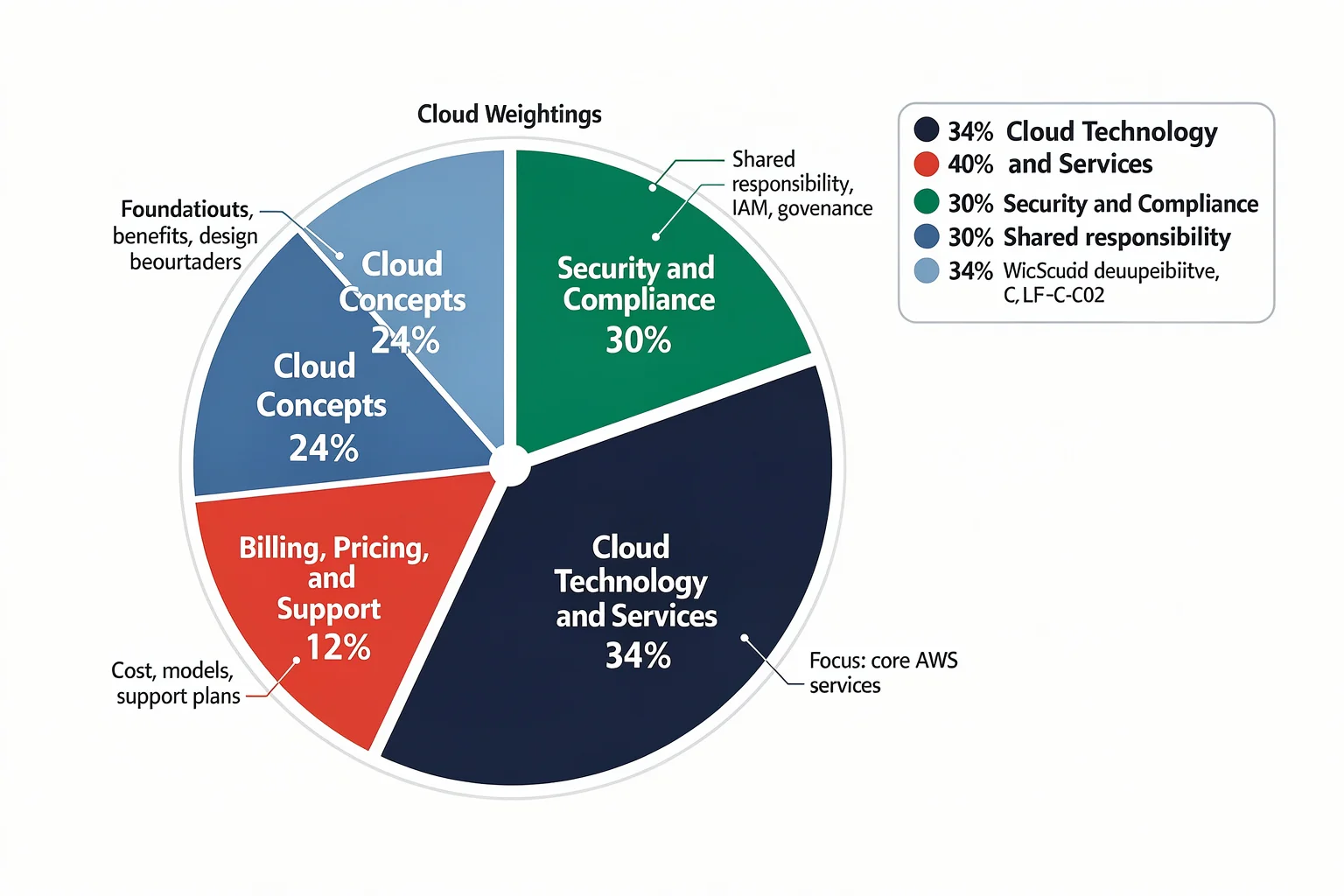
The CLF-C02 exam has four content domains weighted as follows: Cloud Concepts (24%), Security and Compliance (30%), Cloud Technology and Services (34%), and Billing, Pricing, and Support (12%). The heaviest domain, Technology and Services, explicitly expects candidates to "describe and position the core AWS services, including compute, network, database, and storage services" and to "identify AWS services for common use cases" per the AWS Certified Cloud Practitioner (CLF‑C02) exam guide.
That means the exam will present you with a short scenario — a company migrating a database, a team needing to decouple an application, a startup analysing clickstream data — and ask which service solves the problem. Wrong answers often include services that sound plausible but serve a different purpose. Succeeding on the CLF-C02 is less about reciting service definitions and more about knowing what each service is for, and just as importantly, what it's not for.
The official in‑scope AWS services list contains dozens of entries and is explicitly labelled "non‑exhaustive and subject to change." That's why a curated shortlist is so useful: you concentrate on the services with the highest exam weight first, then expand later.
The Services That Made the Cut
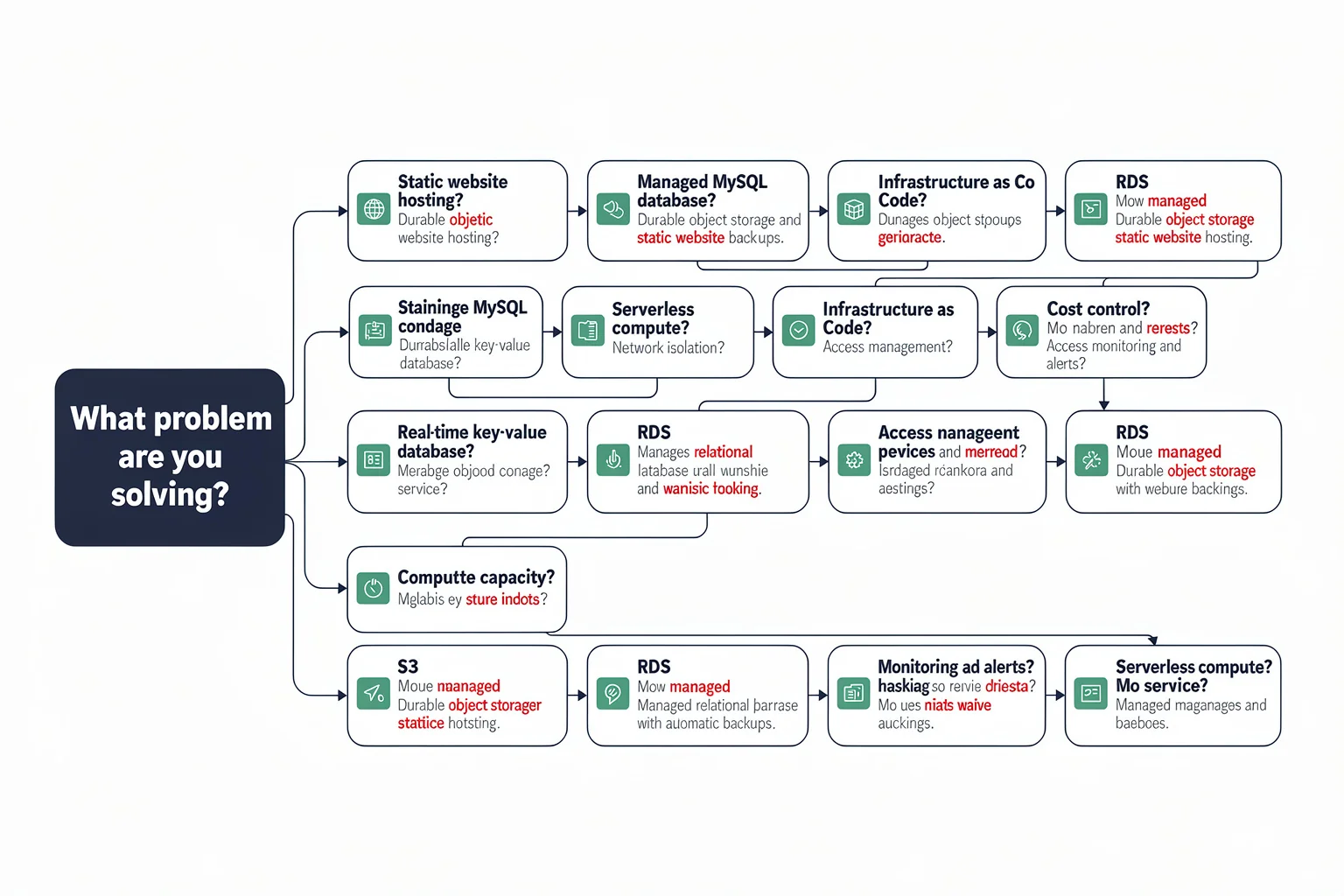
I built this shortlist by cross‑referencing the official exam guide, the in‑scope services list, and the weightings of the four domains. Every service here surfaces repeatedly in practice scenarios and in the sample questions available on the CLF‑C02 exam page. I also factored in the 2026 exam update which added a handful of newer services to the scope. The criteria were: how often the service appears in typical CLF‑C02 items, how much confusion it creates among candidates, and how fundamental it is to understanding AWS as a whole.
Amazon EC2
EC2 is the bedrock compute service, and the exam expects you to understand it well beyond "virtual machines in the cloud." You need to match EC2 pricing models — On‑Demand, Reserved Instances (1‑ or 3‑year), Spot Instances, Dedicated Hosts — to real‑world use cases. A steady‑state web app might suit Reserved, while a batch processing job that can be interrupted is ideal for Spot.
The exam also tests your grasp of what EC2 is not. For example, a scenario about running code without provisioning servers should point you toward AWS Lambda, not EC2. Know the difference between vertical scaling (resizing an instance) and horizontal scaling (adding more instances behind a load balancer), and know that Auto Scaling and Elastic Load Balancing are the services that make horizontal scaling automatic.
A reliable way to anchor this: create a flashcard deck where one side says "Steady‑state web app with predictable demand" and the other says "EC2 with Reserved Instances." Run that deck until you answer without hesitation.
AWS Lambda
Lambda is the poster child of serverless compute and shows up in roughly a quarter of CLF‑C02 scenario questions. The exam tests your ability to recognise when to use Lambda: event‑driven processing, short‑duration tasks, workloads that can start and finish quickly. You do not provision or manage servers — AWS runs the code in response to triggers such as S3 uploads, API Gateway calls, or DynamoDB table updates.
Common trap: Lambda is great for quick function runs, but it has a maximum execution timeout (15 minutes). If a question asks about a long‑running video transcoding job or a legacy application that needs to run for hours, the correct answer is likely EC2 or AWS Batch, not Lambda. Also, know that Lambda handles scaling automatically — you don't configure an Auto Scaling group.
Amazon S3
S3 is storage for the internet, and the exam covers it from multiple angles: storage classes, security controls, and common use cases such as static website hosting, data lake foundations, and backup. The storage classes — S3 Standard, Intelligent‑Tiering, Standard‑IA, One Zone‑IA, Glacier Instant Retrieval, Glacier Flexible Retrieval, and Glacier Deep Archive — form a ladder of decreasing cost and increasing retrieval time. You need to know which class a question asks for based on data access patterns: frequently accessed, infrequently accessed but still needs fast retrieval, or archival.
Security also gets tested. Bucket policies, block public access settings, and the fact that an S3 bucket is private by default are fair game. And you should recognise that S3 supports versioning, making it possible to recover from accidental overwrites. When you encounter a question about a company storing large amounts of log data that are rarely accessed but must be retained for compliance, Glacier is probably the right answer.
Amazon RDS
RDS is the managed relational database service that supports multiple engines: MySQL, PostgreSQL, MariaDB, Oracle, and SQL Server. The exam tests that managed‑service line — AWS handles patching, backups, and failover for you, so you don't have to. That's a common differentiator: a scenario asking for a database that requires minimal administrative overhead points to RDS (or DynamoDB, depending on the data model) rather than a self‑managed database on EC2.
You will see questions about multi‑AZ deployments for high availability and read replicas for read‑heavy workloads — two features the exam loves. There's also a lesser‑known but exam‑relevant feature called RDS Custom, which allows limited OS access for legacy apps. If the question says "managed relational database, MySQL, needs automatic failover," the combination is RDS with multi‑AZ.
Amazon DynamoDB
DynamoDB is the managed NoSQL key‑value and document database. The exam draws a bright line between RDS and DynamoDB: use RDS when you need relational structure, joins, and complex queries; use DynamoDB when you need low‑latency access at any scale with a simpler access pattern. Key concepts include tables, items, and attributes, plus DynamoDB Streams for capturing item‑level changes.
One of the most common exam traps is failing to recognise that DynamoDB handles scaling transparently — you do not manually provision instance sizes the way you would with RDS. Instead, you set read and write capacity (provisioned or on‑demand). Scenario: a gaming company needs a database that can handle millions of requests per second with consistent single‑digit millisecond response times. That's DynamoDB.
Amazon VPC
Virtual Private Cloud is the networking backbone. Even at the foundational level, the CLF‑C02 exam quizzes you on subnets, route tables, internet gateways, and NAT gateways. You need to know the difference between a public subnet (has a route to an internet gateway) and a private subnet (doesn't). A scenario about securing backend servers often calls for placing them in private subnets and using a NAT gateway for outbound internet access.
Security groups and network ACLs are also in scope. The exam asks you to distinguish them: security groups are stateful and operate at the instance level; NACLs are stateless and operate at the subnet level. VPC Flow Logs might appear as a service that captures IP traffic metadata for troubleshooting. If you can draw a simple VPC diagram on a napkin — public subnet with a web server, private subnet with a database, routing to the internet — you've covered the conceptual depth needed.
AWS IAM
IAM controls who can do what in your AWS account, and the CLF‑C02 exam treats it as a pillar of the Security and Compliance domain. You must understand IAM users, groups, roles, and policies. Roles are especially important: they grant temporary credentials to AWS services or users without hard‑coding access keys. A question about an EC2 instance that needs to read from an S3 bucket expects you to choose an IAM role, not embed credentials.
The shared responsibility model also ties in heavily here. AWS secures the infrastructure; you secure your data, end‑points, and IAM configurations. The exam will test that division explicitly. When you see a phrase like "the customer is responsible for," IAM policies and access management are almost always part of the correct answer.
Amazon CloudWatch
CloudWatch is the monitoring and observability service, and it shows up across multiple domains: Billing (monitoring costs), Technology (tracking metrics), and even Security (CloudWatch Logs). The exam expects you to know that CloudWatch gathers metrics from AWS services out of the box — CPU utilisation on EC2, read/write throughput on DynamoDB — and that you can create custom metrics and alarms.
Alarms are a favourite exam topic. A question about automatically scaling an EC2 fleet based on CPU usage requires a CloudWatch alarm that triggers an Auto Scaling policy. CloudWatch Logs, CloudWatch Events (now part of Amazon EventBridge), and dashboards are all fair game. Remember: CloudWatch is for monitoring, not for auditing API activity — that's AWS CloudTrail.
AWS Budgets
The Billing, Pricing, and Support domain accounts for 12% of the exam, and AWS Budgets is the service that asks you to set spending limits and receive alerts when costs exceed a threshold. The exam tests the distinction between AWS Budgets (proactive alerts) and the detailed cost breakdowns in AWS Cost Explorer (retrospective analysis). In a scenario: you want to be notified when your monthly bill hits 80% of your budget — you use AWS Budgets. If you want to visualise spending patterns over the last six months, you use Cost Explorer.
Also know that AWS Budgets can send alerts via email or SNS, and that the free tier includes a reasonable number of budget actions. The exam occasionally asks about the AWS Free Tier itself; understand that Budgets can help you avoid going beyond it unintentionally.
AWS CloudFormation
CloudFormation is the infrastructure‑as‑code service. In CLF‑C02 terms, you need to know that it provisions a collection of AWS resources from a template (JSON or YAML) in a safe, repeatable way. The exam often frames a question around a company that wants to deploy identical environments for development, testing, and production. The correct answer is usually a CloudFormation template, not a manual EC2 snapshot.
CloudFormation also gives you a practical hook for understanding other management services. For example, the template is stored in an S3 bucket, and during creation failures the service can automatically roll back to the previous state. If you see a question about consistent, version‑controlled infrastructure, think CloudFormation. For more details, the AWS CloudFormation concepts are well covered in management‑service documentation.
How to Use This Shortlist in Your Study Plan
The 10 services above give you a solid core, but they don't exist in isolation. The exam will mix them in scenarios that demand you reason across categories. A typical question might describe a company running a web app on EC2, storing images in S3, using RDS for the database, and needing an alert when the monthly bill rises — and then ask which combination of services solves a new requirement. The secret to passing is practice with scenario‑based questions that force you to connect services.
I recommend taking a timed practice session with CLF‑C02 sample questions after you've reviewed the shortlist. Pay attention to the ones you get wrong not because of a knowledge gap, but because you read the scenario too quickly or got tripped by a distractor service. That mirroring of the real exam environment is what builds the right judgment. If you still feel shaky on a particular service, a targeted deck of flashcards — like the ones inside PlanetCert's practice bundle — can help you drill the specific concepts until they stick.
Questions About AWS Services You Might Still Have
Are there services that were recently added to CLF‑C02 I should study?
Yes. The 2026 exam update added several newer services to the scope, including some in the analytics and AI/ML categories. Amazon Comprehend, Amazon Rekognition, and AWS Amplify are now worth knowing at a basic level. The official in‑scope list reflects these changes, so cross‑checking that list once a month is a wise habit.
Do I need to memorise every AWS service acronym?
No. The CLF‑C02 exam isn't a vocabulary test. You need to recall what about 20‑30 core services do, but many others appear only in the answer choices as distractors. Focus on understanding the service's purpose and when you would choose it, not on cramming every acronym. If you recognise that Amazon SQS decouples application components and Amazon SNS delivers push notifications, you have what the exam requires.
Should I study services that are out of scope for now but might appear later?
Not for the CLF‑C02. Stick to the published in‑scope list and the high‑weight services. If you later pursue an associate certification, you'll encounter a broader set, but for the foundational exam, depth on the core services counts more than breadth. When you're uncertain about a service's status, the in‑scope AWS services list is your ground truth.
What service trips up most beginners on this exam?
Without question, the shared responsibility model and the line between IAM and AWS Organizations. Many candidates think IAM handles billing consolidation or organisation‑wide billing — that's AWS Organizations. Another common misstep is confusing CloudWatch (monitoring) with CloudTrail (audit). Drawing a quick two‑column table with "what AWS manages" and "what you manage" during your review can prevent several wrong answers on exam day.
More Resources for Your CLF‑C02 Prep
- AWS Cloud Practitioner Exam Fee 2026: Current Price and Retake Costs
- AWS Certification Exam Updates to Watch in 2026
- 5 AWS Exams Candidates Get Wrong About 2026 Retirements
browse the relevant exam page and purchase a practice test

Discussion
Question Comments
0 comments·0 participantsSign in to leave a comment and access more free questions.