

Best AWS Certification Courses in 2026: AI-900 and Machine Learning Specialisations
When Microsoft expanded its Azure AI credentials in June 2026 — adding new role‑based exams, study paths, and a surge in AI‑900 enrollments — the certification calendar got a hard reset. Suddenly, anyone investing months in AWS AI or machine learning prep had a legitimate question: are the AWS courses keeping pace, or is it time to follow the crowd toward Azure?
AWS didn’t stand still. Through the first half of 2026 it refreshed exam objectives, shipped new AI‑powered labs on Skill Builder, and tightened the alignment between its foundational and specialty certifications. Still, not every course advertised as “2026‑ready” actually covers the domains that the updated AWS Certification Exam Guides now require. This article ranks the AWS AI and machine learning certification prep routes that have demonstrably adapted — and, where it helps, contrasts them with Microsoft’s AI‑900 path so you can commit your study window to a course that won’t leave gaps.
Every item on this shortlist earned its spot by showing real 2026 content changes: updated exam‑guide mappings, new hands‑on lab components, or instructor‑led material refreshed since the latest version drop. For each, I’ll spell out who it fits, what the limitation is, and which study tools (including practice tests) make the fastest difference.
Why AWS AI and ML certifications still call the shots in 2026
The numbers haven’t changed the story. AWS holds roughly 32% of the worldwide cloud infrastructure market, and across industries 64% of organizations still report cloud skills gaps that hold back projects. An AI‑specific AWS credential remains one of the most direct ways to prove you can design, build, and govern machine learning workloads on the platform that most enterprises already run.
Meanwhile, the examination stack moved. AWS now offers a dedicated foundational AI cert — the AWS Certified AI Practitioner (AIF‑C01) — alongside the established Machine Learning – Specialty, and both had content outline updates in early 2026. The official AWS Training and Certification hub added micro‑credentials, generative‑AI learning plans, and the SimuLearn badge program to give hiring managers a verifiable signal of hands‑on experience. If a course hasn’t absorbed at least some of that new material, it’s already behind.
Microsoft’s AI‑900, by contrast, is a single entry‑level exam that tests conceptual knowledge of Azure AI workloads. It’s quick to study, but it won’t teach you to tune a SageMaker endpoint or debug an IAM policy that governs an S3‑hosted feature store. That’s the real trade‑off — and it’s exactly what the ranking weighs.
How the shortlist works — freshness, depth, and exam‑day alignment
I looked for courses that did three things in 2026: they referenced the exam version active today (not last year’s), they included lab time or scenario‑based exercises, and they paired with a legitimate practice‑test source that mirrors the real exam format. A course that updated its slide deck on 2 January 2026 but still leans on multiple‑choice quizzes with zero hands‑on exercise isn’t competitive anymore.
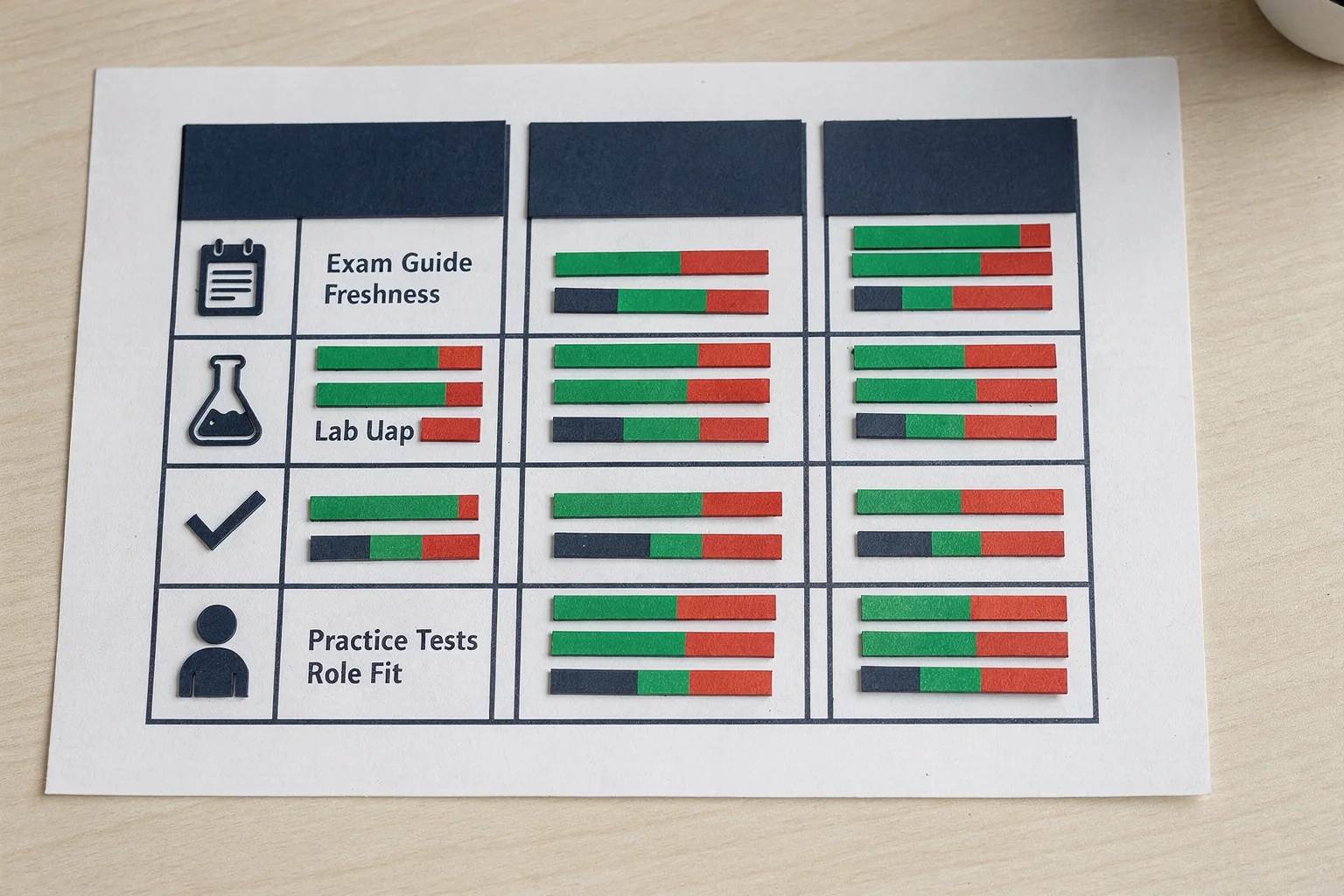
Ranking order puts the most rapidly modernised path first and works down to solid alternatives that lack a lab component or tie less directly to a single exam. Where a Microsoft exam could make sense for a specific reader, I’ve called that out — but the list stays anchored in AWS because you’re reading this as someone who likely already manages AWS workloads or plans to.
1. AWS Certified AI Practitioner (AIF‑C01) — the foundation that keeps expanding
If you want a certification that covers AI, ML, and generative AI concepts on AWS without diving straight into the deep end, AIF‑C01 is the obvious 2026 starting point. The exam guide lists four domains: Fundamentals of AI and ML, Fundamentals of Generative AI, Applications of AI and ML on AWS, and Responsible AI. It’s vendor‑specific enough that the questions will ask you to choose between Bedrock, SageMaker, and Rekognition, but broad enough that someone coming from a development or data background can pick it up.
Why it’s ranked first comes down to update velocity. AWS released new digital‑training modules for the AI Practitioner path on Skill Builder as early as January 2026, and by May the platform added AI‑powered Lab Maker — a tool that spins up personalised sandbox labs for the services tested in the exam. Several third‑party instructors followed suit within weeks, and the most popular Udemy courses for this exam now carry 2026‑edition tags.
Who it fits: Early‑career cloud engineers, technical project managers, or anyone who wants a structured AI curriculum that doesn’t assume you already write Python. It also works as a stepping stone to the Machine Learning – Specialty.
The limitation: Because it’s foundational, some hiring managers treat it as a “nice to have” rather than a signal of production‑ready skill. You’ll still need a portfolio or a specialty cert if the job description mentions model deployment.
When you’re ready to test yourself, pulling together realistic timed practice sessions is where most candidates burn their best hours. The PlanetCert simulator for AWS exams uses scenario‑based item types that match what the test‑centre engine throws at you, and it surfaces explanations for every wrong answer so you’re not just memorising patterns.
2. AWS Certified Machine Learning – Specialty (MLS‑C01) — depth for builders
For engineers who already understand SageMaker, data engineering, and model hosting, the MLS‑C01 remains the specialty credential that carries the most weight. The exam targets people who can frame ML problems, engineer features, train and tune models, and operate the full pipeline on AWS. It isn’t an entry‑level bet — AWS recommends two or more years of hands‑on experience before sitting it.
The 2026 refresh added clearer weighting on MLOps, model monitoring, and governance patterns. The new SimuLearn badges for the ML learning path give candidates a way to prove they’ve completed scenario‑based challenges before booking the exam, which the course market quickly absorbed.
Among commercial prep options, the courses that lead the pack combine updated video deep‑dives with SageMaker‑specific labs and a bank of 200+ practice questions. The AWS Certification Exam Guides page lists every in‑scope AWS service, and the best courses cross‑reference that list lecture by lecture.
Who it fits: ML engineers, data scientists moving to AWS, and solutions architects who want to own the AI pillar of a Well‑Architected review.
The limitation: You’ll need to keep your study material perfectly aligned with the version of SageMaker and its companion services that the exam expects. Some cheap course bundles repackage 2024 content and slap a “2026” label on the thumbnail — cross‑check the section list against the official exam guide before you buy.
PlanetCert’s practice tests for the MLS‑C01 track domain‑level scores, so you can see whether you’re weak on data engineering or strong on model deployment and focus your revision there. That’s far more efficient than re‑watching a 20‑hour video course.
3. AWS Certified Cloud Practitioner (CLF‑C02) — the on‑ramp with AI relevance you didn’t expect
The Cloud Practitioner often gets skipped by technical readers, but the 2026 version (CLF‑C02) now expects you to identify AWS AI and ML services, understand their use cases, and recognise shared‑responsibility implications. Because it covers the whole AWS landscape at a mile‑wide, inch‑deep level, it’s the fastest path to getting AI vocabulary on your CV while you’re still learning to code.
The most‑purchased CLF‑C02 course on Udemy — a 21‑hour programme by Stephane Maarek — illustrates the update tempo that matters. It holds a 4.7 rating from over 1,050 ratings, includes 40+ hands‑on exercises, and has been refreshed multiple times in 2026 alone. The course covers 70+ AWS services and ends with a full‑length practice test with detailed explanations.
Rating: 4.7 out of 5 (1,051 ratings) — 11,917 students — 40+ hands‑on exercises to further strengthening your AWS skills. — Udemy course page
That same teaching model — short, focused videos with frequent quizzes — extends to the same provider’s AI Practitioner and ML Specialty courses, which adopt identical update cadences. You’ll see them republished within days of a new exam guide.
Who it fits: Career switchers, IT support professionals pivoting to cloud, and anyone who wants a single cert that name‑checks both compute basics and Amazon Q.
The limitation: It won’t teach you to build a training pipeline. Use it as a wide‑angle lens; stack a deeper course on top once you’ve passed.
4. Microsoft Azure AI‑900 — the cross‑vendor alternative
A list built around AWS AI/ML still needs to acknowledge the exam that triggered half the 2026 excitement. Microsoft’s AI‑900 — Azure AI Fundamentals — is a single, foundational exam that covers AI workloads, machine learning principles, computer vision, NLP, and conversational AI on Azure. It’s shorter to study, costs £76 (GBP), and has no prerequisites.
The reason it lands here, not higher, is that while AI‑900 is updated, it doesn’t require hands‑on AWS service familiarity. If your employer’s estate is predominantly AWS, studying AI‑900 will teach you concepts but won’t help you operate SageMaker, Bedrock, or IAM access policies for training data. It can, however, function as a quick proof of AI literacy while you work toward a deeper AWS credential.
You can explore the exam topics and recommended study resources on PlanetCert’s AI‑900 exam details page, which includes sample questions and a domain‑by‑domain breakdown.
Who it fits: Multi‑cloud generalists, Microsoft‑stack developers, or anyone hedging their bets while AWS demand stays high.
The limitation: Recruiters categorise it as a fundamentals‑only signal. For senior AI roles on AWS, you’ll still need the specialty.
What ties these paths together — and what makes a course stale
The common thread across the top three AWS picks is that they either come directly from AWS training or map closely to the posted exam guide version. A course can have 1,000 five‑star reviews and still be useless if the lecture list references services that were deprecated or renamed. For example, Amazon Rekognition’s video analysis API received an overhaul in early 2026; a course mentioning the old endpoint syntax is missing the mark.
The same risk applies to AWS machine learning tools shift — as services retire or consolidate, exam objectives follow. The MLS‑C01 no longer tests the original version of Amazon Forecast, and some practice sets haven’t caught up. I’d cross‑check any third‑party material you’re considering against the AWS certification exam updates that dropped mid‑year, because the window between an objective change and a course update can be weeks — and you don’t want to be the person who sits the old version.
Before you book the exam, bullet‑proof your weak spots
No course — AWS’s own included — will cover every permutation of a scenario question. That’s why the most efficient study plans start with a full mock exam on day one, exactly as outlined in several 2026 study frameworks. You identify the domains where you’re scoring below 70%, and you concentrate your video and lab time there instead of rewatching introductory modules.
PlanetCert’s practice tests let you run timed, proctored‑style sessions inside a web‑based simulator that matches the real Pearson VUE interface. After each attempt, you’ll see explanations tied to specific exam objectives, so you’re not just correcting a mistake — you’re learning the principle that will keep the next variant from tripping you up. It’s the same approach that StudyTech AI’s 2026 guide advocates: “Start with a mock exam on day one to expose your gaps, study only those gaps using active recall, track your readiness by domain, and book when the data says you’re ready.”
The labs, the videos, the textbooks — they all become far more effective when you’ve already seen what a passing score demands.
Which credential do you block time for first?
If your primary platform is AWS, start with AIF‑C01. It’s modern, updated aggressively, and gives you a credential that signals AI fluency without pretending you’ve deployed a hundred models. Once you hold it, the MLS‑C01 becomes the logical upgrade.
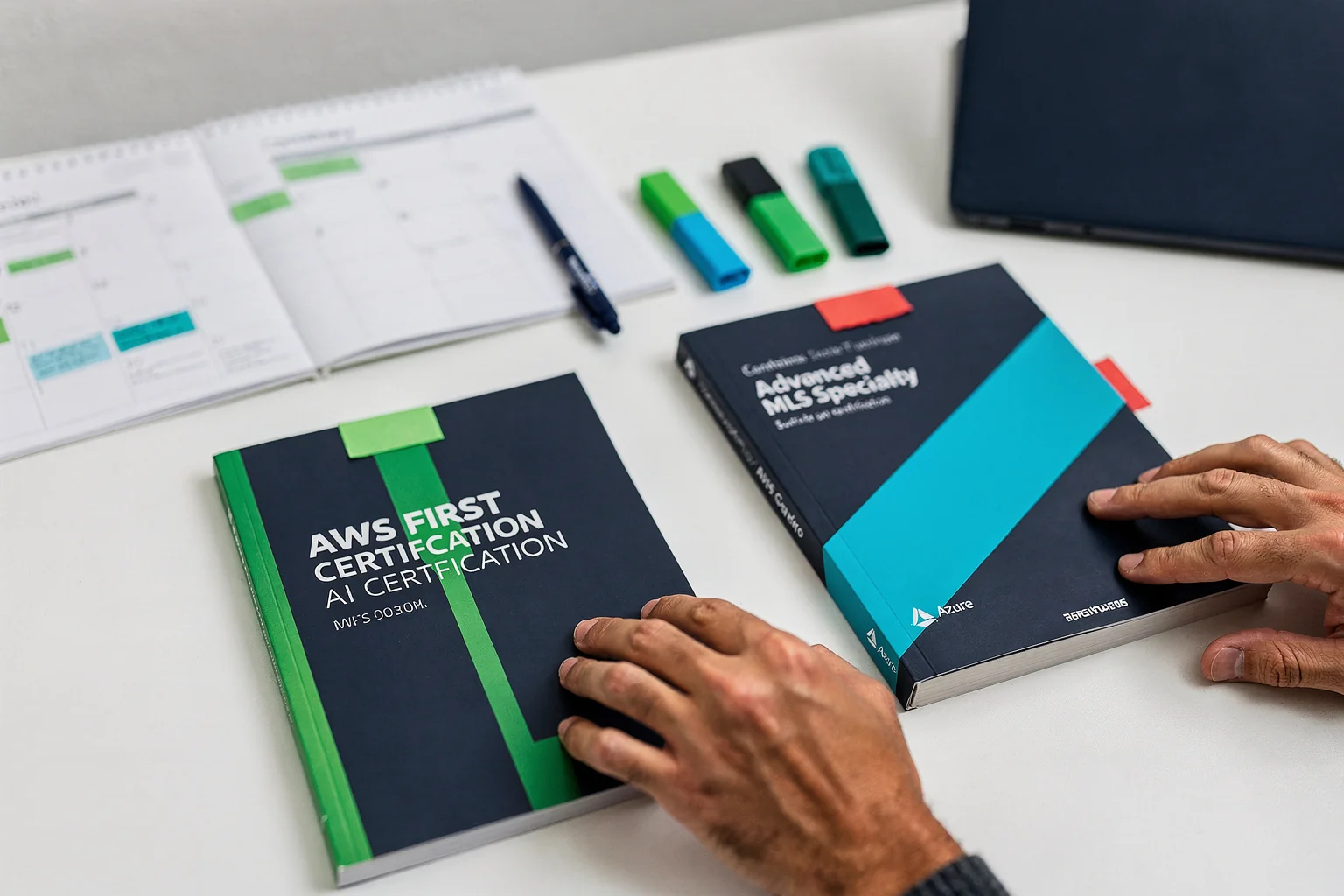
If you’re at a multi‑cloud shop or just want a fast AI basics tick, the AI‑900 is a reasonable detour — just don’t expect it to replace a hands‑on AWS certification when the next project lands.
However you sequence them, pick a course that links every lecture to a specific exam objective and don’t study solo without a practice‑test safety net. The freshest courses in 2026 are the ones that treat the exam guide as a checklist and revise the moment AWS revises.
Next stop: your practice‑exam dashboard
- 2026 Microsoft certification matches
- AWS certification exam updates
- Top AWS machine learning tools shift
browse the relevant exam page and purchase a practice test

Discussion
Question Comments
0 comments·0 participantsSign in to leave a comment and access more free questions.