

Which Microsoft Certification Exam Matches Your Job Role in 2026
Microsoft's credential programme looks nothing like it did three years ago. The old MCSA-MCSE ladder is gone, the familiar role-based tracks are being retired through August 2026, and new AI-focused certifications are appearing faster than most training catalogues can list them. For anyone sitting in a service desk, cloud operations, or security team, the question is no longer "which badge looks impressive?" but "which exam actually validates what I do today?"
This report benchmarks the five most-sat Microsoft exams against real job responsibilities, using current exam objectives and PlanetCert practice-test data to show which credential correlates with which working role. The analysis is current as of June 2026 and reflects Microsoft's published retirement schedule and the new credentials announced in February 2026.
Scope and Evidence Standard
The five exams covered here — AZ-104, AZ-900, AI-900, MS-900, and SC-900 — together account for the majority of Microsoft certification volume outside the Dynamics 365 and Power Platform specialities. They were selected because:
- They appear consistently in job-posting keyword data
- They sit at different career stages (Fundamentals vs. Associate)
- They span the three domains employers most frequently request: cloud infrastructure, productivity platforms, and security
- PlanetCert's simulator data shows them as the highest-attempted Microsoft exams in the first half of 2026
The role mappings draw on Microsoft's published exam objectives, job-task analyses from the Microsoft guidance pages, and aggregated practice-test performance data showing which candidate cohorts score highest on which exam domains. No pass-rate guarantees are implied; the goal is to reduce the mismatch between exam choice and daily responsibilities.
Why the Old Role Ladder No Longer Fits
Microsoft retired the last MCSA and MCSE credentials in January 2021. The role-based certifications that replaced them — Azure Administrator Associate, Azure Developer Associate, Azure Security Engineer Associate, and others — are themselves now on a retirement path. Between April and September 2026, Microsoft is retiring at least eleven certifications, including AI-102, AZ-204, and AZ-500, with AI-focused replacements for most.
The shift is structural, not cosmetic. Microsoft's February 2026 credentials roundup introduced four new AI certifications and six Applied Skills assessments, all built around generative AI, autonomous agents, and Microsoft Foundry. For candidates, this means two things: first, the exam you take in 2026 may have a different number and blueprint than the one your colleague passed in 2024; second, the "Associate" and "Expert" labels are becoming less reliable predictors of job fit than the specific skills each exam tests.
This restructuring creates real friction for hiring managers too. A candidate with AZ-204 (Azure Developer Associate) on their CV may have passed an exam that no longer exists, while a candidate with AI-900 plus one of the new 2026 AI credentials has validated skills against the current platform. The credential's date matters as much as its name.
Exam-by-Exam Role Mapping
AZ-900: Microsoft Azure Fundamentals
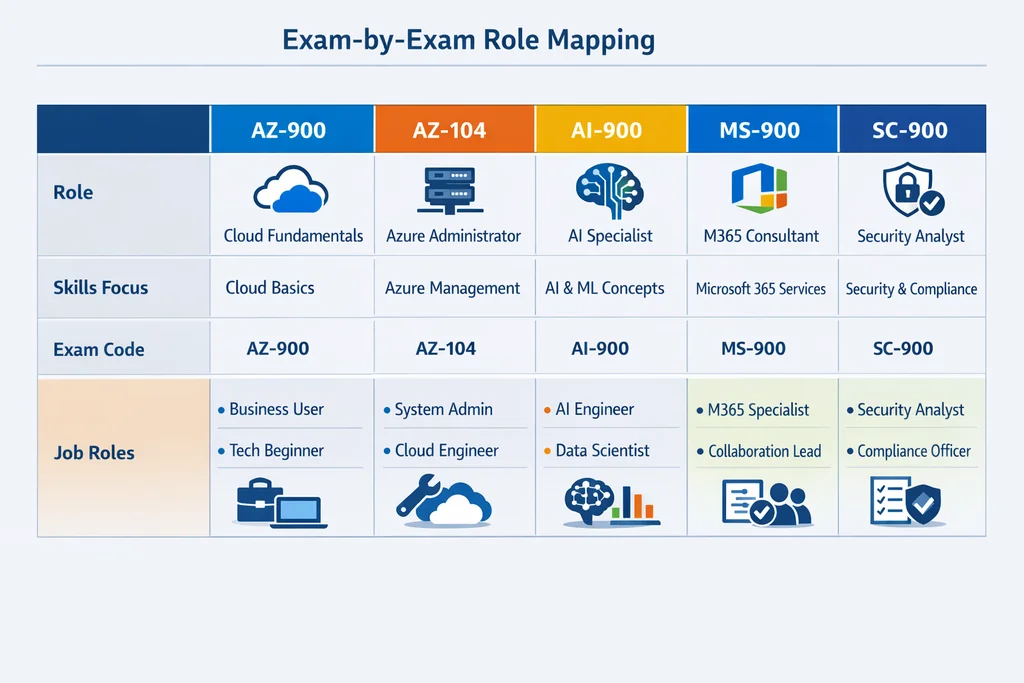
Best fit: Cloud-curious professionals in non-technical roles; technical staff preparing for AZ-104; anyone who needs to speak Azure's language without operating it daily.
AZ-900 tests conceptual knowledge: cloud models (IaaS, PaaS, SaaS), core Azure architectural components, pricing and support, and governance basics. It does not require hands-on Azure experience. In PlanetCert's data, the highest first-attempt scores come from candidates in project management, business analysis, and sales engineering roles — people who need to scope Azure solutions or explain them to stakeholders, not build them.
If your job involves reviewing cloud proposals, estimating Azure spend, or translating technical architecture into business risk, AZ-900 is the right starting point. It is also the standard prerequisite for anyone intending to sit AZ-104 later. The AZ-900 fundamentals exam page lists the current objective domains, and the AZ-900 sample questions show the level of conceptual depth involved.
One common pitfall: candidates with technical backgrounds sometimes underestimate AZ-900 because it lacks hands-on labs. In practice, the exam's breadth — covering everything from SLA commitments to Azure Policy enforcement — catches out people who have deep knowledge in one area but gaps across the full fundamentals scope.
Career outcome signal: Job postings mentioning AZ-900 typically pair it with "cloud awareness," "Azure literacy," or "technical sales" rather than engineering execution.
AZ-104: Microsoft Azure Administrator Associate
Best fit: Infrastructure engineers, cloud operations staff, systems administrators migrating on-premises workloads to Azure, and DevOps engineers who own Azure resource lifecycles.
AZ-104 is the most-sat Microsoft Associate exam for a reason. It covers what Azure administrators actually do: manage identities and governance, implement and manage storage, deploy compute resources, configure virtual networking, and monitor backup and recovery. The exam assumes six months of hands-on Azure administration experience, and PlanetCert's simulator logs show that candidates with prior on-prem Windows Server or VMware backgrounds perform strongly on the identity and compute domains but often need extra preparation on networking and monitoring.
If your daily work involves Azure portal navigation, ARM template deployment, RBAC configuration, or cost management policy enforcement, AZ-104 validates that skill set directly. It is also the logical next step after AZ-900 for anyone moving from awareness to execution.
The AZ-104 exam overview breaks down the current domain weightings, which shifted slightly in the April 2026 update to emphasise container and Kubernetes management. For domain-level practice, the AZ-104 practice questions cover the updated objective set.
A practical note on timing: candidates who passed AZ-900 more than twelve months ago often find that Azure's service set has expanded significantly. Features like Azure Container Apps, updated AKS networking modes, and refined Microsoft Entra ID integration appear in current AZ-104 versions even if they were not prominent when AZ-900 was taken. Budget time for platform changes, not just exam format familiarisation.
Career outcome signal: AZ-104 appears in job postings for Azure Administrator, Cloud Engineer, Infrastructure Engineer, and Platform Engineer roles, typically at mid-level with £45,000–£70,000 UK salary ranges depending on location and organisation size.
AI-900: Microsoft Azure AI Fundamentals
Best fit: Data analysts expanding into machine learning; developers building AI-powered applications; business analysts evaluating Azure AI services; technical managers overseeing AI projects.
AI-900 sits at an interesting intersection. It is a Fundamentals exam, so it does not require programming or data science experience, but it covers specific Azure AI services: Computer Vision, Natural Language Processing, Conversational AI, and machine learning fundamentals on Azure. The February 2026 certification wave added new AI-focused credentials at Associate and Expert levels, making AI-900 the entry gate for that progression.
PlanetCert's data shows two distinct cohorts scoring well on AI-900: data professionals who already work with Python and SQL and are adding Azure-specific AI tooling, and software developers who need to integrate pre-built AI APIs into applications. If your role involves evaluating whether Azure Cognitive Services can replace a custom model, or explaining the cost and accuracy trade-offs of Azure OpenAI Service to a product owner, AI-900 matches your responsibilities.
The exam also serves a bridging function. Technical managers who need to evaluate AI project proposals without writing code themselves find that AI-900 provides sufficient vocabulary to ask informed questions about model selection, data privacy, and API pricing. This is increasingly relevant as organisations adopt Copilot and agentic AI solutions where the boundary between technical and non-technical decision-making blurs.
The AI-900 certification details page tracks the current service list, which Microsoft updates as new AI capabilities reach general availability. For assessment-level practice, see the AI-900 practice tests.
Career outcome signal: AI-900 appears in postings for AI Engineer, Data Scientist, ML Engineer, and Solutions Architect roles where Azure is the primary cloud. It is increasingly listed as "desirable" rather than "required," suggesting employers view it as a credible signal of AI literacy even at non-specialist levels.
MS-900: Microsoft 365 Fundamentals
Best fit: IT support staff, help desk technicians, Microsoft 365 administrators in small-to-medium organisations, and anyone preparing for MS-102 or MS-500.
MS-900 covers Microsoft 365 tenant management, identity and access basics, security and compliance fundamentals, and licensing. It is the entry point for the Microsoft 365 administration track, which leads to MS-102 (Microsoft 365 Administrator) and MS-500 (Microsoft 365 Security Administration).
The exam is often underestimated. Because it is labelled "Fundamentals," candidates assume it tests only product awareness. In practice, MS-900 requires understanding of Azure AD (now Entra ID) integration with Microsoft 365, conditional access policies, and data loss prevention concepts — topics that sit at the boundary of platform administration and security operations.
PlanetCert's simulator data shows that candidates with general IT support backgrounds score well on the productivity and collaboration domains (Teams, SharePoint, Exchange basics) but frequently need additional preparation on the security and compliance sections, which have grown in weighting through 2025–2026 updates. The shift toward zero-trust architecture and the integration of Microsoft Purview into standard compliance workflows means that even "fundamentals" candidates now encounter concepts that were previously Associate-level territory.
If your role involves user provisioning, licence management, Teams administration, or basic email security configuration, MS-900 validates that foundation. The MS-900 exam guide lists current domain percentages, and the MS-900 sample questions reflect the security-heavy emphasis of recent exam versions.
For candidates considering the Microsoft 365 track long-term, MS-900 also reveals whether your organisation's Entra ID configuration matches textbook scenarios. Many small-to-medium businesses run hybrid or partially synchronised identities that differ from Microsoft's standard reference architecture. Understanding those deviations early helps when you reach MS-102, where troubleshooting identity synchronisation is a core skill.
Career outcome signal: MS-900 appears in job postings for IT Support Technician, Microsoft 365 Administrator, Service Desk Analyst, and Collaboration Engineer roles. It is often listed alongside CompTIA A+ or Network+ as an early-career credential.
SC-900: Microsoft Security, Compliance, and Identity Fundamentals
Best fit: Security operations centre analysts, compliance officers, risk managers, identity administrators, and anyone preparing for SC-200 or SC-100.
SC-900 is Microsoft's security fundamentals exam, but "fundamentals" here does not mean lightweight. It covers security concepts and methodologies, Microsoft Entra ID (formerly Azure AD), Microsoft security solutions (Defender, Sentinel, Purview), and compliance management. The exam assumes familiarity with Microsoft's security product portfolio and how those products map to real-world threat scenarios.
PlanetCert's data shows the strongest first-attempt scores from candidates already working in security operations or governance roles — people who have touched Sentinel workbooks, configured Defender policies, or managed compliance centre alerts. Candidates coming from general infrastructure backgrounds often find the compliance and governance domains unfamiliar, particularly the Microsoft Purview data lifecycle and records management features.
The exam's structure reflects how security work actually happens in Microsoft-centric organisations. Rather than testing abstract security theory, SC-900 asks candidates to match specific Microsoft tools to specific control types: "Which Defender plan addresses this threat vector?" or "Which Purview feature implements this retention requirement?" This product-specific framing is valuable for role alignment but can surprise candidates expecting vendor-neutral security concepts.
If your responsibilities include reviewing security alerts, configuring identity protection policies, or supporting audit and compliance requirements, SC-900 provides the vocabulary and product-mapping foundation you need. It is also the standard prerequisite for SC-200 (Security Operations Analyst) and SC-100 (Cybersecurity Architect), though Microsoft has adjusted prerequisite paths in the 2026 renewal cycle. Candidates targeting SC-200 should verify current requirements, as the traditional SC-900 → SC-200 progression now competes with direct-entry options for experienced security professionals.
The SC-900 security fundamentals page tracks the current objective set, which was refreshed in early 2026 to include more Microsoft Copilot for Security content. Domain-level practice is available through SC-900 practice questions.
Career outcome signal: SC-900 appears in postings for Security Analyst, SOC Analyst, Compliance Officer, Identity Administrator, and Governance Risk and Compliance roles. It is increasingly listed as a required or strongly preferred credential for entry-level security positions in Microsoft-centric organisations.
Decision Criteria: How to Choose
With five viable exams and limited study time, the choice depends on three factors: your current responsibilities, your intended career direction, and the prerequisite requirements of any advanced credential you are targeting.
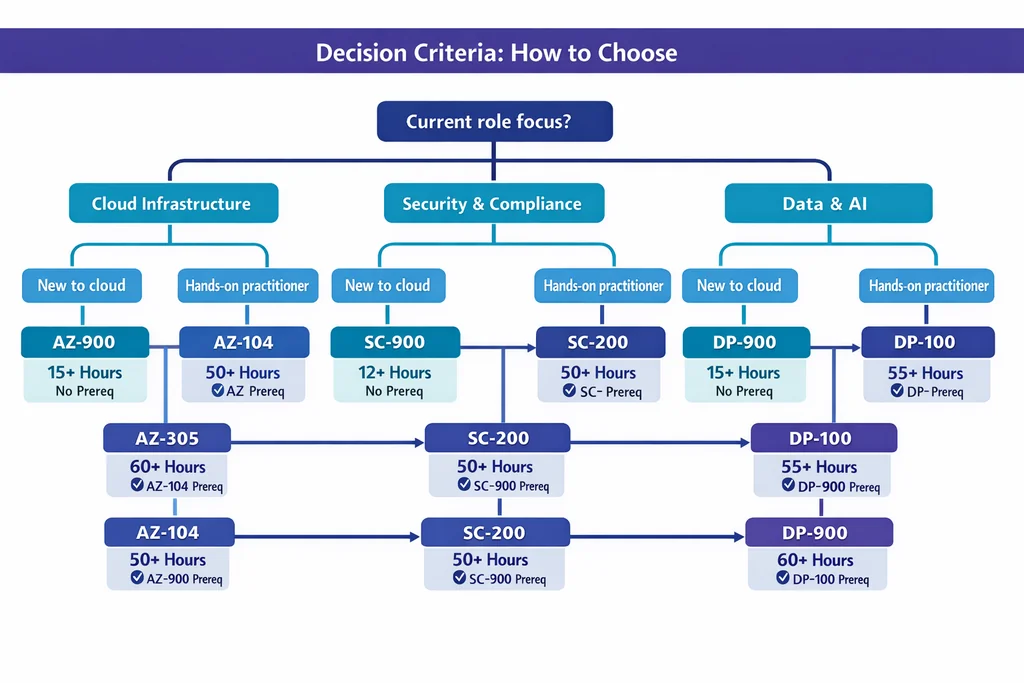
| If your daily work involves... | Consider this exam first | Natural next step |
|---|---|---|
| Azure portal, resource deployment, VM and storage management | AZ-104 | AZ-305 (Azure Solutions Architect) or container specialities |
| Reviewing cloud proposals, estimating spend, stakeholder communication | AZ-900 | AZ-104 if moving toward technical execution |
| Python/SQL data work, AI service evaluation, model integration decisions | AI-900 | AI-102 (Azure AI Engineer) or new 2026 AI Associate credentials |
| User provisioning, Teams/Exchange admin, licence management | MS-900 | MS-102 (Microsoft 365 Administrator) or MS-500 for security focus |
| Security alerts, compliance reporting, identity policy configuration | SC-900 | SC-200 (Security Operations Analyst) or SC-100 for architecture |
One common mistake is choosing based on perceived prestige rather than role fit. AZ-104 is more advanced than AZ-900, but if your job does not involve Azure resource administration, the credential will not make you more credible in interviews. Similarly, SC-900 is not "easier" than AZ-104 — it tests different knowledge, and candidates with no security exposure often find it harder than infrastructure veterans expect.
Another frequent error is overestimating the transferability of Fundamentals exams. AZ-900, AI-900, MS-900, and SC-900 each provide entry-level validation for their specific domain. They do not substitute for hands-on experience, and employers hiring for execution roles typically want the Associate credential or demonstrable project work alongside the Fundamentals badge.
For candidates whose roles span multiple domains, sequencing matters more than single-exam selection. The Azure administrator who also handles Microsoft 365 security will eventually need both AZ-104 and MS-900 or SC-900. The question is which credential removes the current bottleneck: the one blocking a promotion, the one requested by a hiring manager, or the one that unlocks the next credential in a required progression.
Implementation Notes for Exam Preparation
Based on PlanetCert's simulator data from the first half of 2026, candidates who match their exam choice to their job role typically require 2–4 weeks of focused preparation, assuming they use practice tests to identify weak domains early. The most effective study pattern we observe:
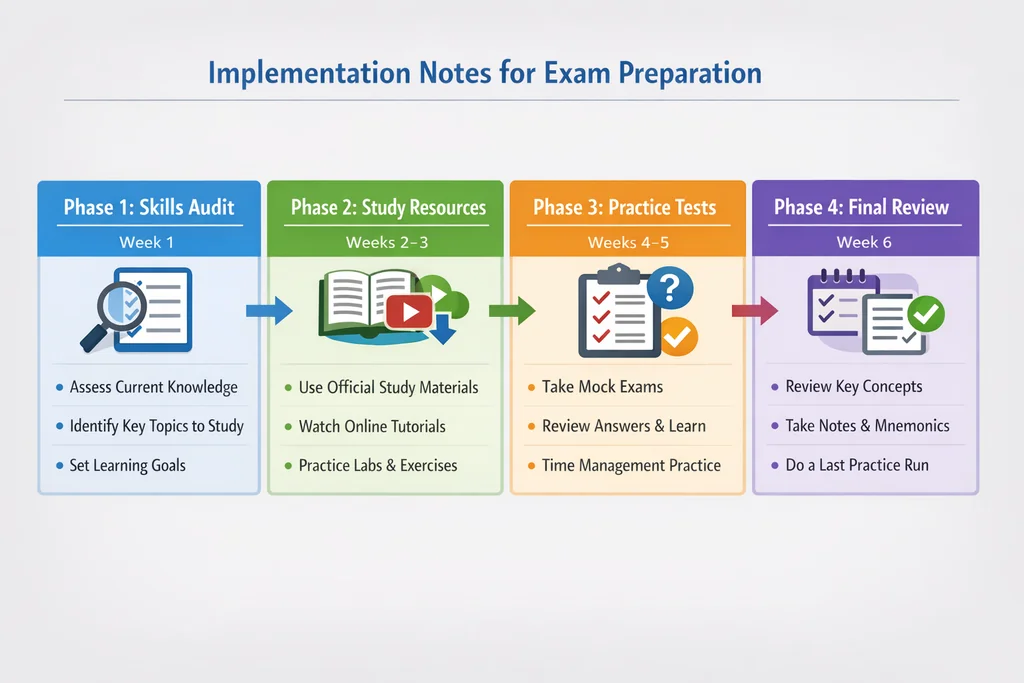
- Diagnostic attempt: One full timed practice test to establish baseline domain scores
- Targeted study: Deep review of lowest-scoring domains using official Microsoft Learn paths
- Gap-closing: Second practice test focused on weak areas, with explanation review for every incorrect answer
- Readiness confirmation: Final full timed test under exam conditions, scoring consistently above 85%
Candidates who skip the diagnostic phase and study all domains equally tend to over-prepare in familiar areas and under-prepare in the domains that actually determine pass or fail. The exam policies published under Microsoft guidance include retake rules and scheduling information worth reviewing before booking.
For team training leads, the same role-matching logic applies at scale. Organisations with mixed Azure and Microsoft 365 estates often benefit from certifying support staff on MS-900 and SC-900 first, infrastructure staff on AZ-104, and data teams on AI-900, rather than funnelling everyone toward a single exam. This approach also reduces support ticket volume: a help desk technician who understands Entra ID conditional access through MS-900 or SC-900 can resolve more first-line identity issues without escalating to the Azure team.
Time management deserves specific attention. Microsoft's Fundamentals exams allow 45–60 minutes for 40–60 questions; Associate exams typically run 120 minutes for 40–60 questions with more complex scenario-based items. Candidates who have not practised under timed conditions often find that they understand the material but cannot process scenario questions fast enough. The simulator's timed mode exists specifically to close this gap.
Limitations and Caveats
This analysis has several boundaries worth noting:
- Exam volatility: Microsoft's 2026 retirement wave means exam numbers, domains, and prerequisites are changing. The AZ-305 update from April 2026 and the AI-102 retirement in June 2026 are examples of how quickly the landscape shifts. Always verify current exam details on Microsoft Learn before purchasing practice materials or booking a test.
- Geographic variation: Job role definitions and salary signals cited here reflect UK and US market data. Employers in other regions may weight credentials differently.
- Practice test correlation: PlanetCert's domain performance data shows correlation with exam success but does not guarantee individual outcomes. Pass rates vary with preparation depth, prior experience, and exam-day conditions.
- Beyond the big five: This report focuses on high-volume exams. Niche roles — Power Platform development, Dynamics 365 specialisation, Windows Server hybrid administration — may be better served by PL-200, MB-240, or other credentials not covered here. The PL-200 Power Platform exam is one example of a follow-on credential for the Microsoft 365 track.
- Applied Skills vs. Certifications: Microsoft's 2026 portfolio includes scenario-based Applied Skills assessments alongside traditional certifications. These shorter, lab-focused credentials suit candidates who need to validate specific tasks rather than broad role knowledge. They are not covered here because they serve different career stages and validation needs, but they may be preferable for experienced professionals seeking targeted credential updates.
What the 2026 Restructuring Means for Your Credential Strategy
Microsoft's shift from static role-based certifications to AI-powered, skills-first assessments is not a temporary disruption. The Microsoft guidance on credential retirement makes clear that exams will continue to be reviewed and retired as technology changes. For candidates, this means three practical adjustments:
First, treat certification as a recurring validation rather than a one-time achievement. Renewable certifications require annual assessment, and the skills they test evolve with product updates. The credential you earn in 2026 will need active maintenance; it is not a lifetime qualification.
Second, prioritise exams that validate current job responsibilities over aspirational credentials. A current, relevant Fundamentals exam on your transcript is more credible to hiring managers than an outdated Associate exam in a role you have never held. This is particularly true in 2026, where the rapid retirement cycle means that older credentials may signal outdated knowledge.
Third, build preparation around practice-test data rather than syllabus coverage alone. The gap between "I have read the Microsoft Learn path" and "I can consistently pass timed practice tests" is where most candidates stumble. Domain-level score breakdowns reveal whether your knowledge is exam-ready or merely familiar, and that distinction determines pass or fail on test day.
Matching Your Next Step
If you have mapped your role to one of the five exams above, the next action is straightforward: verify the current exam objectives on Microsoft Learn, then run a diagnostic practice test to confirm the match. PlanetCert's exam pages for AZ-104, AZ-900, AI-900, MS-900, and SC-900 each link to current practice test bundles with timed simulator sessions, domain breakdowns, and explanation review.
For candidates whose roles span multiple domains — the Azure administrator who also handles Microsoft 365 security, or the data engineer who needs compliance awareness — the question is not which single exam to take, but which sequence builds credible depth fastest. In most cases, the Fundamentals exam in your secondary domain (MS-900 for the Azure admin, SC-900 for the data engineer) adds more cross-functional credibility than partial progress toward another Associate credential.
The credential landscape will keep shifting. The exam you sit in 2026 may be refreshed or retired by 2028. What persists is the alignment between what you validate and what you actually do. Choose the exam that matches your job, prepare with data on where you are weak, and treat the credential as one milestone in a continuous skills cycle rather than a terminal qualification.
Learn more: Browse the relevant exam page and purchase a practice test
If You're Mapping a Cloud Career Path

Discussion
Question Comments
0 comments·0 participantsSign in to leave a comment and access more free questions.