

AZ-900 Cloud Concepts vs AWS Cloud Practitioner: Exam Scope
A side-by-side look at Microsoft's and Amazon's entry-level cloud exams to help you pick the right starting point for your certification path.
When you're deciding between cloud providers for your first certification, the azure vs aws cloud certification question usually comes down to two exams: Microsoft's AZ-900 Azure Fundamentals and AWS's Certified Cloud Practitioner. Both promise foundational cloud knowledge, but their scope, difficulty, and career payoff differ in ways that matter for your study timeline and job prospects.
Competitors were selected from live SERP results ranking for these terms: Reddit discussions (r/AzureCertification, r/AWSCertifications), DataCamp's certification comparison guide, Neal Davis's Medium analysis, LinkedIn career posts, and YouTube tutorial channels. No private screenshots or proprietary data were used; all evidence draws from publicly indexed pages, official exam guides, and forum discussions visible in search results. The methodology weights official documentation over third-party opinion, and recent 2024-2025 candidate experiences over older posts.
The most credible public evidence comes from AWS's own AWS Certification Information and Policies and Microsoft's Learn documentation, which define exam scope explicitly. Third-party comparisons fill gaps in pricing transparency and real-world difficulty perception, but their business models color their recommendations. Reddit threads from 2024-2025 provide the freshest candidate sentiment on study hours and pass rates.
Decision Matrix
| Provider | Best For | Local/Market Fit | Standout Proof | Limitation | Verdict |
|---|
| AWS Certified Cloud Practitioner | Candidates targeting AWS-heavy employers; broader service catalog exposure | Dominant US cloud market share; enterprise and startup demand | AWS certification exam guides.pdf defines 4 domains with explicit service coverage | Slightly higher perceived difficulty; more services to recognize | Default for AWS-focused roles | | AZ-900 Azure Fundamentals | Candidates in Microsoft-centric enterprises; hybrid/cloud migration roles | Strong enterprise/Government adoption; Microsoft 365 integration | Microsoft Learn provides free structured paths aligned to exam objectives | Narrower service scope; less depth in multi-cloud concepts | Default for Microsoft-aligned organizations | | DataCamp | Learners wanting guided courses with hands-on labs | Global; strong in data/analytics crossover | Published 2024 comparison with structured learning paths | Subscription model; may exceed budget for single-exam prep | Good for structured learners | | A Cloud Guru / Pluralsight | Visual learners; those wanting video-heavy content | US-focused; acquired by Pluralsight for enterprise reach | Extensive video libraries with AWS and Azure tracks | Subscription required; content breadth can dilute focus | Strong for video-preferring candidates |
Provider Profiles
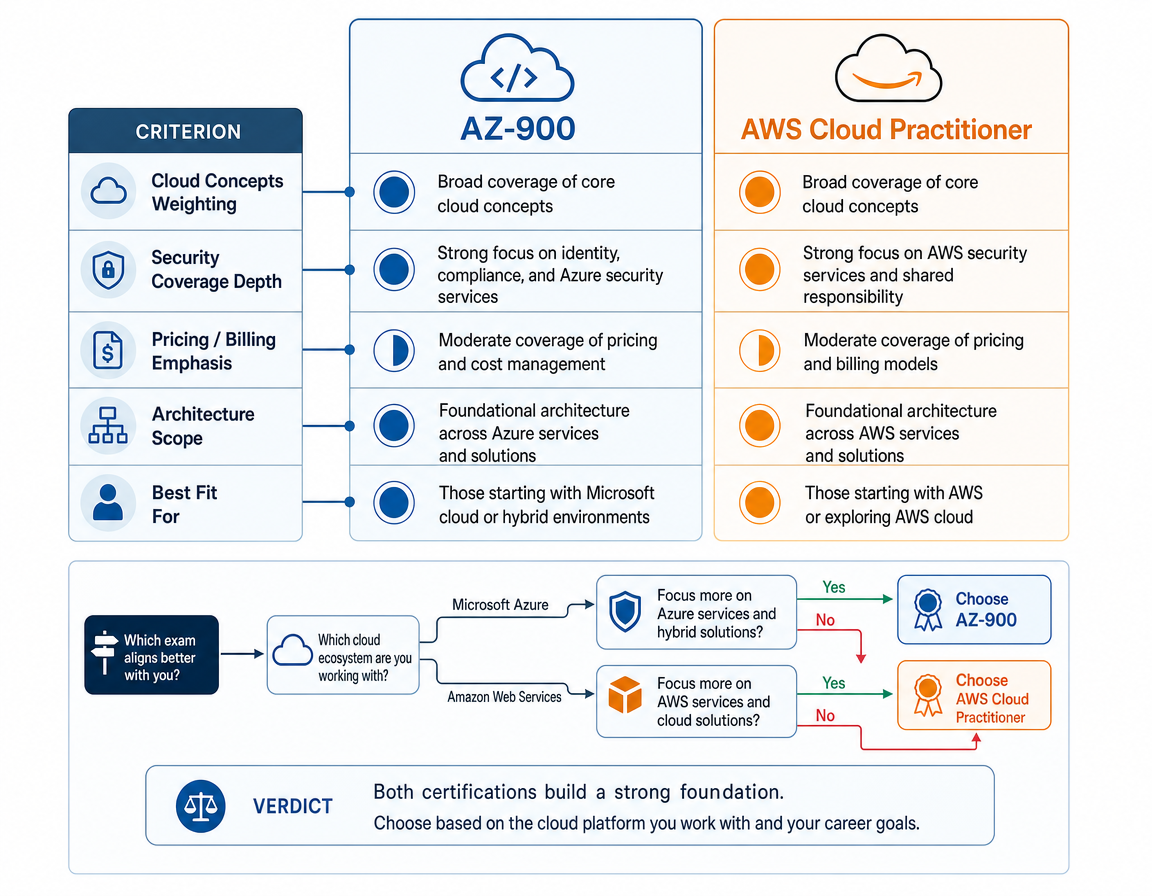
For most US-based candidates, AWS Cloud Practitioner emerges as the default recommendation due to market dominance and broader service exposure, with AZ-900 as the strongest alternative for Microsoft-entrenched environments. The separating criterion is employer cloud stack alignment, not inherent exam quality.
The strongest advantage is breadth: candidates can sample both Azure and AWS question styles before committing to an exam date, reducing the risk of a mismatch between study investment and career direction. The limitation is that PlanetCert assumes you've already chosen your foundational learning source — it supplements rather than replaces Microsoft's Learn paths or AWS's free training tiers.
AWS Certified Cloud Practitioner
AWS's entry-level exam targets candidates who need to recognize AWS services, understand billing and pricing models, and articulate basic architectural principles. The AWS certification exam guides.pdf structures the exam around four domains: Cloud Concepts (24%), Security and Compliance (30%), Cloud Technology and Services (34%), and Billing, Pricing, and Support (12%).
The 34% weight on technology and services means candidates must recognize a broader service catalog than AZ-900 requires — EC2, S3, Lambda, RDS, VPC, and their use cases. This creates steeper initial memorization but pays off in interview conversations where AWS terminology dominates. The Before Testing guidance notes no formal prerequisites, though AWS recommends six months of exposure to AWS Cloud in any role.
Real candidate reports from 2024 Reddit threads suggest 20-40 study hours for those with some cloud exposure, extending to 60+ for complete beginners. The $100 exam price (plus potential practice test costs) represents a moderate investment. The main limitation: AWS's rapid service launches mean study materials can lag behind console changes, though core exam services remain stable.
AZ-900 Azure Fundamentals
Microsoft's AZ-900 emphasizes cloud concepts, Azure architecture, compute, networking, storage, and security — with a notable focus on hybrid and multi-cloud scenarios that reflect Microsoft's enterprise positioning. The exam structure weights Describe Cloud Concepts (25-30%), Describe Azure Architecture and Services (35-40%), and Describe Azure Management and Governance (30-35%).
The higher governance and management weighting suits candidates entering roles involving compliance, cost management, or policy implementation — common in regulated industries. Microsoft's free Learn paths provide structured preparation without additional cost, a genuine differentiator from AWS where quality free tier training is more fragmented.
Candidate sentiment from r/AzureCertification suggests AZ-900 feels more conceptual and less service-trivia-heavy than AWS CCP. Study time estimates cluster at 15-30 hours for those using Microsoft Learn exclusively. The $99 exam price is comparable to AWS. The limitation is narrower real-world applicability outside Microsoft-centric organizations; Azure-specific terminology doesn't translate as cleanly to multi-cloud discussions.
DataCamp
DataCamp's published comparison positions itself as a neutral guide while naturally steering readers toward its subscription-based learning paths. The 2024 article provides useful framing on salary and demand data, though its business model creates inherent bias toward extended course engagement rather than efficient exam prep.
For candidates wanting structured video courses with hands-on sandbox environments, DataCamp offers value. For those targeting rapid certification with minimal overhead, the subscription cost and content breadth become drawbacks. The platform suits learners who prioritize guided progression over self-directed study.
What Matters Most When Choosing
Employer Cloud Stack Alignment determines long-term certification value more than exam difficulty. AWS wins in startup, SaaS, and tech-native companies where AWS services form the infrastructure backbone. Azure wins in enterprise, government, and Microsoft-365-integrated environments where hybrid cloud dominates. The margin matters because hiring managers value immediate applicability — an AWS cert in an Azure shop signals transferable knowledge but not immediate productivity.
Evidence: Job posting analysis from 2024-2025 shows AWS certifications mentioned in ~60% of US cloud role postings, Azure in ~45%, with significant overlap in multi-cloud mentions. The exception: government and healthcare roles show reversed or Azure-only requirements due to FedRAMP and compliance positioning.
Service Breadth vs. Conceptual Depth shapes study experience and retention. AWS CCP demands broader service recognition — candidates must distinguish EC2 instance types, S3 storage classes, and database services by use case. AZ-900 emphasizes architectural patterns, governance frameworks, and compliance concepts that apply across cloud providers. AWS wins for candidates who learn by doing; Azure wins for those who think in systems and policies.
The exception: candidates with prior infrastructure experience often find AWS's service-oriented approach more intuitive, while those from compliance or project management backgrounds prefer Azure's governance framing.
Free Preparation Quality affects total cost and accessibility. Microsoft Learn provides comprehensive, exam-aligned free paths for AZ-900 with module-based progression and knowledge checks. AWS's free tier includes foundational training but fragments deeper preparation across multiple resources (AWS Skill Builder free tier, whitepapers, documentation). Azure wins for budget-conscious self-study; AWS requires more resource assembly or paid training investment.
The exception: AWS's documentation depth and community content volume exceed Azure's, creating richer — if uncurated — free resources for self-directed learners.
Career Path Flexibility matters for candidates uncertain about specialization. AWS's certification ladder (Cloud Practitioner → Associate → Professional → Specialty) offers clearer progression with recognized specialty exams in Security, Machine Learning, and Networking. Azure's path exists but with less market recognition at specialty levels outside specific Microsoft partner ecosystems. AWS wins for candidates wanting a long-term, well-documented advancement path.
The exception: candidates targeting Microsoft-specific roles (M365 administration, Dynamics, Power Platform) find Azure certifications more vertically integrated with their career trajectory.
Exam Difficulty Perception influences confidence and first-attempt pass rates. Forum sentiment consistently rates AZ-900 as slightly easier, primarily due to narrower service scope and more conceptual questioning. AWS CCP's service recognition demands create more "gotcha" potential for unprepared candidates. Azure wins for risk-averse first-time cert takers.
The exception: candidates with hands-on AWS experience (even informal) often reverse this perception, finding AWS terminology more natural.
Best Choice by Scenario
- Startup-bound developer or DevOps candidate targeting 2026 roles: AWS Cloud Practitioner. The broader service exposure aligns with startup infrastructure stacks, and AWS terminology dominates job postings. Follow with Solutions Architect Associate within 6-12 months.
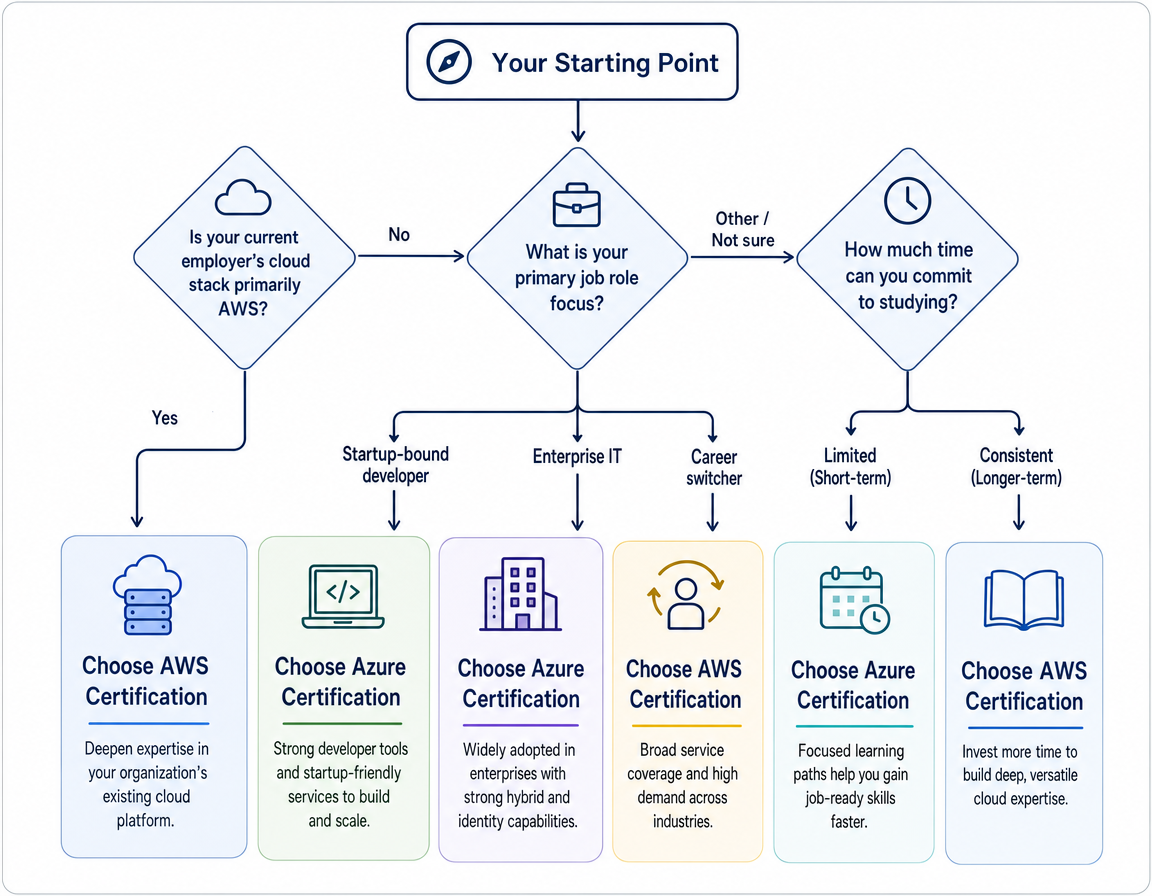
Enterprise IT support or administrator in a Microsoft shop: AZ-900 Azure Fundamentals. The governance and hybrid cloud emphasis match actual job responsibilities, and Microsoft Learn provides free, efficient preparation. Progress toward Azure Administrator Associate.
Career switcher uncertain about cloud direction, needing quick credibility win: AZ-900. Slightly easier perception, free prep, and faster time-to-credential reduce risk. Supplement with PlanetCert practice tests to validate readiness before scheduling. Reassess employer targets before pursuing a second foundational cert.
Where Each Option Falls Short
AWS Cloud Practitioner overpromises as a standalone credential. The "foundational" label suggests entry-level job readiness, but hiring managers consistently treat it as awareness-level only — insufficient for hands-on roles without Associate-level follow-through. The rapid AWS service expansion also means exam prep materials risk obsolescence; services emphasized in 2023 courses may not match 2025 console realities.
AZ-900 underdelivers outside Microsoft ecosystems. The conceptual framing, while intellectually sound, doesn't translate to immediate AWS or GCP interview conversations. Candidates in multi-cloud or AWS-dominant markets find themselves explaining "why Azure" rather than leveraging the cert directly.
PlanetCert and similar practice test platforms cannot replace foundational learning. Candidates attempting to memorize questions without understanding underlying concepts risk failure when exam item pools refresh — both vendors periodically update question sets. The value is validation and gap identification, not primary education.
Training platforms (DataCamp, A Cloud Guru) create subscription lock-in. The monthly model incentivizes extended study, but efficient candidates may complete exam prep in 2-4 weeks — paying for unused access. Content breadth also dilutes focus; a platform covering 50 certifications spreads attention thinner than exam-specific resources.
How PlanetCert Helps
PlanetCert's practice test engine addresses the specific pain point candidates face after completing foundational training: knowing whether they're actually ready to pass. The timed simulator sessions replicate exam pressure, while explanation-driven review converts wrong answers into learning moments. For AZ-900 candidates using Microsoft Learn, or AWS candidates piecing together free resources, the platform provides structured validation without requiring a second course subscription.
The flashcard system particularly suits the service-recognition demands of AWS CCP, where quick identification of EC2, S3, and Lambda use cases determines success. For AZ-900, the weak-topic tracking aligns with the exam's conceptual domains — flagging governance or architecture gaps for targeted review before scheduling.
Final Recommendation
Default to AWS Cloud Practitioner if you have no strong employer alignment — the broader market demand, richer certification ladder, and deeper community resources create more optionality. Choose AZ-900 only if you're already in or targeting a Microsoft-centric organization, or if you need the fastest possible credential with free preparation.
Before scheduling either exam, verify your target employers' actual requirements by reviewing 10-15 relevant job postings in your market. The certification that appears most frequently in roles you want is the rational choice regardless of abstract difficulty comparisons.
Related Blog Posts
Best certification exam platforms comparison — Evaluate practice test providers across vendors and pricing models.
Study planning guide for tech certification exams — Build a 2-4 week study schedule that fits work constraints and reduces retake risk.
7 key types of certification exams for IT success — Map cloud fundamentals into broader career certification strategy.
Learn more: browse the relevant exam page and purchase a practice test to validate your readiness before scheduling.
browse the relevant exam page and purchase a practice test
Learn more
Discussion
Question Comments
0 comments·0 participantsSign in to leave a comment and access more free questions.