
Top AWS Machine Learning Tools Shift After Recent Service Retirements
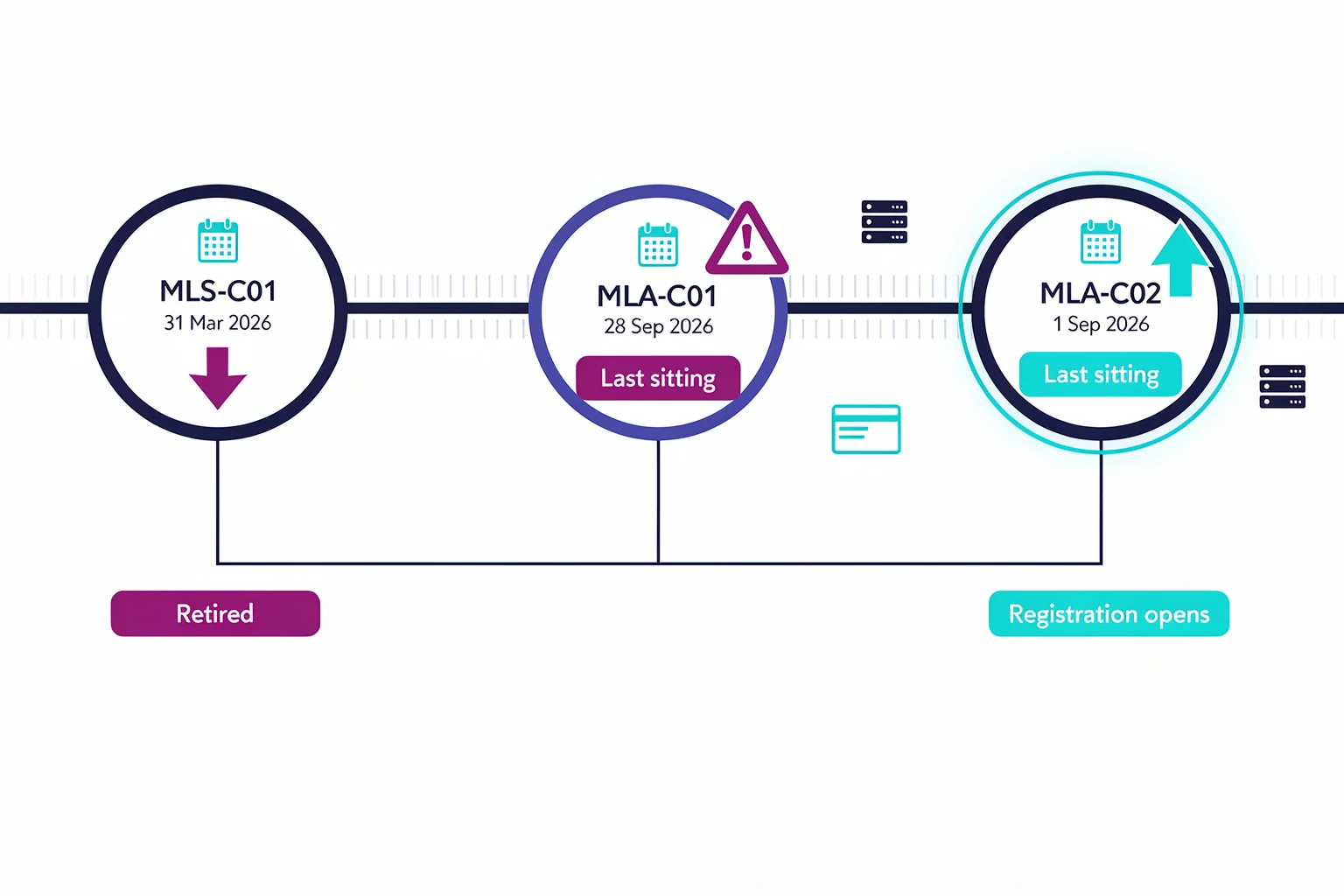
If you’ve been tracking AWS machine learning certifications this year, you already know the ground has shifted. The MLS-C01 exam—the Specialty-level machine learning credential—retired on 31 March 2026. Meanwhile, the AWS Certified Machine Learning Engineer – Associate (MLA-C01) is getting a major refresh. Registration for the updated version, MLA-C02, opens on 1 September 2026. Those aren’t just administrative changes. They signal a real pivot in the set of top AWS machine learning tools that certification candidates need to know. The tools you should be fluent with today aren’t the same list you would have memorised a year ago.
What changed with the AWS ML certifications
The retirement of MLS-C01 removed the most advanced, broad-scope ML exam from AWS’s roster. In its place, the MLA-C01 already focused on the hands-on engineering skills of deploying and operating ML workloads. Now the MLA-C02 update goes further. AWS hasn’t published the final exam blueprint yet, but the AWS Certification Exam Updates to Watch in 2026 resource captures what we know so far. The new exam will lean harder into generative AI, foundation model deployment on Amazon Bedrock, and MLOps with Amazon SageMaker AI—all areas where the tooling has evolved rapidly.
That means if you’re studying from an MLS-C01‑era syllabus, you’re likely spending time on services that have dropped in priority or been replaced entirely by AWS’s newer stack. Even those who passed MLA-C01 should revisit their knowledge: the MLA-C02 isn’t a minor revision. It introduces fresh domains around responsible AI, model monitoring at scale, and agent-based workflows. The exam itself remains at the associate level, but the depth on tools like SageMaker Model Cards and Bedrock Agents reflects the direction AWS is taking its platform.
Why the tool map looks different now
There’s a simple reason the exam content shifted: the way teams actually build ML on AWS has changed. Three years ago, a typical workflow involved spinning up a SageMaker notebook instance, training an XGBoost model, and deploying it to a real-time endpoint. Today, that’s only one of many patterns. Foundation models accessed through Bedrock, Hugging Face integrations into SageMaker Studio, and agentic AI workflows built with Bedrock AgentCore are now mainstream. AWS’s own recommendation engine has moved toward Bedrock as the starting point for generative AI, while SageMaker AI remains the workhorse for custom models.
The AWS Well-Architected Machine Learning Lens reinforces this split: it organises guidance around the full ML lifecycle, from data engineering to deployment and monitoring, with equal attention to traditional supervised learning and to foundation-model operations. For exam candidates, that translates into needing comfort with both worlds. You can’t just memorise a few SageMaker API calls and call it done. You need to understand when to fine-tune a model in SageMaker versus when to prompt-engineer in Bedrock, and how to govern both paths.
The AWS ML tools that matter most going forward
Based on the announced MLA-C02 domains and the service coverage in recent AWS certification updates, here are the top AWS machine learning tools you’ll want under your fingers—and that you can expect to see in exam scenarios.
Foundation models and generative AI
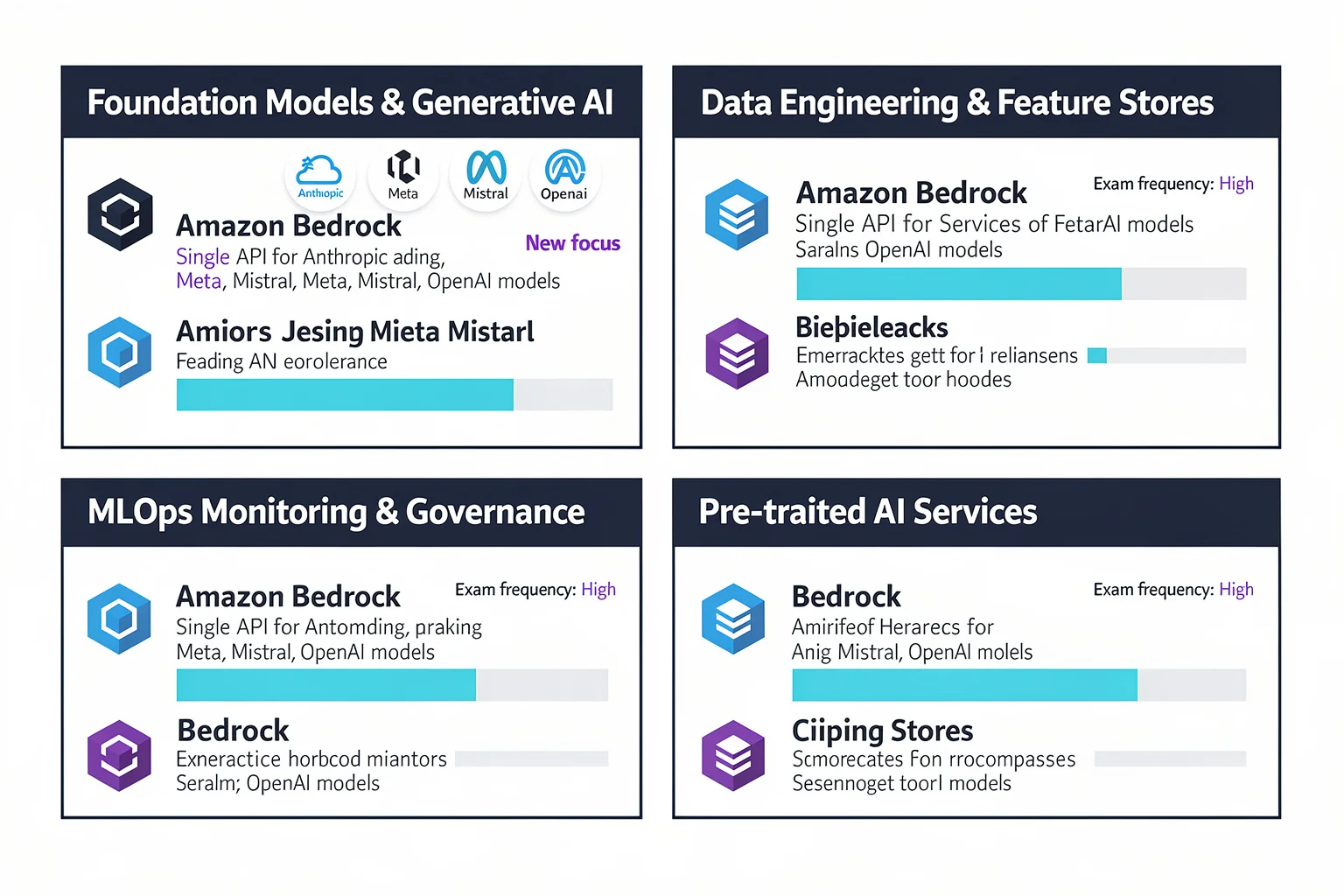
Amazon Bedrock is now the front door to foundation models on AWS. It gives you a single API to call models from AI21 Labs, Anthropic, Cohere, Meta, Mistral, Stability AI, and—as of July 2026—OpenAI GPT-5.6 Sol, Terra, and Luna, plus xAI’s Grok 4.3. The exam may ask you to choose the right Bedrock inference parameter, select an appropriate model for a document-summarisation task, or troubleshoot a model invocation that returns a throttling error. Expect to see questions about Bedrock Agents and Knowledge Bases, too.
Example Bedrock invocation using the AWS CLI
aws bedrock-runtime invoke-model
--model-id anthropic.claude-3-sonnet-20240229-v1:0
--body '{"prompt":"\n\nHuman: Summarise this log file.\n\nAssistant:"}'
--cli-binary-format raw-in-base64-out
output.json
Amazon SageMaker AI remains the core platform for building, training, and deploying custom models. The renamed service (SageMaker AI instead of just SageMaker) reflects deeper integration of foundation model workflows alongside classic ML. SageMaker JumpStart now lets you launch a Hugging Face model with a single click from the Hugging Face hub directly into SageMaker Studio. For the exam, you’ll need to know how to configure training jobs, set up hyperparameter tuning, manage endpoints with auto-scaling, and use SageMaker Pipelines for MLOps.
While you’re working through these commands, a quick pass through some MLA-C01 sample questions can highlight whether you’re over-indexing on theory and missing the practical troubleshooting details the exam rewards.
Data engineering and feature stores
AWS Glue (for ETL and cataloguing) and Amazon SageMaker Feature Store now appear in multiple exam domains. The MLA-C02 blueprint includes a dedicated data engineering section. You should be able to write a Glue job that transforms raw Parquet data into a format SageMaker can consume, and then store features online for low-latency inference.
Amazon Kinesis Data Streams and Kinesis Data Firehose show up often in real-time inference pipelines. A typical scenario: a third-party IoT sensor sends data to Kinesis, a Lambda function preprocesses it, and a SageMaker endpoint returns a prediction. That flow is practically a guaranteed exam pattern.
MLOps, monitoring, and governance
AWS Step Functions now integrates natively with SageMaker Pipelines, giving you a serverless way to orchestrate multi-step ML workflows. Combined with Amazon EventBridge for event-driven triggers, this pairing lets you build automated retraining pipelines—a topic you can’t afford to skip.
For monitoring, Amazon CloudWatch and SageMaker Model Monitor are the go-to tools. The exam might describe a scenario where a model’s prediction accuracy drifts over time and ask you which service to use for automated detection. Model Monitor captures data quality, model quality, and bias drift, feeding metrics into CloudWatch alarms.
On the governance side, AWS’s commitment to responsible AI surfaces in the MLA-C02 blueprint. Amazon SageMaker Model Cards is one of the newer services you’ll need to know. It generates a structured document capturing a model’s intended use, risk rating, training details, and evaluation metrics. You can export it to a PDF for compliance audits. Expect a question like: “A financial services company needs to document every model’s risk profile before production. Which service should they use to create an auditable record?” The correct answer is Model Cards.
Pre-trained AI services worth knowing
While the exam focus has shifted toward generative AI and custom models, the legacy AI services haven’t vanished. Amazon Comprehend (text analytics), Amazon Rekognition (image and video analysis), and Amazon Textract (document extraction) still appear in integration scenarios. However, AWS now gives you a choice of 23 pre-trained services, according to its Choosing an AWS machine learning guide. In the exam, you’re more likely to be asked to combine a pre-trained service with a custom Bedrock agent than to build a standalone Rekognition project.
How to adjust your study plan for the new exam reality
If you’re holding an active MLS-C01 certification, your credential remains valid for three years from the date you passed. But the knowledge gap between MLS-C01 and MLA-C02 is real, and a lot of MLS-C01 holders are realising that their expertise needs a refresh. I’d recommend starting with a skill inventory: list the tools you used on your last project, then cross-reference them against the Cloud Foundations blueprint changes and the new MLA-C02 content outlines. You’ll quickly spot where SageMaker AI, Bedrock, and MLOps services have displaced older methods.
Hands-on practice matters more than ever. AWS Skill Builder now offers Lab Maker, an AI-powered tool that generates personalised labs for popular AWS services, which can help you build muscle memory with the new tooling. If you prefer a structured approach, PlanetCert’s practice tests cover the exact exam domains and are updated as blueprints change. Working through a set of MLS-C01 sample questions gives you a benchmark of how your existing knowledge lines up against the associate-level expectations—just keep in mind that the question style for MLA-C02 will feel a little different, with more scenario-based items around Bedrock and SageMaker AI.
Time-box your study. I’ve seen many candidates succeed with a four-week plan: two weeks for core tools and hands-on labs, one week for practice exams and gap analysis, and the final week for weak-area drilling with flashcards and simulator sessions. If you’re juggling work, the simulator’s timed mode helps you build exam stamina in 30-minute chunks.
Questions candidates are asking about the new exams
I already passed MLS-C01. Is my certification void?
No. Your MLS-C01 certification remains valid for three years from the date you passed. It still carries weight on your CV. But to stay current, consider pursuing the MLA-C02 when it becomes available, or the new GenAI Developer Professional credential, which covers Bedrock and generative AI applications in depth.
Can I still sit the current MLA-C01 exam?
Yes. The last day to take MLA-C01 in English is 28 September 2026. If you’ve been preparing for MLA-C01, you can still take it, but you’ll eventually need to recertify on the updated version. Many candidates are waiting for MLA-C02 to avoid taking the exam twice.
Which tools are likely to drop off the exam?
Expect less emphasis on Amazon Elastic Inference (already retired) and AWS Deep Learning AMIs as standalone resources. The new exam treats SageMaker AI as the default for custom model training and leans on Bedrock for anything involving foundation models. Tools like AWS DeepRacer and DeepLens, which once appeared in entry-level demos, are now absent from official training materials.
How deep does the exam go on generative AI?
MLA-C02 doesn’t require you to build a foundational model from scratch. It tests your ability to select the right model on Bedrock, configure inference parameters, set up Agents and Knowledge Bases, and apply responsible AI practices using tools like SageMaker Model Cards and Guardrails for Amazon Bedrock. You’ll also need to understand cost optimisation patterns for high-volume token usage.
Are PlanetCert’s practice tests already updated for MLA-C02?
PlanetCert’s question bank for MLA-C01 closely mirrors the core MLA-C02 domains, and the team adds new items as AWS releases detailed blueprints. The 5 AWS exams candidates get wrong about 2026 retirements article can help you identify common misconceptions about version transitions, so you don’t waste time studying the wrong objectives.
Dig deeper into AWS certification shifts
- AWS Data Engineer Associate: Step-by-Step Prep Path
- Best AWS Certification Path Diagrams to Chart Your Cloud Career
- How to Pass the AWS Data Engineer Associate Exam in 30 Days
browse the relevant exam page and purchase a practice test

Discussion
Question Comments
0 comments·0 participantsSign in to leave a comment and access more free questions.