

Best AWS Certification Path Diagrams to Chart Your Cloud Career
If you've ever stared at AWS's certification page and felt more confused than when you started, you're not alone. AWS now offers twelve certifications across four levels, and the hardest part isn't passing the exams — it's figuring out which one to take next, and in what order. A clear certification path diagram can turn that uncertainty into a one-page plan. But not every visual guide is worth printing out. Some are outdated, some bury the exam codes you actually need, and a few lead candidates down dead ends that haven't been recommended since 2024.
I've spent the last week pulling apart the most commonly shared diagrams and roadmaps, checking each one against the current exam guides and the latest certification changes. Here's what holds up, what doesn't, and which one belongs on your study wall.
What Separates a Useful Diagram from a Pretty Poster
Before naming names, let's set a baseline. A good certification path diagram needs three things: completeness, currency, and role alignment. If it's missing any of those, you're better off reading the exam guide directly.
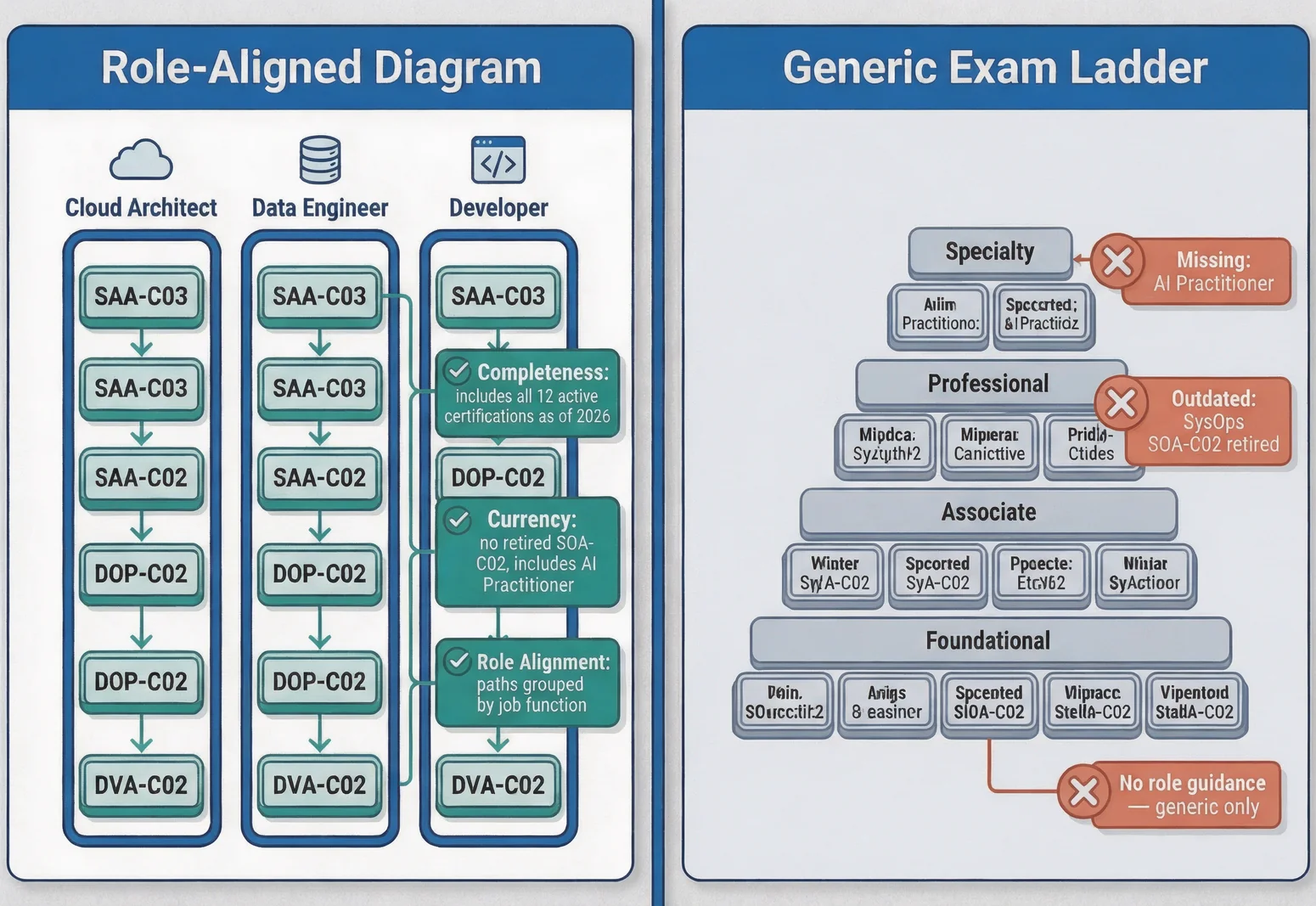
Completeness means the diagram shows every active certification at every level. AWS certification count has been stable since mid-2025, but some older visuals still show the retired SysOps Administrator — Associate under SOA-C02 rather than the current CloudOps Engineer path, or they omit the AI Practitioner entirely. That's a deal-breaker.
Currency is about more than exam codes. The diagram should note when a cert was last updated, or at least not contradict what the AWS Certification Exam Guides show. If you find a roadmap that still lists SAA-C02 as the current Solutions Architect Associate exam, close the tab.
Role alignment is the trickier one. A diagram can be complete and current but still useless if it doesn't map certifications to the job you actually want. The best visuals connect exams to roles: cloud architect, data engineer, security specialist, and so on. Without that, you're just looking at a list of exam codes with no decision logic.
With those three criteria in mind, here's how the available diagrams measure up.
The AWS Certification Paths PDF: Official and Role-Aligned
The most authoritative source you'll find is the official Plan your AWS Certification Journey PDF hosted on awsstatic.com. This isn't a blog post or a third-party interpretation — it's the same document AWS updates whenever the certification portfolio changes.
What makes this diagram stand out is its job-role focus. Instead of a generic pyramid of certs, the PDF presents distinct paths for application architects, cloud data engineers, software development engineers, cloud engineers, and several business roles. Each role gets a short list of recommended certifications in sequence, with optional add-ons like the AI Practitioner for those who want to layer AI skills onto their existing path.
The PDF is updated regularly, but it's not versioned in a way that makes the revision date obvious. Candidates who download it in July 2026 will see the current lineup, but there's no easy way to tell whether you're looking at a six-month-old copy. If you rely on this diagram, bookmark the AWS exam guides page alongside it and cross-check the exam codes once a quarter.
A second strength of the PDF is that it covers both technical and non-technical career switchers. The "From a non-IT background" flow starts you with Cloud Practitioner and then routes you to AI Practitioner, which is now AWS's recommended second step for newcomers who want to demonstrate cloud literacy quickly. That's a nuance many third-party roadmaps miss because they assume every reader is already in a technical role.
The PDF's main limitation is that it's a static page. It doesn't link to study resources or explain the differences between similar exam names, so you'll still need to visit the exam guides to understand what each test covers and how much it costs. But as a one-page reference that shows you what path to follow based on your actual job title, it's the strongest starting point.
The AWS Certification Website: Interactive but Not a Single Visual
When you land on the AWS Certification page, you're greeted with a smooth, interactive layout that lists every certification by level, with collapsible sections for Foundational, Associate, Professional, and Specialty. It's not a single diagram you can print, but it's the most current representation of the certification hierarchy — and it's the one page AWS keeps updated in real time.
The site's strength is its click-through detail. Each certification tile links to the exam guide, sample questions, and preparation resources. For someone still exploring, this is genuinely useful. You can browse the role-based certs, read the target candidate descriptions, and get a sense of which exam matches your day job without downloading anything.
The downside, of course, is that it doesn't function as a path diagram in the traditional sense. There's no visual sequencing between certs, no recommended order, and no connection to specific career tracks. It's more of a catalogue than a roadmap. If you already know you want to go from Cloud Practitioner to Solutions Architect Associate and then possibly to the Professional level, the website won't draw that line for you.
Still, I keep it bookmarked as a validation source. Before you commit to any third-party roadmap, open the AWS certification page and verify that the exams listed match. If a third-party diagram shows a cert at the Associate level that the AWS page has moved to Professional, that's a red flag. Use the site as your truth check, not your daily planner.
Community-Built Roadmaps: When to Trust Independent Diagrams
Several independent developers and training blogs have published their own visual roadmaps, and a couple of them are genuinely well done. The Sailor.sh roadmap (updated in March 2026) stands out because it includes realistic timelines — showing, for example, that a Solutions Architect Associate might take 2-3 months of study for someone with prior cloud experience, while a Professional-level cert could eat up five months. It also sequences exams for specific career paths, like moving from Data Engineer Associate to Database Specialty or Machine Learning Specialty.
ExamCert.app's ladder-style diagram takes a different approach, stacking exams from foundational to professional and including cost and study-hour estimates directly on the visual. That's helpful for someone budgeting time and money, but the estimates are averages and won't apply to everyone. You also need to check that the exam codes align with the current AWS exam guides, because third-party roadmaps can lag behind by a few months.
The risk with any independent diagram is freshness. When AWS retires an exam or introduces a new one — as they did with the AI Practitioner and the revamped CloudOps Engineer — independent roadmaps often don't get updated immediately. If you're planning your certification journey for the second half of 2026, make sure any community roadmap you use references the latest AWS certification exam updates. It's also worth reviewing which AWS exams are retiring in 2026 so you don't accidentally prep for a test that's about to vanish.
That said, the best third-party diagrams do something the official AWS materials don't: they contextualise the certs within the broader technology job market. For example, a roadmap that notes the Solutions Architect Professional is increasingly valued in enterprise migration projects gives you career intelligence that a static PDF can't offer. Treat these diagrams as supplementary, not primary.
How to Turn Any Diagram into an Actionable Study Plan
Having a diagram pinned to your wall is great, but it won't pass an exam for you. The real value of a path diagram is that it forces you to make a sequence decision. Let me give you a concrete example.
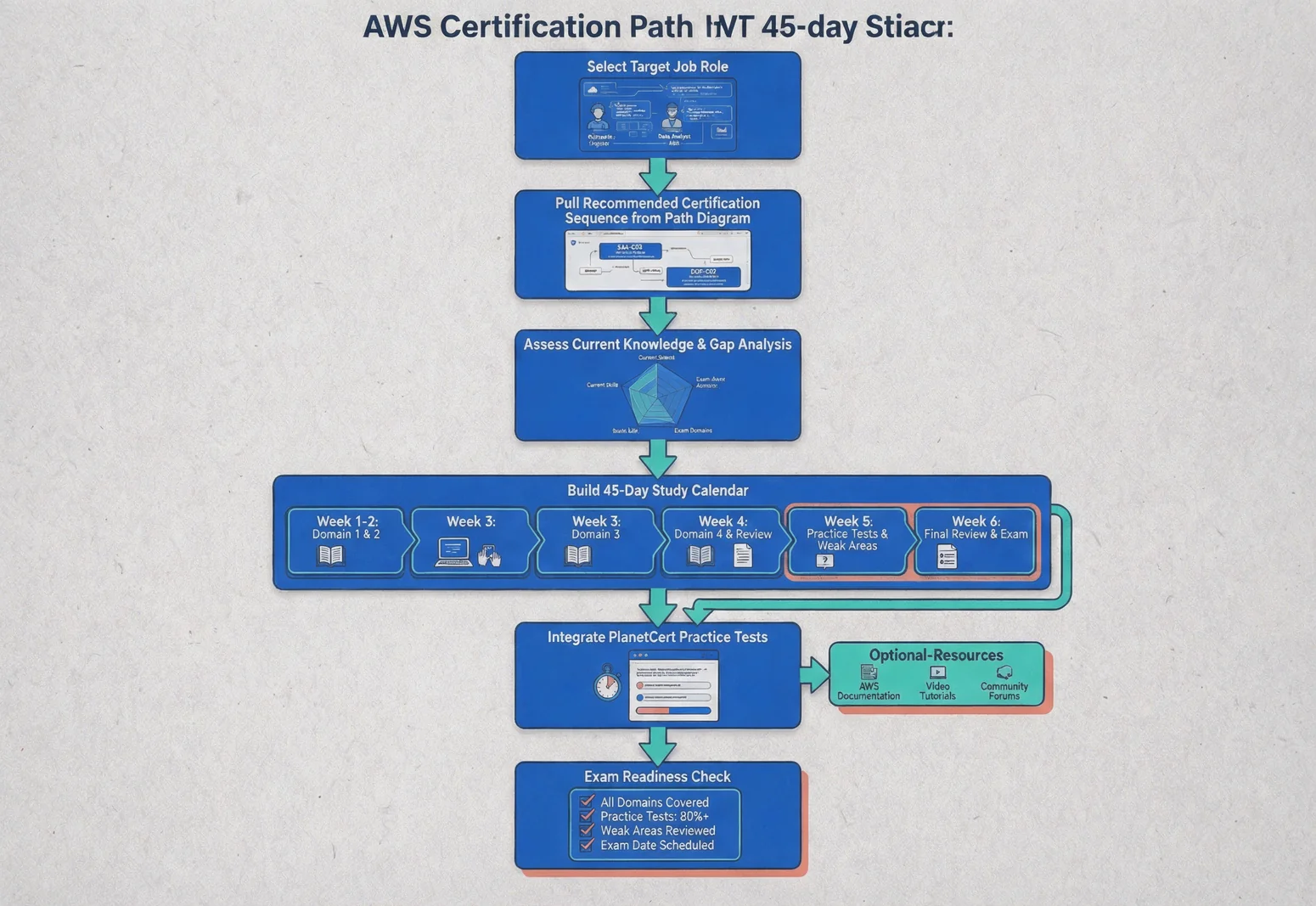
Priya has been a systems administrator for three years, all on-prem. She wants to move into a cloud role but isn't sure whether to start with Cloud Practitioner or jump straight to an Associate-level cert. She pulls up the official AWS certification paths PDF and finds her role — cloud engineer — in the list. The PDF recommends starting with Cloud Practitioner (CLF-C02) as the foundation, then moving to the CloudOps Engineer — Associate (SOA-C03) and optionally adding the AI Practitioner (AIF-C01). That sequence makes sense because it matches her day-to-day operational mindset.
Priya then cross-references the AWS Cloud Practitioner exam guide to understand exactly what CLF-C02 covers, and she notices that the exam fee is reasonable enough to book it without overthinking. She marks her calendar for a test date 45 days out, uses the diagram to visualise her long-term goal, and gets moving.
That's what a good path diagram does: it shortens the decision paralysis. If you find yourself bouncing between three different roles in your head, pick the one most adjacent to your current job title, trace the recommended path on the official PDF, and commit to the first exam. After that, the next step becomes obvious.
"Your AWS Certification tells employers, clients, and teammates what you're capable of." — AWS Training and Certification Blog, June 2026
Questions That Trip Up Candidates (Even After They've Seen a Diagram)
Do I need to pass every certification on a path? No. Most diagrams show the full set of relevant exams as a menu, not a mandatory checklist. Pick the ones that align with the role you want next. Very few professionals hold more than four or five active AWS certs at once.
Can I skip Cloud Practitioner if I have hands-on AWS experience? Absolutely. The official AWS materials note that Cloud Practitioner is optional for candidates with an IT or STEM background. If you've been building on AWS for a year or more, go straight to the Associate-level exam that matches your role — but I'd still skim the CLF-C02 blueprint to spot any foundational gaps.
What about the AI Practitioner — is it worth adding? In 2026, the AI Practitioner has become a frequent second step after Cloud Practitioner, especially for candidates without a development background. It's a short, broad exam that shows employers you can talk about AI/ML services at a level that supports business decisions. If your path diagram includes it as an optional layer, treat it as a low-cost way to differentiate yourself in a job market where AI literacy is increasingly expected.
How do I know if a diagram is outdated? Compare its exam codes against the AWS Certification Exam Guides page. If any code doesn't match the current version, the diagram is stale. This is especially important for Associate-level certs, which tend to get revised every two to three years.
Once I pick a path, where do I go from there? That's where structured practice comes in. Online simulators can replicate the timing and question format so you walk into the exam centre knowing exactly what to expect. If you've mapped out your path to the Solutions Architect Associate, for instance, a focused SAA-C03 question bank can surface the weak spots before they cost you a retake.
Keeping Your Path Fresh After You've Locked It In
- AWS Certification Exam Updates to Watch in 2026
- How to Pass the AWS Cloud Practitioner CLF-C02 on Your First Attempt
- AWS Data Engineer Associate: Step-by-Step Prep Path
browse the relevant exam page and purchase a practice test

Discussion
Question Comments
0 comments·0 participantsSign in to leave a comment and access more free questions.