

How to Pass the AWS Cloud Practitioner CLF-C02 on Your First Attempt
Most people who fail the CLF-C02 do not lack ability. They lack structure. They treat a foundational cloud exam like a trivia quiz, cram for three days, and walk into the testing centre guessing between two answers that both sound plausible.
I have seen this pattern repeatedly across candidate forums and training cohorts. The people who pass on their first attempt share one trait: they treat preparation as a project with a deadline, not as a topic to get around to eventually. This guide gives you that structure. It covers a realistic 2-4 week timeline, how to use practice tests as diagnostic tools rather than reassurance crutches, and the specific mistakes that cause first-time failures.
If you have already booked your exam—or you are deciding whether to book it—this walkthrough will show you exactly what to do between now and test day.
What the CLF-C02 Actually Tests
Before you open any study resource, understand what AWS expects. The CLF-C02 exam overview breaks the assessment into four domains:
| Domain | Weight | Focus |
|---|---|---|
| Cloud Concepts | 24% | Value proposition, design principles, economics |
| Security and Compliance | 30% | Shared responsibility model, IAM, compliance programs |
| Cloud Technology and Services | 34% | Core AWS services, use cases, architectural decisions |
| Billing, Pricing, and Support | 12% | Pricing models, cost optimisation, support plans |
Notice the weighting. Security and compliance plus cloud technology and services together account for 64% of your score. If you are short on time, those two domains deserve disproportionate attention. The billing domain is the smallest, yet it trips up candidates who assume it is just common sense. AWS pricing has specific mechanics—reserved instances, savings plans, tiered storage—that reward precise knowledge.
The exam format is 65 questions in 90 minutes, either multiple choice or multiple response. There is no hands-on lab component. The passing score is 700 out of 1000, but AWS uses scaled scoring, so you cannot calculate a simple percentage. Your goal is comfortable consistency across all four domains, not perfection in one and weakness in another.
One detail many overlook: the exam includes 15 unscored questions that AWS uses for statistical evaluation. You will not know which these are. This means your effective accuracy on the 50 scored questions needs margin above the nominal 70% threshold. Aim for mastery, not minimums.
Mapping Your 2-4 Week Study Timeline
The right timeline depends on your starting point. If you use AWS services daily in your role, two weeks of focused review may suffice. If cloud concepts are new to you, plan for four weeks. Here is a structure that works for either duration.
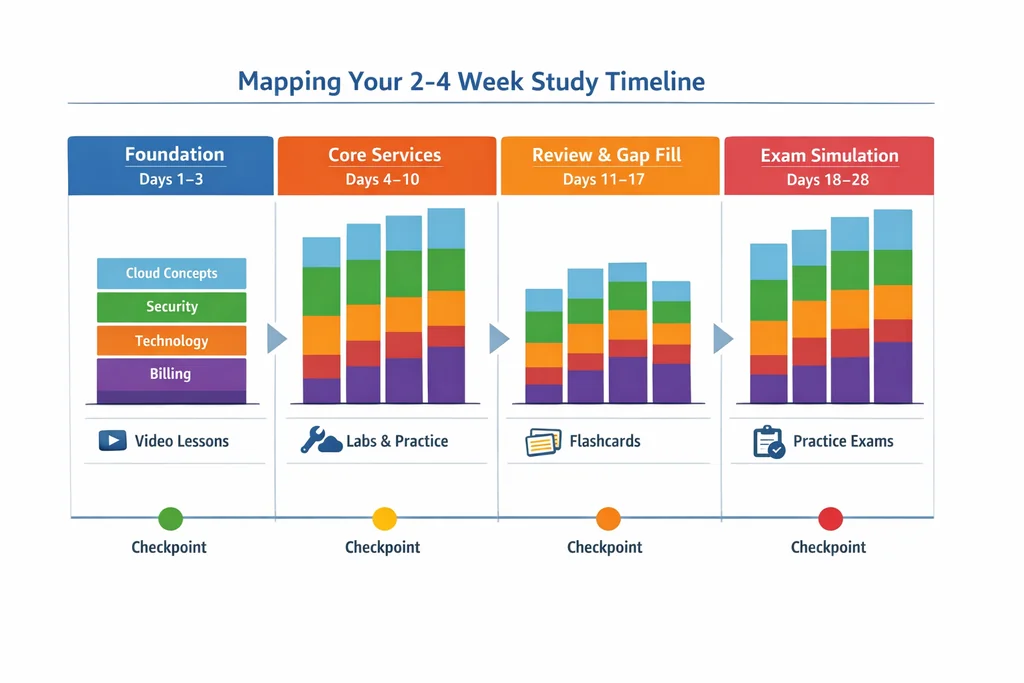
Week 1: Foundation and diagnostic
Start with the official AWS exam guide. Read it once to understand domain boundaries. Then take a full practice test cold—no preparation, no peeking at notes. This is your diagnostic. The score matters less than the pattern. Which domains show gaps? Which question styles confuse you?
Spend the remainder of week one on cloud concepts and security fundamentals. These are the most conceptual domains, and they underpin everything else. Do not memorise service lists yet. Focus on understanding why AWS structures security the way it does, why the shared responsibility model exists, and how cloud economics differ from on-premises capital expenditure.
A useful mental model for cloud concepts: think of AWS as a utility, not a product. You do not buy a server; you rent capacity by the hour. This shift from capital expenditure to operational expenditure changes how organisations plan, budget, and scale. The exam tests whether you understand these implications, not whether you can list the six advantages of cloud computing from memory.
Week 2: Services, use cases, and active recall
This is where you dive into the service catalogue. EC2, S3, RDS, Lambda, VPC, Route 53, CloudFront—the core services that appear repeatedly. For each service, learn three things: what it does, when you would choose it, and what you would pair it with.
Use flashcards for active recall. The act of retrieving information strengthens memory far more than re-reading. If you are using PlanetCert's materials, the flashcard sets are organised by domain, which lets you weight your effort toward the 64% of content that drives your score.
When studying services, avoid the trap of learning in isolation. The exam presents scenarios, not definitions. You need to know that S3 stores objects, but more importantly, you need to recognise when a scenario describes object storage versus block storage versus file storage. The what is easy; the when is what separates pass from fail.
Consider this scenario: a media company needs to store video archives that are rarely accessed but must be retained for seven years. The correct storage class is S3 Glacier Deep Archive, not S3 Standard-IA, because retrieval frequency is extremely low and cost dominates the decision. Candidates who memorise "Glacier = backup" without understanding the cost-retrieval trade-off choose incorrectly when the scenario emphasises long-term retention over occasional access.
Week 3: Billing, pricing, and mixed practice
The billing domain is small but technical. Learn the difference between on-demand, reserved, and spot pricing. Understand when savings plans beat reserved instances. Know the support plan tiers and what each includes.
More importantly, begin mixed-domain practice tests. Single-domain quizzes build knowledge; mixed tests build exam stamina. The real exam jumps between security, architecture, and pricing without warning. Your brain needs practice in context-switching under pressure.
For billing specifically, create a quick-reference card with pricing model use cases. Spot instances for fault-tolerant batch work. Reserved instances for predictable baseline capacity. Savings plans for flexible commitment with automatic application across instance families. The exam rewards knowing which model fits which scenario, not memorising price points that change anyway.
A common mistake: assuming reserved instances are always cheaper than savings plans. Reserved instances offer the deepest discount for specific instance types in specific regions. Savings plans provide comparable discounts with flexibility across instance families, regions, and even compute services. If a scenario mentions unpredictable growth or multi-region deployment, savings plans are usually the better answer.
Week 4: Weak-area targeting and simulation
By now your diagnostic data is clear. Spend 60% of your time on your weakest domain, 40% on maintaining strength elsewhere. Run at least two full timed simulations in conditions that mimic test day: quiet room, no interruptions, strict 90-minute limit.
The final two days before your exam should be light review only. Cramming new material creates confusion and anxiety. Trust your preparation.
If your timeline is compressed to two weeks, collapse weeks one and two into a single foundation-plus-services block, then move immediately to mixed practice. You will sacrifice some depth, which makes your diagnostic phase even more critical for efficient targeting. With only two weeks, you cannot afford to study what you already know. The cold practice test becomes your filter for where every hour must go.
Using Practice Tests as Diagnostic Tools
This is where many candidates go wrong. They treat practice tests as confidence builders, taking the same quiz repeatedly until they score 90%. That is wasted effort. You are not learning; you are memorising answer positions.
The effective approach uses three distinct practice test phases:
Phase 1: Diagnostic (one test, untimed, no notes)
Take this before any serious study. Your goal is a question-by-question inventory of gaps. Do not review explanations yet. Mark your uncertain answers and move on.
The diagnostic phase reveals something important: your instinctive mistakes. These are errors you make when reasoning from partial knowledge, and they are the hardest to unlearn. A candidate who consistently confuses security groups with network ACLs, for example, has a mental model problem that re-reading definitions will not fix. They need to articulate the difference explicitly: security groups are stateful and operate at the instance level; network ACLs are stateless and operate at the subnet level. One allows return traffic automatically; the other requires explicit rules.
Phase 2: Learning (domain-focused, immediate review)
After studying a domain, take a targeted quiz. Review every explanation immediately, including questions you answered correctly. The explanation often contains context that deepens your understanding or corrects a lucky guess.
The CLF-C02 practice questions are structured for this phase. Each explanation references the relevant AWS documentation and explains why distractors are wrong, not just why the correct answer is right.
This matters because AWS writes sophisticated distractors. Wrong answers are rarely nonsense; they are plausible services applied to slightly wrong scenarios. Understanding why a distractor fails in a specific context prepares you for the next variation of that question.
Phase 3: Simulation (full tests, timed, spaced repetition)
In your final week, take full timed tests with at least 48 hours between attempts. This spacing prevents recognition-based answering and forces genuine recall. Your scores should trend upward. If they plateau, you have a review problem, not a test problem.
Aim for consistent scores in the 80-85% range before sitting the real exam. The official exam includes unscored questions that do not affect your result, so your effective accuracy on scored items needs margin.
For additional question variety, the more CLF-C02 questions provide supplementary scenarios that test the same objectives from different angles. Exposure to varied question wording reduces the risk of pattern-matching instead of reasoning.
Common Pitfalls That Cause First-Time Failures
After analysing failure patterns across hundreds of candidate reports, several mistakes appear repeatedly. Avoiding these is as important as knowing the material.
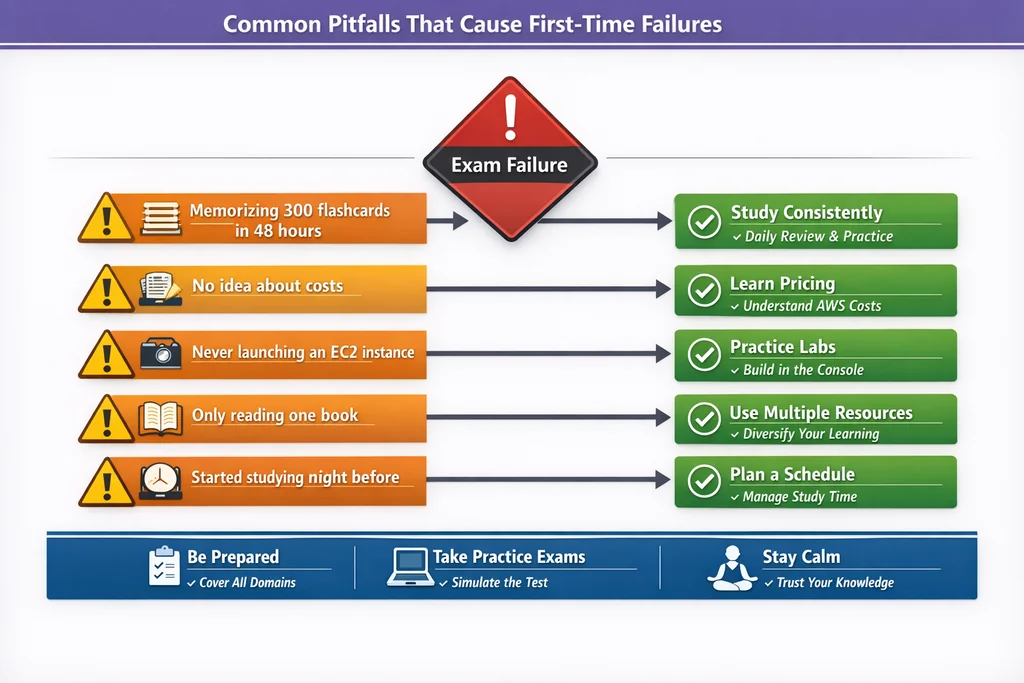
Pitfall 1: Confusing similar services
AWS designs distractors around services with overlapping functions. S3 Standard versus S3 Standard-IA versus S3 One Zone-IA. NAT Gateway versus Internet Gateway. RDS Multi-AZ versus read replicas. The exam tests whether you know the specific use case and trade-off, not whether you have heard of both services.
Build comparison tables for service pairs that confuse you. The act of articulating differences in your own words forces precision.
Here is a practical example: NAT Gateway and Internet Gateway both enable outbound internet connectivity, but from different starting points and with different security implications. An Internet Gateway attaches to a VPC and allows instances with public IP addresses to reach the internet directly. A NAT Gateway sits in a public subnet and allows instances in private subnets to initiate outbound connections without exposing them to inbound traffic. The exam might describe a database server that needs to download patches but must not be publicly accessible. The correct answer is NAT Gateway, not Internet Gateway, because the requirement is outbound-only from a private subnet.
Pitfall 2: Neglecting the shared responsibility model
This appears in the security domain and indirectly in architecture questions. Candidates often assume AWS handles more than it does, or less. Know exactly where AWS responsibility ends and customer responsibility begins for IaaS, PaaS, and SaaS offerings.
A common error: assuming AWS patches operating systems on EC2 instances. It does not, unless you use specific managed services. For standard EC2, OS patching is your responsibility. Misunderstanding this boundary leads to wrong answers on security and compliance questions.
The shared responsibility model shifts based on service type. With EC2 (IaaS), you manage the operating system, applications, and data; AWS manages the hypervisor and physical infrastructure. With RDS (PaaS), AWS manages the database engine patching and backups; you manage the data, schemas, and access control. With Amazon S3 (SaaS-like in its abstraction), AWS manages nearly everything except the buckets, objects, and IAM policies you configure. The exam frequently tests whether you recognise which party manages a specific component in a given service model.
Pitfall 3: Ignoring AWS-specific terminology
The exam uses precise AWS language. "Highly available" and "fault tolerant" are not interchangeable. "Elastic" and "scalable" have distinct meanings. Read questions slowly and match the terminology in the answer choices to the scenario described.
Consider the difference: high availability means the system continues operating during component failures, typically through redundancy across availability zones. Fault tolerance means the system continues operating without any degradation during component failures, often through automatic failover mechanisms that mask the failure entirely. Elasticity refers to automatic scaling in response to demand changes; scalability refers to the ability to handle growth, whether automatic or manual. Using these terms imprecisely leads to selecting answers that sound right but describe different architectural properties than the scenario requires.
Pitfall 4: Poor time management
Ninety minutes for 65 questions sounds generous until you hit a multi-response question requiring careful analysis. Budget roughly 75 seconds per question. If you are uncertain, mark and move on. The exam interface allows review, and a later question may trigger recall.
For deeper analysis of these failure modes, the AWS practitioner pitfalls guide expands on each with specific examples and correction strategies.
Pitfall 5: Using outdated materials
The CLF-C02 replaced CLF-C01 in September 2023. Older courses and practice tests still circulate. Verify that any resource you use explicitly references CLF-C02 objectives. The retired CLF-C01 questions can be useful for understanding exam evolution, but do not rely on them for current preparation.
Key differences between versions include expanded coverage of sustainability, more emphasis on container services (ECS, EKS, Fargate), and updated security services. If your study material mentions only EC2 and Lambda without addressing containerisation trends, it may be outdated.
Building Exam-Day Confidence
Technical knowledge is necessary but not sufficient. Test anxiety degrades performance for many capable candidates. Here are practical techniques that work.
Sleep and scheduling
Book your exam for your peak cognitive hours. For most people this is mid-morning, after the initial grogginess clears but before afternoon fatigue sets in. Avoid scheduling immediately after a work shift or during a period of heavy project pressure.
If you are taking the exam online from home rather than at a testing centre, prepare your environment in advance. Clear your desk of everything except your ID. Test your internet connection and webcam the day before. The 15-minute check-in process adds stress if you are scrambling to resolve technical issues.
Online proctoring has specific requirements that differ from testing centres. You need a private room with a closed door, no posters or writing visible on walls, and no other people entering during the exam. Your phone must be out of reach, not just silenced. Running through a mock check-in the day before identifies problems when you have time to fix them.
The 24-hour buffer
Do not study new material the day before. Review your comparison tables, skim flashcards, and rest. Your brain consolidates memory during sleep; give it the opportunity.
This buffer is particularly important for procedural knowledge. The shared responsibility model, pricing comparisons, and service selection criteria you have studied need integration time. Cramming new facts interferes with this consolidation and often produces the frustrating experience of knowing you studied something but being unable to retrieve it under pressure.
Question attack strategy
Read the question stem first, not the answers. Many candidates read all four options, form a preference, then bend the question to fit. Read the scenario, predict the answer type, then match to options. This reduces the influence of plausible distractors.
A practical technique: after reading the stem, cover the answer choices and articulate what you expect the answer to involve. If the scenario describes a static website needing global distribution with low latency, your prediction should include CloudFront and S3. Then uncover the choices and look for that pairing. This prevents the cognitive bias where an attractive but incorrect option redirects your reasoning.
Flagging discipline
Use the flag feature strategically. Flag questions where you have eliminated two options but remain uncertain between two. Do not flag questions where you have no idea; guess and move on. Return to flagged questions only if time permits, and avoid changing answers unless you have specific new reasoning.
Statistically, your first answer is more likely correct than a changed answer, unless you have identified a specific error in your initial reasoning. The temptation to change answers stems from anxiety, not improved analysis. Reserve changes for cases where you later remember a specific fact that contradicts your original selection.
What to Do After You Pass
The Cloud Practitioner is a foundation, not a destination. It validates broad awareness rather than deep implementation skill. Most candidates who earn it move toward role-based certifications: Solutions Architect, Developer, or SysOps Administrator.
If you are considering that path, the Solutions Architect sample questions give you early exposure to the next difficulty level. The jump from CLF-C02 to SAA-C02 is significant. The Associate-level exams include scenario-based questions with multiple valid services, requiring you to select the most cost-effective or operationally efficient option. Early exposure helps you calibrate whether your study habits need adjustment.
For example, a CLF-C02 question might ask which service provides object storage. The answer is S3. An SAA-C02 question might describe a workload with unpredictable traffic, strict latency requirements, and a need for SQL compatibility, then ask which database solution is most cost-effective while meeting performance needs. The answer requires comparing RDS, Aurora Serverless, and DynamoDB across dimensions the foundational exam treats separately.
For immediate next steps, update your LinkedIn and CV. The Cloud Practitioner carries recognition among hiring managers who value cloud literacy across technical and non-technical roles. It signals that you understand AWS fundamentals enough to participate meaningfully in cloud discussions, even if implementation is not your primary function.
Consider also whether your organisation has AWS training credits or partner programmes that subsidise further certification. Many companies invest in cloud upskilling once an employee demonstrates commitment by passing the foundational exam. The certification itself may unlock internal training budgets or partner-tier benefits that reduce costs for your next exam.
Questions Candidates Actually Ask
Do I need hands-on AWS experience to pass?
No, but it helps. The exam is conceptual. You can pass with strong theoretical knowledge and careful practice test work. However, candidates with even brief console experience often find service questions more intuitive because they have visual context for how services interact.
If you lack hands-on experience, the AWS free tier offers enough sandbox time to launch an EC2 instance, create an S3 bucket, and configure basic IAM policies. Even two hours of guided console work cements abstract concepts into memorable experience. Try this sequence: create an IAM user with limited S3 permissions, log in as that user, attempt to access EC2 (which should fail), then observe how the error message reflects the permission boundary you configured. This single exercise teaches IAM policy evaluation more effectively than reading about it.
How much does the exam cost?
As of early 2026, the standard exam fee is $100 USD. AWS occasionally offers discounts through training partners or promotional events. Check the official AWS certification portal for current pricing in your region.
Can I retake if I fail?
Yes, but the retake policy requires a 14-day waiting period and full fee payment for each attempt. This is why first-attempt preparation matters financially as well as professionally.
Are practice test scores predictive of real exam performance?
Generally, yes, if you use quality materials and simulate exam conditions. Consistent scores in the 80-85% range on timed, mixed-domain tests typically correlate with passing the real exam. Scores below 70% indicate significant gaps that warrant additional study before booking.
One caveat: prediction accuracy depends on question quality. Tests that reuse the same question pool or emphasise memorisation over reasoning may inflate scores without improving real exam readiness. Verify that your practice source updates questions regularly and explains reasoning rather than just stating correct answers.
How long is the certification valid?
AWS certifications are valid for three years. You can recertify by passing the current exam again or by earning a higher-level certification, which automatically extends lower-level validity.
Ready to start preparing? Browse the CLF-C02 exam page and purchase a practice test to begin your structured study plan.
Where to Go Next With Your AWS Certification Path
- AWS practitioner pitfalls guide
- Retired CLF-C01 questions
- Solutions Architect sample questions

Discussion
Question Comments
0 comments·0 participantsSign in to leave a comment and access more free questions.