
If you've been building cisco practice test lab scenarios in Packet Tracer and you're eyeing ENCOR, ENARSI, or the CCIE Enterprise lab, you've probably already hit the wall: the command you need either doesn't exist, silently accepts bad input, or the feature isn't in the device catalogue at all. That's not you doing it wrong. Packet Tracer is a teaching simulator with a curated command subset, and Cisco never intended it to carry you past CCNA-level work. This article walks through exactly where it stops — SD-WAN, DNA Center, ISE, advanced QoS — what Cisco Modeling Labs (CML) actually fixes, and how to close the remaining gap with scenario-based practice so your study time matches the exam blueprint instead of fighting your tooling.
What Packet Tracer actually simulates, and what it only imitates
Packet Tracer is not an emulator. It doesn't run Cisco IOS images; it runs a software model that mimics IOS behaviour for the features Cisco's education team chose to implement. That distinction matters more than any feature list.
For CCNA 200-301 work, the model is genuinely good. VLANs, inter-VLAN routing, OSPF single-area, static NAT, ACLs, EtherChannel, basic wireless — all of it behaves close enough to real gear that your muscle memory transfers. Where candidates get burned is assuming that closeness scales. It doesn't.
Independent testing cataloguing Packet Tracer's deviations from real IOS shows a consistent pattern: commands parse and accept input that real IOS would reject, show command output is simplified or missing fields, and entire subsystems (advanced routing policy, MPLS, most security features) are absent. The danger isn't the missing commands — those are obvious. It's the commands that exist but behave loosely. You can practise a syntax error in Packet Tracer for weeks and never know it, because the simulator accepted it.
A Cisco community thread from September 2025 captures the mood: long-time users asking for updated device models and command sets that track current exam content. The requests keep coming because the gap keeps growing as blueprints move toward controllers, automation, and policy-based fabrics — exactly the things a pedagogical simulator can't cheaply model.
So the honest framing for your study plan: Packet Tracer is a topology sketchpad and a CCNA trainer. Anything beyond that, you're borrowing confidence the tool can't repay on exam day.
The specific walls: SD-WAN, DNA Center, ISE, and QoS
Let's get concrete, because "Packet Tracer has limitations" is useless advice until you know which blueprint domains those limitations sit in.
SD-WAN
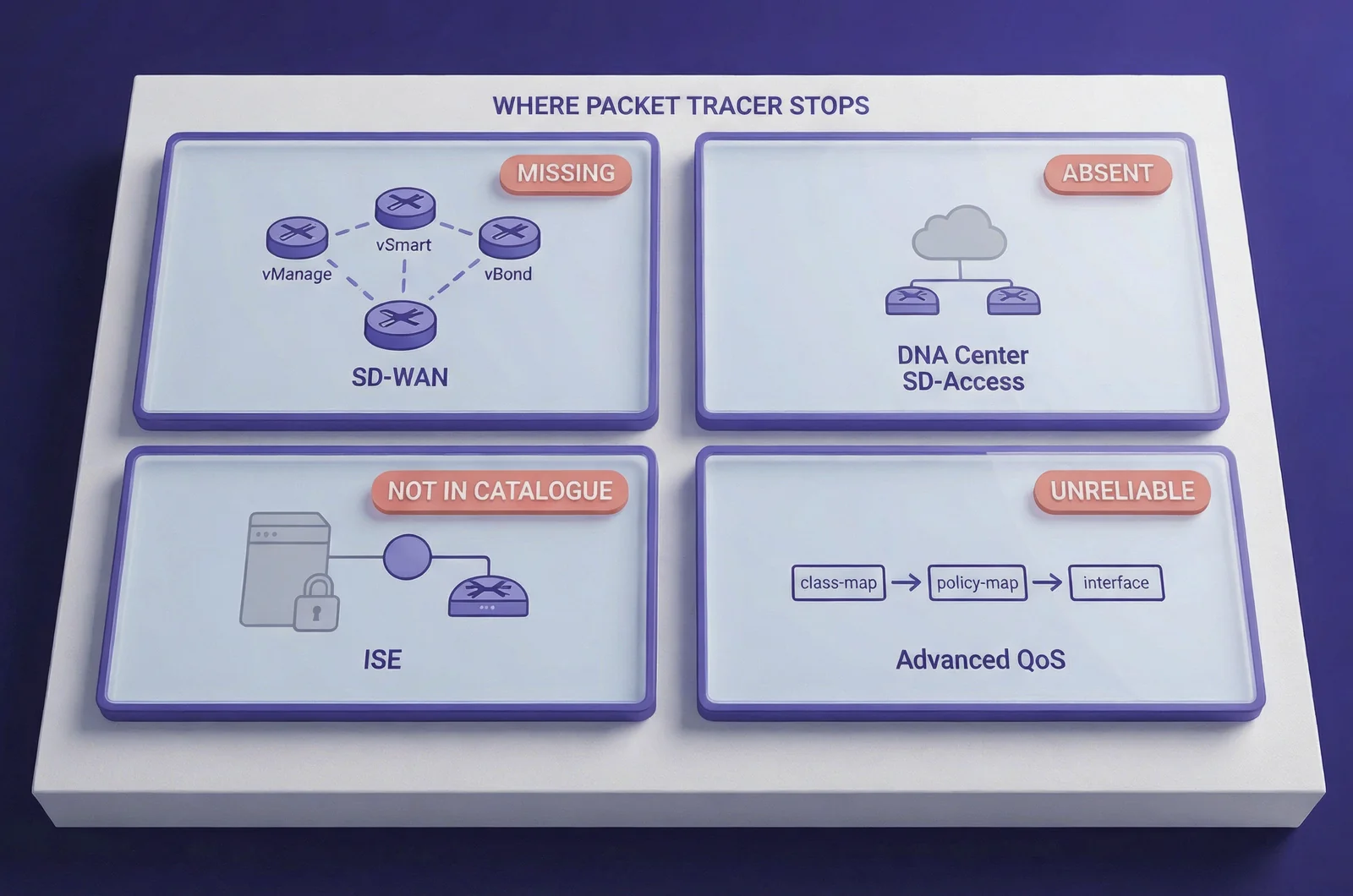
Cisco SD-WAN (the Viptela-derived architecture, now Catalyst SD-WAN) is a controller-based system. The whole point of it is the separation of management (vManage), control (vSmart), orchestration (vBond), and data plane (the WAN edge routers). There is no vManage, no vSmart, no vBond in Packet Tracer's device list, and no way to stand up the certificate-based control connections that make the overlay work. You cannot practise TLOCs, OMP, centralized vs localized policies, or application-aware routing — which is awkward, because SD-WAN design and implementation is a scored domain in both CCNP Enterprise concentration exams and the CCIE Enterprise Infrastructure lab.
This isn't a minor omission. On the CCIE EI lab, SD-WAN and SD-Access together represent a substantial slice of the eight-hour practical. If your only hands-on tool is Packet Tracer, you will meet those technologies for the first time in the exam.
DNA Center and SD-Access
Same story, different controller. Cisco DNA Center (now Catalyst Center) is a full appliance — assurance dashboards, SD-Access fabric provisioning, SDA border/control/edge roles, LISP and VXLAN under the hood, DNA spaces, templates, PnP workflows. None of it exists in Packet Tracer. You can build the underlay routing that an SDA fabric would sit on top of, but you can't practise anything the exam actually asks about the fabric itself: fabric site design, host onboarding, scalable group tags, policy enforcement through ISE integration.
Candidates prepping for ENARSI or ENSLD sometimes assume they can "lab the routing parts" in Packet Tracer and read the controller parts. That halves your preparation on an exam where the blueprint explicitly weights SD-Access.
ISE
Identity Services Engine is a policy server, not a router or switch, so its absence from a network simulator is unsurprising — but it's worth naming because 802.1X, MAB, TrustSec/SGTs, posture, and guest access show up across CCNP Security, the SCOR core, and the CCIE Security lab. The CCIE Security practice labs Cisco publishes include scenarios built around ISE and DNAC integration, including a newer scenario using updated versions of both — a quiet confirmation that these products are live exam content, not background reading.
Advanced QoS
This one is subtler, because Packet Tracer does have some QoS commands. The problem is fidelity. Real Catalyst and ISR platforms implement MQC (class-map / policy-map / service-policy) with hardware-specific queueing behaviours, shaping vs policing differences, and platform-dependent defaults. Packet Tracer accepts a subset of MQC syntax but doesn't reproduce queue behaviour, drops, or platform variations in any trustworthy way. For ENCOR's QoS domain or the CCIE lab's QoS tasks, "the command was accepted" tells you almost nothing about whether you configured it correctly.
Where CML picks up, and where it still stops
Cisco Modeling Labs is the obvious next step, and it's a genuinely different category of tool: CML boots real virtual machine images — IOSv, IOS XE (CSR1000v/Cat8000v), NX-OSv, ASAv — on a hypervisor. When you type a command in CML, you're talking to actual IOS XE code. Show output is real. Bugs are real. That realism is exactly what CCNP and CCIE candidates need for routing, switching, MPLS, segment routing, multicast, and QoS on IOS XE nodes.
The CML vs Packet Tracer comparison on Goldfish Networks puts it plainly: Packet Tracer simulates, CML virtualizes. For anything where command fidelity matters, virtualization wins by default.
But CML has its own edges, and candidates on the Cisco Learning Network ask about them constantly. One thread asking whether CML can build ACI, SD-Access and SD-WAN labs for CCIE Enterprise gets at the core issue: the controller-based parts of the blueprint don't run in a personal CML instance. vManage/vSmart/vBond and DNA Center images aren't part of the standard personal license, and even where people have sourced images, the resource requirements (RAM in the tens of gigabytes, plus licensing entanglements) put a full SD-WAN or SDA fabric beyond most home labs. A second thread on labbing SD-WAN in CML for CCIE study ends up in the same place: you can approximate pieces, but not the real controller workflow.
The official CML FAQ is worth reading before you buy, mainly to confirm the current licensing tiers and which node images are included in the personal edition. As of late 2026 the personal license sits around the $199/year mark for a 20-node limit, with a higher tier for more nodes — check the FAQ for the current numbers, because Cisco has adjusted both pricing and node caps over the years.
A practical way to think about the split:
| Task type | Packet Tracer | CML Personal | Cisco's hosted labs |
|---|---|---|---|
| CCNA switching/routing basics | Yes, well | Overkill but fine | Unnecessary |
| Advanced IOS XE routing, MPLS, QoS | No / unreliable | Yes — real images | Yes |
| SD-WAN overlay (vManage, policies) | No | Not realistically | Yes |
| DNA Center / SD-Access fabric | No | Not realistically | Yes |
| ISE, 802.1X, TrustSec | No | Not included | Yes (CCIE Security labs) |
| Command fidelity for syntax drills | Loose | Exact | Exact |
Cisco's own answer: hosted practice labs and graded labs
Cisco clearly knows the gap exists, because in recent years it started selling the missing piece directly. CCIE Practice Labs give you a fully functional, hosted lab environment in four-hour sessions (five hours for Data Center) at $50 per session, covering CCIE Enterprise Infrastructure, Security, Service Provider, Collaboration, and Data Center. The scenarios target specific technologies, and because all devices in the topology are live, you can also ignore the scripted scenario and run your own — which makes them the cheapest legitimate way to get real SD-WAN, SDA, and ISE seat time without owning the images.
Above that sits Graded Labs, Cisco's premium option: an exam-mirroring environment with automated grading and detailed feedback, priced around $1,000 (or 10 Cisco Learning Credits), one attempt per purchase, launchable within 90 days. That's a dress rehearsal price, and for most candidates it only makes sense in the final two or three weeks before a scheduled lab date.
The study-stack implication is straightforward:
- CCNA: Packet Tracer alone is fine. Spend your money on practice questions, not lab tooling.
- CCNP Enterprise/Security: CML Personal for the IOS XE-heavy domains, plus hosted sessions or sandbox time for controller topics.
- CCIE: CML for volume practice, Cisco's hosted practice labs for SD-WAN/SDA/ISE, and optionally one Graded Lab attempt as a final checkpoint.
Closing the gap with scenario-based practice tests
Here's the part most tooling comparisons skip: even with perfect lab access, labs don't teach you how Cisco phrases and scores exam tasks. The written CCNP exams (and the lab's design/troubleshoot sections) test whether you can read a scenario — "users on VLAN 40 can't reach the SaaS app after the policy change; which vSmart policy fixes it?" — and map it to a technology behaviour under time pressure. That's a different skill from configuring the thing, and it needs its own practice.
This is where well-built scenario questions earn their place. A good cisco practice test lab scenarios set does three things a simulator can't:
- It rehearses controller-era topics you can't lab. You can answer fifty scenario questions about vManage policy construction or ISE authentication flows in the time it takes to build one partial SD-WAN topology. For blueprint domains with no home-lab path, question banks with strong explanations are the main way to build recognition speed.
- It catches shallow understanding. Configuring OSPF in Packet Tracer until it works teaches you one path. Scenario questions force you through the paths that don't work, which is what troubleshooting items actually measure.
- It builds exam pacing. Timed simulator sessions train the read-decide-answer rhythm that eight hours of lab or 90 minutes of multiple choice demands.
The quality bar matters here. You want questions with full explanations (not just answer letters), coverage mapped to current blueprint versions, and a timed mode that mimics the real delivery engine. That's the niche PlanetCert's Cisco practice tests are built for — exam-style scenario questions with explanations, run in a timed web simulator — and it pairs naturally with whatever lab tool you chose above. If you're comparing question-bank styles, our guide to Boson CCNA practice exams breaks down how another leading Cisco-focused engine structures its scenarios, and the broader certification exam simulators roundup compares timed full-length formats across vendors.
One tool idea if you like planning visually: a simple gap-matrix spreadsheet — blueprint domains down the left, your tools across the top (Packet Tracer, CML, hosted labs, question bank), and a traffic-light in each cell for "can practise hands-on / question-only / no coverage." Ten minutes of filling that in usually reveals that controller-era domains are red across every hands-on column, which is your signal to weight scenario questions there.
A realistic stack for each certification level
Pulling it together, here's how I'd allocate effort and budget depending on where you're headed.
Studying for CCNA 200-301: Packet Tracer covers the blueprint's hands-on needs. Add a question bank with timed mode and explanations, and you're done. Don't buy CML yet; the money is better spent on a second practice test round.
Studying for ENCOR or ENARSI: Buy CML Personal. Lab the routing, BGP, MPLS, and QoS domains properly on real IOS XE. Accept that SD-WAN and SD-Access will be question-bank topics plus one or two hosted lab sessions if you want controller seat time before the exam.
Studying for SCOR or CCIE Security: CML handles the ASA/IOS XE portions. ISE and DNAC scenarios come from Cisco's hosted practice labs — the CCIE Security scenario list shows exactly which technology mixes Cisco considers lab-worthy, which doubles as a free study checklist.
Studying for CCIE Enterprise Infrastructure: CML for daily volume, Cisco's $50 practice lab sessions for SD-WAN/SDA, and a question bank for the design and theory sections of the written core. Consider one Graded Lab attempt in the final month if budget allows.
Also keep one eye on the calendar: Cisco's certification portfolio is shifting — the DevNet track becomes the Automation track in February 2026, and a refreshed CCNA 2.0 goes live in February 2027 — so always validate your study stack against the blueprint version you're actually booked for, not the one you started reading about.
Questions readers ask about Packet Tracer and CML
Is Packet Tracer enough for CCNP? No. It lacks the IOS XE feature depth ENCOR and ENARSI assume, and it has nothing for the SD-WAN and SD-Access domains. Use CML for the routing-heavy material and scenario questions for controller topics.
Can CML run SD-WAN or DNA Center? Not in the personal edition, in any practical sense. The controller images aren't included, and home-built workarounds demand RAM and licensing that most candidates don't have. Cisco's hosted practice labs are the realistic route.
Is CML worth it just for CCNA? Usually not. Packet Tracer covers the CCNA blueprint's hands-on scope, and CML's real-image fidelity doesn't change outcomes at that level enough to justify the cost and setup.
What replaces lab practice for ISE topics? Nothing fully replaces it, but Cisco's hosted CCIE Security practice labs include ISE scenarios, and well-written scenario questions build the recognition speed you need for written exams.
Keep building your Cisco study plan


Discussion
Question Comments
0 comments·0 participantsSign in to leave a comment and access more free questions.