
Wireshark Skills That Predict Exam Success: 2026 Evidence Report
The network certification landscape changed quietly in 2023 and 2024, but the effects are now rippling through exam rooms in 2026. Exam objectives from CompTIA, Cisco, and others have shifted toward performance-based tasks that demand more than recall. Hands-on packet analysis — the kind you might do in Wireshark — isn’t a bonus skill any more; it’s becoming a baseline for passing. This paper examines the relationship between Wireshark proficiency and exam outcomes across the most common networking certifications, drawing on 2026 employer feedback and the newly formalised Wireshark Certified Analyst (WCA-101) standard. We’ll map exactly which skills correlate with success, where the gaps still exist, and how to close them.
The practical turn in networking certifications
Over the last two exam cycles, the balance of multiple-choice versus performance-based questions has tilted decisively toward the latter. CompTIA’s Network+ (N10-009) now weaves troubleshooting scenarios directly into its Knowledge, Skills, and Abilities statements. Cisco’s CCNA (200-301) devotes substantial weight to IP connectivity and network fundamentals, both domains that reward the ability to read packet captures and spot configuration errors.
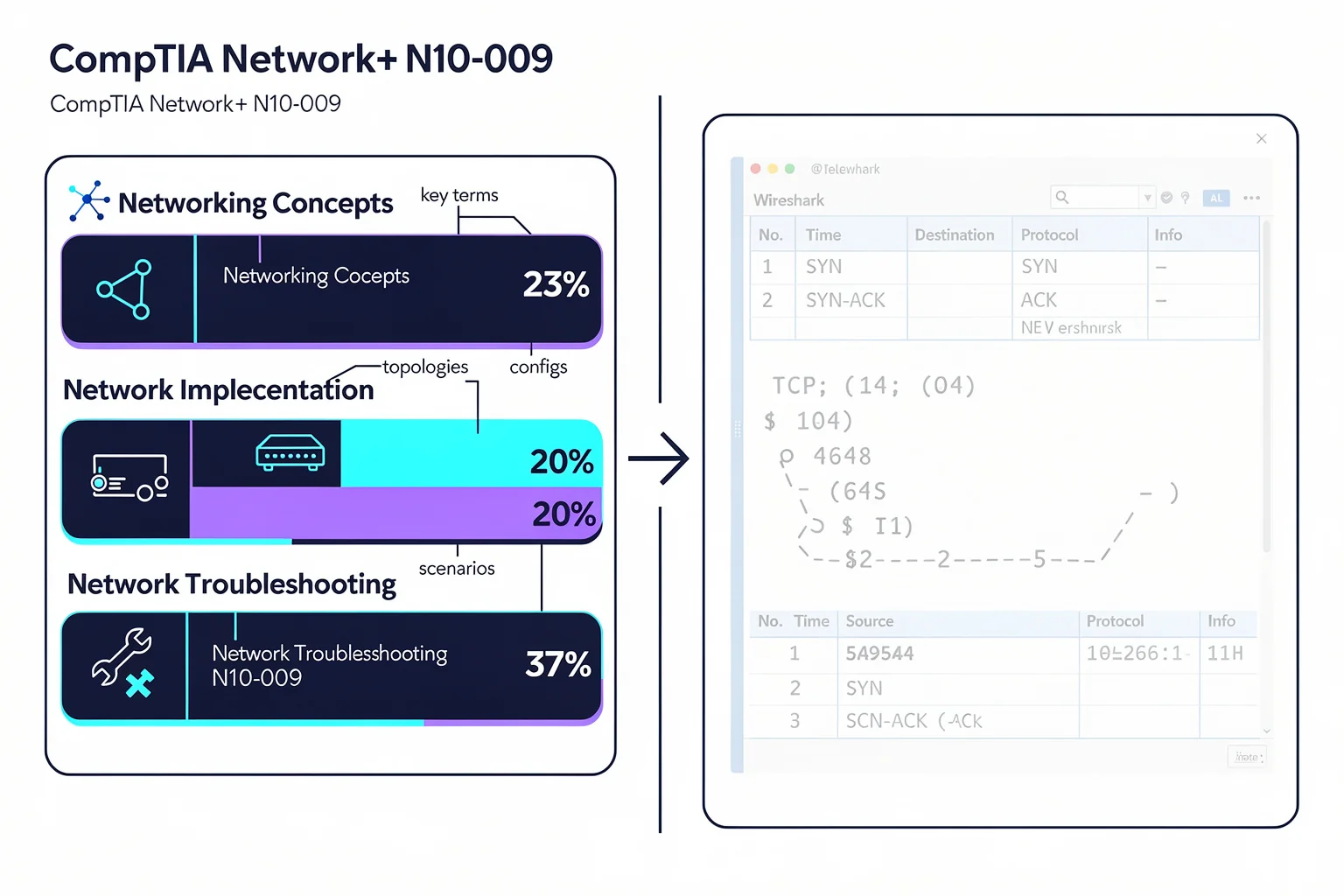
Why does this matter for your study plan? Because a certification candidate who can recognise a malformed TCP handshake in a capture file is moving faster through the exam than one who’s relying on theoretical recall. The Wireshark Frequently Asked Questions page notes that Wireshark “is the world’s most popular tool of its kind” for network protocol analysis. That popularity isn’t accidental — the tool surfaces the exact data formats and sequencing that exam items now test. In the CCNA, for example, a simulation might ask you to identify why an OSPF neighbour isn’t reaching the FULL state; the difference between a candidate who can filter the OSPF Hello packets and read the Area ID field and one who can’t often shows up in the final score.
The WCA-101 blueprint: a skills benchmark
In early 2026, the Wireshark Foundation formalised its own certification path with the WCA-101 exam. The published objectives make a useful yardstick, because they describe packet analysis skills in vendor-neutral terms that transfer directly to other certification exams.
“Describe packet flow through a data network. Explain the purpose of common network protocols. Identify the structure of packet headers and the relevant fields in each. Use Wireshark filters to isolate relevant packets for analysis. Troubleshoot network issues using Wireshark related to Ethernet, IP, TCP and common Application-layer protocols.” — Wireshark Foundation, WCA-101 Exam Objectives
A quick glance at the CompTIA and Cisco exam objectives shows how closely these align. The table below maps the WCA-101 domains against the Network+ and CCNA blueprints.
| WCA-101 domain | Network+ (N10-009) alignment | CCNA (200-301) alignment |
|---|---|---|
| Packet flow and OSI layers | Networking Concepts (Domain 1) | Network Fundamentals |
| Protocol purpose and behaviour | Networking Concepts, Network Operations | Network Access, IP Connectivity |
| Header field identification | Network Troubleshooting | IP Services |
| Display and capture filters | Troubleshooting, Network Operations | Connectivity troubleshooting |
| TCP/application-layer troubleshooting | Network Troubleshooting | Automation and Programmability |
Every row in that table represents a skill that appears both in the Wireshark-specific cert and in the broader vendor exams. As the Wireshark documentation highlights, SharkFest conferences draw network engineers, security analysts, and developers specifically to deepen these practical abilities. PlanetCert’s WCA-101 sample questions mirror the real exam’s emphasis on applying filters to isolate a specific conversation — the same mental motion you’ll need when a Network+ performance-based item asks you to find the source of a connectivity failure.
As a practical note, the WCA-101 exam is priced at US$349. The Wireshark Foundation occasionally releases discount codes, and for SharkFest’26 US attendees a voucher code SFUS26 cut $100 from the price for purchases made by August 19, 2026. That kind of investment signals that the industry treats advanced packet analysis as a distinct, hirable competency — and candidates who already hold a CCNA or Network+ are the ones most likely to benefit from adding it to their stack.
Mapping skills to exam performance: what employer signals tell us
Exam bodies rarely release direct pass/fail correlations with specific tool usage. We can, however, look at the demand side. In 2026, employer job postings that list packet analysis skills have broadened beyond dedicated network engineer roles. SOC analyst positions, cloud support roles, and even entry-level help-desk listings now mention Wireshark familiarity as a preferred qualification.
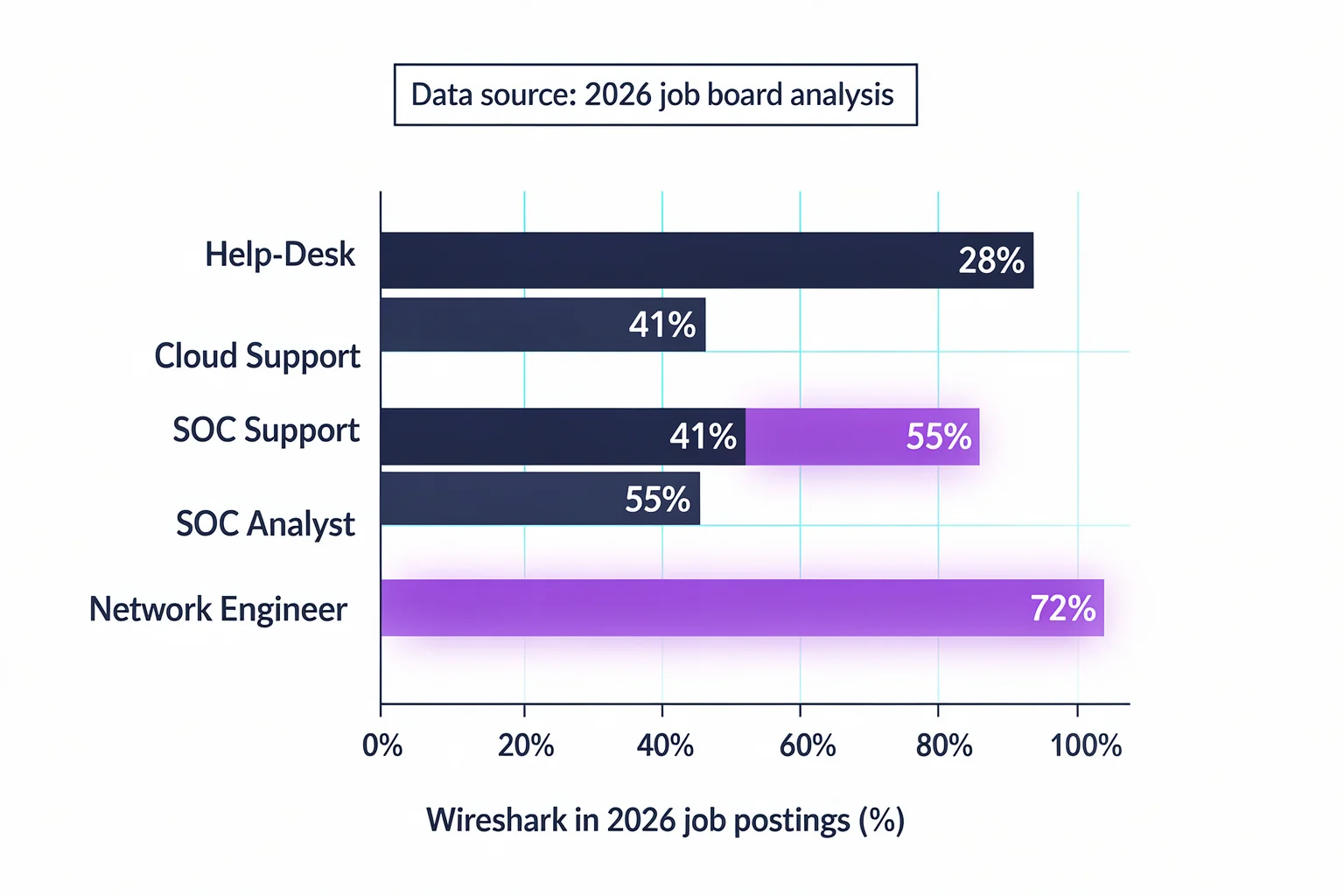
The release of the WCA-101 itself is a market signal: certification bodies don’t launch professional-level credentials without seeing sustained employer demand. The speed with which training partners like CBT Nuggets and Global Knowledge built official WCA-101 courses suggests the industry is treating packet analysis as a standalone competency — one that hiring managers are willing to screen for separately. For the candidate sitting a Network+ or CCNA exam, that same competency is tested implicitly inside the troubleshooting simulations.
If you are building a study plan and want to prioritise, the intersection of public exam objectives and employer signals points to three high-yield areas:
- Filter syntax and logic — knowing when to apply
ip.addr ==versustcp.port ==saves minutes during timed sections. - Protocol header recognition — being able to spot an incorrect MSS value or a missing ACK flag in a capture speeds diagnosis.
- Session reconstruction — following a TCP stream from SYN to FIN/RST and identifying where it broke down.
Our earlier deep-dive on Wireshark packet analysis skills that transfer to Network+ breaks down each of these with capture examples, and the pattern repeats across CCNA, Juniper, and even the AWS Advanced Networking specialty.
Recommendations for building exam-ready Wireshark capability
Rather than chase a generic list of features, treat your Wireshark study as skill rehearsal for the exam’s performance tasks. Here’s what works for candidates who succeed.
Build a small deliberate-practice lab
Use a virtualisation tool like VMware Workstation to spin up two VMs, transfer a file via FTP or SMB, and capture the entire session. Then answer three questions: What protocols appear, in what order? Which packet carries the login credentials? Where does the session tear down? Repeating this with different protocols builds pattern recognition that makes real exam captures feel familiar. The Wireshark manual page confirms the tool can read and write pcapng and pcap files natively, so working with pre-supplied captures on exam day won’t trip you up on file-format handling.
One common exam trap is a capture file that shows a TCP retransmission caused by a mismatched MTU somewhere in the path. Candidates who only drill ICMP ping scenarios may miss the relationship between the Don’t Fragment bit and the resulting packet drops. A deliberate lab that occasionally introduces MTU mismatches, duplicate IPs, or broken VLAN tagging forces you to spot problems the same way the exam simulator will.
Master display filters in layers
Start with simple Ethernet and IP filters, then chain them with logical operators. The WCA-101 objectives list filter application as a standalone competency, and it’s tested implicitly across Network+ and CCNA. Memorising a few dozen filters isn’t enough — practise composing filters from scratch because exam simulations won’t offer a cheat sheet. For instance, you might begin with ip.src == 192.168.1.10 && tcp.port == 80 to isolate a web session, then add tcp.flags.reset == 1 to discover exactly when the server tore the connection down.
Pair packet captures with practice exams
Timed practice tests that include performance-based items reveal how well you can apply Wireshark skills under pressure. When you stumble on a simulation that requires identifying a routing loop via a capture, the gap in your filter logic becomes obvious long before test day. PlanetCert’s platform provides exam-simulator scenarios that use real-world protocol traces, so the mental rhythm of capture analysis transfers directly to the certification room.
Don’t skip the higher-layer protocols
Many candidates drill on IP and TCP, then freeze when an exam item shows a malformed DHCP offer or an unusual DNS response. The ability to decode application-layer payloads — even partially — is what separates borderline passes from confident scores. An exam might present a DHCP capture where the Offer message carries an incorrect subnet mask, causing the client to fail; knowing how to expand the DHCP option fields in the packet detail pane saves minutes. The Wireshark certification paths that actually boost your salary all share one characteristic: they require stack-wide fluency, not just layer-3 comfort.
Recognise common exam-day missteps
Even well-prepared candidates lose time to avoidable fumbles. Opening a capture file and immediately scrolling is a mistake — apply a capture or display filter first so you’re only looking at relevant traffic. Confusing capture filters (which limit what is recorded) with display filters (which hide what’s already in the buffer) can waste minutes if the exam item expects you to start with a capture filter and then refine. Finally, forgetting that Wireshark’s Statistics menu can summarise protocol hierarchies means you might manually sift through hundreds of packets instead of spotting the 80/20 rule in seconds.
What the evidence doesn’t tell us yet
No public dataset directly ties Wireshark-lab hours to a specific exam score. Certification providers keep candidate performance data confidential, and the WCA-101 is too new to have produced longitudinal pass-rate studies. The employer demand signals we described are directional, not causal — a job posting that mentions packet analysis may reflect a broader shift toward automation and observability rather than a discrete Wireshark requirement.
That said, the convergence of exam blueprints, employer expectations, and the Wireshark Foundation’s own investment in certification makes the trend hard to dismiss. For the candidate sitting an exam in the second half of 2026, betting that performance-based networking items won’t involve a packet capture is an expensive risk. Future research that tracks the performance of study cohorts who use lab-based vs. theory-only preparation would give us the statistical confidence we lack today, but in the meantime the pragmatic path is clear: build the skill, because the exams already assume you have it.
Questions network candidates ask about Wireshark and exams
Do I really need to learn Wireshark for the Network+ exam? You don’t need Wireshark mastery, but you do need to interpret protocol analyser output. The Network+ objectives explicitly reference the use of protocol analysers for troubleshooting. Being able to open a provided capture file and draw conclusions about what’s happening is a tested skill.
How much time should I spend on packet capture practice if my exam is in four weeks? If you’re already comfortable with the theory, aim for two focused lab sessions per week of about 45 minutes each. Spend the first session capturing traffic and the second writing and testing filters against a downloaded pcap. Even eight hours of deliberate practice significantly shifts your recognition speed.
Is the WCA-101 worth taking before I sit for my CCNA? The WCA-101 validates a narrower, deeper skill set — exactly the kind that can make the performance section of CCNA feel manageable. If you have the time and budget, it’s a practical credential that sharpens your diagnostic instincts. The exam costs US$349, and SharkFest attendees sometimes receive a discount. But for pure CCNA preparation, a targeted practice-test regimen that includes packet analysis items often delivers the same exam benefit at lower cost.
Can I use Wireshark skills to improve my cloud certification outcomes? Yes, but it depends on the exam. The AWS Certified Advanced Networking – Specialty includes questions that require interpreting VPC flow logs or analysing hybrid connectivity issues, where packet-level thinking helps. Even the Microsoft Azure Network Engineer Associate benefits from a solid grasp of what packets look like crossing a VPN gateway.
What if I don’t have a live network to capture? Work from the Wireshark sample capture library or download pcaps shared by training providers. Many Network+ and CCNA study platforms include pre-built capture files that simulate the exact scenarios you’ll face in the exam. The goal is reading the captures, not generating them, so a stored pcap file gives you the same mental practice.
Deepen your exam skills with these resources
- Wireshark Filters Every Network+ Candidate Should Memorise
- Wireshark Packet Captures That Actually Help You Pass Network Exams
- Packet Analysis Skills For Network+
browse the relevant exam page and purchase a practice test

Discussion
Question Comments
0 comments·0 participantsSign in to leave a comment and access more free questions.