

Wireshark Certification Paths That Actually Boost Your Salary
If you spend your days staring at packet captures, you already know that Wireshark fluency separates average network troubleshooters from the people who fix things before the outage ticket even lands. But when it comes to putting that skillset onto a CV, the certification landscape is messy. There is no single "wireshark certification" — there are at least three paths, each with different costs, different exam formats, and different weight with employers. This article walks through the ones that actually appear in job listings, so you can pick the path that matches your role and stop guessing.
Three paths that show up in job listings
I’m going to cover three routes: the official Wireshark Certified Analyst (WCA), the longer-running Wireshark Certified Network Analyst (WCNA), and the EC-Council Certified Network Security Engineer (C|NSE). Each one signals something different to a hiring manager. One says "I’m current with the Wireshark Foundation’s latest exam." Another says "I’ve had packet chops for years." The third says "I live in the security operations centre." Your current job title usually tells you which one belongs on your study plan.
The Wireshark Certified Analyst (WCA) — the official credential
The Wireshark Foundation launched the WCA exam in 2025, and it is now the vendor-neutral cert they actively maintain. You sit proctored exam WCA-101, which contains 50–60 multiple-choice, matching, and fill-in-the-blank questions across 120 minutes. The cost is US $349 per attempt, and you can take it at a Kryterion testing centre or through remote human-proctored Webassessor sessions in over 1,000 locations worldwide. The official exam objectives confirm that 10% of the exam focuses on navigating Wireshark’s interface, 20% on core protocol analysis (Ethernet, IP, TCP), and the rest on troubleshooting and packet-level diagnostics. You are not just clicking through a simulator; you are being tested on whether you can identify malformed headers, isolate a retransmission cascade, and explain what the capture is actually telling you.
The Foundation says the certification is designed for "IT professionals who use Wireshark—or plan to use it—to analyze and troubleshoot network or application performance issues." That broad definition covers network engineers, SOC analysts, cloud engineers who inspect east-west traffic, and even developers debugging API latencies. The WCA FAQ lists official training partners like Packet Pioneer, Network Nerd, and SYN-bit, so you can pair instructor-led labs with self-study.
What the WCA doesn’t have yet is a decade of employer awareness — it barely passed its first birthday in June 2026. But it has the Wireshark Foundation’s stamp, a structured objectives map, and a renewal cycle. It also aligns with the training that SharkFest attendees are already doing. If you are starting fresh and want the credential that will still be current three years from now, WCA is the obvious choice.
The Wireshark Certified Network Analyst (WCNA) — the legacy path that still has clout
Before the WCA existed, the WCNA was the Wireshark certification. It emerged from the old Wireshark University programme and became a staple for network analysts. The exam itself is still being run by training providers. NICCS, the U.S. cybersecurity training catalogue, listed a four-day WCNA boot camp as recently as June 2025. Candidates who have taken it describe a 100-question, pass/fail exam that tests the same TCP/IP and troubleshooting muscles, often with a sharper emphasis on pre-built Wireshark profiles and ring-buffer configuration. Because it is not directly managed by the Wireshark Foundation today, the WCNA typically comes bundled as part of a training course rather than as a standalone exam purchase.
Recruiters who have been hiring for NOC roles for 15 years still recognise "WCNA" on a CV. If you already own the WCNA or you’re midway through a course that uses the older objectives, it remains a perfectly valid credential. The downside is that the Foundation is not updating WCNA objectives, so its alignment with current Wireshark 4.x features may drift over time. For a newcomer, I’d treat the WCNA as a solid second option — worth it only if your employer’s training provider is already paid up and you want the quickest route to a recognised line on your LinkedIn profile.
The EC-Council C|NSE — the security engineer’s Wireshark weapon
The EC-Council Certified Network Security Engineer (C|NSE) is a different animal. It is not a "Wireshark certification," but packet analysis with Wireshark forms the technical bedrock of the exam. The C|NSE syllabus covers network forensics, IDS/IPS rule writing, log correlation, and incident response workflows. Priced around $400, the exam normally follows an EC-Council training course and assumes you already have a baseline networking knowledge equivalent to Network+ or CCNA.
Security analysts who earn the C|NSE often cite it in the same breath as their GIAC or CEH because it demonstrates they can reconstruct an attack timeline from pcaps. If your day job involves threat hunting, the C|NSE gives you a credential that speaks directly to that work. For a pure network engineer, though, the C|NSE’s security focus may be overkill, and the lack of a direct Wireshark Foundation imprimatur can be a question mark on purely networking-focused job applications.
What these certifications actually cost (time and money)
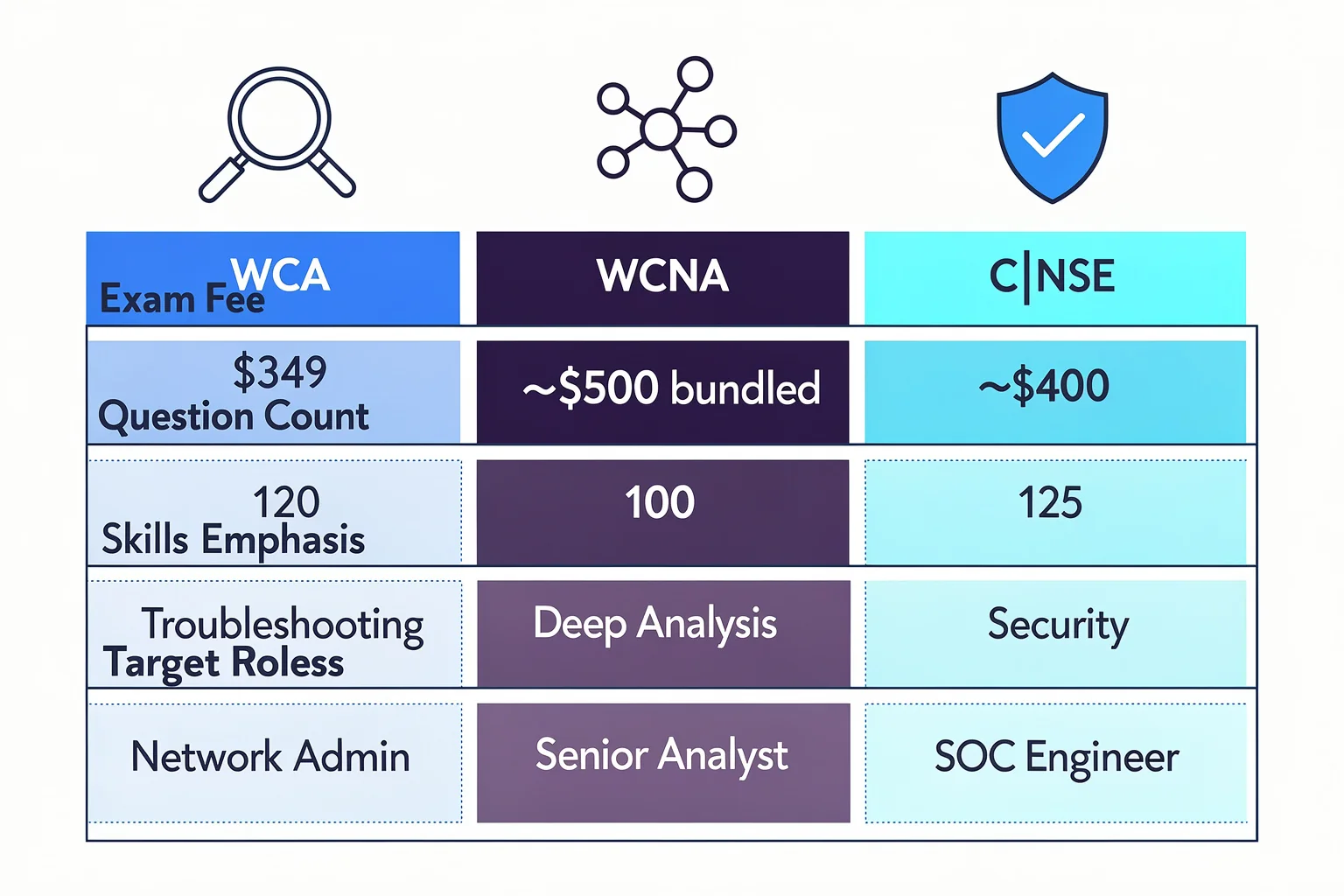
Cost is not just the exam fee; it’s the training, the time off the roster, and the inevitable retake when you bomb a section. Here’s a snapshot of what each path demands today.
| Certification | Exam fee (approx.) | Question count | Recommended study duration | Renewal requirement |
|---|---|---|---|---|
| WCA (WCA-101) | $349 | 50–60 | 6–8 weeks (self-paced) | Renew every 3 years |
| WCNA | Bundled in course (course ~$2,000–$3,000) | ~100 | 1 week (boot camp) | None stated |
| C | NSE | ~$400 (exam only) | Not publicly disclosed | 8–12 weeks (course + lab) |
Most of my readers are working full-time while studying. A WCA self-study path, combined with a practice-test bank and a lab environment, can keep total outlay well below $500. A WCNA boot camp is faster but locks you into a $2,000+ course fee. The C|NSE demands the steepest time investment if you don’t already work in a security role. Pick the one that fits both your budget and the number of uninterrupted evenings you can realistically block out.
Which path fits your role?
Use this decision fork to shortcut the choice.
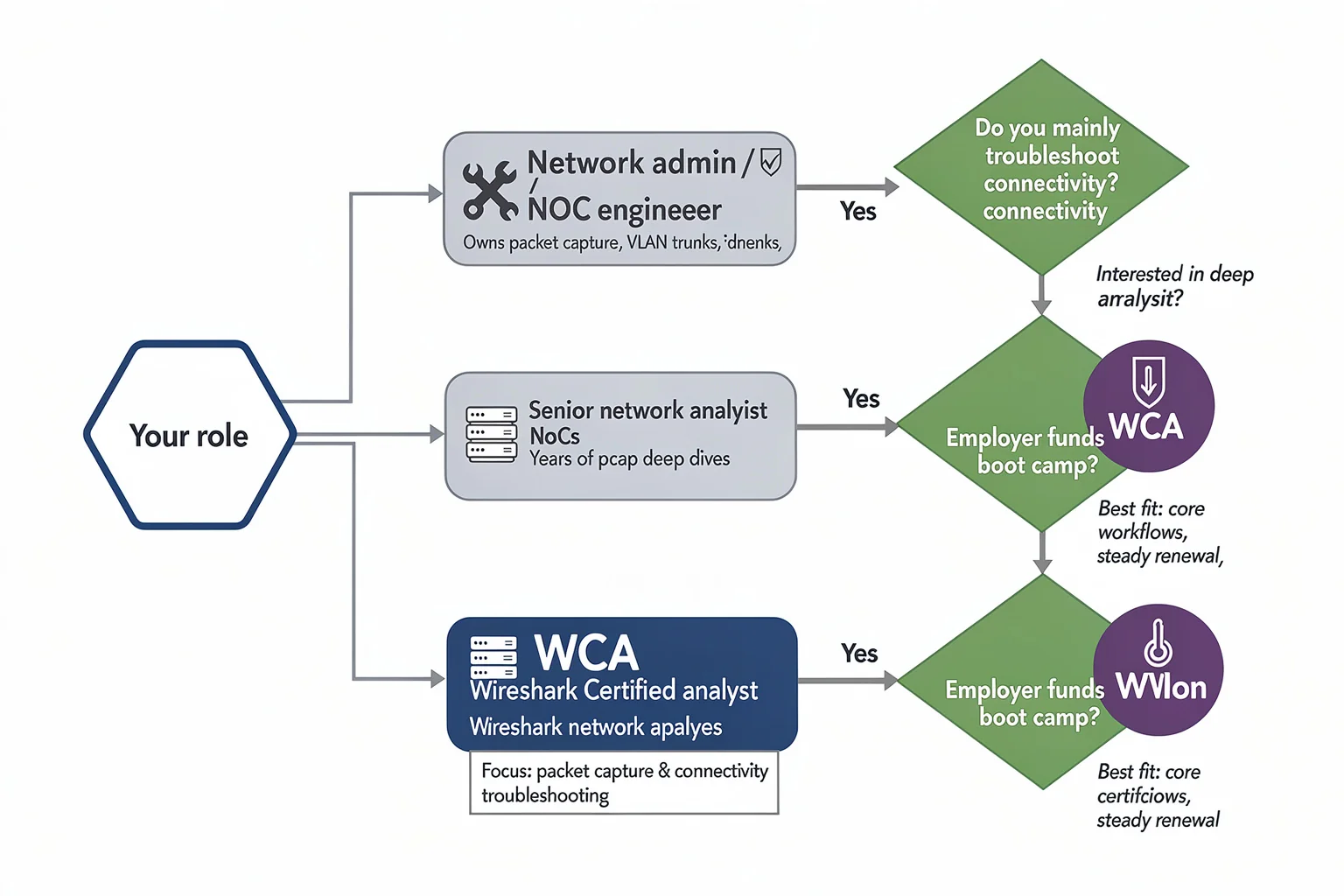
You are a network administrator or NOC engineer who mainly troubleshoots connectivity and owns the packet capture when a VLAN trunk flaps. Pick WCA. The objectives map directly onto your daily work, and the Foundation’s renewal cycle keeps your credential aligned with Wireshark releases.
You are a senior network analyst who has been dissecting pcaps for years but never formalised the skill with a cert. Your employer is willing to pay for a boot camp and you need the badge in the shortest possible timeline. Consider WCNA, but verify the training provider still aligns with Wireshark 4.x concepts.
You are a SOC analyst, incident responder, or security engineer who spends more time on Suricata alerts than on BGP peering. Pick the C|NSE. The cert tells a hiring manager that you can take a pcap from a SIEM alert, pull session data with tshark, and map it to the MITRE ATT&CK framework. WCA or WCNA won’t hurt, but they won’t carry the same weight in a security shop.
Study resources that actually prepare you for the exam
No matter which path you choose, reading a 1,000-page study guide without touching a capture file is a recipe for failing. Build your study toolkit so that every theory session finishes with a live trace.
The Wireshark Foundation includes sample traces and lab scenarios in its official training courses, and independent platforms like Packet Pioneer’s WCA labs (sometimes discounted to $89.99 during SharkFest) give you real-world captures built around the exam objectives. You also need a high-quality question bank. I keep the WCNA sample questions page open during review weeks. It is not a dump — it is 126 verified practice items with explanations that close gaps in your protocol understanding. Running timed simulator sessions with the same question format you will see on exam day reduces the cognitive load when the proctoring camera is on.
After you have a baseline score, work through intentional packet-capture exercises. I wrote about how targeted trace analysis can raise your exam readiness over on the post about Wireshark packet capture study tips. The idea is simple: find a capture that exhibits the exact symptom a domain objective describes — say, a TCP window size collapse — and explain the behaviour to a rubber duck. Do that for 30 captures and the exam’s scenario-based questions will feel like old news.
Finally, use flashcards. PlanetCert’s flashcard system lets you drill protocol fields, Wireshark filter syntax, and key flags without firing up a full lab. It’s the 15-minute gap filler that turns dead time into memorised detail.
What candidates often ask about these certifications
Does a Wireshark certification guarantee a salary bump?
No single credential guarantees a raise. But when Foote Partners’ Q1 2026 pay index showed IT certification premiums surging while noncertified skills posted their steepest decline in two decades, it became clear that employers are paying a premium for verified, specialised expertise. A WCA or C|NSE next to a CCNA or AWS Cloud Practitioner tells a hiring panel you don’t just ping — you investigate.
Is the WCA exam hard?
It is thorough rather than tricky. The 120‑minute clock gives you roughly two minutes per question, which is enough if you have filtered real traffic before. The fill-in-the-blank items reward muscular memory of field names and display filter syntax, so don’t just read the objectives — type them.
Can I take the exam online?
Yes. The WCA exam is delivered via Kryterion’s Webassessor platform, which supports remote human proctoring. You will need a quiet room, a webcam, and a stable internet connection. The Wireshark Foundation FAQ walks through the registration steps.
Does the certification expire?
The WCA certification is valid for three years. You can renew it by retaking the exam or, in the future, through continuing education credits (the Foundation expects to release details soon). The WCNA historically had no formal expiration, but employers increasingly expect a current credential. EC-Council C|NSE holders maintain their certification through the ECE programme, which requires earning credits from training, publishing, or teaching.
Are there free practice questions for the WCA-101?
Yes. PlanetCert publishes a long set of WCA-101 sample questions with explanations. It is a free resource you can use to gauge your starting point before you buy a full test bundle.
Keep building your certification toolkit
Pairing a Wireshark credential with a broader networking or security cert is still the fastest way to move up the salary ladder. Use these guides to extend your study plan beyond the packet capture window.
References
Go Deep — Wireshark • Go Deep | Documentation ... ## User Documentation ... several formats: ... ### Export Regulations ... ## Developer Documentation ... The Wireshark Developer's Guide is
Wireshark Packet Captures That Actually Help You Pass Network Exams
AWS ML Specialty Free Questions: Where to Find Realistic Practice
Best AWS Certification Courses in 2026: AI-900 and Machine Learning Specialisations
browse the relevant exam page and purchase a practice test

Discussion
Question Comments
0 comments·0 participantsSign in to leave a comment and access more free questions.