

CompTIA's 2026 Certification Map After SecAI+ and Security+ Refresh
Three overlapping moves are reshaping how IT professionals build credentials this year: CompTIA launched SecAI+ in April, refreshed the Security+ SY0-701 objectives, and began rolling out its Xpert Series for senior practitioners. If you have an exam date on your calendar, you need to know which version is current, which materials still match the test, and whether a new credential changes your path.
This article maps what's live, what's announced, and what's fading. It draws on CompTIA's official product roadmap and partner communications through May 2026.
What CompTIA Changed and When
CompTIA typically updates exams on a three-year cycle, but 2026 brought more than a routine refresh. The association introduced an entirely new certification tier, adjusted its flagship security exam mid-cycle, and signaled broader restructuring for advanced credentials.
SecAI+ (CY0-001) went live in April 2026. CompTIA announced the exam on April 20, positioning it as a vendor-neutral credential for securing AI-enabled enterprise systems. The certification blends baseline cybersecurity knowledge with AI-specific risk management, governance frameworks, and operational controls. It targets security professionals who now face generative AI tools, LLM integrations, and automated threat surfaces they did not train for three years ago.
Security+ SY0-701 received a 2026 objective refresh. The exam originally launched November 7, 2023, with five domains and 28 objectives, down from SY0-601's six domains and 35 objectives. The 2026 refresh does not change the exam code but updates specific objectives to reflect zero-trust architecture maturity, cloud security control evolution, and AI-augmented threat tactics. Per the CompTIA Product Roadmap, this is a content refresh rather than a version replacement, meaning SY0-701 remains the single active Security+ exam.
The Xpert Series entered phased rollout. CompTIA is positioning these credentials above its traditional stack for senior architects and lead practitioners. Details remain sparse in public documentation, but the series represents a deliberate expansion upward as the lower and mid-tier exams face market saturation.
Where Each Certification Sits Today
Understanding the current stack matters because CompTIA's retirement schedule creates hard deadlines. You cannot mix expired objectives with current exam vouchers.
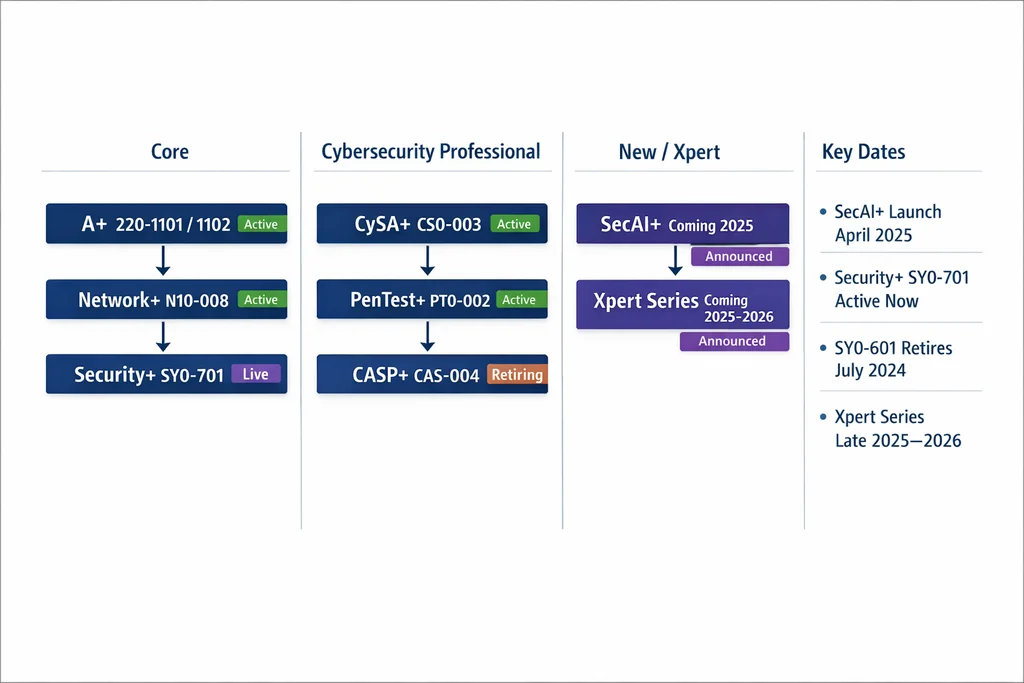
Security+ SY0-701 is the only live Security+ exam. SY0-601 retired July 31, 2024. SY0-501 and earlier versions are long expired. If you hold study materials dated before November 2023, they cover retired content. The 2026 refresh means even some post-2023 resources need verification against the latest objective PDFs. Candidates preparing now should pull current objectives directly from CompTIA's site and cross-check against SY0-701 sample questions that reflect the refreshed domain weights.
SecAI+ CY0-001 is live and exam-ready. It does not replace Security+; it sits adjacent to it. CompTIA frames SecAI+ as a specialty credential for practitioners who already understand security fundamentals and now need AI-contextual skills. The exam covers AI system attack vectors, model governance, data poisoning risks, and compliance frameworks specific to automated decision systems. For candidates deciding between credentials, the choice depends on your role: SOC analysts and security engineers likely need both, while IT support professionals moving toward security should start with Security+ SY0-701 exam objectives.
A+ Core Series (220-1101 and 220-1102) remains active with its own 2026 updates. CompTIA refreshed the Core objectives to emphasize cloud-connected endpoint support, modern mobile platform management, and updated security expectations for entry-level technicians. The Partner Resources page tracks objective mappings for instructors, and the changes reflect what employers now expect from help desk and field service roles.
Network+ N10-009 launched in 2024 and remains current. No 2026 refresh has been announced, making it the stable mid-tier credential for candidates building toward security or cloud specializations.
Cloud+ CV0-004 and Cloud Essentials+ CLO-002 continue as CompTIA's infrastructure and cloud literacy credentials. Neither received major 2026 updates, though Cloud+ incorporates platform-agnostic skills that overlap with security domains in hybrid environments.
Which Exams Are Retiring or at Risk
CompTIA's standard retirement window is three years after launch. That puts SY0-701 on watch for late 2026 or early 2027, though CompTIA has not announced a firm retirement date. The 2026 objective refresh suggests the association is extending the exam's life rather than replacing it immediately.
Definitively retired: SY0-601 (July 31, 2024), SY0-501 (July 31, 2021), and all earlier Security+ versions. If you see practice tests or study guides labeled SY0-601, they are obsolete. The same applies to pre-2022 A+ and Network+ versions.
At risk of obsolescence: Any third-party materials published before April 2026 that claim to cover "current" Security+ objectives without specifying the refresh. The 2026 changes are not cosmetic. Domain 1 (General Security Concepts) gained explicit AI threat coverage. Domain 3 (Security Architecture) expanded zero-trust implementation scenarios. Domain 5 (Security Program Management and Oversight) added governance structures for automated security tooling.
Candidates sitting for SY0-701 in late 2026 should verify their resources match the refreshed objectives, not merely the 2023 launch version. This is where CompTIA practice tests with verified question banks become essential, since outdated dumps and unvetted question sets will misalign with current exam weightings.
How the New Stack Affects Your Study Plan
The 2026 changes create three distinct candidate profiles, each with a different optimal path.
Profile one: New to security, no prior CompTIA certs. Start with Security+ SY0-701. It remains the baseline for DoD 8570 compliance, entry-level security roles, and most SOC analyst job postings. Add SecAI+ only after you have SY0-701 scheduled or passed, since SecAI+ assumes familiarity with security operations that the A+ or Network+ tracks do not fully provide.
Profile two: Security+ certified before 2024, considering renewal or advancement. If you hold SY0-601 or earlier, your certification is still valid through its three-year expiration, but you cannot recertify using retired exam versions. Plan your renewal CEUs now, or sit for SY0-701 before your expiration date. If you work in an environment deploying AI tools, add SecAI+ as a stackable credential rather than a replacement.
Profile three: Career switcher with A+ or Network+, targeting 2026 job markets. The refreshed Security+ objectives explicitly address skills employers now list in junior security roles: cloud identity management, zero-trust network segmentation, and incident response for automated environments. Your study timeline should budget 4-6 weeks for SY0-701 if you have Network+ knowledge, 8-10 weeks if coming from A+ alone. Use flashcards for domain vocabulary and timed simulator sessions for the 90-minute exam format.
Maya Chen, a desktop support technician in Austin, passed Network+ in January 2026 and started Security+ prep in March. She noticed her older SY0-601 study guide from a colleague mentioned six domains, while current materials list five. That discrepancy led her to check CompTIA's official objective PDF, where she discovered the 2026 refresh added AI threat scenarios she had not seen in the borrowed book. She switched to updated SY0-601 sample questions only to confirm what retired content looked like, then focused her real prep on current SY0-701 materials. Her exam is scheduled for June.
What SecAI+ Actually Tests
SecAI+ is not Security+ with AI buzzwords added. It is a narrower, deeper credential with distinct content boundaries.
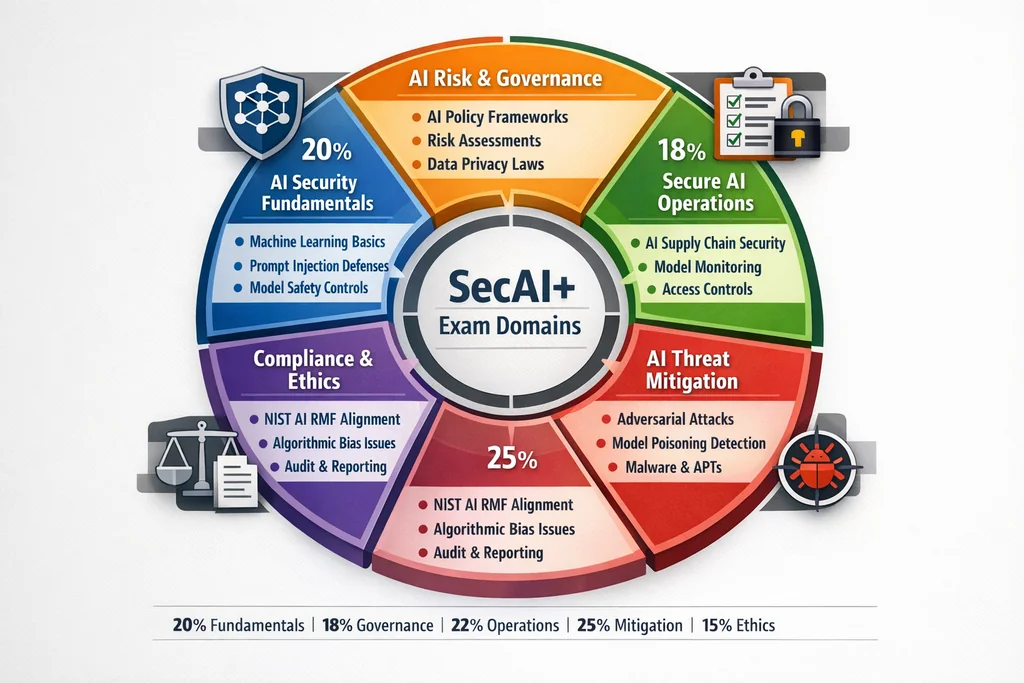
The exam covers four major areas: AI system vulnerabilities (including prompt injection, model inversion, and training data exposure), governance and risk management for automated systems, secure deployment of AI tooling in enterprise environments, and operational monitoring of AI-generated outputs. It assumes you already understand network security, identity management, and incident response, the foundational Security+ territory.
CompTIA's April 2026 announcement emphasized "enterprise-trusted" validation, meaning the credential targets practitioners who need to justify AI security posture to auditors, regulators, and senior leadership. This is not a developer-focused machine learning certification. It is a security operations credential for the AI era.
For candidates wondering whether SecAI+ replaces CASP+ or other advanced CompTIA certs, the answer is no. It fills a gap between mid-tier security knowledge and specialized AI risk expertise. The CompTIA SecAI+ exam page tracks availability and practice materials as the credential gains adoption.
Exam Pricing and Practical Logistics
CompTIA raised exam prices effective early 2026. The increases affect all tiers, though exact amounts vary by region and voucher channel. Total Seminars reported the price changes in mid-May, noting that candidates purchasing through academic or partner programs may see different rates than retail voucher buyers.
For budget planning, assume Security+ SY0-701 sits in the $400-450 range at retail, with SecAI+ comparably priced as a new specialty exam. A+ and Network+ remain slightly lower. These costs do not include retake fees, which apply if you fail on the first attempt.
The financial case for passing on the first try has never been stronger. CompTIA's data, published in the March 2026 State of the Tech Workforce report, shows net tech employment growing 1.9% this year with 185,499 new positions projected. Certification remains a differentiator in that competitive labor pool, but failed attempts cost both money and study momentum.
How to Verify Your Materials Are Current
With three overlapping changes in play, outdated study resources are a genuine risk. Here's how to audit what you own.
Check the exam code on every practice test, book, and video course. Security+ must read SY0-701, not SY0-601 or SY0-501. A+ must read 220-1101/220-1102, not 220-1001/220-1002. Network+ must read N10-009.
Check the publication or revision date. Materials revised after April 2026 for Security+ should incorporate the refreshed objectives. If the copyright date is 2023 or 2024, look for an errata sheet or update supplement from the publisher.
Check for AI-specific content in Security+ materials. The 2026 refresh added explicit AI threat coverage. If your resource mentions "emerging threats" in generic terms without addressing LLM risks, automated phishing, or model governance, it predates the refresh.
Check the CompTIA Product Roadmap directly. The CompTIA Product Roadmap lists live exams, in-development credentials, and confirmed retirements. It is the authoritative source for version status, more reliable than third-party blog posts that may not update when schedules shift.
What to Watch in Late 2026
Three developments could further reshape the map before year-end.
SY0-701 retirement timing. CompTIA has not confirmed a date, but the three-year window from November 2023 suggests late 2026 or early 2027. If you are mid-study, do not delay. A version change means new objectives, new practice tests, and a reset of available study resources.
Xpert Series expansion. The initial rollout covers select advanced roles. If CompTIA adds security or AI architecture tracks to this series, the credential stacking logic for senior practitioners could shift. Watch CompTIA's ChannelCon announcements and partner briefings for specifics.
Cross-vendor alignment. Cisco's 2026 certification updates, reported in late May, explicitly bake AI and automation into CCNA and CCIE paths. CompTIA's SecAI+ launch may trigger responsive moves from (ISC)², ISACA, or other security credentialing bodies. For candidates choosing between vendor-neutral and vendor-specific paths, this competitive pressure could improve material quality and exam relevance across the industry.
FAQ
Is SY0-701 still the current Security+ exam?
Yes. SY0-701 launched November 7, 2023, and received a 2026 objective refresh. It is the only active Security+ exam as of May 2026. SY0-601 retired July 31, 2024.
Do I need SecAI+ if I already have Security+?
Not unless your role requires AI security expertise. SecAI+ is a stackable specialty credential, not a replacement. Security+ remains the baseline for compliance and entry-level security positions.
Will SY0-701 retire soon?
CompTIA has not announced a retirement date. The standard three-year window suggests late 2026 or early 2027, but the 2026 objective refresh may extend the exam's lifespan. Check the official roadmap for updates.
Are my 2023 SY0-701 study materials still valid?
Partially. Core concepts remain accurate, but the 2026 refresh added AI threat coverage and adjusted domain weights. Supplement older materials with current objective PDFs and updated practice questions.
Should new candidates start with A+ or jump straight to Security+?
A+ remains valuable for help desk and support roles. If you target security specifically and have basic IT knowledge, you can attempt Security+ directly, but the refreshed objectives assume familiarity with networking and endpoint concepts that A+ and Network+ cover systematically.
Learn more: Browse CompTIA practice tests
Further Reading
References
- Security+ (Plus) Certification — Security+ (Plus) Certification | CompTIA CompTIA Security+ is the premier global certification that establishes the essential skills required for core security functions and a

Discussion
Question Comments
0 comments·0 participantsSign in to leave a comment and access more free questions.