

CTT+ is one of those certifications where “knowing the material” is not enough. The CTT+ Essentials exam tests whether you can apply training concepts in realistic classroom or virtual training scenarios, choose the best next step, and justify decisions that improve learning outcomes. That means your prep has to combine fundamentals (adult learning, instructional design, evaluation) with judgment (what you do first, what you say next, and why).
Below is a practical, exam-focused guide to CTT+ Essentials exam prep, including the topics to prioritize, what the format typically looks like, and pass tips you can use immediately.
What the CTT+ Essentials exam is really testing
The “Essentials” portion of CTT+ is commonly positioned as the knowledge base behind effective instruction. In practice, expect questions that probe your ability to:
- Align training objectives to business needs and learner needs
- Choose instructional methods that fit the audience and constraints
- Manage classroom dynamics (in-person or virtual) while maintaining learning flow
- Measure learning effectively and adjust instruction based on evidence
- Communicate clearly, inclusively, and professionally
In other words, the exam leans heavily toward applied training decisions, not just memorizing terminology.
CTT+ Essentials exam format (what to expect)
Exam formats can change over time, and different providers sometimes describe them differently. Most candidates should expect a computer-based, timed exam featuring multiple-choice and scenario-based questions.
Your safest move is to confirm the current exam details (time limit, number of questions, scoring) on the certification owner’s official page before you book. Use this article as your prep framework, then calibrate your pacing and practice sets to the current published constraints.
What “scenario-based” usually means here
Scenario questions often include:
- A short vignette about learners, constraints, objectives, or a classroom challenge
- Several answer choices that all sound plausible
- One “best” answer that reflects sound learning principles and professional trainer behavior
Success comes from recognizing patterns: what the question is really evaluating (analysis, sequencing, learner engagement, evaluation validity, accessibility, risk management) and eliminating answers that are technically true but contextually wrong.
CTT+ Essentials exam topics to prioritize (high-yield map)
Most Essentials-style blueprints cluster around core training lifecycle skills: analyze, design, deliver, evaluate, and improve. Use the map below to drive your study plan and, importantly, your practice-test review.
| Topic area (Essentials) | What you should be able to do | What to practice with questions |
|---|---|---|
| Adult learning principles | Match methods to adult learner motivation, relevance, and experience | Identify the “best next step” when engagement drops or resistance appears |
| Instructional design basics | Translate needs into objectives, content sequence, and methods | Pick objectives written at the right level and aligned to outcomes |
| Training delivery and facilitation | Maintain flow, clarity, pacing, and learner participation | Choose interventions for confusion, dominant participants, or low participation |
| Communication and presentation | Use clear language, questioning techniques, and inclusive communication | Spot wording that is ambiguous, biased, or misaligned to the audience |
| Learning evaluation and feedback | Select appropriate checks for understanding and evaluation methods | Differentiate reaction vs learning vs behavior outcomes (and what to do with each) |
| Classroom and environment management | Handle logistics, disruptions, time constraints, and virtual delivery issues | Decide how to respond when tools fail, time runs short, or conflict emerges |
| Professionalism, ethics, and risk | Act appropriately with learner data, accommodations, and safety concerns | Identify safest, most ethical actions when constraints and policies conflict |
A key insight: in many CTT+-style questions, the “right” answer is the one that protects learning outcomes while also respecting constraints (time, policy, safety, inclusion) in a professional way.
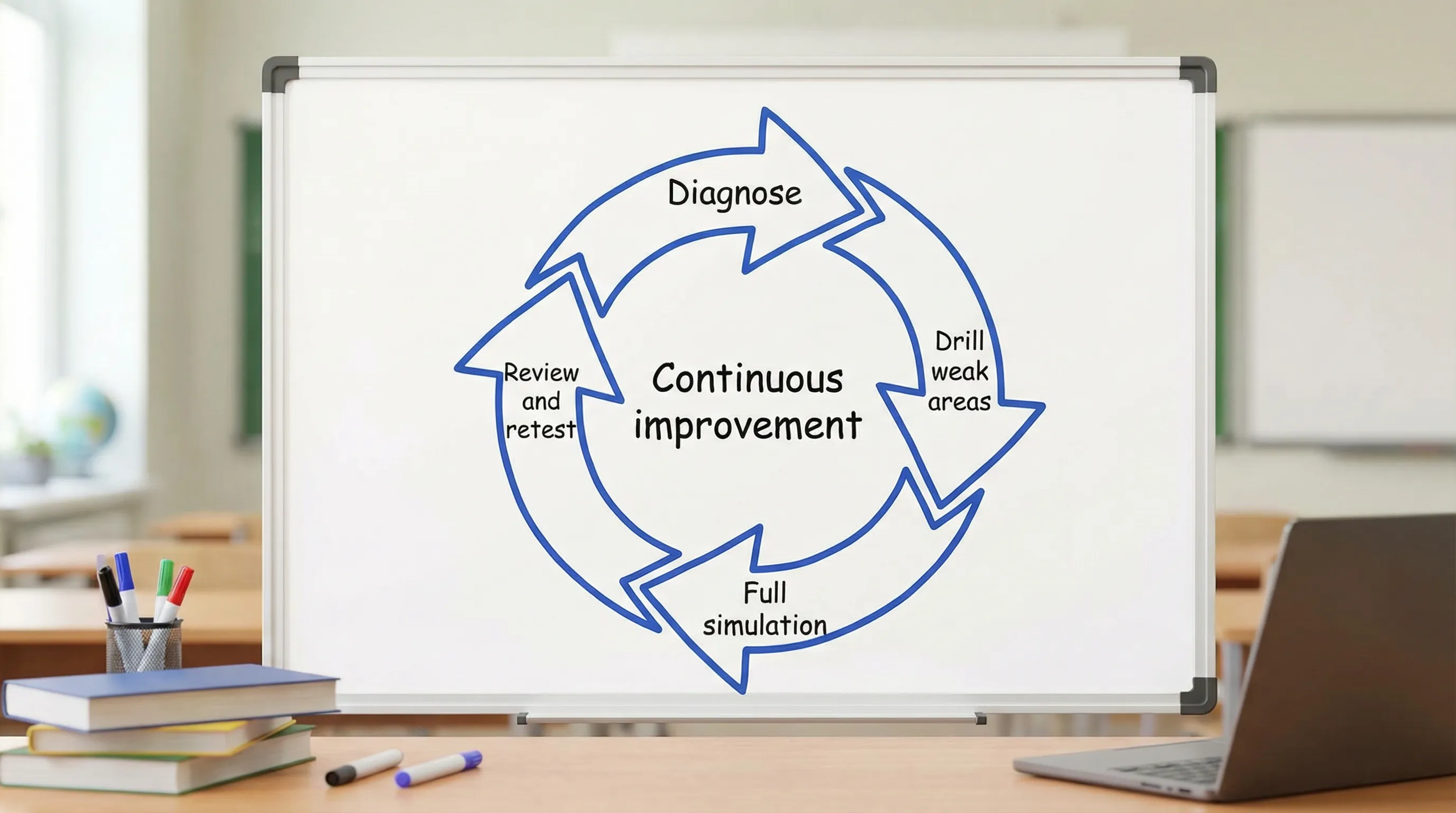
A study approach that fits the CTT+ Essentials exam (without wasting time)
Because the exam is judgment-heavy, passive reading alone usually produces false confidence. Use a loop that forces recall, application, and review.
Step 1: Start with a diagnostic set (and do not “study first”)
Take a short, timed diagnostic (for example, 30 to 60 questions) to expose your real gaps. Your score matters less than your error patterns.
Immediately after, write an error log with three fields:
- What I chose (and why I chose it)
- What the better answer is (and why it’s better in this scenario)
- Rule I’ll use next time (a one-sentence decision rule)
This turns every missed question into a reusable decision tool.
Step 2: Drill by decision type, not just by topic
Many candidates stall because they drill “adult learning” in the abstract. A faster method is to drill by the decision the question is asking you to make, such as:
- Best next step (sequence and prioritization)
- Best response (classroom management and facilitation)
- Best measurement method (evaluation validity)
- Best redesign choice (objectives, activities, assessments alignment)
This mirrors how the exam forces you to think.
Step 3: Add full simulations earlier than you think
Once you can explain why the correct answer is correct (not just recognize it), you should start mixing in full, timed practice exams. Full simulations train:
- Pacing under time pressure
- Stamina and focus
- Trap avoidance (especially “sounds nice but not best” options)
If you are using a web-based platform, make sure you practice in a realistic interface and keep conditions consistent (quiet room, no phone, single sitting).
Pass tips for CTT+ Essentials (the traps to watch)
Tip 1: Look for alignment, objectives, activities, evaluation
A common exam pattern is misalignment. The distractor answers often propose a valid training activity that does not measure the objective, or an objective that does not match the stated need.
When stuck, ask:
- What is the objective, stated or implied?
- Does this choice help learners achieve it in the given constraints?
- Does it give the trainer evidence of learning (not just “they liked it”)?
Tip 2: Choose “best,” not “true”
Multiple answers may be true in real life. The exam usually rewards the option that is:
- Most immediate and actionable
- Most learner-centered
- Most evidence-based (checks understanding, validates learning)
- Safest and most professional
Tip 3: In classroom management scenarios, stabilize first
When a scenario includes disruption (conflict, confusion, tech failure), the best answer often stabilizes the environment before continuing content. That can mean resetting expectations, clarifying instructions, or switching to a backup plan.
The distractor is often “push through the agenda.” A professional trainer protects outcomes and learner experience first.
Tip 4: Do not over-index on jargon
Knowing terms helps, but the exam tends to reward practical decisions. If an option is buzzword-heavy but vague (“use a constructivist approach to maximize engagement”), be cautious unless it clearly maps to the scenario and constraints.
How to know you are ready (practical benchmarks)
Instead of aiming for a single magic score, use readiness signals tied to performance and consistency.
| Readiness signal | What it looks like in practice | Why it matters |
|---|---|---|
| Stable performance across mixed sets | Your results don’t swing wildly by domain | The exam mixes domains and decision types |
| You can explain answers out loud | You can justify correct choices and eliminate distractors | Prevents recognition-only learning |
| Fewer “process errors” | Less rushing, fewer misreads, better time control | Many misses come from avoidable mistakes |
| Error log repeats are dropping | The same mistake type shows up less each week | Indicates true learning, not more exposure |
Using practice tests the right way for CTT+ Essentials
For scenario-heavy exams, the value of practice exams is not just volume, it is feedback quality and review discipline.
A strong workflow is:
- Take a timed set.
- Review every miss and every guess.
- Write a one-sentence rule (“If learners are disengaged, first diagnose cause with a question or quick check, then adjust method.”).
- Retest that rule within 48 to 72 hours using new questions.
If you want a single place to run this workflow, use Planet Cert practice tests with explanations and a realistic web simulator so your practice feels like exam day. You can start with mixed quizzes, then shift to full simulations as your error log stabilizes.
To explore options, see Planet Cert practice exams and look for CTT+ Essentials exam questions and simulator-style practice.
Exam-day strategy (quick but effective)
Pacing
Do a fast first pass and avoid getting stuck. If a scenario question is long, identify the task first (best next step, best evaluation method, best response), then re-read with that goal.
Elimination
Actively eliminate answers that:
- Ignore constraints stated in the prompt
- Skip diagnosis and jump to a “solution” too early
- Measure the wrong thing (reaction vs learning)
- Create unnecessary risk (privacy, safety, inclusion)
Keep your professional-trainer lens on
When two options are close, the better answer usually reflects what a competent trainer would do in a real organization: clarify, validate, measure, adapt, document appropriately.
Frequently Asked Questions
What should I study for the CTT+ Essentials exam first? Start with adult learning principles and alignment (objectives, activities, evaluation). Then move to facilitation and classroom management scenarios, because many questions test “best action” judgment.
Is the CTT+ Essentials exam mostly theory or practical scenarios? Expect a mix, but many candidates experience it as application-heavy. Even theory questions often ask you to apply a principle to a realistic training situation.
How many practice questions should I do for CTT+ Essentials exam prep? Do enough to see repeated patterns and reduce repeat mistakes in your error log. A better target than raw volume is consistent performance on mixed, timed sets plus strong explanations for your choices.
What is the best way to review missed CTT+ Essentials questions? Use an error log and write a one-sentence decision rule for each miss. Retest those rules within 48 to 72 hours on new questions to confirm the learning transferred.
Can I request a CTT+ Essentials practice exam if I do not see it available? Yes. PlanetCert supports requesting exams they do not have yet, and they aim to add it within 7 days. Check Planet Cert test questions for current availability and request options.
Prepare faster with realistic CTT+ Essentials practice
If you want your prep to feel like the real thing, use Planet Cert practice tests to run timed quizzes, full simulations, and focused review with explanations. You can also request an exam if you do not see the exact version you need.
Get started here: Planet Cert CTT+ Essentials practice tests.

Discussion
Question Comments
0 comments·0 participantsSign in to leave a comment and access more free questions.