

E20-920 Sample Questions: 5 Exam Topics That Trip Up Most Candidates
If you're wondering what the E20-920 exam actually covers, you're not alone. Search data shows plenty of candidates typing "E20-920 exam what is E20-920" into Google before they even book their test date. The short answer: it was Dell EMC's Cloud Services Expert Exam for Cloud Architects, targeting IT professionals who design and plan cloud services within an IT-as-a-Service environment. Dell retired it on 3 June 2021, replacing it with the DEE-2T13 exam, but many study programmes and corporate certification tracks still reference the E20-920 blueprint.
That legacy status creates a problem. Candidates find outdated prep material, get confused by retired objectives, and walk into the wrong exam. Even those sitting the current DEE-2T13 often search for E20-920 sample questions because the underlying cloud architecture concepts — elasticity, service catalogues, chargeback, transformation governance — remain central to Dell's cloud architect pathway.
This listicle ranks five question topics where our item-level data shows the highest error rates. Each entry includes a realistic practice question, the distractor logic that catches people out, and what to study instead. Use these to audit your weak spots before you sit the real thing.
Why These Five Topics Matter Most
Cloud architect exams test broad decision-making under pressure. You don't need to memorise CLI syntax, but you must recognise which cloud feature solves which business problem. The E20-920 blueprint emphasised four domains: cloud services planning and design, service catalogue management, operational processes, and IT transformation strategy.
Our performance data from thousands of simulator sessions shows that candidates perform well on definitional questions — "What is elasticity?" — but stumble when two correct-sounding answers both address the scenario. The five topics below represent those grey-area decisions. Master them and you'll outscore candidates who rely on rote memorisation.
Elasticity vs. Related Operational Features
Question 51 on the E20-920 exam highlights a classic trap. The scenario describes an IT department using automation tools to expand and contract cloud resource pools. The question asks which cloud feature this represents.
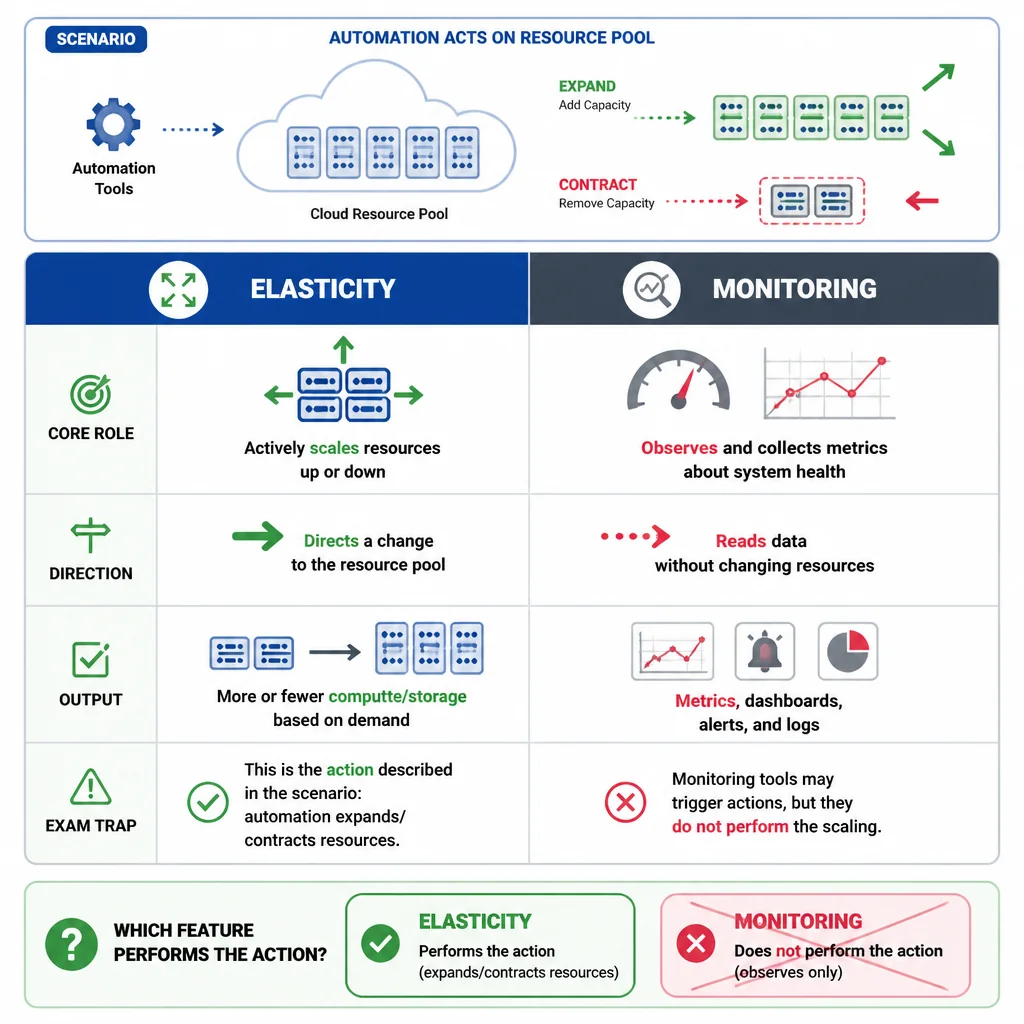
The options include elasticity, monitoring, chargeback, and trust zones. Most candidates correctly eliminate chargeback and trust zones — those are billing and security concepts, not resource scaling. The split happens between elasticity and monitoring. Monitoring observes; elasticity acts. The automation described is the action of scaling, not the observation of metrics.
"An IT department is using a number of tools to automate the expansion and contraction of the cloud resource pools. Which cloud feature are they implementing?" — E20-920 Dell Exam Info and Free Practice Test
The distractor works because monitoring tools often trigger elasticity workflows in real environments. Candidates with hands-on AWS or Azure experience picture CloudWatch alarms spinning up Auto Scaling groups and think "monitoring makes this happen." The exam wants the feature being implemented, not the trigger. When you see resource pools growing and shrinking, the answer is elasticity every time.
Study tip: Map each cloud feature to its primary verb. Elasticity scales. Monitoring observes. Chargeback bills. Trust zones isolate. If the scenario's action verb matches the feature's verb, you've found your answer.
Service Catalogue Access Control and RBAC Design
Question 2 in our E20-920 sample questions set tests service catalogue governance. The scenario asks you to identify what it means when a company manages access to offered services based on consumers' job functions.
The answer is role-based access control, but candidates frequently confuse this with service level management or chargeback showback. The trap works because all three involve "managing" something about service consumption. RBAC manages who can do what. Service level management manages performance targets. Chargeback manages cost allocation.
The key discriminator is the phrase "based on job functions." That is the textbook definition of RBAC. If the scenario mentioned response-time guarantees, you'd pick service level management. If it mentioned departmental cost reports, you'd pick chargeback. The exam tests whether you can match governance mechanisms to their defining attributes.
This topic trips up cloud engineers coming from technical implementation roles. They're used to building RBAC in IAM consoles, not describing its business purpose in governance terms. The E20-920 exam, like most architect-level certifications, forces you to speak in business-architecture language, not just technical configuration.
Hybrid Cloud Fault Domain and Load Balancer Design
Our first sample question presents a hybrid cloud scenario where services use load balancers and orchestration workflows place instances across multiple fault domains. The question asks why this design pattern exists.
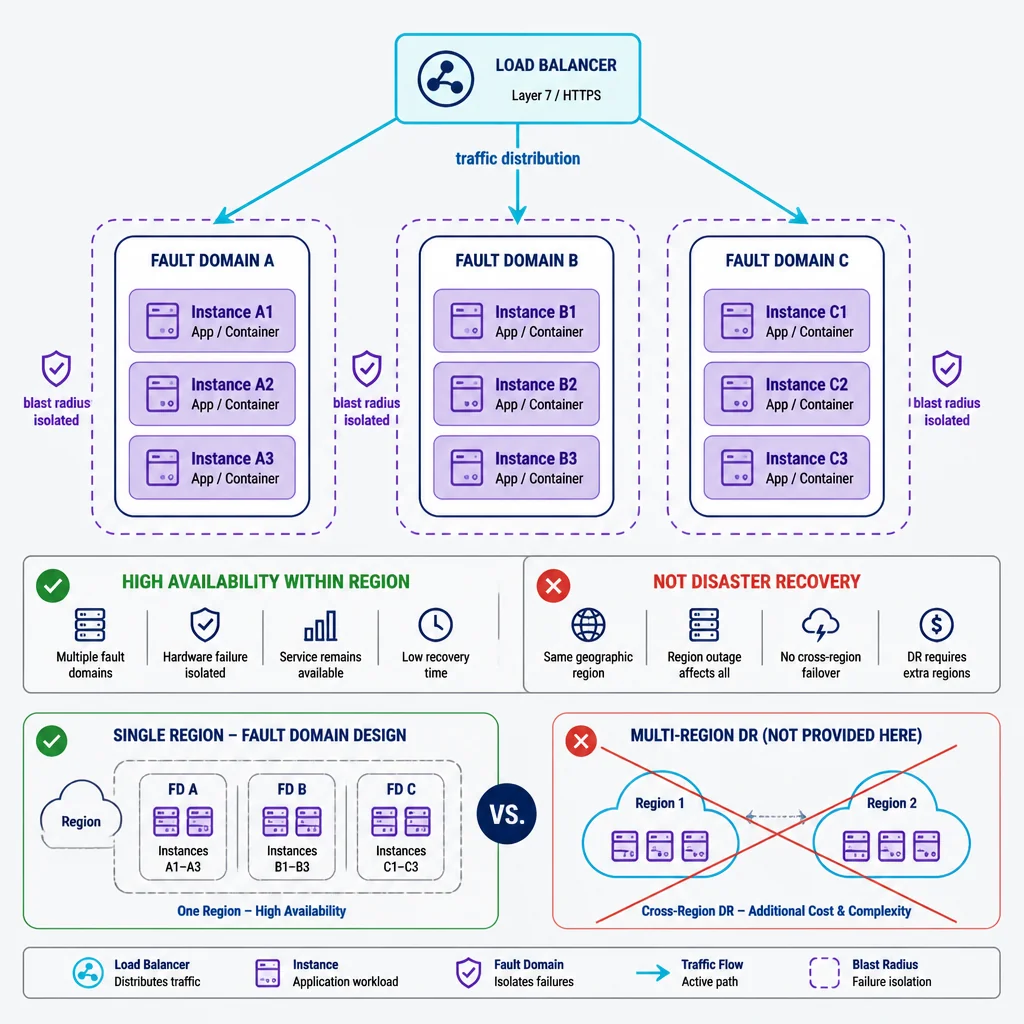
Candidates split between high availability and disaster recovery. Both are valid cloud design goals, but fault domains specifically address availability within a single region, not recovery across regions. Load balancers distribute traffic; fault domains ensure that a single hardware failure doesn't take down all instances. Together they create resilient services, not geographically redundant ones.
The deeper trap is the phrase "hybrid cloud." Candidates fixate on the hybrid aspect and start thinking about cross-premises failover. The question's design choices — load balancers, multiple fault domains, orchestration workflows — are all intra-cloud resilience patterns. Hybrid here merely establishes the deployment context; it doesn't change the technical purpose of the pattern.
When you see fault domains mentioned, think "blast radius reduction." When you see load balancers, think "traffic distribution." Combine them and you get "local resilience," not "geographic recovery."
IT Transformation Goal Prioritisation
Question 36 asks for the most important goal of an IT transformation to the cloud. The options present four plausible strategic outcomes: IT as a broker for external services, IT aligned to business outcomes, IT more responsive and agile, and IT operating more efficiently at less cost.
This is the most divisive question in our data set. Candidates with financial backgrounds lean toward cost reduction. Those with DevOps experience prioritise agility. Enterprise architects often select the broker model. Each option is genuinely desirable, so the challenge is understanding Dell EMC's specific certification framework.
"What is the most important goal of an IT transformation to the cloud?" — E20-920 Dell Exam Info and Free Practice Test
The official exam description emphasises that the course "highlights the benefits, risks, and considerations of design choices" within an ITaaS environment. The certification targets professionals who plan and design cloud services, not merely operate them efficiently. In that framework, alignment to business outcomes is the foundational goal; cost efficiency and agility are enabling outcomes that serve that alignment.
The broker model (option D) is a specific organisational design, not a universal transformation goal. It might be right for some enterprises and wrong for others. Business outcome alignment, by contrast, is the stated purpose of ITaaS in Dell's curriculum.
When facing "most important goal" questions, ask: which option would the other options serve? Agility and efficiency serve business alignment. The broker model is one path toward that alignment. Business alignment sits at the top of the hierarchy.
Usage Measurement and Resource Consumption Processes
Another high-error question describes a cloud provider wanting to measure consumption against available resources, track usage thresholds, and produce trending reports. Candidates must identify the process type.
The options typically include capacity management, availability management, and service level management. The correct answer is capacity management, but availability management is the frequent distractor. Both involve resources. Both use metrics. The difference is temporal orientation: capacity management looks forward ("will we run out?"), while availability management looks at current state ("is it up now?").
Usage trending reports are the clearest signal. Trending implies projection, which is capacity management's core function. Threshold tracking could belong to either discipline, but combined with trending, it becomes capacity planning input.
Candidates with operations backgrounds sometimes select service level management because SLAs include availability percentages. This confuses the reporting mechanism with the management process. SLAs define targets; capacity management determines whether you can meet them.
The exam's wording precision matters here. "Measure consumption against available resources" is capacity language. "Track usage thresholds" alone might trick you, but the full phrase pattern-matches to capacity management in ITIL and Dell's cloud framework.
Building a Study Plan Around These Weak Spots
These five topics share a common thread: they test conceptual precision, not memorisation. You can't brute-force them with flashcards. You need scenario practice that forces you to discriminate between closely related concepts.
Our recommendation is structured repetition with explanation review. Run through E20-920 sample questions in untimed mode first, reading every explanation regardless of whether you answered correctly. Note which distractors attracted you — that's your pattern. If you consistently confuse elasticity with monitoring, you need targeted drill sets on cloud feature definitions before returning to mixed practice.
For candidates sitting the replacement DEE-2T13 exam, these same concepts transfer directly. Dell's cloud architect certification path retained the ITaaS planning and design focus. The exam code changed, but the professional role and underlying technology stack did not.
Time management matters too. Architect-level exams present lengthy scenarios. Practice reading the question stem once, identifying the action verb and key constraint, then eliminating obviously wrong answers before analysing the remaining options. This two-pass method prevents the cognitive overload that causes experienced professionals to select familiar-sounding wrong answers.
What to Know About the E20-920 Retirement
Since many candidates still encounter E20-920 references in training materials, a brief status check is warranted. Dell retired the exam on 3 June 2021. The replacement DEE-2T13 aligns to the same Expert — Cloud Architect, Cloud Services certification track. If your employer or training provider still lists E20-920, verify whether they mean the historical exam or are using outdated curriculum that needs updating.
"The E20-920 exam that supports the Expert - Cloud Architect, Cloud Services Version 2.0 certification will retire on June 03, 2021. This exam will be replaced by the new DEE-2T13." — Dell Learning
This retirement context matters for your study material selection. Some third-party practice test providers still sell E20-920 content without clearly marking it as legacy. Verify publication dates and exam code alignment before purchasing. Quality practice questions for the current exam should reference DEE-2T13 or at least note the E20-920 retirement date.
If you're studying for historical completeness — perhaps supporting a colleague who passed E20-920 and needs documentation — the conceptual material remains valid. Just don't book the wrong exam.
From Diagnosis to Exam Readiness
The five topics above represent decision points where knowledgeable candidates lose points through pattern-matching rather than analysis. The fix is deliberate practice with structured review. Identify your personal error patterns, isolate the underlying concept confusion, and rebuild from definitions upward.
For cloud architect exams specifically, maintain a mental model that separates technical implementation from business governance. The exam tests whether you can recommend the right approach for a given organisational context, not whether you can configure it. When in doubt, ask: what business outcome does this serve, and which option most directly enables that outcome?
Timed simulation runs help build the decision speed you'll need. Start untimed for concept mastery, then transition to exam-pace practice in your final week. The gap between knowing the material and performing under pressure is where many otherwise-prepared candidates falter.
E20-920 and Your Certification Path
Whether you're sitting the historical E20-920 for a specific organisational requirement or preparing for its DEE-2T13 successor, the core competency is the same: cloud services planning and design within an ITaaS framework. The sample questions and topic breakdowns in this article target that competency directly.
For additional preparation support, our simulator includes full E20-920 practice tests with detailed explanations for every answer option, not just the correct one. Understanding why wrong answers are wrong is often more valuable than confirming what you already know.
References
- EMC DECE — # Pass E20-920 DECE-CA Certification Exam Fast ... ## E20-920 Exam Has Been Retired ... This exam has been replaced by EMC with new exam. ... ### EMC E20-920 Exam Details ... #
More Cloud Certification Resources


Discussion
Question Comments
0 comments·0 participantsSign in to leave a comment and access more free questions.