
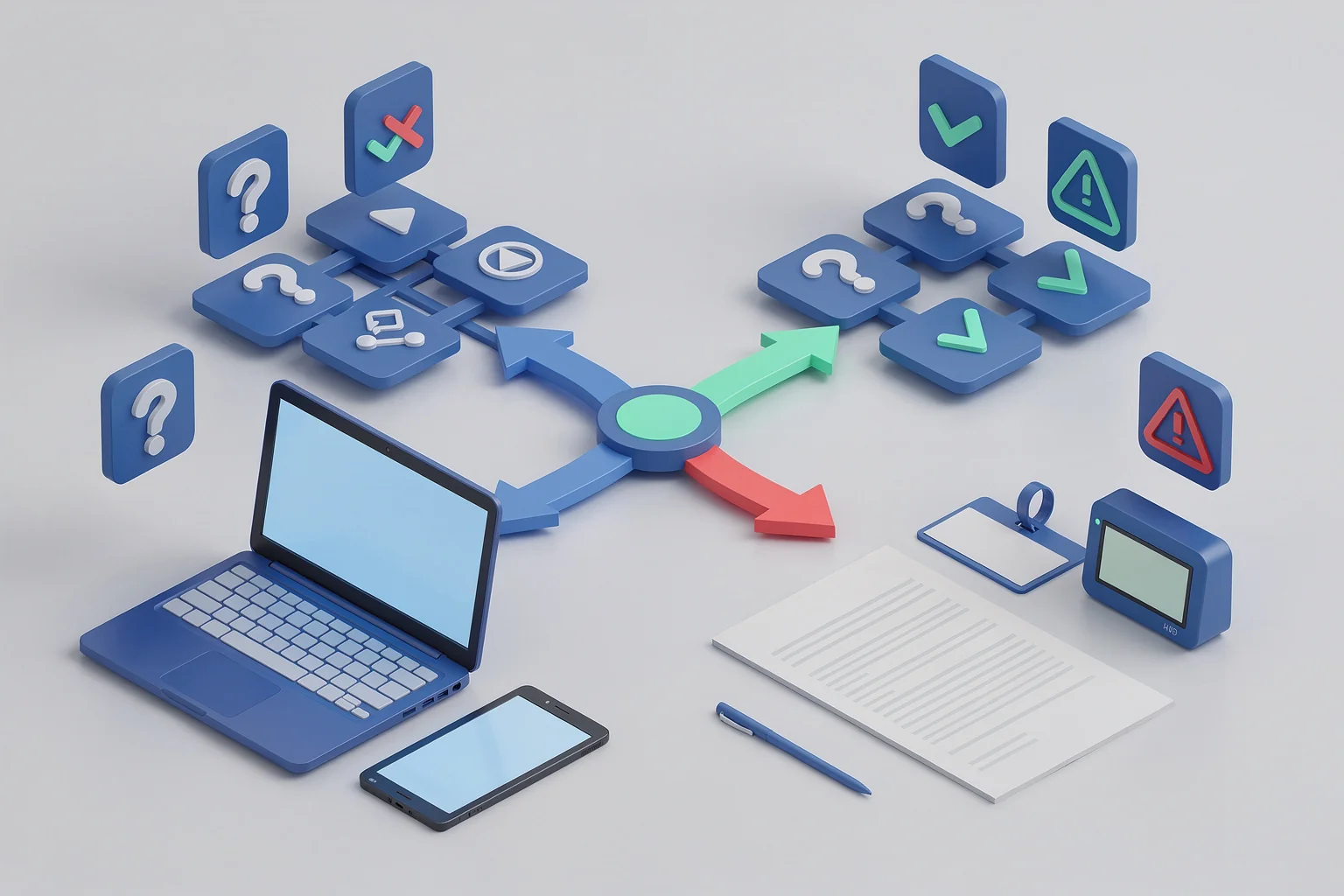
Practice Exam vs Real Exam: Key Differences Explained
You've been running through timed sets for weeks. Your scores are climbing, and the answer explanations are starting to feel obvious. Yet something in the back of your head keeps asking: will it all fall apart when you sit for the real thing? You're not alone. Most certification candidates discover that practice tests and the live exam are two different animals, even when the question bank looks legitimate. This article walks you through exactly where the gaps live, why they matter, and how to adjust your preparation so the transition feels less like a jump into cold water.
Why does the real exam feel harder than practice tests?
The immediate reaction many test-takers report is that the actual exam questions seem harder, even when they cover the same blueprint. Part of this is genuine: live exams use item pools that have been through formal psychometric review and are selected to meet specific difficulty targets. Practice tests, on the other hand, often mirror the content but not the same statistical calibration.
But there's a bigger factor at play, and it has less to do with the questions and more to do with the stakes. When you click “Start” on a practice exam, you know you can pause, retry, or walk away. At a Pearson VUE centre—or even under the watchful eye of an online proctored session—that exit door closes. The pressure changes how your brain processes information. A scenario that you'd methodically troubleshoot at home suddenly feels ambiguous under the clock.
The most significant difference between a practice test and the real exam isn't the content—it's the context. —Practice Tests vs Real Tests, Testara (2025)
That shift in context triggers test anxiety, which can drop your working memory capacity and slow your reading pace. You might second-guess answers that you'd usually breeze through. This is normal, and it's a gap you can narrow by simulating exam pressure during practice—something we'll explore in a moment.
How accurate are practice test scores compared to the real exam?
This is the question that keeps candidates up at night, and the short answer is: they're directionally useful but not a precise mirror. Certification bodies such as CompTIA, Cisco, and AWS use scaled scoring models that are weighted by domain and calibrated against a large population. Practice platforms can approximate those scales, but they rarely have access to the actual weighting mechanism.
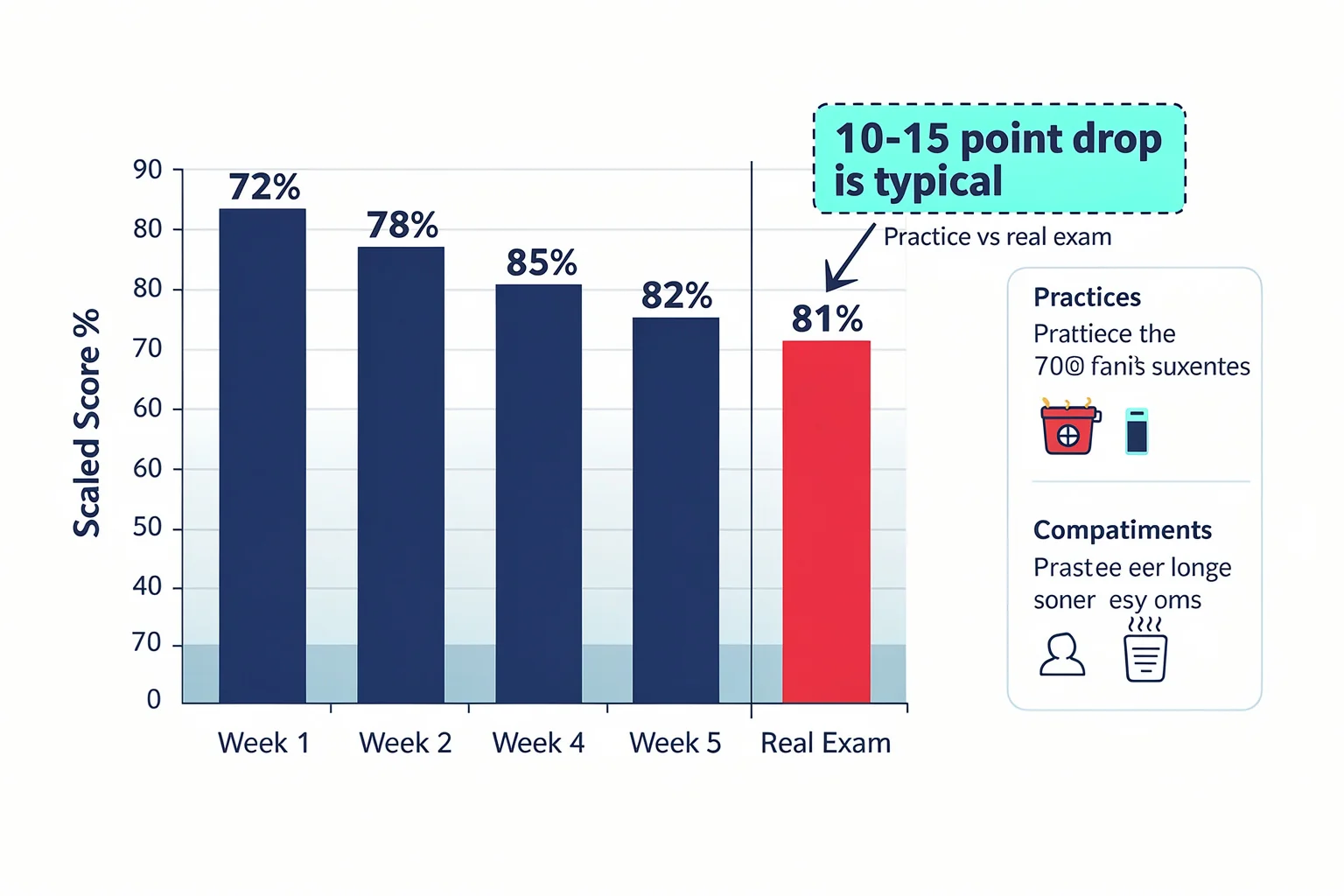
A dedicated analysis of the bridge between practice and actual scores from Crucial Exams in May 2026 notes that most candidates see a noticeable score drop—sometimes 10 to 15 percentage points—when they move from practice sets to the live environment. The article Practice Exam Score vs Actual highlights three factors that inflate practice results: retake familiarity, an untimed review habit, and the absence of performance anxiety create a gap that can make readiness look stronger than it is.
Even more telling: practice exams don't have the same post-exam standardisation that live exams do. Exam boards—whether in IT certifications or academic qualifications—set grade boundaries only after a full national cohort has taken the test, as the Cambridge OCR team explains when discussing What are the grade boundaries for practice papers. That process simply cannot happen with a set of practice questions. So when your practice engine says “80%”, it's telling you that you got 80% of that particular set right under rehearsal conditions—not that you're guaranteed an 800 on the exam's scale. Treat practice scores as a trendline, not a prediction.
What are the practical differences in question style?
It's easy to assume that if you're using a good practice bank, the real questions will look the same. They often do, but there are subtle stylistic shifts that can catch you off guard.
Real exam items are typically written by vendor-appointed SMEs and reviewed through multiple editorial rounds. They use precise language, sometimes deliberately ambiguous around edge cases, relying on you to select the best answer rather than a single correct one. Practice questions from third-party providers—even high-quality ones—tend to be slightly more direct to help you learn the material. That's not a flaw; it's a design choice. But on exam day, you'll encounter more multi-step reasoning and distractors that are genuinely plausible.
Another difference is the distribution of question types. Many candidates practise heavily with multiple-choice items, but real exams for Cisco, AWS, and Microsoft now include drag-and-drop, simulations, command-line tasks, and even live-lab environments. For example, the CCNA 200-301 v1.1 exam includes a mix of configuration-based items that require you to interact with a simulated IOS. If your practice sessions never leave the realm of “click one answer”, you're missing a chunk of what the proctored experience demands.
When you are working with a simulator that mirrors these interactive formats—like the timed modes on PlanetCert—you can start exposing yourself to the mental load of typing commands against a ticking clock. The goal is not to replicate the exam exactly (that would breach all sorts of NDAs), but to build the muscle of performing technical tasks under time constraints.
How does the exam environment affect performance?
The environment is the single largest gap between practice and real exam experiences. At home, you're comfortable. You might have a second monitor, notes on your desk, or a coffee within reach. You can stretch, check your phone, or even step away for a moment. None of that applies in a Pearson VUE test centre.
Candidates who take their first certification at a physical centre are often rattled by the check-in process: emptying pockets, removing watches, being escorted to a cubicle, and being aware that every movement is recorded. Even if you're testing online, the proctoring software requires a clean workspace, a camera scan, and strict silence. That alone can raise your heart rate before you've even seen the first question.
Environmental differences also mess with your time management instincts. During practice, you might spend two minutes debating a tricky subnetting question because you know you can make up the time later. On the real exam, every question is weighted, and you only get one pass through most sections. If you get stuck, you have no “pause and come back” luxury. Building the habit of answering within a strict time limit—every single time—is critical. One effective approach is to run full-length timed sessions in a room that isn't your usual study spot, maybe even wearing the same kind of clothing you'd wear to a centre. It sounds trivial, but creating a distinct “exam space” helps your brain shift into the right mode.
What about time pressure and exam fatigue?
IT certification exams typically run from 90 to 180 minutes, with question counts ranging from 55 to 100+. Practice sets often let you take a breather or look at the clock without consequence. On the real exam, the countdown never stops, and the fatigue is real.
When you're tackling a practice test, you might not even notice the muscle weariness building around question 60 because you can pause. In a live environment, that same point might coincide with a low-energy moment. You start re-reading questions, losing focus, and making simple mistakes. A network engineer I spoke to recently described bombing a cloud architecture question halfway through an AWS exam simply because their brain was trying to context-switch between VPC routing tables and S3 lifecycle policies too quickly. They knew the answer; they just couldn't summon it in the moment.
The solution pair: practice exam endurance and brain pacing. Train yourself to mark or flag questions and move on quickly. In exams that allow review, save the hard ones for a second pass so you don't burn clock on uncertainty. In exams like the CompTIA A+ core series, where you cannot go back, you need to commit to an answer with a clear “this is my best guess, next” mentality. You can rehearse that decision-making rhythm at home by disabling the back button in your simulator settings—some platforms, including PlanetCert's, let you toggle that feature.
How should I use practice exams to prepare for the real thing?
Given all the differences, why bother with practice exams at all? Because they're still the most efficient tool for turning knowledge into exam-day performance—when used strategically. The key is to stop treating them as knowledge checkers and start treating them as performance simulators.
Learning mode vs testing mode
Start your study cycle by using practice sets in a diagnostic mode: untimed, open-note, focusing on explanation reviews. This is your learning phase. About two to three weeks before your target date, switch gears. Do full-length timed exams under simulated conditions, even if your scores go down initially. The dip is expected—your brain is adjusting to the time pressure. Use the results to identify weak domains, then revisit the textbook or lab for that specific area.
Building test-day reflexes
A practical example: if you're studying for the AWS Solutions Architect Associate SAA-C03, you could take a broad diagnostic set early on to see which services (e.g., Lambda, RDS, VPC peering) you're weakest on. Then, after targeted study, do a full 65-question set under timed, review-blocked conditions. When you finish, drill deeper on the missed questions but resist the urge to immediately memorise the right answer. Instead, understand why you made the mistake: was it a knowledge gap, a reading error, or a time-management fault? That triage is the difference between using practice exams for learning and just gaming them for score inflation.
Can practice exams predict whether I'm ready to book?
The answer isn't a yes or no. Your practice scores can give you a good rough signal, but you need to look at more than the percentage.
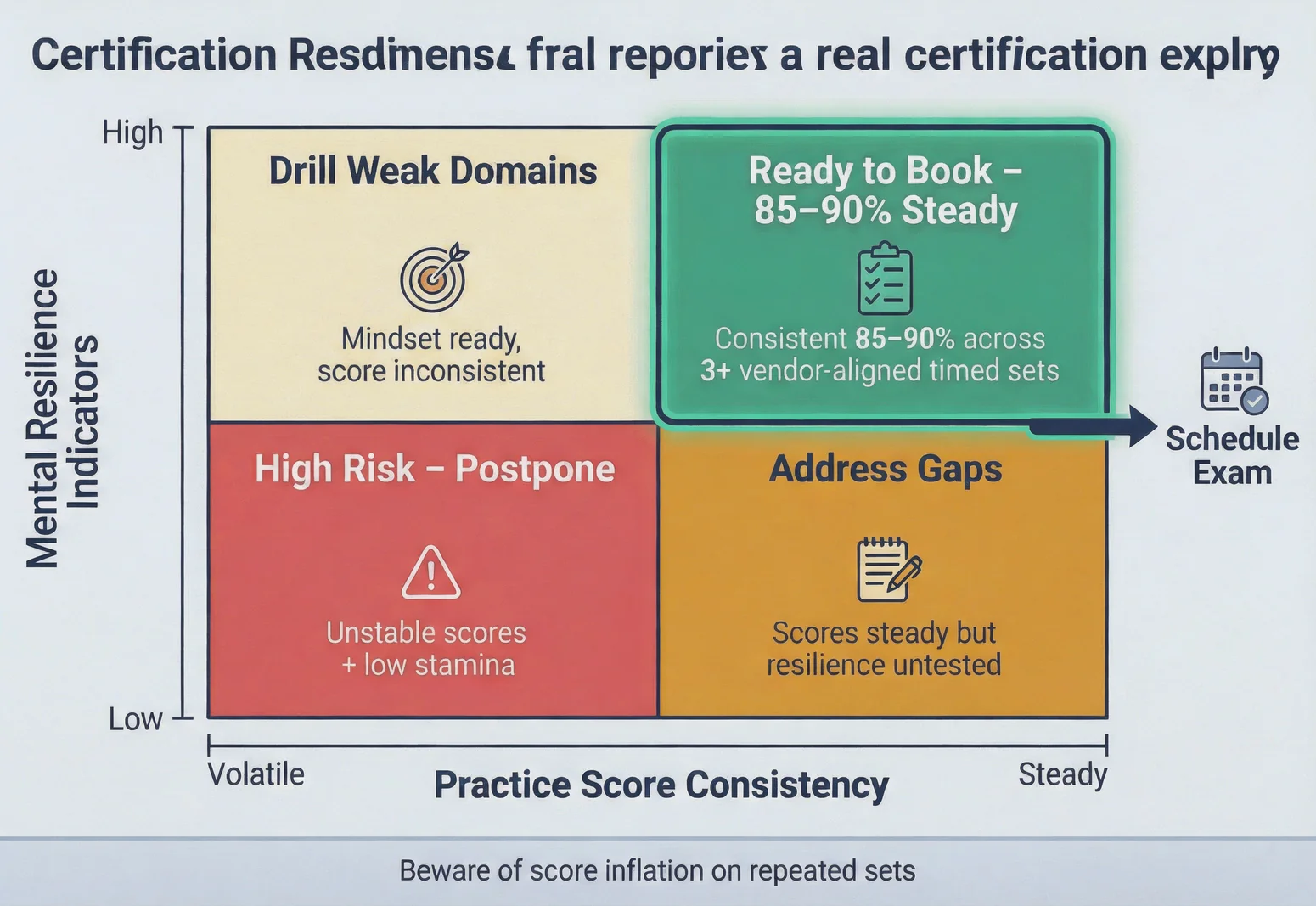
Many coaches suggest that if you're consistently scoring 85–90% on high-quality, vendor-aligned practice tests under timed conditions, and you're not seeing wild swings between attempts, you're probably in the zone. However, if you've hit 90% three times on the same set but then struggle with a new set from a different provider, you've memorised questions, not concepts. That's a red flag.
Also, consider your mental resilience score. Take a practice exam at 8 a.m. on a weekday, after a normal morning routine, with the same restrictions you'd face on test day. If your score drops significantly—say 15% below your best—you might need more endurance work or a later exam slot. The gap between your best practice performance and your worst realistic simulation is a solid gauge of your stability under duress.
If you're seeing a tight band of scores across multiple distinct practice banks and you've trained for the environment, go ahead and schedule the real exam. But don't wait for the perfect percentage. The real exam will never feel the same as practice, and you don't need it to. You just need to trust that your preparation has built the reflexes to handle whatever shows up.
Dig deeper into your exam prep
- How to Vet a CCNA Practice Exam Before You Pay
- Which CCNA Practice Exams Prepare You for the 2027 V2.0 Blueprint
- Where to Find Free CCNA Practice Exams That Actually Help
browse the relevant exam page and purchase a practice test

Discussion
Question Comments
0 comments·0 participantsSign in to leave a comment and access more free questions.