
How to Vet a CCNA Practice Exam Before You Pay
Use Cisco's official exam blueprint and community-tested quality signals to evaluate any CCNA practice test before you spend money on it.
The hunt for the best ccna practice exams reddit users actually trust tends to generate noise faster than signal. Every provider touts "exam-realistic" content, yet candidates keep stumbling onto question banks stuffed with obsolete material, bare-bones explanations, or scenarios that feel nothing like the actual 200-301. This guide gives you a repeatable, six-step vetting process you can run on any practice exam before opening your wallet.
Before You Begin
This walkthrough targets anyone prepping for Cisco's CCNA 200-301 who wants to dodge low-quality practice tests. You should already grasp the CCNA certification path and know the current exam is 200-301 v1.1. We're covering how to evaluate third-party practice exams against Cisco's official standards — not exam registration, picking study courses, or designing lab topologies. The end goal is a scored evaluation you can use to compare two or more providers head-to-head.
Time required: 45-60 minutes for your first evaluation, 15-20 minutes for each exam after that.
Required tools: Free sample questions or a trial from the practice exam provider, the Cisco 200-301 exam objectives PDF, and somewhere to take notes.
Skill level: Intermediate — you should already know your way around basic networking terms like VLANs, OSPF, NAT, and ACLs.
Prerequisite most people miss: Grab the official exam objectives first. Without Cisco's blueprint as your baseline, you're judging coverage and difficulty against guesswork, not reality.
Success Checks
By the end of this process, you should be able to confirm:
- The practice exam's question distribution lines up with Cisco's six official domains within 5 percentage points.
- At least 80% of sampled questions include explanations referencing specific configuration commands, show output analysis, or why wrong answers fail.
- The simulator handles timed mode, bookmarking for review, and performance breakdowns by topic area.
- Nothing in the question bank leans on memorized dumps, verbatim wording from known pirated sources, or content clearly stale for the v1.1 exam.
- You can pinpoint three specific weaknesses that would skew your study plan if you used this exam.
- You have a numerical score (1-10) to stack against alternative practice exams.
Step 1: Download and Map the Official Exam Objectives
Skip this and you're evaluating against hunches, not Cisco's actual requirements. The 200-301 v1.1 exam spans six weighted domains, and plenty of budget practice exams still hew to older versions or give short shrift to newer territory like automation and programmability.
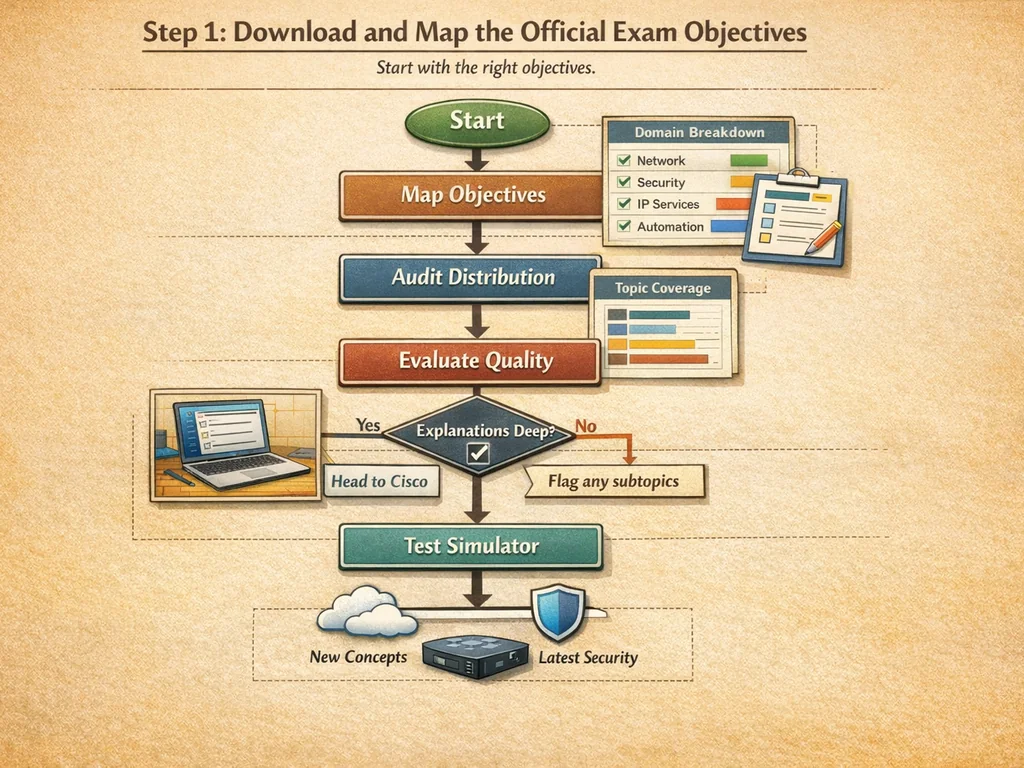
- Head to Cisco's certification site and download the CCNA Exam and Training objectives for exam 200-301 v1.1.
- Build a simple spreadsheet with six rows: Network Fundamentals (20%), Network Access (20%), IP Connectivity (25%), IP Services (10%), Security Fundamentals (15%), Automation and Programmability (10%).
- Flag any subtopics that look new or expanded in v1.1 — REST API concepts, JSON data formats, and network programmability foundations among them.
Expected result: A weighted checklist of every exam topic you can use to audit any practice exam's coverage.
Verify: Count the major topic headings in the official objectives. You should see roughly 45-50 distinct subtopics across all six domains.
Step 2: Audit Question Distribution Against the Blueprint
A practice exam that dumps 50% of its questions into subnetting and barely touches automation isn't "tougher" or "more thorough" — it's off-target. Misaligned exams burn study hours on overrepresented topics and leave you exposed on heavily weighted domains you barely touched.
- Ask the provider for their topic breakdown, or manually sort 50-100 sample questions into your objectives spreadsheet.
- Calculate each domain's percentage of the total.
- Flag any domain drifting more than 5 percentage points from Cisco's weights. Security Fundamentals at 10% instead of 15%? That's a gap.
- Watch Automation and Programmability especially. Older or cheaper exams often squeeze in 2-3% here instead of the full 10%.
Expected result: A scored alignment report showing which domains match, exceed, or fall short of official weights.
Verify: Your percentages should sum to 100%. If Automation and Programmability is missing entirely or shoved under "other topics," the exam is stale.
Step 3: Evaluate Question Quality and Explanation Depth
The real CCNA tests application and analysis, not just recall. Candidates on Reddit consistently point to this as the make-or-break factor: do your practice questions force you to parse show command output, troubleshoot configurations, or pick the best option when several look workable?
- Run through 10-15 sample questions at about 90 seconds each to match exam pace.
- For every question, ask yourself: Does this demand reading output, interpreting a topology, or applying a concept? Or is it just asking for a memorized fact like OSPF's default administrative distance?
- Read every explanation, even for questions you nailed. Solid explanations spell out why the right answer works, why each distractor falls apart, and ideally cite the relevant IOS command or configuration syntax.
- Check whether wrong answers feel plausible. On the real exam, distractors often mirror common misconfigurations. If the wrong choices are laughably obvious, the question's too easy and breeds false confidence.
Expected result: At least 70% of questions demand analysis over recall, with explanations averaging 4-6 sentences and specific command references.
Verify: Pick a question you missed. Can you explain why your answer failed using only the explanation — no googling? If it says "B is correct because OSPF is better" without unpacking why your RIP choice failed for this specific topology, the explanation's too thin.
Step 4: Test the Simulator Interface and Timing
CCNA gives you 120 minutes for roughly 100 questions. Your brain operates differently under the gun, and the interface itself — how you flag questions, review marked items, hop between sections — directly impacts your efficiency. A PDF question list or basic quiz app doesn't replicate this.
- Launch a full-length timed practice exam if you can, or at minimum a timed 20+ question section.
- Confirm the interface includes: question flagging for later review, a visible countdown timer, free navigation between questions, and a final review screen showing flagged and incomplete items.
- Note whether the simulator shows one question at a time (like the real exam) or dumps everything in a scrollable list. The single-question format changes how you manage time and nerves.
- Check if performance analytics slice your score by domain. You need this to spot weak areas for targeted study.
Expected result: You finish a timed session without technical glitches and get a score report with domain-level breakdowns.
Verify: After the timed session, can you list your three weakest domains? If the simulator spits back only a raw percentage with no topic analysis, it can't guide your remaining study time.
Step 5: Verify Content Freshness and Community Reputation
CCNA content shifts. Cisco folded in SD-Access elements, expanded API coverage, and recalibrated security topics for v1.1. A practice exam written for 2020 might still be on sale in 2026 with minimal touch-ups. Reddit's CCNA community usually catches discrepancies between practice questions and real exam experiences before anyone else.
- Search the Ccna subreddit for the provider's name plus "practice exam" or "outdated." Focus on threads from the last 12 months.
- Look for specific complaints, not vague gripes: "Questions still treat EIGRP as required" (it got cut from CCNA), "Zero REST API questions," or "Saw three of these exact questions on the real exam" (possible dump material).
- Check the provider's site for a "last updated" date or version history. Legitimate shops update quarterly or after Cisco announces changes.
- Cross-reference any configuration questions against what the Configuration portion of the CCNA exam actually requires — the real exam uses a constrained command set compared to full IOS, and quality practice exams should respect that limitation.
Expected result: Recent positive mentions with specific quality details, no widespread freshness complaints, and documented updates within the last 6-12 months.
Verify: Can you find three Reddit posts from the last year where passing candidates name this practice exam as helpful? If every mention is 2+ years old or vague ("good questions"), the community signal's too weak to trust.
Step 6: Score the Exam and Document Your Decision
Without a numerical comparison, you'll default to price or marketing hype when choosing between providers. A structured score blocks that and gives you an audit trail if you need to chase a refund.
- Rate the practice exam 1-10 on: Blueprint Alignment, Question Quality, Explanation Depth, Simulator Realism, Content Freshness, and Community Reputation.
- Weight Blueprint Alignment and Question Quality at 1.5x each — these drive exam readiness most directly.
- Calculate a weighted total out of 80 possible points. Below 50 means significant gaps; 50-65 is acceptable with supplementation; 65+ is strong.
- Document specific gaps for any category scoring below 8. These become action items: "Supplement with extra automation questions from [source]" or "Add 5 lab hours since simlets are underrepresented."
Expected result: One comparable score and a prioritized gap list to fill through other study resources.
Verify: Can you explain to another candidate in two sentences why you picked this practice exam and what its main weakness is? If you can't name a weakness, you haven't evaluated critically enough. Every commercial product involves tradeoffs.
Troubleshooting: Common Mistakes and Fixes
Problem: The practice exam scores me at 95%, but I fail the real exam.
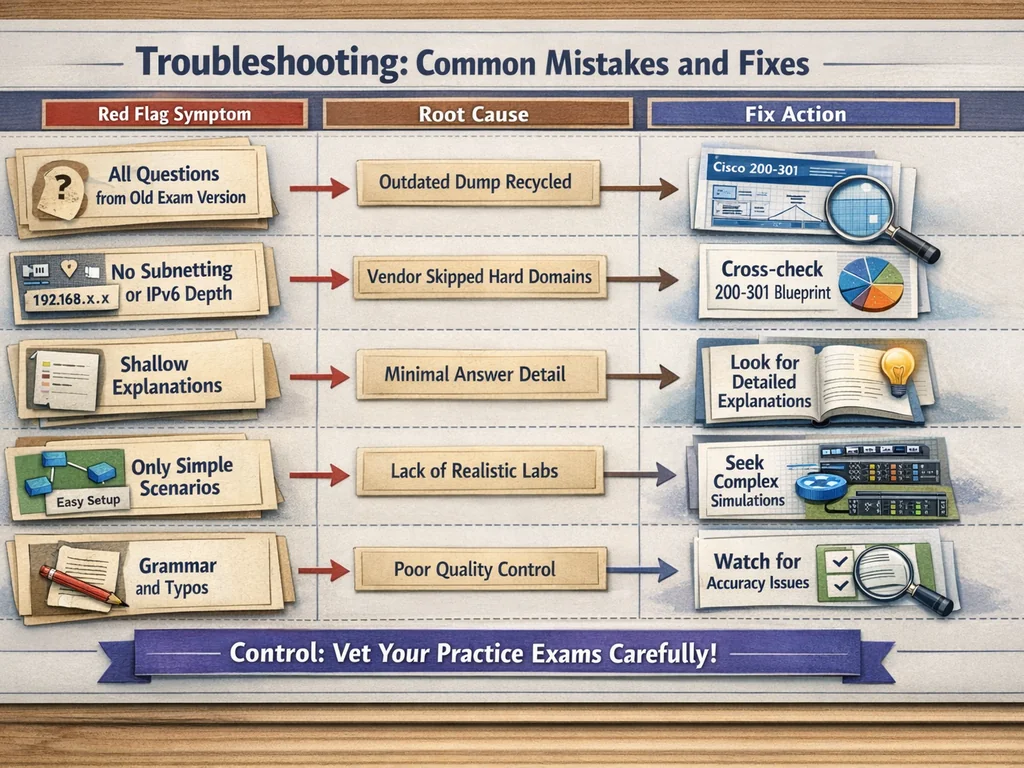
Cause: The practice exam's too easy, uses outdated question styles, or trains pattern recognition instead of concept application. Plenty of budget exams recycle question templates with swapped IP addresses.
Fix: Re-audit using Step 3. If fewer than 50% of questions require analysis, switch to a harder provider or supplement with Cisco's official practice tests and hands-on labs. Don't trust percentage scores from unvalidated sources.
Problem: I can't find any recent Reddit discussions about this provider.
Cause: The provider's brand new, extremely niche, or markets mainly outside community channels. Alternatively, they may have rebranded after quality complaints.
Fix: Search the company name plus "review" and check dates. If they launched within 6 months, either wait for more community validation or put their free trial through heavy paces before buying. New providers can be gems, but they carry more uncertainty.
Problem: The exam advertises "875 questions" but many are duplicates with tiny tweaks.
Cause: Some providers pad question counts by rewording identical scenarios or changing only IP addresses. This inflates volume without adding study value.
Fix: Sample 20 random questions and check for genuine uniqueness. Spot obvious duplicates? Divide the advertised count by your duplication rate and recalculate value per unique question. A 200-question bank with zero redundancy beats an 800-question bank that's 75% recycled.
Problem: Explanations reference commands or features not in the current exam objectives.
Cause: Content was built for older exams (ICND1/ICND2 era) or accidentally includes CCNP-level material.
Fix: Cross-reference any unfamiliar command or concept against your official objectives document. If it's absent, flag it out of scope. Some advanced content can be enriching, but it shouldn't dominate your limited CCNA prep time.
Problem: The simulator crashes or acts weird on mobile devices.
Cause: Some web-based simulators run on outdated frameworks or never got tested across browsers and screen sizes.
Fix: Test on whatever device you actually plan to study with. If you need mobile access for commute sessions, verify this before purchase. A desktop-only simulator constrains your study schedule flexibility.
Verify the Result
Circle back to your Success Checks from the top. For each one, confirm your practice exam meets or exceeds the bar:
- Blueprint alignment within 5%: Stack your Step 2 spreadsheet against Cisco's weights. Any domain outside tolerance needs supplemental material.
- 80% of questions with strong explanations: Review your Step 3 notes. Weak explanations mean you'll be researching correct answers yourself or picking a different provider.
- Simulator supports timed mode, bookmarking, and domain breakdowns: Confirm from Step 4. Missing features mean missing prep for exam mechanics.
- No dump material or outdated content: Confirm from Step 5. Red flags here mean don't use the material, other scores notwithstanding.
- Three identified weaknesses: Confirm from Step 6. You want specific, actionable gaps — not fuzzy worries.
- Numerical comparison score: Confirm your weighted total. Use this to compare multiple providers directly.
If any check fails, don't run with that practice exam as your primary tool. A failing check means either a different provider or a hybrid study plan combining multiple resources to cover gaps.
How PlanetCert Helps
PlanetCert's Cisco Certified Network Associate (CCNA) Practice Exam is built around the 200-301 v1.1 objectives with domain-weighted question pools, detailed explanations citing IOS commands and show output analysis, and a simulator replicating single-question navigation with flagging and timed modes. The performance dashboard slices results by Cisco's six official domains, so you know precisely where to pour remaining study time.
For candidates weighing multiple providers, PlanetCert offers sample questions you can audit using this exact six-step process. That lets you apply the same scoring framework before any purchase. The Cisco Practice Tests 2026 catalog also covers related exams like CCNA Cybersecurity (CyberOps Associate) and CCNA Automation if your certification path stretches beyond the core exam.
Next Steps
Once you've finished this evaluation, build a study schedule that allocates time proportional to your weakest domains — not evenly across everything. Use your practice exam's domain breakdown (or a diagnostic test if you haven't taken one yet) to identify where 60% of your study hours should land. Then schedule your first full timed practice exam two weeks before your real test date, leaving runway for remediation based on results.
If you're weighing multiple certification paths, browse the broader Cisco Practice Tests 2026 catalog to see how CCNA specialization exams like CyberOps or DevNet Associate slot into longer-term career planning.
Related Blog Posts
- Best Practice Tests For Ccna Exam Success — A direct comparison of major CCNA practice exam providers using the evaluation criteria from this guide
- What Is CCNA Certification — Foundational overview of the CCNA program, exam versions, and recertification requirements
- Study Planning Guide for Tech Certification Exams — Framework for building schedules around practice test results and domain weakness analysis
- Certification Exam Prep Checklist Before Test Day
- Best Certification Exam Platforms Comparison
browse the relevant exam page and purchase a practice test
Get started
Discussion
Question Comments
0 comments·0 participantsSign in to leave a comment and access more free questions.