
Where to Find Free CCNA Practice Exams That Actually Help
Most free CCNA practice tests online are either outdated, misaligned with the 200-301 blueprint, or so poorly written they teach bad habits. I've watched candidates burn weeks on recycled 200-125 questions only to discover their "free" resource covered subnetting methods Cisco dropped years ago. The real problem isn't finding free material — it's finding free material that actually moves you toward a pass.
This article cuts through the noise. I'll show you where to find legitimate ccna practice exam free resources that match current exam objectives, explain what each source does well (and where it falls short), and help you build a study plan around the gaps these free tools leave open. Whether you're self-funding your cert or just want to test the waters before committing to paid prep, you'll leave with actionable next steps.
Why Most Free CCNA Practice Tests Fail You
The 200-301 exam covers six domains: Network Fundamentals, Network Access, IP Connectivity, IP Services, Security Fundamentals, and Automation and Programmability. Cisco's official exam topics spell out exactly what candidates must demonstrate, yet many free test banks ignore entire sections — especially automation, which now carries meaningful weight on the live exam.
Three patterns kill the value of supposedly free prep:
Recycled legacy content. Sites repackage old CCNA questions from the 200-125 era without updating for current blueprint emphasis. You end up drilling frame relay and RIPv2 while neglecting REST APIs and JSON data formats that actually appear on your test date.
No explanation depth. A question bank with answers but without reasoning teaches you to memorise, not to troubleshoot. The real 200-301 rewards applied knowledge — configuring, verifying, and diagnosing network behaviour under time pressure.
Broken question logic. Poorly constructed distractors, grammatical errors, or technically impossible scenarios train your brain to expect sloppy problems. The actual Pearson VUE exam is precise. Your practice should be too.
When I evaluate a free resource, I check three things: blueprint coverage accuracy, explanation quality, and whether the question style mimics Cisco's actual format including drag-and-drop, simulation, and multiple-choice with multiple correct answers. Most free sources hit one of these criteria. Very few hit all three.
Cisco's Own Free Materials (And Their Real Limits)
Cisco provides foundational training through Cisco U. and makes exam topics publicly available. These are essential starting points, not complete prep solutions.
The official 200-301 exam topics PDF remains your single source of truth for what Cisco can test. Download it, print it, and mark every line red/yellow/green based on your confidence. This costs nothing and prevents the common failure mode of over-studying comfortable topics while avoiding weak areas.
Cisco's free content has gaps though. You won't find full-length timed practice exams in their free tier. Their tutorials and videos explain concepts well but don't force retrieval practice under exam conditions — the exact skill that separates passing from failing. For that, you need external question banks.
Johns Hopkins University's Free CCNA Practice Exam
Johns Hopkins University's Center for Talented Youth offers a genuinely useful Practice Exam for Cisco Certified Network Associate candidates. This resource stands out for several reasons that most free alternatives miss.
The platform provides three practice modes — timed, untimed, and custom — letting you build from untimed careful work up to full exam simulation. Each attempt includes explanations for both correct and incorrect answers, which is where real learning happens. You can retake indefinitely, and the question distribution aims to mirror the live certification exam's topic weightings.
What's the catch? Question volume is limited compared to paid platforms. You won't get thousands of items here. The interface is functional rather than polished. And while the content aligns with v1.1 objectives, you'll want to verify specific automation and programmability coverage against the newer v2.0 blueprint that Cisco announced in May 2026 for February 2027 implementation.
I recommend this resource for candidates who've completed initial content study and need a reality check before scheduling their exam. It's also excellent for identifying specific weak domains to target in final review. Use it 2-3 weeks before your test date, not as your primary learning tool.
Community-Driven Options: Reddit and Open Platforms
The CCNA subreddit maintains active discussion of free resources, including a community-built practice app with 600+ questions that surfaced in early 2025. These community efforts can surprise you with quality — or disappoint with unchecked errors.
What works: Recent community question sets often reflect current exam experiences. Contributors who've sat the exam recently remember specific topic emphases and question styles. Discussion threads surface which free resources helped actual passers.
What doesn't: No quality control. A question might have a wrong answer marked correct, or explanation logic that contradicts Cisco documentation. You need enough knowledge to self-verify, which creates a catch-22 for early-stage candidates.
How to use safely: Cross-reference every questionable explanation against Cisco's official documentation or verified instructor materials. Treat community banks as supplementary exposure, not primary study. Time yourself even when the platform doesn't force it — untimed practice builds false confidence.
The OpenExamPrep free CCNA practice test offers 200+ questions with no registration required. This removes friction for quick sessions but means no progress tracking across attempts. Their pass rate estimate of 25-30% on first attempts suggests realistic question difficulty, though I'd verify this against your own performance on verified materials.
Mobile Apps: Free CCNA Practice on Your Phone
Several free CCNA practice test apps exist for iOS and Android. These suit candidates with fragmented study time — commutes, lunch breaks, waiting rooms. The convenience is genuine; the quality varies enormously.
Look for apps that:
- Specify 200-301 alignment, not generic "CCNA" content
- Update their question bank within the last 12 months
- Provide explanations beyond simple answer reveals
- Allow flagging questions for later review
Red flags include: apps with no version history, overwhelmingly positive reviews with vague text (possible fake ratings), or content that feels like a braindump collection. The latter won't prepare you for Cisco's emphasis on configuration and troubleshooting scenarios.
I typically recommend mobile apps for quick reinforcement of already-studied topics, not for initial learning. The small screen format works poorly for complex topology questions or multi-step simulation items. Use them to maintain momentum between dedicated study sessions, not as your main preparation vehicle.
How to Vet Any Free CCNA Practice Test in Five Minutes
Before investing study hours in any free resource, run this quick validation:
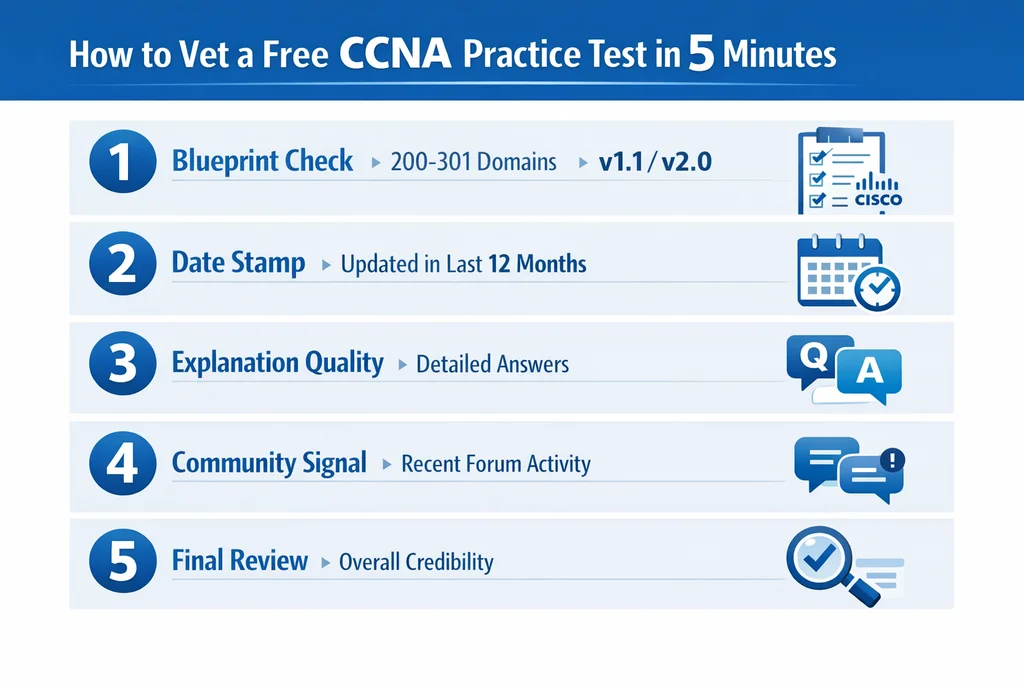
Check the blueprint version. Look for explicit 200-301 mention, ideally with v1.1 or v2.0 specification. Generic "CCNA" labels usually mean outdated content.
Sample the automation coverage. Ask a test question about REST APIs, JSON parsing, or Python network automation. If the resource has nothing here, it's not current.
Verify explanation depth. Pick three questions you answered correctly by guess. Does the explanation teach you why your guess worked, or just confirm the right letter? Shallow explanations mean shallow learning.
Test the distractor quality. In multiple-choice items, do wrong answers represent common misconceptions and configuration errors? Or are they obviously absurd? Cisco writes plausible distractors; your practice should too.
Check for simulation-style items. The real exam includes drag-and-drop and simulation questions. Free resources rarely replicate these well, but if they exist, that's a quality signal.
This five-minute screen eliminates perhaps 70% of free resources that would waste your time.
Building a Hybrid Study Plan Around Free Resources
Free practice exams work best as one component of a structured approach, not the entire strategy. Here's how I'd layer them for a typical 8-10 week CCNA preparation:
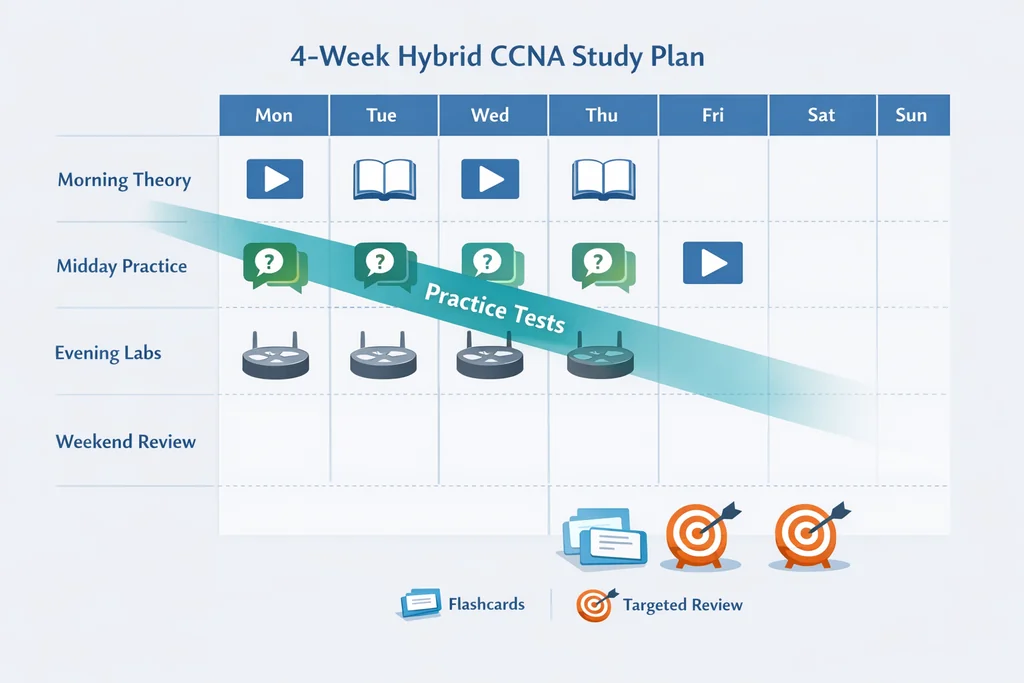
Weeks 1-4: Foundation building. Use Cisco's free training materials, official documentation, and a primary textbook (Odom's CCNA guides remain the standard). Take untimed practice questions from free banks to reinforce reading — focus on accuracy, not speed.
Weeks 5-6: Gap identification. Sit the Johns Hopkins timed practice exam or similar verified free resource. Mark every missed topic on your printed blueprint. This diagnostic tells you where to concentrate final study.
Weeks 7-8: Intensive practice. Rotate between free question banks for volume, but add at least one paid resource with full exam simulation for realistic pressure practice. Our own 200-301 sample questions provide exam-style items with detailed explanations, and you can progress through more 200-301 questions for extended coverage.
Final week: Full timed simulation, review of flagged weak areas, light maintenance practice only. Cramming new topics now increases anxiety without improving retention.
The Hidden Cost of "Free"
Every free resource demands something: your email for marketing, your time for vetting, your attention to ads, or your tolerance for incomplete coverage. The real calculation isn't zero versus paid — it's whether the resource accelerates your path to certification or delays it.
Consider the exam fee itself. Cisco charges roughly $300 USD for the 200-301 attempt. Failing once costs that plus your study time. A quality practice test that prevents one failure pays for itself many times over. Free resources that leave you underprepared create expensive false confidence.
This doesn't mean avoid free tools. It means use them strategically, with eyes open to their limitations, and know when to supplement with verified paid materials.
What to Expect from the CCNA v2.0 Transition
Cisco announced the CCNA 200-301 Version 2.0 blueprint on May 20, 2026, with the refreshed exam launching February 3, 2027. If you're testing before that date, the current v1.1 objectives still apply. If you're planning a late 2026 or 2027 exam, start tracking v2.0 preparation materials now.
The new blueprint emphasises AI-driven network operations, expanded automation, and modern security practices — topics many current free resources haven't fully incorporated. Cisco is releasing foundational training materials at no cost through Cisco U. during this transition period, which may become your best free resource for v2.0-aligned content.
Wendell Odom's blueprint deep dive provides the most detailed early analysis of specific topic changes. If you're deciding between v1.1 and v2.0 preparation, his guidance on what shifted and what stayed consistent will save you hours of confusion.
When Free Resources Hit Their Ceiling
There's an honest moment in every CCNA journey when you recognise that free materials alone won't carry you across the finish line. This isn't a failure of discipline or intelligence — it's a recognition that certain exam skills require specific tooling.
Full exam simulation, for instance, demands software that replicates the Pearson VUE interface, enforces the 120-minute time limit precisely, and serves questions with the same weighting variability you'll face on test day. No free resource I'm aware of replicates this faithfully. The Johns Hopkins exam comes closest with its timed mode, but it still runs in a standard web browser rather than the locked-down exam engine.
Progress analytics represent another ceiling. Knowing you scored 65% on a practice test is minimally useful. Knowing you scored 82% on Network Access but 47% on Automation and Programmability — with trend lines across five attempts — transforms how you allocate final study hours. This granularity requires platform investment.
Finally, question volume matters. The 200-301 draws from a large item bank. To see enough variations of subnetting problems, VLAN troubleshooting scenarios, and ACL logic questions, you need hundreds of quality items. Free resources typically offer dozens to low hundreds. Our additional 200-301 samples and 200-301 practice examples extend your exposure significantly, and the extended 200-301 questions provide further depth for candidates targeting high scores.
FAQ
Can I pass CCNA using only free practice tests?
It's possible but risky. Free tests typically lack sufficient volume, simulation-style questions, and progress tracking for comprehensive preparation. Most successful candidates combine free resources with at least one paid practice exam platform for realistic exam simulation.
How do I know if a free CCNA test uses current 200-301 questions?
Verify explicit 200-301 mention (not generic "CCNA"), check for automation/programmability coverage, and look for recent update dates. Cross-reference sample questions against Cisco's published exam topics PDF.
Are free mobile CCNA apps worth downloading?
Selectively. Quality varies from excellent community-built tools to braindump collections. Check reviews for technical accuracy mentions, verify update frequency, and test explanation depth before relying on any app.
What's the best free resource for CCNA simulation questions?
Honestly, there isn't one. Free platforms rarely invest in the interface development for proper simulation items. This is where paid resources — or Cisco's official practice materials — become essential.
How close to my exam should I use free practice tests?
Use diagnostic free tests 3-4 weeks before your date to identify weak areas. Save final full-simulation practice for paid resources that replicate actual exam conditions most closely.
Further Reading

Discussion
Question Comments
0 comments·0 participantsSign in to leave a comment and access more free questions.