

The Types of Questions You'll Actually Face on the CCNA 200-301
Walking into the CCNA 200-301 without knowing the question formats is like showing up to a lab exam with only a textbook. Cisco tests more than memorization. The exam mixes five distinct question types across 120 minutes, and each format demands a different approach. Whether you are scheduling your first attempt or retaking after a narrow miss, understanding how these questions work will change how you study and how you manage time on test day.
What Does the CCNA 200-301 Exam Look Like Overall?
The Cisco Certified Network Associate exam (200-301) runs 120 minutes with 100 to 120 questions. The exact count varies per delivery because Cisco pulls from a dynamic pool. Per the 200-301 CCNA v1.1 exam topics, the content covers six domains: network fundamentals, network access, IP connectivity, IP services, security fundamentals, and automation and programmability.
Questions appear in five formats. Some are quick points. Others eat 10 to 15 minutes each. The mix shifts between exam versions, so you cannot bank on a fixed ratio. What you can control is preparation strategy for each type.
How Do Multiple-Choice Questions Work on the CCNA?
This is the format most candidates expect. You will see two variants: single-answer and multiple-answer. Single-answer presents four options with one radio button. Multiple-answer shows checkboxes, and you must select all correct responses to earn the point. Partial credit does not exist. Miss one correct checkbox and the entire question scores zero.
Cisco often writes multiple-answer items with plausible distractors. A question might ask which three protocols operate at Layer 2, then list five options where two are Layer 3. The trap is selecting an option that sounds right but belongs to a different layer or context.
Strategy: Read the question stem twice before glancing at options. Identify whether it asks for "the best" answer (single) or "which of the following" (potentially multiple). For multi-answer items, treat each option as a true/false statement. Only check the ones you can defend with certainty.
When Marcus sat for his CCNA in February 2026, he lost two multi-answer questions by over-selecting. He remembered OSPF and EIGRP as routing protocols, saw "IP routing" in an option, and checked it without confirming whether the question asked for IPv4-specific protocols or general routing behaviors. That hesitation cost him roughly 3% of the total score.
What Are Drag-and-Drop Questions and How Should You Approach Them?
Drag-and-drop items test your ability to match concepts, sort steps, or complete diagrams. You might drag routing protocols to their correct administrative distance values, or match OSI layer names to their functions. Some versions present a network topology where you drag IP addresses to interfaces based on subnetting rules.
These questions reward hands-on familiarity more than flashcard memorization. If you have only read about subnetting but never practiced assigning addresses to router interfaces, the drag-and-drop format will expose that gap quickly.
Strategy: During study sessions, use physical or digital flashcards for matching exercises, but also practice with a subnetting calculator and real topology drawings. Build muscle memory for common pairings: DHCP messages (Discover, Offer, Request, ACK), OSPF neighbor states (Down, Init, Two-Way, ExStart, Exchange, Loading, Full), or wireless security standards.
Time management matters here. Drag-and-drop questions often carry the same point value as a multiple-choice question but take longer. If you are stuck, use the exam's mark-and-review feature. Return after completing the straightforward items.
What Is a Testlet and Why Does It Trip People Up?
Testlets group two to five multiple-choice questions around a single scenario. You might receive a network diagram showing three routers with partial configurations, then answer four questions about routing behavior, ACL placement, or VLAN design based on that topology.
The danger is over-reading the scenario. Testlet scenarios often include irrelevant details—a switch model number, an unused interface, a subnet that does not participate in the questions. Candidates waste minutes analyzing every label instead of focusing on what the questions actually ask.
Strategy: Skim the scenario for 30 seconds, then read the first question. Return to the scenario only for details that question requires. Answer each sub-question independently. One question might ask about OSPF cost; the next might ask about native VLAN behavior. Do not let an early answer bias a later one.
Testlets appear early or mid-exam. They are not separately timed, so the group consumes your overall 120-minute budget. Budget 8 to 12 minutes per testlet depending on complexity.
How Do Simlets Differ from Full Simulations?
Simlets sit between testlets and full simulations. You get a live network topology—often a simplified Packet Tracer-style environment—and must use show commands to answer multiple-choice questions. Unlike a full simulation, you cannot change configurations. You only investigate.
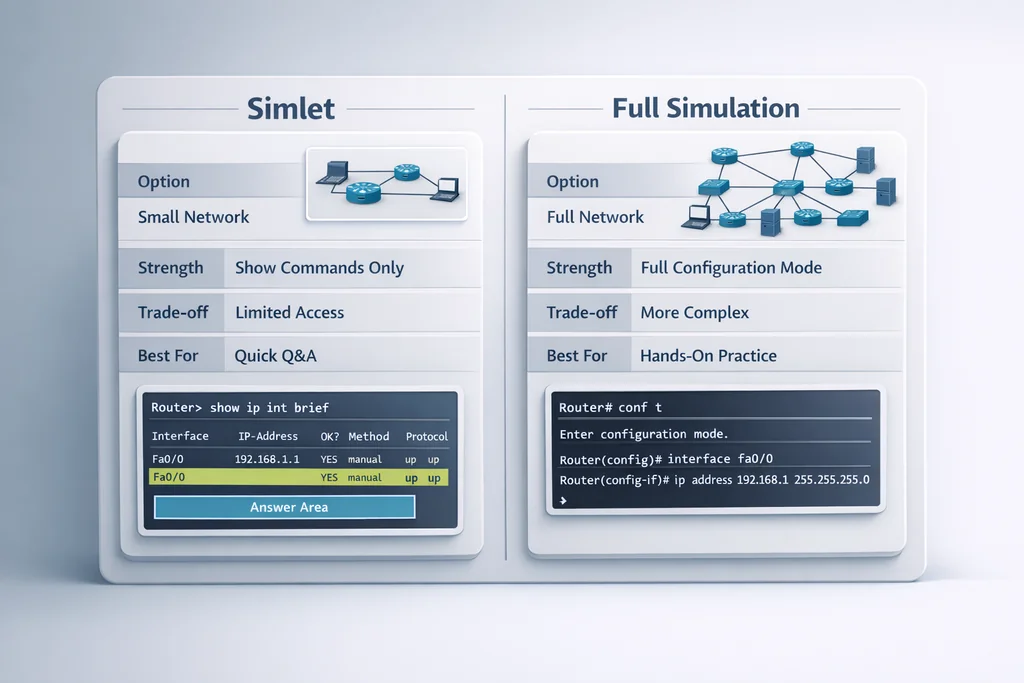
A typical simlet presents two routers with a suspected OSPF adjacency issue. You can run show ip ospf neighbor, show ip interface brief, or show running-config. The questions ask why adjacency failed or which parameter mismatches. Your job is diagnostic, not remedial.
Strategy: Know your show commands cold. Practice with a CCNA practice test that includes simlet-style items. On exam day, run the most specific show command first. If the question asks about Layer 2, start with show mac address-table or show vlan brief rather than generic show running-config output that floods you with irrelevant data.
The simlet format rewards candidates who have spent time in real or simulated CLI environments. Reading command outputs in a book is not the same as parsing them under time pressure.
What Makes Cisco Simulation Questions the Biggest Time Sink?
Full simulations are the most complex format. You receive a broken network and must fix it using the actual Cisco IOS CLI. Tasks range from configuring VLANs and trunking to troubleshooting NAT or implementing basic security policies. The simulation engine accepts a subset of real IOS commands, but not all syntax variations work.
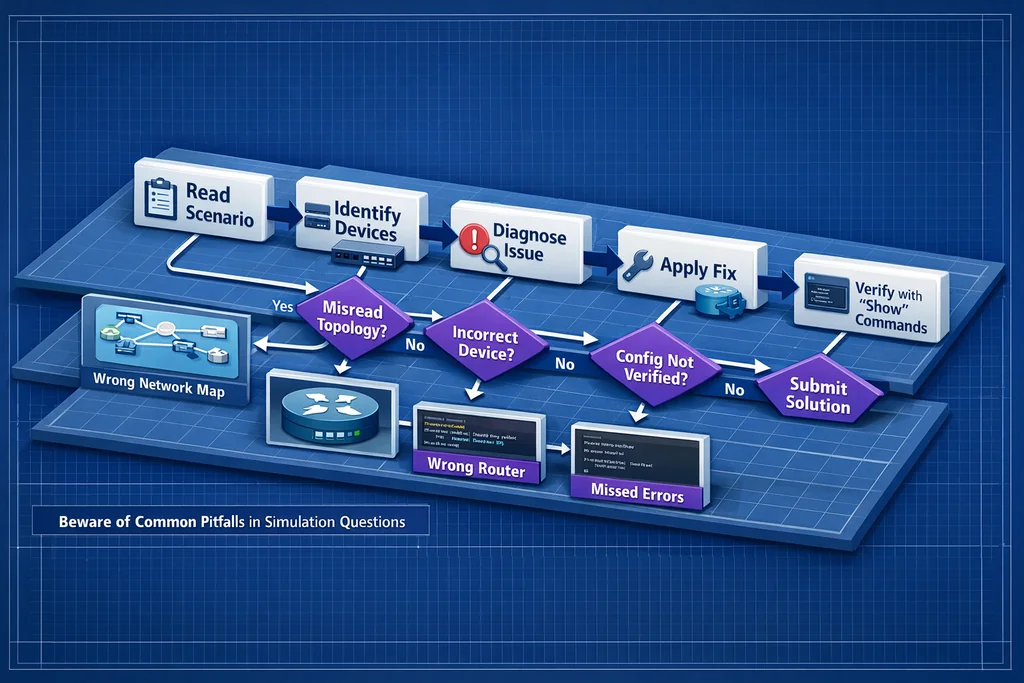
These questions can consume 10 to 20 minutes each. The exam typically includes one to three simulations. Because they are heavily weighted, a failed simulation can drop your score significantly.
Strategy: Verify connectivity after every change. Use ping and show commands to confirm your fix worked before moving on. The simulation grades specific outcomes, not the elegance of your approach. If the task requires host A to reach host B, test that path directly.
Watch for subtle requirements. A simulation might ask you to "configure inter-VLAN routing" but also include a note that "no dynamic routing protocols should be used." That constraint means router-on-a-stick with subinterfaces, not OSPF or EIGRP. Missing constraints is the most common failure mode.
When Priya practiced for her CCNA, she spent three weeks in a home lab building topologies from scratch. On exam day, she recognized a simulation topology she had rebuilt four times during prep. She finished in 11 minutes while others in her testing center were still struggling with show output at the 20-minute mark.
How Should You Practice for Each Question Format?
Generic question banks help with multiple-choice, but they rarely prepare you for simulations or simlets. You need layered practice:
- Multiple-choice: Use flashcards and timed quizzes for speed. Focus on distinguishing between similar protocols or standards.
- Drag-and-drop: Build matching exercises from the CCNA exam topics list. Convert each topic into a pairing task.
- Testlets: Practice reading scenarios once, then answering without re-reading. Build tolerance for irrelevant detail.
- Simlets and simulations: Use a simulator or emulator. PlanetCert's 200-301 sample questions include exam-style items with explanations that walk through the reasoning process.
Time your practice sessions. If you consistently spend 18 minutes on simulations, you need faster command recall or a more structured troubleshooting approach. The exam does not reward thoroughness if it leaves you rushing through 30 multiple-choice questions at the end.
What Test-Day Tactics Help Across All Question Formats?
Several habits apply universally. First, use the mark-and-review feature aggressively. Every question you answer confidently locks in points and reduces cognitive load. Second, watch for negative wording: "Which is not a valid OSPF neighbor state?" or "All of the following are true except." These questions invert normal thinking and cause careless errors under pressure.
Third, manage the tutorial time. Cisco offers a 15-minute tutorial before the exam begins. Use it to acclimate to the interface, especially if you have never taken a Cisco exam. Practice dragging items, resizing simulation windows, and navigating between questions. Real exam time does not start until you end the tutorial, so this is free preparation.
Fourth, bring a time checkpoint strategy. At 60 minutes remaining, you should be roughly halfway through. At 30 minutes, you should have simulations completed or nearly so. If you fall behind, switch to answering and marking rather than perfecting.
Frequently Asked Questions
How many simulations appear on the CCNA 200-301?
Cisco does not publish a fixed number. Most candidates report one to three simulations or simlets per exam. The total question count (100-120) includes all formats.
Are CCNA exam questions repeated between attempts?
No. Cisco draws from a large pool, and questions are randomized. Two candidates sitting the same day will see different items. Focus on understanding concepts rather than memorizing specific questions.
Can I use abbreviations in simulation commands?
The simulation engine accepts common abbreviations like sh for show or int for interface, but not all shortcuts work. If an abbreviation fails, type the full command. Do not waste time debugging syntax when the full word works reliably.
What happens if I run out of time?
Unanswered questions score zero. There is no penalty for guessing. If time expires, Cisco submits whatever you have completed. Prioritize answering every question, even if some are guesses, over perfecting a single simulation.
Do testlets and simulations show partial credit?
Testlet sub-questions score independently. Simulations typically grade on whether the required outcome is achieved, not on partial configuration. Simlets score as multiple-choice: correct or incorrect per question.
Further Reading
- Running Wireshark Labs as CCNA 200-301 Practice
- How to Vet a CCNA Practice Exam Before You Pay
- What Is CCNA Certification
Ready to see these formats in action? Browse the 200-301 sample questions at PlanetCert to practice exam-style items with detailed explanations and timed simulator sessions.

Discussion
Question Comments
0 comments·0 participantsSign in to leave a comment and access more free questions.