

How to Pass Certification Quizzes on Your First Attempt
You’ve booked the exam, bought a video course, and maybe even told your manager you’re going for it. Then you open your first set of practice questions and the score hits like a cold shower. You suddenly realise how far the vendor’s question logic is from the textbook chapter you read last night. That moment is the real starting point for most certification candidates.
What separates a pass from a expensive retake is not more hours in the course. It is a method for using quizzes as learning tools, not scorecards. This walkthrough gives you that method. It works across vendor exams — Cisco, CompTIA, AWS, Microsoft, ISC2 — because the underlying loop is the same.
You’ll need your exam blueprint, a trustworthy practice test source, a calendar, and the willingness to treat every wrong answer as a free tutorial. Let’s get into it.
Start with the Exam Blueprint, Not the Questions
The official exam objectives document is the only study artefact that tells you what the exam is measuring. Start there. Download the PDF from the certifying body: CompTIA, Cisco, ISC2, AWS — they all publish one free. Read it once for scope. Then read it a second time and physically check off every topic where you’d struggle to give a 60‑second explanation. Those are your study targets.
A blueprint reveals topic weights, too. For example, on the CCNA 200-301 v2.0, network fundamentals and security fundamentals are weighted differently; knowing that lets you allocate study time proportionally. The same logic applies to AWS Certified Cloud Practitioner CLF-C02, where you must weight billing and pricing differently from technology concepts.
“The official exam blueprint is the only study document that tells you what the exam is trying to measure. Start there, not with a random video course and not with a pile of notes.” — MindMesh Academy, How to Study for a Certification Exam
Without this map, practice quizzes become random button‑clicking. With it, every question you encounter connects to a specific line in the objectives. You’re not just answering — you’re putting a pin in a curriculum.
Choose Practice Tests That Teach, Not Just Test
Not all question banks are created equal. A good practice test gives you more than a score. It leaves you with a crisp explanation and a reference back to the objective. A bad one drills you on braindumps or brute‑force trivia that the real exam left behind two versions ago.
When you shop for a practice test set, check three things. First, are the questions mapped to the current exam version? If a vendor changed the blueprint in 2026 and the question bank still references last year’s domains, its value is limited. Second, does each question come with a detailed explanation for every answer choice, not just the correct one? Third, can you filter by domain so you can target weak areas? If a provider can’t answer those three, spend your money elsewhere.
For Cisco exams, you can apply a simple vetting checklist that covers timing constraints, question style, and update frequency. The detailed guide to evaluating CCNA practice exams walks through exactly that. The same criteria transfer to any platform: evidence of regular updates, verifiable domain mapping, and explanatory depth.
PlanetCert’s test engine, for instance, gives you domain‑filtered sessions and full‑length explanations so you’re always practising against the current objectives. That matters more than the number of questions in the bank.
Build a Two‑Week Quiz Cycle That Builds Recall
Cramming doesn’t work for certification exams because the question bank is too wide. Instead, run a repeating two‑week cycle that mixes learning, recall, and scenario practice.
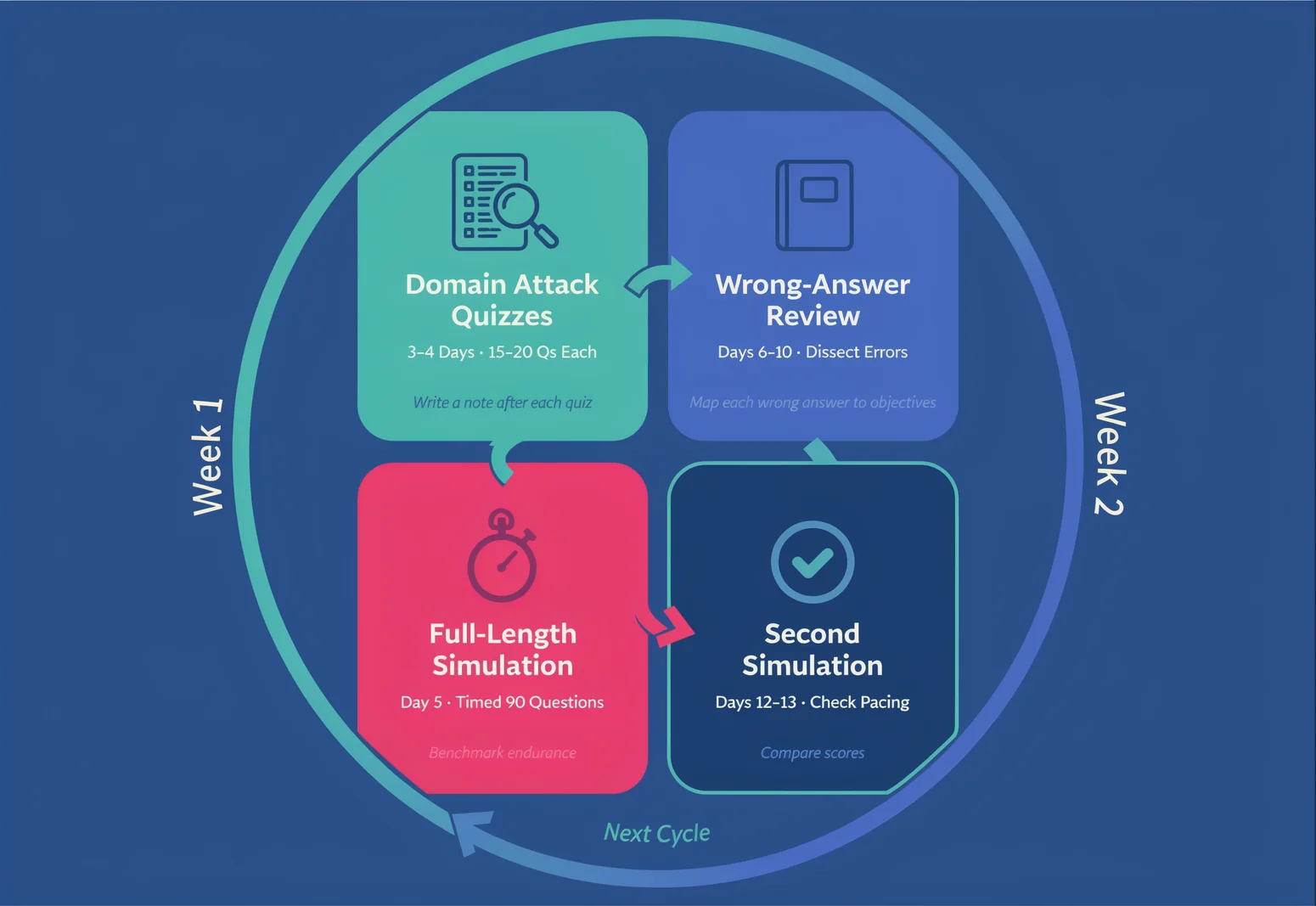
Block one: domain “attack” sessions. Pick two exam domains you scored weakest on in your first diagnostic. Over three or four days, run short, focused quizzes of 15–20 questions covering only those domains. After each session, read every explanation — even the ones you got right — and make a short note in a digital scratch file. The note doesn’t need to be beautiful. It just needs to capture the concept, your mistake, and a quick fix.
Block two: full‑length timed simulation. By the end of the first week, take a complete practice exam under timed conditions. No phone, no pausing. The purpose is not to predict your final score. It’s to train your brain to stay fresh through the full question count, which matters when you’re staring at question 87 and your coffee has worn off.
Block three: review and re‑map. Spend two or three hours the next day going through every missed question and categorising the failure. Did you miss it because you didn’t know the fact, misread the prompt, or ran out of time? Write the category next to each missed item. Then pull a fresh 20‑question set from the same trouble domains and try again.
Block four: a second full‑length simulation. By the end of the second week, you want to see two trends: fewer factual misses and fewer time‑management errors. If your scores are still flat, you may be moving through material too fast. Slow down and re‑focus on the highest‑weighted domains.
This cycle forces retrieval practice, which research consistently shows beats passive re‑reading. One study found that testing yourself on material produces “substantially greater long‑term retention” than studying the same material again. That’s the engine behind the plan.
“The testing effect shows retrieval practice produces substantially greater long‑term retention than re‑reading (Roediger and Karpicke 2006, Psychological Science).” — Ran Chen, EA, CFP, OpenExamPrep
Review Every Wrong Answer Like a Forensic Analyst
A wrong answer is a gift — it points exactly where your preparation is weak. But most candidates treat it as a demoralising number and move on. Don’t. When you get a question wrong, open your scratch file and answer four questions:
- Which exact exam objective does this question map to? (Look it up if you’re not sure.)
- Why did I choose the answer I chose? Was it a guess, a partial understanding, or a timing panic?
- What is the correct answer, and what makes it correct in the context the vendor expects?
- What one sentence will I write down that will prevent me from missing this concept again?
This exercise takes time — maybe five minutes per wrong answer — but it builds the kind of understanding that a second full‑length simulation will test. If you do this for every wrong answer across a bank of 300‑400 questions, you end up with a personalised study guide that targets only your actual gaps.
For example, suppose you miss an SAA-C03 question about choosing between S3 storage classes. When you map it back to the objective, you realise the exam tests not just the class names but the retrieval time and cost trade‑offs. That’s a different layer than the lecture covered, and your note now addresses it. The SAA-C03 objective‑to‑service mapping guide illustrates how tightly linked these details are to the exam logic.
Train Your Timing and Exam‑Day Endurance
Time management on certification quizzes is a separate skill from content knowledge. You can know every answer cold and still fail because you spent four minutes on a tricky subnetting question early in the test. The fix is to practice with a pacing rhythm.
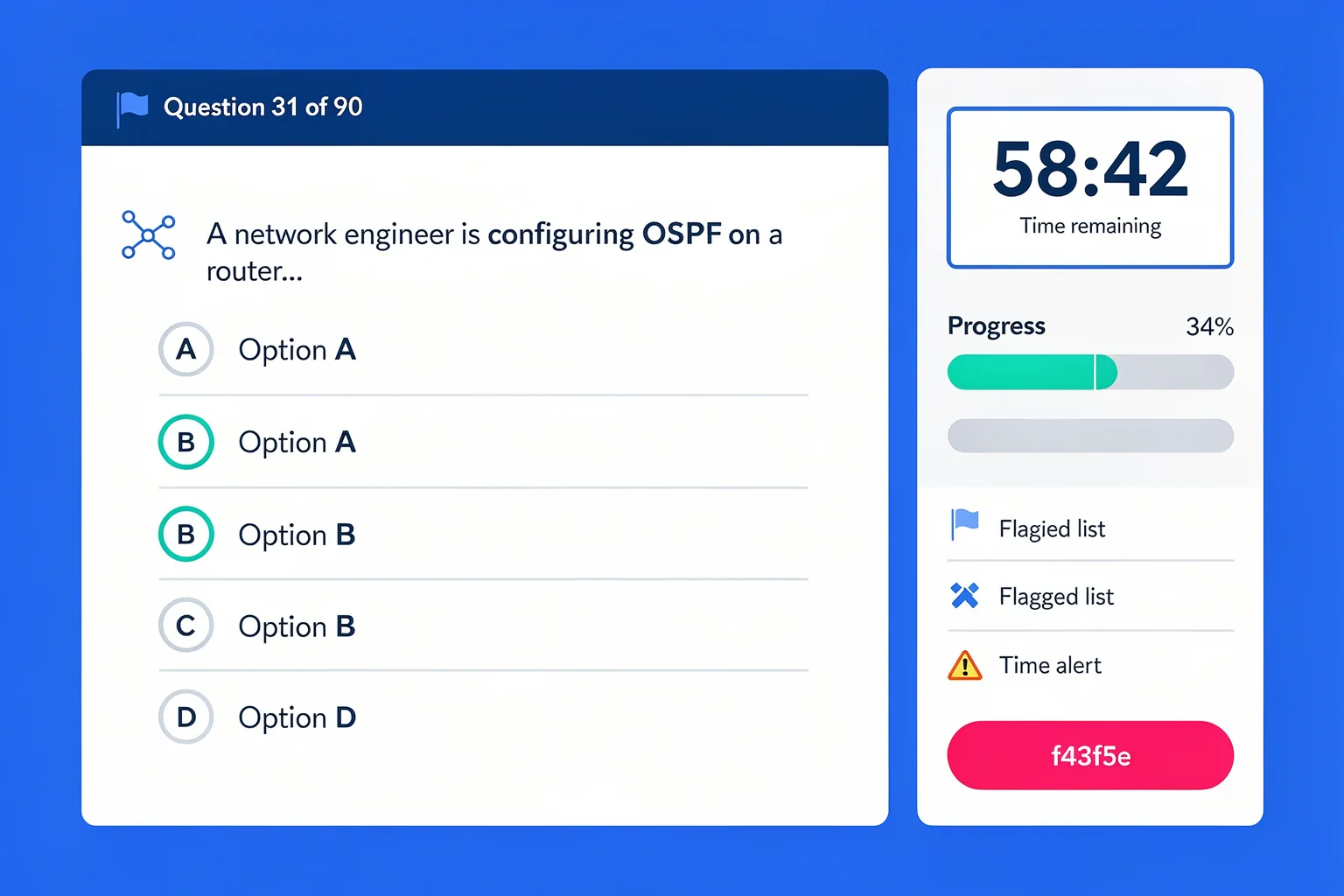
At the beginning of any timed quiz, quickly divide the total minutes by the number of questions. For a 90‑question exam with 90 minutes, that’s roughly one minute per question. Mark your time checkpoints: by question 30, you should have 60 minutes remaining; by question 60, 30 minutes remaining. If you’re behind, you skip — flag the question for review and move on. You can’t review what you haven’t reached.
Some platforms let you flag questions and return to them at the end. Use that feature aggressively. The first pass through the test should clear all the straightforward, definitional questions. Save the scenarios, exhibits, and multi‑part items for the second pass when you’ve banked easy points and calmed down.
Also factor in the exam environment. The Open Group’s official Exam Guide notes that before you schedule, you should verify system requirements for online proctored exams, including quiet environment, proper lighting, and no prohibited materials. Those logistics are part of quiz readiness. If you find yourself troubleshooting a webcam driver five minutes before the launch, you’ve added stress that erodes your pacing plan.
Avoid These Three Common Quiz‑Prep Mistakes
Even a good plan can fall apart if you fall into these traps. I see them in candidates week after week.
First, treating practice tests as score predictors. A practice score in week one is not a forecast. It’s a diagnostic. Obsessing over early numbers leads to either false confidence or needless despair.
Second, using only one set of practice questions. A single question bank gives you a single phrasing style. The real exam often phrases the same concept in three different ways — scenario, exhibit, direct question. You need to see multiple phrasings for the same topic so your brain recognises the underlying logic, not the wording.
Third, studying in marathon sessions right before the quiz. After about 90 minutes of intense focus, retrieval accuracy drops. Space your sessions, and always end your study day with a short, low‑stakes quiz that leaves you feeling sharp, not exhausted. That last impression of confidence carries into the next morning.
Quick Answers to Common Quiz Prep Questions
How many practice questions should I do before taking the real exam?
Enough to see every major domain phrase at least twice. For a typical associate‑level exam, that’s usually 300–400 questions across two or three different providers.
Do I need to simulate the full exam length every time I practice?
No. Run one full‑length simulation early to benchmark your endurance, then switch to domain‑focused sessions of 20–40 questions. Save a second full simulation for the final week to check your pacing.
What if my practice scores aren’t improving after two weeks?
Stop taking new questions and audit your wrong answers. If the majority of misses fall into the same one or two objectives, put the quizzes on pause and study just those topics with a different medium — video, lab, documentation — then return with fresh quizzes.
Can I pass without using official practice tests?
You can, but you’re leaving the most accurate feedback loop on the table. Official tests mirror the exam logic and phrasing better than third‑party banks alone, though a well‑maintained third‑party platform that follows the blueprint closely can be just as effective.
References
- How to Study — How to Study for an IT Certification (and Actually Pass): A Practical 2026 Playbook | Cert Climb ... This is the playbook I wish someone had handed me before my first cert. It's
- How to Study for Certification... — ## How to Study for a Certification Exam: 5 Proven Steps ... The good news is that how to study for a certification exam isn't a mystery. The system that works is repeatable. It
What to Read Next
- How to Vet a CCNA Practice Exam Before You Pay
- How to Pass the AWS Cloud Practitioner CLF-C02 on Your First Attempt
- How to Map Every SAA-C03 Exam Objective to a Real AWS Service
browse the relevant exam page and purchase a practice test

Discussion
Question Comments
0 comments·0 participantsSign in to leave a comment and access more free questions.