

Practice A+ Exam: Boost Your 2025 Pass Rates
Most American IT professionals and career switchers know that a strategic approach to CompTIA A+ preparation dramatically improves certification success rates. With over 30 percent of first-time candidates missing the passing mark, the stakes are high for anyone pursuing this vital credential in 2025. Strong practice exams and targeted study resources offer focused support, helping you master complex technical domains and build the confidence needed for first-attempt certification success.
Key Takeaways
| Point | Details |
|---|---|
| Comprehensive Preparation Required | Candidates should allocate at least 10-12 weeks for dedicated study and practice exams to increase the chances of success. |
| Understand Exam Structure | Familiarize yourself with the distinct question types and the specific focus areas of both Core 1 and Core 2 exams. |
| Focus on Practical Skills | Emphasizing hands-on experience, especially in performance-based questions, is critical for passing the exam. |
| Avoid Common Pitfalls | Thorough self-assessment and targeted study plans can help in addressing knowledge gaps and improving exam readiness. |
Understanding the CompTIA A+ Practice Exam
The CompTIA A+ certification represents a critical entry point for professionals seeking to establish their credentials in information technology support and technical operations. Designed to validate foundational skills in computer hardware, software, networking, and security, this certification requires comprehensive preparation through strategic practice exams that simulate actual testing conditions.

Practice exams serve multiple crucial purposes for certification candidates. They provide an opportunity to assess current knowledge levels, familiarize yourself with exam question formats, and identify potential knowledge gaps across core technical domains. Comprehensive practice tests help candidates develop test-taking strategies, manage time effectively, and build confidence before sitting for the official examination.
The CompTIA A+ certification consists of two primary exam components: Core 1 (220-1101) and Core 2 (220-1201). Each exam covers specific technical competencies, including hardware, networking technologies, virtualization and cloud computing, network troubleshooting, operational procedures, and security fundamentals. Successful candidates must demonstrate practical skills across hardware and software configuration, troubleshooting methodologies, and technical communication.
Exam Structure Overview:
- Total Exam Time: 90 minutes per exam component
- Number of Questions: Approximately 90 questions per exam
- Question Types: Multiple choice, performance-based scenarios, and drag-and-drop
- Passing Score: 675 (on a scale of 100-900)
Pro tip: Allocate at least 10-12 weeks of dedicated study time and complete multiple full-length practice exams to maximize your preparation and increase your likelihood of certification success.
Exam Versions, Structure, and 2025 Updates
The CompTIA A+ certification continues to evolve, reflecting the dynamic landscape of information technology and the changing skill requirements for entry-level technical professionals. In 2025, the certification undergoes significant updates to ensure alignment with current industry standards and emerging technological trends. Exam preparation strategies now emphasize practical skills and real-world problem-solving across both Core 1 and Core 2 exam components.
The 2025 version of the CompTIA A+ certification maintains its two-exam structure, with each test focusing on specific technical competencies. Core 1 (220-1101) concentrates on foundational hardware and networking technologies, while Core 2 (220-1201) delves deeper into operational procedures, security, and advanced troubleshooting techniques. The updated exams introduce new content areas that reflect recent technological advancements, including cloud computing, virtualization, and expanded cybersecurity concepts.
Key Updates for 2025:
- Enhanced focus on emerging technologies
- More comprehensive cybersecurity content
- Updated hardware and software configuration scenarios
- Increased emphasis on cloud and virtualization technologies
- Expanded troubleshooting methodologies
Exam Structure Breakdown:
Here’s a summary comparing the Core 1 and Core 2 exam components for quick reference:
| Exam Component | Main Focus Areas | Typical Candidate Challenge | 2025 Update Highlight |
|---|---|---|---|
| Core 1 (220-1101) | Hardware, Networking, Cloud Basics | Complex hardware troubleshooting | Greater focus on virtualization |
| Core 2 (220-1201) | Security, Operating Systems, Operational Procedures | In-depth security concepts | Expanded cybersecurity questions |
-
Core 1 (220-1101)
- Mobile Devices and Networking
- Hardware and Virtualization
- Windows Operating Systems
-
Core 2 (220-1201)
- Operating Systems
- Security
- Software Troubleshooting
- Operational Procedures
Pro tip: Create a comprehensive study plan that maps each exam domain to your current skill set, identifying and prioritizing areas that require additional preparation and hands-on practice.
Practice Question Types and Exam Domains
The CompTIA A+ certification exam employs a sophisticated approach to assessing IT support professionals’ skills through diverse question types that go beyond traditional multiple-choice formats. Candidates can expect a comprehensive evaluation that tests both theoretical knowledge and practical problem-solving abilities across critical technical domains.
The exam primarily utilizes four distinct question types designed to comprehensively assess a candidate’s technical competence. Multiple-choice questions test foundational knowledge, while performance-based questions simulate real-world technical scenarios. Drag-and-drop questions evaluate practical configuration skills, and simulation-based tasks require candidates to demonstrate actual troubleshooting and system management techniques.
Exam Domain Breakdown: Core 1 (220-1101) Domains:
- Mobile Devices (15%)
- Networking (20%)
- Hardware (25%)
- Virtualization and Cloud Computing (10%)
- Hardware and Network Troubleshooting (20%)
- Operating Systems (10%)
Core 2 (220-1201) Domains:
- Operating Systems (25%)
- Security (25%)
- Software Troubleshooting (20%)
- Operational Procedures (15%)
- Software and Database Concepts (15%)
Question Type Distribution:
- Multiple Choice: 65-75%
- Performance-Based: 15-25%
- Simulation Scenarios: 10-15%
Pro tip: Practice each question type systematically, allocating specific study time to understand the unique requirements of performance-based and simulation questions, which often challenge candidates more than traditional multiple-choice formats.
Effective Study Methods and Resource Selection
Successful CompTIA A+ certification preparation requires a strategic and comprehensive approach to studying. Comprehensive learning strategies emphasize combining multiple study methods to maximize knowledge retention and practical skill development across the exam’s technical domains.
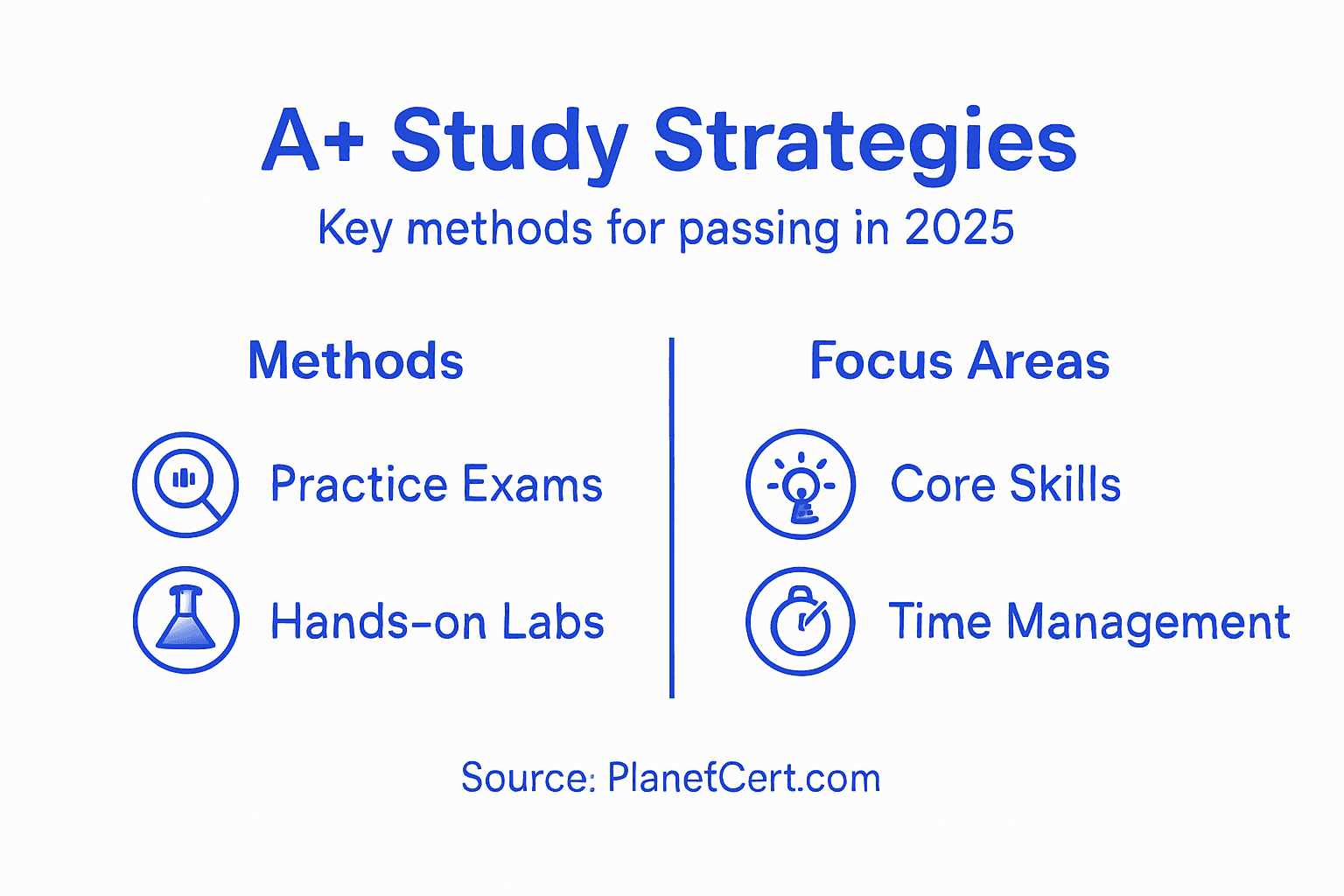
Effective study techniques involve creating a multi-dimensional learning plan that incorporates various resource types. Video lectures provide theoretical foundations, while hands-on labs and simulation exercises develop practical troubleshooting skills. Practice exams and mock tests are crucial for understanding question formats and identifying knowledge gaps. Candidates should prioritize resources that offer interactive learning experiences, including virtual lab environments, step-by-step tutorials, and real-world scenario-based practice questions.
Recommended Study Resource Categories:
- Official CompTIA Study Guides
- Online Video Training Courses
- Interactive Practice Exam Platforms
- Technical Hands-on Labs
- Community Forums and Study Groups
- Virtual Simulation Environments
Key Study Method Strategies:
- Create a structured weekly study schedule
- Use multiple learning resources
- Practice active recall techniques
- Conduct weekly self-assessment tests
- Focus on practical skill demonstration
- Join study groups for collaborative learning
Recommended Study Time Allocation:
- Theoretical Learning: 40%
- Hands-on Practice: 35%
- Practice Exams: 25%
Pro tip: Develop a personalized study strategy that combines different learning methods, focusing on your individual strengths and addressing specific knowledge gaps across the CompTIA A+ exam domains.
Use this quick reference to guide balanced exam preparation:
| Study Strategy Element | Why It Matters | How It Boosts Performance |
|---|---|---|
| Weekly Self-Assessment | Identifies weaknesses early | Enables targeted remediation |
| Hands-on Labs | Builds practical skill set | Increases confidence on scenarios |
| Error Log Maintenance | Tracks recurring mistakes | Reduces repeated errors |
Common Mistakes That Lower Pass Rates
Successful CompTIA A+ certification requires understanding and avoiding critical preparation pitfalls that can significantly impact exam performance. Exam preparation strategies reveal several common mistakes that consistently undermine candidates’ chances of passing the certification test.
One of the most prevalent errors is inadequate preparation across exam domains. Many candidates focus exclusively on their strongest areas while neglecting critical technical domains like networking, security, and troubleshooting. This approach creates substantial knowledge gaps that can lead to unexpected failures. Performance-based questions, which simulate real-world technical scenarios, often expose these weaknesses most dramatically, requiring comprehensive understanding rather than surface-level knowledge.
Top Mistakes That Reduce Pass Rates:
- Insufficient hands-on technical practice
- Overlooking detailed exam objectives
- Neglecting performance-based question preparation
- Failing to review and analyze practice test errors
- Inconsistent and unstructured study approach
- Limited exposure to practical troubleshooting scenarios
Strategic Mistake Prevention:
- Conduct thorough self-assessment of technical skills
- Create targeted study plans addressing weak domains
- Utilize multiple practice exam resources
- Analyze and learn from every incorrect practice question
- Simulate real exam conditions during preparation
Knowledge Gap Identification Techniques:
- Diagnostic practice tests
- Detailed error log tracking
- Focused remedial study sessions
- Peer group discussions
- Professional mentorship
Pro tip: Maintain a comprehensive error log during practice exams, systematically tracking and addressing each mistake to transform weaknesses into strengths before the actual certification test.
Maximizing First-Attempt Success in 2025
Successfully passing the CompTIA A+ certification on the first attempt requires a strategic and comprehensive preparation approach. Targeted study strategies are critical for candidates aiming to maximize their performance and overcome the challenges of this rigorous technical examination.
Candidates must develop a multifaceted preparation strategy that goes beyond traditional studying methods. This involves creating a detailed study plan that covers all exam domains with varying levels of depth, prioritizing high-weight technical areas, and implementing consistent practice techniques. Understanding the exam’s structure, mastering troubleshooting scenarios, and developing strong time management skills are essential components of a successful first-attempt strategy.
First-Attempt Success Strategies:
- Create a comprehensive 12-week study schedule
- Identify and focus on high-weight exam domains
- Complete multiple full-length practice exams
- Develop advanced troubleshooting skill sets
- Practice time management techniques
- Engage with technical community forums
Key Preparation Focus Areas:
- Theoretical Knowledge Mastery
- Comprehensive domain understanding
- Deep technical concept comprehension
- Practical Skill Development
- Hands-on laboratory experiences
- Real-world scenario simulation
- Exam Strategy Refinement
- Question type familiarity
- Stress management techniques
- Time allocation strategies
Performance Optimization Techniques:
- Diagnostic skill assessment
- Targeted weakness remediation
- Systematic error tracking
- Continuous learning approach
- Mental preparation techniques
Pro tip: Develop a personalized study rhythm that balances intense technical preparation with regular mental and physical breaks to maintain optimal cognitive performance during your certification journey.
Accelerate Your CompTIA A+ 2025 Success with Proven Practice Solutions
Preparing for the updated CompTIA A+ exams demands more than just studying theory. Candidates often struggle with mastering performance-based questions and managing time across varied domains such as hardware, networking, and cybersecurity. If you want to close your knowledge gaps, build hands-on skills, and confidently tackle the Core 1 and Core 2 components, a strategic approach with real exam simulation is essential.
At PlanetCert.com, we understand the challenges highlighted in this guide. Our platform offers a comprehensive library of verified real exam questions, interactive practice tests, and detailed study guides designed specifically for the 2025 CompTIA A+ exams. Whether you need to sharpen troubleshooting techniques or deepen your understanding of virtualization and cloud technologies, our resources are crafted to maximize your first-attempt pass rate and reduce costly re-takes.
Take control of your certification journey today. Explore our CompTIA A+ practice exams and study materials and equip yourself with the tools to master every exam domain.
Ready to boost your 2025 CompTIA A+ exam performance with authentic practice tests and expert guidance? Visit PlanetCert.com now and start building the confidence and skills that lead to certification success.
Frequently Asked Questions
How can I effectively prepare for the CompTIA A+ certification exam?
To effectively prepare for the CompTIA A+ certification exam, create a structured weekly study schedule that combines theoretical learning, hands-on practice, and multiple practice exams to reinforce your knowledge and skills.
What types of questions can I expect on the CompTIA A+ certification exam?
The CompTIA A+ certification exam includes multiple-choice questions, performance-based scenarios, drag-and-drop questions, and simulation tasks that evaluate both theoretical knowledge and practical skills.
How long should I dedicate to studying for the CompTIA A+ exam?
It’s recommended to allocate at least 10-12 weeks of dedicated study time, focusing on different exam domains and practicing with full-length exams to maximize your chances of success.
What are common mistakes to avoid when preparing for the CompTIA A+ exam?
Common mistakes include insufficient hands-on practice, overlooking exam objectives, neglecting performance-based question preparation, and not analyzing errors from practice tests. A structured study plan can help mitigate these issues.
Recommended

Discussion
Question Comments
0 comments·0 participantsSign in to leave a comment and access more free questions.