

You have an exam budget, a job title that sits somewhere between delivery and engineering, and two acronyms competing for the same line on your CV. PRINCE2 vs PMP is not a question with one right answer. It is a question about what your employer actually rewards, how much time you can carve out of a delivery sprint, and whether you want to prove you can govern a project or prove you can lead one.
This guide walks through the structural difference between the two credentials, what each exam asks of you, how employers in different regions read them, and how to pick when you work in an IT context where hybrid Agile delivery is the norm rather than the exception.
Two frameworks, two different jobs to be done
The cleanest way to hold both certifications in your head is this: PRINCE2 is a method, PMP is a body of knowledge. That distinction shows up in almost every downstream difference, from how the exams are written to what a hiring manager assumes you can do on day one.
PRINCE2 gives you a defined process model. It tells you who sits in which role, what documents get produced at each stage, and where the decision gates are. It is prescriptive by design, which is exactly why governments and large enterprises like it: two project managers trained in the method will run comparable projects in comparable ways.
PMP, administered by the Project Management Institute, tests breadth instead. It assumes you already have project experience and asks whether you can reason across scope, schedule, cost, risk, stakeholders, and procurement in ambiguous situations. There is no single prescribed process to memorize. You are being assessed on judgment.
That difference has a practical consequence for IT professionals. If your organization already has a delivery framework and you need to operate inside it credibly, a method gives you vocabulary fast. If you are the person expected to make calls when the framework does not cover the situation, a knowledge-based credential signals that.
The PMP vs PRINCE2 comparison from Techademy frames the same split around cost, career outcomes, and methodology, and it is worth reading alongside this piece if you want a second structural view.
Where the current versions sit
PRINCE2 is on Version 7, launched in September 2023. That release replaced the old themes with practices, added a dedicated people element, and strengthened coverage of sustainability, digital delivery, and data management. If you are studying from pre-2023 material, you are studying a retired edition.
PMP runs on PMI's current Exam Content Outline, which has leaned into predictive, agile, and hybrid approaches in roughly equal measure. That matters for IT candidates specifically: the exam no longer treats waterfall as the default and Agile as the exception.
What each exam actually puts you through
Exam logistics decide a lot of real-world outcomes. A credential you cannot schedule around your on-call rotation is a credential you will keep postponing.
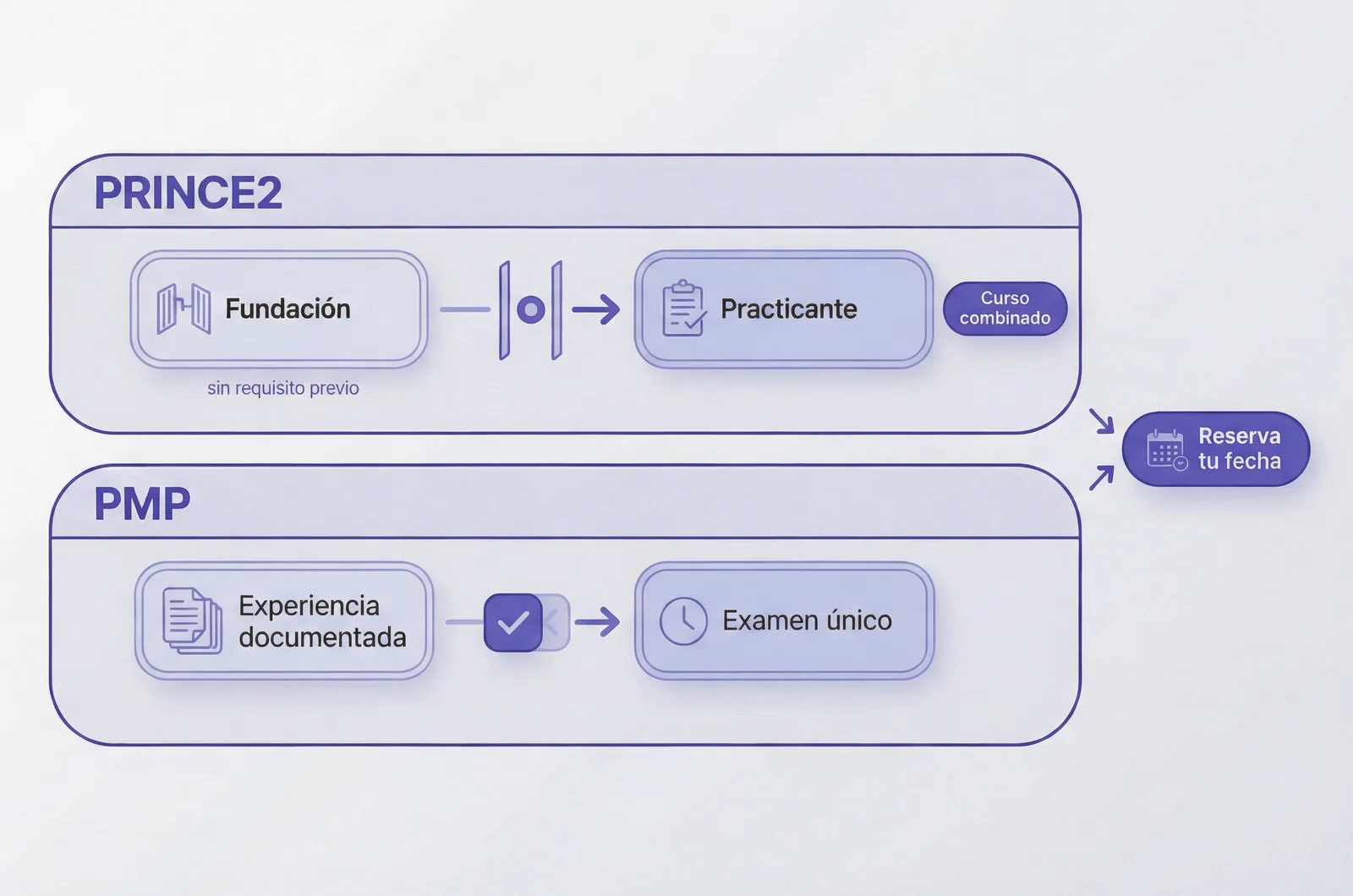
PRINCE2 splits into two levels. Foundation is the entry gate and must be passed before you can sit Practitioner. Foundation checks whether you understand the method's principles, practices, and processes. Practitioner checks whether you can apply them to a described project scenario. Most candidates take them as a combined course over a few days, then sit both exams in quick succession.
PMP is a single exam, but the eligibility bar is higher. You need documented project management experience before PMI will let you book it, which means the exam is a validation step rather than an entry point. For someone two years into an IT support or engineering role, that eligibility requirement is often the deciding constraint, not the exam content itself.
Cost and renewal, side by side
| Factor | PRINCE2 | PMP |
|---|---|---|
| Structure | Foundation + Practitioner, two exams | One exam |
| Prerequisite experience | None for Foundation | Documented project management hours required |
| Typical exam fee | Roughly $300–$400 for the certification path | Higher, and varies by PMI membership status |
| Renewal model | Subscription or retake, depending on your route | Continuing certification requirements over a fixed cycle |
| Version currency | Version 7 (2023) | Current PMI Exam Content Outline |
The PRINCE2 fee range of $300–$400 covers the official proctored examination, according to Cert Demand's 2026 PRINCE2 guide, which also tracks hiring demand for the credential. Treat any figure here as a starting point for your own quote, since training bundles, VAT, and regional pricing move the total.
Renewal is the cost people forget. PMP requires ongoing professional development units to stay active, which is a recurring commitment of time rather than a single payment. PRINCE2 renewal depends on which route you took, and some paths are simpler than others. Whichever you choose, budget for the maintenance, not just the first sitting.
How hard each one feels
Difficulty is personal, but the shape of the difficulty differs.
PRINCE2 Practitioner rewards careful reading. The scenario questions hinge on whether you can match a described situation to the right process step or role. Candidates who memorize definitions without practicing application tend to stall here.
PMP rewards reasoning under ambiguity. Many questions have two defensible answers, and you are picking the one that best reflects PMI's way of thinking about stakeholder value and risk. That is a skill you build through practice questions, not through rereading a guide.
For both, timed practice under exam conditions is the single highest-return activity in the final two weeks. If you are preparing for a vendor exam at the same time, the same habit applies: PlanetCert's exam simulator and timed practice modes are built around exactly that loop, and the explanations are there to close gaps rather than just score you.
Which credential your employer actually recognizes
This is where geography and sector matter more than exam content.
PRINCE2 dominates in the UK, much of Europe, Australia, and in organizations that run formal governance structures: government departments, defense contractors, large consultancies, and enterprises with a PMO that issues templates. If your projects have a board, a business case, and stage gates, PRINCE2 is the shared language.
PMP carries more weight in North America and in multinational companies that treat project management as a portable professional discipline rather than a delivery method. It also travels well across industries, which is useful if you are not sure you will stay in IT.
For IT specifically, the honest picture is mixed. PRINCE2-related job demand exists in the United States, but it is more niche than PMP or Agile certification demand, according to Spoclearn's 2026 US certification analysis. That does not make it worthless. It means the value is concentrated in specific employer types rather than spread across the whole market.
The hybrid delivery problem
Most IT projects now run some blend of planned stages and iterative delivery. Neither certification fully describes that reality on its own, and pretending otherwise is how people end up with a certificate that does not match their Monday morning.
The practical move is to pick the credential that covers the part of hybrid delivery you are weakest at. If you can already run a sprint but freeze when someone asks for a business case and a stage plan, PRINCE2 fills the gap. If you can produce governance documents but struggle to justify trade-offs to a sponsor under pressure, PMP's scenario reasoning is the better training.
PRINCE2 Version 7's additions around people, sustainability, and digital delivery were partly a response to this hybrid reality, so the method is less rigid than its reputation suggests.
Choosing when you are early in an IT career
If you are early-career, the sequencing question usually answers itself.
PMP requires documented project management experience, so it is often not available to you yet. PRINCE2 Foundation has no such prerequisite, which makes it the accessible first step. You can sit it, learn the vocabulary of governance and stage boundaries, and apply that language in your current role while you accumulate the experience PMP will eventually demand.
That path has a second benefit. Working inside a structured method teaches you what evidence of project work looks like, which makes the PMP application process far less painful later. People who struggle with PMI eligibility audits are usually people who never documented their project involvement as they went.
If you are mid-career with a decade of delivery behind you, the calculation flips. You likely already have the experience PMP wants, and the credential's portability across employers and regions may be worth more to you than a method you can learn on the job.
A quick way to decide
Ask yourself three questions in order.
- Does my target employer's job posting name one of these credentials? Search the actual listings you would apply for. The answer usually settles it.
- Can I meet the eligibility requirements today? If PMP's experience bar is out of reach, that is your answer for this year.
- Which skill gap is costing me more right now, governance or judgment? Pick the credential that trains the weaker one.
If you want a fourth check, look at your calendar. A combined PRINCE2 Foundation and Practitioner course compresses into a few days of study plus exam prep. PMP preparation typically spreads across weeks. Choose the one your schedule can actually absorb, because an unfinished study plan costs more than either exam fee.
Building a study plan that survives a work week
Certification prep fails for boring reasons: an unrealistic plan, no feedback loop, and no timed practice until the week before.
A workable structure for either credential looks like this. Spend the first pass building coverage, reading or watching material without trying to retain everything. Spend the second pass on practice questions, and treat every wrong answer as a note to yourself rather than a score. Spend the final stretch on timed full-length sessions so the exam's pacing stops being a surprise.
Two to four weeks is a realistic window for a focused candidate with prior project exposure. If you are learning the domain from scratch, double it and do not feel bad about it.
Flashcards help most for the parts that are genuinely memorization: PRINCE2's roles and process steps, or PMI's terminology. They help least for scenario reasoning, which only improves through repeated exposure to scenario questions and reading the explanations carefully.
PlanetCert's practice tests and flashcards follow that same coverage-then-drill-then-simulate sequence, which is a useful template even if you build your own plan from other materials.
Questions that come up before booking
Can I hold both certifications? Yes, and plenty of project managers do. The two are complementary rather than competing: one gives you a method, the other validates breadth of judgment. If your employer reimburses certification costs, stacking them over a couple of years is a reasonable plan.
Does an older PRINCE2 certification still count? Holding a pre-Version 7 certification does not automatically invalidate it, though you may want to refresh your knowledge given how much the 2023 edition changed. Check with the awarding body for your specific situation before assuming either way.
Is PMP worth it if my company uses PRINCE2? It depends on where you want to go next. PMP's portability is the argument for it, and if you plan to move between employers or regions, that portability has real value even inside a PRINCE2 shop.
Which one pays more? There is no clean answer, because salary differences track role, sector, and region more than certification. Look at postings for the job you want in the market you want, and compare what they list.
How long is each certification valid? Both require ongoing maintenance rather than a one-time pass. PMP uses a continuing development cycle; PRINCE2 renewal depends on the route you took. Build the renewal cost into your decision, not just the exam fee.
Where to go next with your certification plan
The decision comes down to what you need to prove. If you need a shared governance language fast and you are early in your career, PRINCE2 Foundation is the accessible entry point. If you have the project experience and want a credential that travels across employers and borders, PMP is the stronger long-term asset.
Either way, the exam is the easy part to plan and the hard part to execute. Book a date, build a practice loop, and let the timed sessions tell you when you are ready.
More on Prince2


Discussion
Question Comments
0 comments·0 participantsSign in to leave a comment and access more free questions.