

VMware Certification Tracks 2026: VCP, VCAP, VCIX Compared
If you stared at the VMware certification catalogue in 2024 and felt like someone had tipped a filing cabinet onto the floor, you weren't imagining it. Broadcom's acquisition tore up the old programme — mandatory training prerequisites disappeared, exam pricing got flattened, and whole product tracks got sliced away while new ones opened. The result is a cleaner set of VMware certification tracks, but it still leaves you with a decision: which credential actually matches your daily work and where you want to be in two years?
I'm going to walk through the three main tiers — VCP, VCAP, and VCIX — as they stand halfway through 2026. Along the way I'll explain what each one proves, what it costs, what you can skip, and which path makes sense for a vSphere admin who lives in the client versus a cloud architect building Kubernetes on VCF. No marketing speak, no vague "this cert will change your career" promises. Just the current facts, including the exam codes you'll actually book.
The Broadcom Reset
The old VMware certification programme was a maze of mandatory training courses, staggered pricing, and prerequisites that chained every cert to the one below it. On 6 May 2024, Broadcom drew a line through most of that, as confirmed in the official VMware Certification Program update.
Three changes define the current landscape:
- You can sit any VCP, VCAP, or Specialist exam without completing a training course or holding a lower-tier cert first. The gatekeeping is gone.
- Every VCTA, VCP, VCAP, and Specialist exam now costs $250 USD globally. Before this, a VCAP could set you back $450, so the price drop for advanced candidates is real.
- VMware Cloud Foundation certifications carry a 36-month validity window, with a straightforward recertification model. You retake the current exam version or earn a higher credential in the same track to renew the lower one automatically.
As of May 6, 2024, VMware by Broadcom is moving to simplify and streamline the program for all candidates. As a result, VCP, VCAP and Specialist certifications no longer require a mandatory training or other certification prerequisite. — Shirley Arteaga, VMware Certification Program FAQ
The product tracks got consolidated, too. End-User Computing was spun off entirely. What remains are six product areas anchored around VMware Cloud Foundation, vSphere Foundation, and a handful of specialist domains. The VMware Certification Tracks diagram Broadcom publishes lays out the full matrix, but for most people the decision tree ends up looking the same: pick a level, pick a product, then pick a role within it.
Starting Point: VCP Explained
VCP — VMware Certified Professional — is still the credential most hiring managers recognise by name. It proves you can deploy, configure, and manage a specific VMware product in a live environment. In 2026, there's no generic "VCP" anymore. You choose a product stack and a role, and the exam code reflects both.
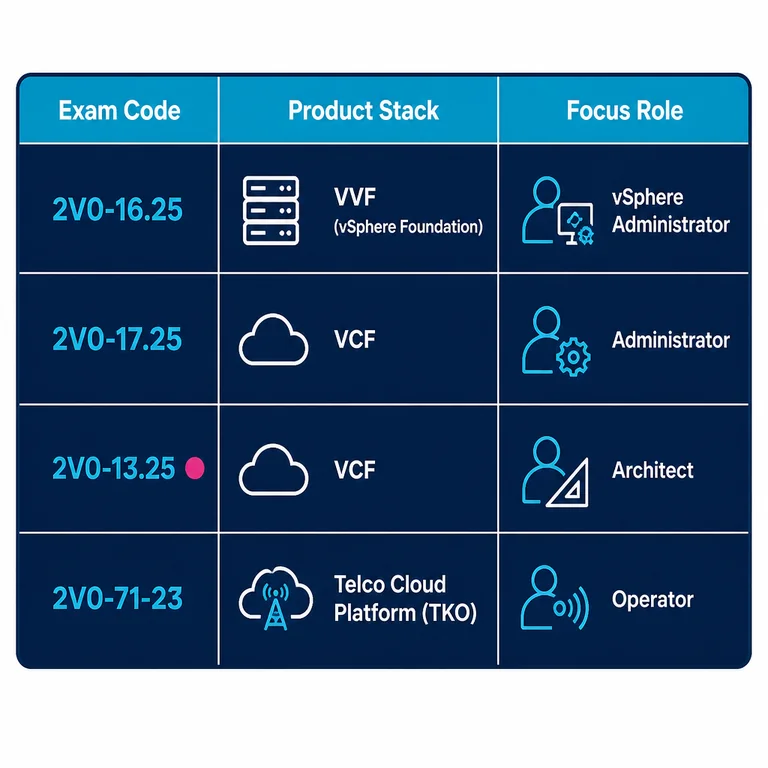
The most commonly pursued VCP paths right now:
- VCP-VVF Administrator (2V0-16.25): The natural successor to the old VCP-DCV. It covers vSphere Foundation administration — 60 questions, a scaled passing score of 300, and a 135-minute appointment that includes extra time for non-native English speakers.
- VCP-VCF Administrator (2V0-17.25): For shops that have standardised on Cloud Foundation rather than standalone vSphere. Focuses on build, management, and automation across the full VCF stack.
- VCP-VCF Architect (2V0-13.25): A design-focused credential on VCF. You're proving you can architect a solution, not just keep it running.
- VCP-TKO (2V0-71-23): The Tanzu Kubernetes Operator exam, aimed at engineers managing Kubernetes clusters through the Tanzu platform.
If you spend most of your week inside the vSphere Client — migrating VMs, right-sizing clusters, troubleshooting performance — the VCP-VVF Administrator is the most direct translation of your daily work into a certification. A VCP-DCV sample exam covering the vSphere 8.x Professional track still has strong carryover relevance, because the domain weights and question style for the VVF exam follow a similar pattern.
If your employer has already moved to VCF, the VCP-VCF Administrator makes more sense. And if you're on the architecture side, designing solutions rather than operating them, the VCP Cloud Foundation prep materials for the architect path will give you the right focus.
One tactical point worth flagging: Broadcom no longer mandates a training course for your first VCP, but the recommendation to take one still stands. The exam assumes production-level familiarity. If you're learning from scratch, a nested ESXi lab and several rounds of timed simulator work are non-negotiable. Plan for 6 to 12 weeks of consistent evening and weekend study if you're already working hands-on with the platform.
Going Deeper: VCAP and the Kubernetes Shift
VCAP — VMware Certified Advanced Professional — targets the people who design automated workflows, troubleshoot at scale, and make architectural decisions that affect hundreds of workloads. It's the certification that says "I don't just operate the stack; I shaped how it runs."
The 2026 VCAP lineup has been refreshed with several exams that signal where VMware thinks the market is heading:
- VCAP-VCF Operations (3V0-22.25): Deep-dive into VCF operational workflows, automation, and troubleshooting — the stuff you face during a major incident at 03:00.
- VCAP-VCF Architect (3V0-24.25): Advanced architecture and design on Cloud Foundation, extending the VCP architect track into genuine multi-tenant, multi-site design territory.
- VCAP VKS: The wildcard. Launched in January 2026, this certification validates expert skills on vSphere Kubernetes Service within VCF 9.0. It exists because the industry shifted: 93% of developers are deploying to Kubernetes in some form, according to the CNCF/SlashData State of Cloud Native Development Q1 2025 Report. VMware's answer is a credential that bridges traditional virtualisation and cloud-native operations.
The VCAP VKS is worth a close look if your organisation is in the middle of a containerisation push. Prashanth Shenoy, writing on the VMware Cloud Foundation blog, described it as closing "the Kubernetes gap" — engineers who knew vSphere inside out but couldn't reason about pods, services, and cluster networking.
VCAP exams are noticeably heavier than VCP. Expect more scenario-based questions, design decision trees, and troubleshooting simulations that assume you've been doing the work for a year or more. A VCAP 2026 practice test gives you a realistic sense of the pacing and question complexity. Most candidates need 3 to 4 months of focused preparation, especially if they're balancing full-time operations work. The good news is that with the flat $250 fee, there's no financial penalty for attempting the exam — the barrier is purely technical.
Who should aim for VCAP? Senior infrastructure engineers, cloud platform architects, consultants designing multi-tenant VCF environments, and anyone targeting a "Staff Engineer — Virtualisation" or "Principal Cloud Architect" role. In the UK market, these roles typically sit in the £70,000–£95,000 band, though the exact figure depends on the specific track and sector.
The VCIX Layer: When Implementation Expertise Matters
VCIX — VMware Certified Implementation Expert — sits above VCAP and below VCDX. It's the least discussed of the three tiers because there's no standalone exam you can walk into and sit. To earn a VCIX in any product track, you must already hold both a VCP and a VCAP in that same area, and then complete a practical assessment that proves you can actually implement the solution in a realistic environment.
The 2025 VMware Cloud Foundation Certification paths document shows the progression clearly: VCP → VCAP → VCIX, with VCDX as the terminal design-expert credential beyond that. VCIX occupies the narrow space where multiple-choice answers stop mattering and actual delivery becomes the standard.
The timeline is the longest of the three. A realistic path: earn your VCP (2–3 months), spend 6–12 months gaining deeper project experience, earn your VCAP (3–4 months), and then tackle the VCIX implementation requirement. Most people take 18 to 24 months from their first VCP to VCIX completion, assuming they're working on the platform full-time.
Is VCIX worth the effort? For a vSphere administrator who mainly handles day-to-day operations, probably not immediately. The VCP and VCAP will open more doors in the short term. But if you lead VCF design and deployment projects, work as an embedded consultant at large enterprise accounts, or are positioning for a principal architect title, VCIX differentiates you from the much larger pool of VCP-holders. It's a smaller credential ecosystem, and hiring managers who understand what "implementation expert" actually means tend to weigh it accordingly.
Choosing Your Track: Three Real Scenarios
Abstract advice only gets you so far. Let me ground this in the three profiles I see most often in exam prep forums and training classrooms.
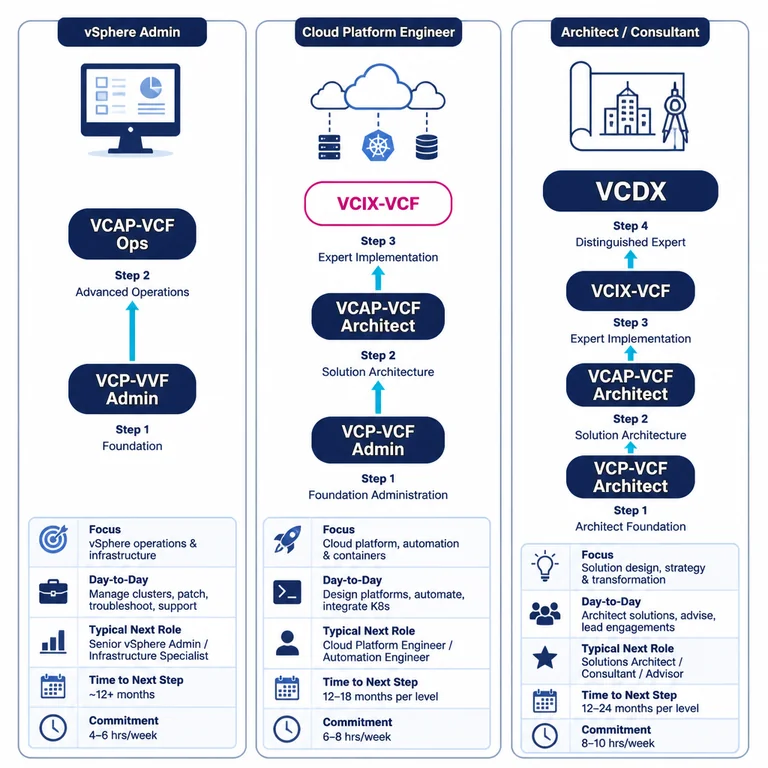
The vSphere administrator. You spend your days in the vSphere Client — managing clusters, patching hosts, troubleshooting performance. Start with VCP-VVF Administrator. It's the most literal translation of your current work into a certification. If your employer's roadmap includes a VCF migration, consider the VCP-VCF Administrator instead. After holding that VCP for a year and deepening your automation and design skills, the VCAP-VCF Operations or VCAP-VCF Architect is the sensible next step. A solid prep resource for the architect path is the VCP Cloud Foundation prep material, which covers the solution-design side of VCF.
The cloud platform engineer. Your world includes vSphere, NSX, vSAN, and — increasingly — Kubernetes clusters you didn't build but now have to support. Your path runs through VCP-VCF Administrator first, then VCAP VKS as container orchestration claims more of your week. The Kubernetes-focused VCAP that launched in early 2026 was essentially built for this exact profile. From there, VCIX in the VCF track becomes relevant once you're leading implementation projects rather than just participating in them. A VCAP Cloud Foundation exam prep resource will help you test readiness before booking the architect-level VCAP.
The architect or consultant. You design solutions; you don't spend much time operating them. Start with VCP-VCF Architect, progress to VCAP-VCF Architect, and plan for VCIX as the proof point that you can deliver what you design. The VCDX track sits beyond that, but it's a fundamentally different challenge — defending an original design before a panel — and worth treating as a separate multi-year goal.
Whichever track you choose, the single highest-ROI activity in the final two weeks before any exam is timed simulator work. Reading documentation and watching videos builds knowledge. Sitting through 60 to 135 questions under exam conditions builds readiness. Without that pressure practice, even experienced engineers can misjudge pacing and run out of time. If you want to browse the full range of current VMware exam preparation options, that's a good place to start once you've settled on a specific exam code.
What You'll Actually Pay in 2026
The financial picture is simpler than ever. Each exam attempt costs $250 USD — no distinction between VCTA, VCP, VCAP, or Specialist. Fail, and the retake costs another $250. There are no mandatory training fees, though many candidates still invest in official courses, practice tests, or home lab hardware.
For a single VCP, the minimum cash outlay is the exam fee plus whatever you spend on study materials. For someone pursuing all three tiers in one track — VCP, VCAP, and VCIX — the exam fees total $750, plus prep resources. Compared to the pre-2024 structure, where a VCAP alone cost $450, the current model is noticeably cheaper for advanced candidates.
The hidden cost is time. A VCP can be earned in 2–3 months of consistent evening and weekend study. VCAP realistically takes 3–4 months. VCIX adds another 6–12 months of project-level experience before you're ready for the implementation assessment. If you're self-funding, the exam fees are manageable; it's the opportunity cost of those study hours that stacks up.
Recertification adds a longer-term cost, but the process is simpler than it used to be. VCF-based certifications expire after 36 months. When that window closes, you retake the current version of the exam or earn a higher credential in the same track, which automatically renews the lower one. Timing your progression so that a VCAP attempt resets the VCP clock can save you a retake fee if you plan it right.
Questions From the Field
Can I jump straight to VCAP without a VCP?
Technically yes — there's no prerequisite certification required. The VCAP assumes production-level depth, though, and skipping the VCP means you'll be missing the structured study and exam experience that most candidates rely on. Possible, but not recommended.
Does the VCP still need a training course?
No. Since May 2024, all VCP, VCAP, and Specialist exams are exam-only. Training is recommended, not mandatory.
What happened to the old VCP-DCV?
The classic Data Center Virtualization credential has been replaced by role-based exams under the VVF and VCF families. The VCP-VVF Administrator is the closest equivalent. Legacy VCP-DCV holders keep their cert until its original expiration date; new candidates take the updated exams.
How long do these certifications stay valid?
VMware Cloud Foundation certifications carry a 36-month validity window. Non-VCF tracks may have different renewal policies, so check the specific exam guide for your path.
Is VCIX worth the extra effort if I already hold a VCAP?
It depends on your role. For operators and administrators, the VCAP is usually sufficient. For implementation consultants, project leads, and principal architect candidates, VCIX provides tangible differentiation in a smaller, more competitive pool.
Learn more: browse the relevant exam page and purchase a practice test
A Few Pages Worth Bookmarking
browse the relevant exam page and purchase a practice test
Learn more
Discussion
Question Comments
0 comments·0 participantsSign in to leave a comment and access more free questions.