
What VMware VCP-DCV Costs in 2026 After the Broadcom Changes
The sticker shock hits at checkout. You have been budgeting $250 for the VCP-DCV exam voucher, but your cart total just jumped to $4,250. That gap between expected and actual cost derails more VMware certification plans than failing the exam itself. Since Broadcom acquired VMware in late 2023 and restructured the certification program in May 2024, the rules around what you must pay, what you can skip, and where hidden fees lurk have changed dramatically. This guide walks you through building an accurate 2026 budget for earning your VMware Certified Professional - Data Center Virtualization credential, line item by line item, with the policy context you need to avoid surprises.
What Changed in May 2024 and Why It Matters for Your Wallet
Broadcom's certification overhaul on May 6, 2024, eliminated the mandatory training prerequisite for VCP, VCAP, and Specialist-level exams. Previously, candidates had to complete an official VMware course, typically costing $4,000 or more, before they could even sit for the exam. That requirement is gone. The change immediately lowered the barrier for experienced administrators who already know vSphere but lacked the budget or time for formal training.
The same policy update standardized exam pricing. All VCTA, VCP, VCAP, and Specialist exams now cost $250 globally, down from the previous VCAP rate of $450. Per the Vmware Certification Frequently Asked Questions, vouchers purchased before May 6, 2024, remain valid at their original face value, but no refunds or price adjustments are issued for earlier purchases. If you held a $450 VCAP voucher from 2023, you use it or lose the difference.
These two changes create a fork in the road for 2026 candidates. You can now pursue VCP-DCV for as little as $250 plus study materials, or you can still invest in official training if your employer covers it or your experience gaps demand structured learning. Understanding which path fits your situation determines whether your total out-of-pocket cost stays under $500 or climbs past $4,500.
The policy shift also removed certification expiration dates for credentials earned after May 2024. Earlier VCP-DCV certifications required renewal every two years through continuing education or higher-level exams. That recurring cost, both in fees and study time, no longer applies. Your credential remains valid indefinitely, though its market relevance depends on keeping current with vSphere releases.
This expiration change carries subtle implications for hiring managers. Some recruiters still scan resumes for recent certification dates, conflating "no expiration" with "perpetually current." You may need to explain in interviews that your 2025 VCP-DCV reflects vSphere 8.x knowledge, not outdated skills. Prepare concrete project examples from your work history to demonstrate continued hands-on experience.
The acquisition itself introduced operational friction that candidates still encounter in 2026. Broadcom's integration of VMware's certification systems into its own infrastructure created temporary portal outages, delayed score reporting, and confusion about where to purchase vouchers. While most systems have stabilized, you may still encounter references to legacy VMware URLs that redirect unexpectedly. Bookmark the current Broadcom certification portal directly rather than relying on old bookmarks or search results.
The Core Exam Voucher: Current Price and Purchase Options
The VCP-DCV exam, currently delivered as 2V0-21.23 for vSphere 8.x, carries a flat $250 fee. This applies whether you buy directly from Broadcom's certification portal, through Pearson VUE, or via authorized resellers. The VMware Certified Professional page confirms this pricing without regional variation.
You have three purchase channels to consider:
- Direct from Broadcom/VMware: Full price, immediate delivery, direct support for voucher issues.
- Pearson VUE: Same $250 rate, integrated with exam scheduling, sometimes bundled with practice tests.
- Authorized training partners: Occasional discounts for students or corporate bulk purchases, but verify voucher validity before buying.
Watch for expired voucher scams on secondary markets. Since the 2024 pricing change, old $450 vouchers circulate at inflated prices. Check the expiration date and confirm the voucher covers the exact exam code you need. The current VCP-DCV exam is 2V0-21.23; older codes like 2V0-21.20 (vSphere 7.x) or 2V0-622 (vSphere 6.5) are retired for new certifications.
Voucher validity periods matter for planning. Most VMware exam vouchers expire 12 months from purchase. If you buy during a promotional period but cannot schedule within that window, you forfeit the full amount. Map your study timeline before purchasing. A typical candidate needs 6 to 12 weeks of preparation, but those studying part-time around full-time work often need 16 to 20 weeks.
The 12-month expiration creates pressure that works against many candidates. The temptation to buy early "while thinking about it" leads to wasted vouchers when work projects intervene. A more reliable approach: complete 60% of your planned study before purchasing, then buy the voucher to create a fixed deadline. This reverses the typical sequence but protects your budget.
Payment method selection also affects final cost. Some corporate credit cards charge foreign transaction fees even for USD purchases processed through international Pearson VUE subsidiaries. Check your card terms or use a fee-free alternative. The $250 base rate should not become $262.50 through a 5% FTF you could have avoided.
Bulk voucher purchases deserve mention for team or organizational certification programs. Some employers negotiate enterprise agreements with Broadcom or Pearson VUE for multiple exam vouchers at slight discounts, typically 5% to 10% off standard pricing. These arrangements usually require minimum commitments of 10 or more vouchers and may restrict usage to specific exam codes or employee groups. If your organization has such an agreement, confirm whether VCP-DCV is included and whether you must use the corporate purchase channel or can buy individually and seek reimbursement.
Training: Optional Now, But Still a Major Line Item
With the mandatory training requirement removed, you face a genuine choice. The official VMware vSphere: Install, Configure, Manage course runs approximately $4,250 for a five-day instructor-led session. Self-paced online versions cost less, typically $2,500 to $3,500, but lack the structured accountability many candidates need.
When does training still make sense? Consider the investment if you match any of these profiles:
- You have fewer than two years of hands-on vSphere administration.
- Your environment runs older vSphere versions and you need exposure to vSphere 8.x features.
- Your employer offers a training budget that would otherwise expire.
- You learn poorly from self-study and need instructor interaction.
When can you skip it? Experienced administrators managing vSphere 7 or 8 environments daily often pass with quality practice tests and focused lab work. The Vmware Exam Guide Review Vcp materials outline the specific vSphere 8.x competencies tested, letting you self-assess your readiness against the objective domains.
Maria Chen, a systems administrator in Chicago, faced this exact decision in early 2025. With four years managing a vSphere 7 cluster but no 8.x exposure, she initially enrolled in the $4,250 course. Two days in, she realized the curriculum covered features her environment already used. She withdrew, forfeited the deposit, and shifted to a $199 practice test subscription plus home lab rebuild. She passed 2V0-21.23 on her first attempt, total cost under $450.
Her experience illustrates a critical point: the value of training depends entirely on your knowledge gaps, not your years in the field. A ten-year veteran who has only managed vSphere 6.7 may need the structured exposure more than a three-year administrator who has already deployed vSphere 8.x in production.
Training withdrawal policies deserve scrutiny before enrollment. VMware's standard terms typically allow full cancellation within 48 hours of course start, partial refund through day two, and no refund thereafter. Maria's forfeiture could have been worse; she acted quickly. Read the specific terms for your delivery format, as virtual instructor-led training sometimes has stricter cancellation windows than in-person sessions.
Corporate training packages introduce another variable. Some employers negotiate annual training credits with VMware or authorized partners, covering the course at no direct cost to you. However, these arrangements often require manager approval six to eight weeks in advance and may restrict course selection to predetermined curricula. Factor administrative lead time into your certification timeline if employer funding is part of your plan.
Alternative training formats have proliferated since the prerequisite removal. Third-party boot camps, typically $1,500 to $2,500 for compressed three-day sessions, offer middle-ground pricing between self-study and official VMware courses. Quality varies dramatically: some employ former VMware instructors with deep curriculum knowledge, while others repackage freely available documentation with minimal added value. Before purchasing, verify instructor credentials, request a detailed syllabus mapped to 2V0-21.23 objectives, and seek reviews from recent attendees specifically about exam pass rates.
Practice Tests and Study Materials: The Hidden Budget Layer
Quality preparation materials separate first-attempt passes from costly retakes. Budget for these categories:
- Official VMware practice exam: $100 to $150, available through Broadcom's learning portal.
- Third-party practice tests: $50 to $200, with question banks ranging from 200 to 800+ items.
- Home lab or cloud sandbox: $0 if you have existing hardware, or $50 to $200 monthly for cloud-based vSphere environments.
- Study guides and reference materials: $40 to $100 for current vSphere 8.x certification guides.
The PlanetCert VMware Practice Tests 2026 catalog includes exam-specific question sets with explanations for each answer choice, plus a simulator that mimics the timed exam environment. For candidates who learn best by identifying weak spots through repeated testing, this format often proves more efficient than re-reading documentation.
Avoid the temptation to rely solely on free resources. The VCP-DCV exam tests specific vSphere 8.x configurations, troubleshooting scenarios, and feature behaviors that change between versions. Outdated practice questions from vSphere 6.5 or 7.0 will mislead you on current exam objectives.
The quality variance in third-party materials demands scrutiny. Some providers recycle old questions with minor wording changes, creating false confidence. Others provide explanations that merely restate the correct answer without teaching the underlying concept. When evaluating practice tests, check these criteria:
- Question count relative to price (aim for 300+ unique items per $100 spent).
- Explanation depth (should reference specific vSphere documentation or configuration steps).
- Version alignment (confirm coverage of vSphere 8.x, not generic vSphere content).
- Simulator fidelity (timed format, flag-and-review functionality, domain breakdown in results).
David Park, a network engineer transitioning to virtualization in 2025, learned this distinction the hard way. He purchased a $49 practice test package with 500 questions, scored 90% consistently, and walked into the exam confident. His actual score: 280 out of 500, failing by approximately 20 points. The practice questions tested memorization of feature lists; the exam tested application of those features in failure scenarios. He replaced the cheap package with a simulator that forced scenario-based reasoning, passed on his second attempt, but added $250 in retake costs to his budget.
Home lab costs vary dramatically based on your starting point. Candidates with existing ESXi hosts or nested virtualization capability can build study environments at no incremental hardware cost. Those starting from scratch face choices: used enterprise servers from eBay ($200 to $500), Intel NUC or similar compact systems ($400 to $800), or cloud-based nested virtualization through providers like Ravello or cloud lab services ($50 to $150 monthly). The cloud option suits candidates without space for physical hardware or those needing vSphere features unavailable in nested setups.
Study guide selection narrowed in 2024 when VMware Press reduced its certification title output. The primary remaining print resource is the official certification guide, typically $50 to $70. Supplement with VMware's freely available documentation library, particularly the vSphere 8.x Configuration Maximums, Security Configuration Guide, and product documentation. These sources lack exam-focused structure but provide authoritative detail on tested features.
The documentation library itself represents a significant but free resource. VMware's technical documentation for vSphere 8.x spans thousands of pages across dozens of PDFs and HTML guides. The challenge is navigation: knowing which documents contain exam-relevant content versus administrative procedures you will never be tested on. Focus your documentation reading on the Installation and Setup, Security, and Resource Management guides, which align most closely with the 2V0-21.23 objective domains. Avoid deep-diving into niche topics like vSphere Replication or Site Recovery Manager unless your work environment specifically uses them; these appear minimally on the VCP-DCV exam.
Retake Fees and Failure Scenarios
Failing the VCP-DCV exam costs more than pride. Each retake requires a new $250 voucher. Broadcom does not offer discounted retake pricing or "second shot" promotions as of 2026.
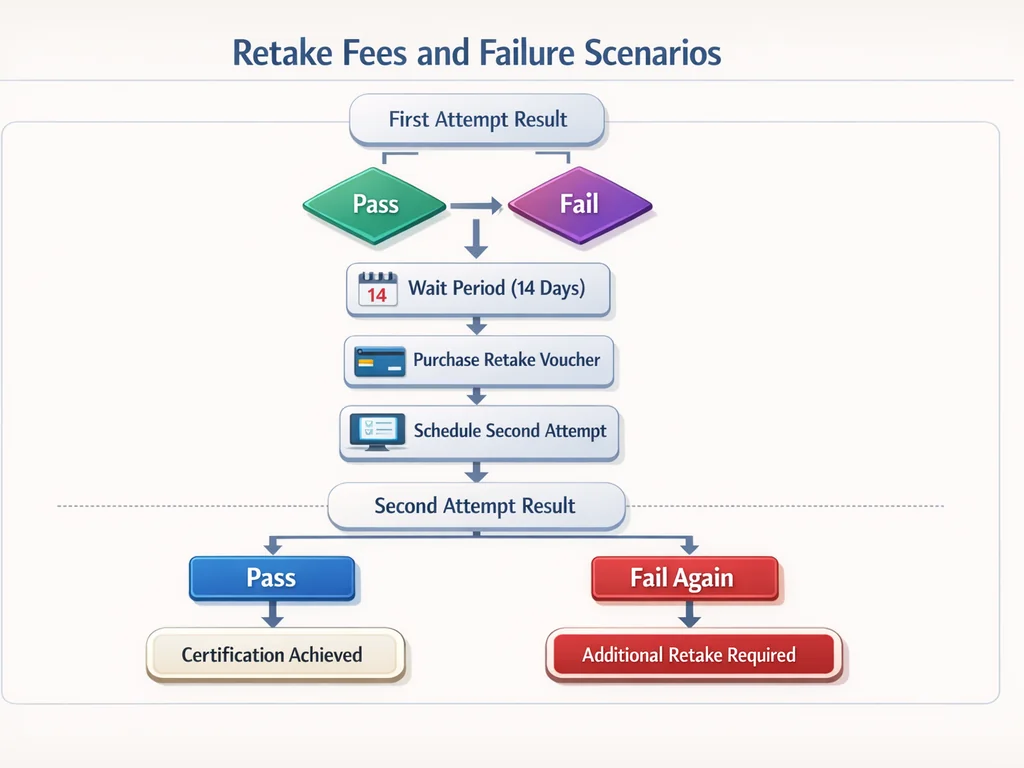
The exam format itself creates pressure: 70 questions in 130 minutes, with a mix of single-choice, multiple-choice, matching, and drag-and-drop items. The passing score is not publicly disclosed, but historical data suggests approximately 300 out of 500 scaled points. You receive a score report breaking performance by objective domain, which becomes your retake study roadmap.
To minimize retake risk, schedule your exam only after consistent practice test scores exceed 85% across all domains. The $250 you spend on a voucher is cheaper than the $250 retake, but both pale next to the career delay of a failed attempt.
The score report deserves careful analysis, not just a glance at pass or fail. The exam covers seven objective domains, including architecture and technologies, planning and designing, installing and configuring, and optimizing and troubleshooting. A failing score with strong performance in five domains but weakness in two suggests targeted study for three to four weeks. A failing score with weakness across four or more domains indicates a broader knowledge gap requiring eight to twelve weeks of foundational work.
Retake timing affects both cost and success probability. VMware requires a seven-day waiting period between attempts, though Pearson VUE's scheduling system sometimes shows earlier slots that will be rejected. Use this week productively: review weak domains, not just retake practice tests. Candidates who rush to reschedule within the minimum window often repeat the same preparation mistakes.
Psychological costs compound financial ones. A first-attempt failure creates self-doubt that degrades performance on subsequent tries. Some candidates enter a cycle of repeated failures, each adding $250 and eroding confidence. Break this pattern by changing preparation methods after a failure, not just repeating more of the same. If practice tests failed to predict your first attempt, add hands-on lab work. If labs were insufficient, seek structured explanation resources.
The emotional toll extends beyond individual attempts. Candidates preparing for high-stakes certification exams often experience anxiety that impairs sleep, work performance, and relationships in the weeks before testing. Budget time for stress management as you would budget money for materials: schedule breaks, maintain exercise routines, and avoid cramming in the 48 hours before your exam. The $250 exam fee is wasted if you arrive too exhausted to think clearly.
Certification Renewal and Hidden Long-Term Costs
VCP-DCV certifications earned before May 6, 2024, carried a two-year expiration and required either passing a higher-level exam or completing continuing education credits. Post-May 2024 certifications have no expiration date per the current Broadcom policy. Your credential remains valid indefinitely, though its market value depends on keeping current with vSphere releases.
This change eliminates recurring renewal fees but introduces a different consideration: version relevance. Employers increasingly specify "VCP-DCV 2023" or "VCP-DCV 2024" in job postings, implying preference for recent certifications. While your credential does not expire, its market value may degrade as newer vSphere versions release. Budget for eventual recertification on a three- to four-year cycle to stay competitive.
The version-linking policy also affects how you present your credential. A VCP-DCV 2023 (2V0-21.23) remains valid, but hiring managers may ask when you earned it and what vSphere versions you have worked with since. Maintain a log of significant projects, migrations, and feature deployments to demonstrate continued relevance without formal recertification.
For candidates holding pre-2024 certifications, the transition creates confusion. If you earned VCP-DCV 2022 under the old two-year renewal rules, you may have already let it lapse or completed renewal requirements. The new no-expiration policy does not retroactively apply. Check your certification portal status carefully; a lapsed credential requires retaking the current exam at full cost, not a simple renewal process.
The credential's perceived value also shifts with industry trends. As containerization and Kubernetes increasingly supplement or replace traditional virtualization in some environments, pure VCP-DCV holders may find employers seeking broader platform expertise. Consider whether your certification strategy should include complementary credentials like VMware's Tanzu Kubernetes offerings or cloud-native certifications from other vendors. This does not directly affect your 2026 VCP-DCV budget but shapes the long-term return on your certification investment.
Building Your 2026 VCP-DCV Budget: Three Scenarios
Use these realistic scenarios to model your own costs. All figures assume first-attempt passes; add $250 per retake if needed.
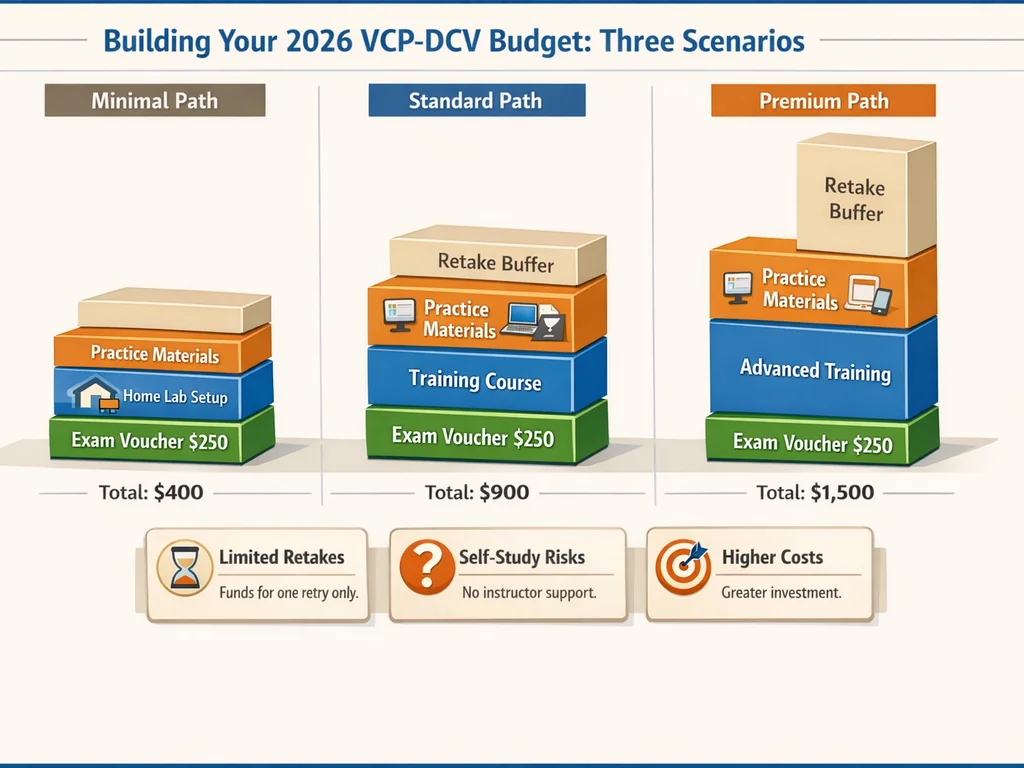
Self-Study Path (Minimum Viable Budget)
- Exam voucher: $250
- Practice tests and study materials: $150
- Home lab (existing hardware): $0
- Total: $400
Balanced Preparation Path
- Exam voucher: $250
- Practice test subscription with explanations: $199
- Cloud lab environment (2 months): $100
- Current study guide: $60
- Total: $609
Employer-Funded Training Path
- Exam voucher: $250
- Official VMware course: $4,250
- Practice tests: $150
- Total: $4,650 (typically employer-reimbursed)
The self-study path demands discipline and existing vSphere experience. The balanced path suits most candidates, providing structured practice without the training premium. The employer-funded path makes sense when someone else's budget covers the course, or when your experience gaps are substantial enough that unstructured learning would extend your timeline by months.
A fourth path exists for candidates with access to VMware's academic partnerships or corporate training agreements. Some universities and community colleges offer the official curriculum at reduced rates, typically $1,500 to $2,500, with the same certification alignment. Check with your institution's continuing education department or your employer's learning and development team for eligibility.
Consider hybrid approaches that blend these scenarios. Maria Chen's path, for example, combined elements of self-study and balanced preparation: she used existing hardware, purchased practice tests, and self-funded without employer support. Her $450 total sits between the minimum and balanced scenarios, reflecting her specific knowledge gaps and resources.
Tax implications vary by jurisdiction and employment status. In the United States, certification exam fees and preparation materials are generally deductible as work-related education expenses if they maintain or improve skills required in your current job. However, expenses qualifying you for a new trade or business are not deductible. Consult a tax professional if you are career-switching into virtualization from an unrelated field; your VCP-DCV pursuit may not qualify for the same deductions as a current administrator's recertification.
International candidates face additional complexity. While Broadcom standardized exam pricing at $250 USD globally, local taxes, currency conversion fees, and payment processing charges vary. Candidates in India report effective costs of approximately ₹21,000 to ₹23,000 depending on exchange rates and GST application. European candidates may encounter VAT of 19% to 27% added at checkout. Factor these adjustments into your personal budget rather than assuming the $250 figure applies precisely in your market.
Scheduling Your Exam: Timing Costs You Might Overlook
Pearson VUE operates VMware certification exams at test centers and through online proctoring. Both formats cost the same $250, but logistics differ:
- Test center: Travel time, parking ($10 to $25 in most metro areas), and inflexible scheduling during business hours.
- Online proctoring: Requires a private, quiet room, reliable internet, and a cleared desk. Technical failures during check-in can force rescheduling with no refund.
Schedule at least two weeks out to secure your preferred time slot. Last-minute bookings, especially for online exams, often show limited availability during evenings and weekends when working candidates prefer to test. The $250 voucher is non-refundable within 72 hours of your appointment.
Rescheduling fees add hidden cost. Pearson VUE charges $50 for changes made within 72 hours but more than 24 hours before the exam. Changes within 24 hours forfeit the full voucher value. Plan your study completion date conservatively. If you target March 15 for readiness, schedule for March 22 to buffer unexpected work demands or family obligations.
Time-of-day selection affects performance for many candidates. Morning slots suit those with peak cognitive function early in the day. Evening slots work for night owls but risk fatigue from full workdays. Factor your chronotype into scheduling, not just availability. A $250 exam taken at your worst hour of the day is poor value.
Geographic considerations extend beyond test center proximity. Some rural candidates face drives of two hours or more to the nearest Pearson VUE facility, effectively adding travel costs and fatigue to exam day. Online proctoring eliminates this but introduces its own geographic constraint: internet bandwidth and stability. VMware recommends 1 Mbps upload/download minimum for online exams, but candidates in areas with intermittent connectivity report check-in failures even at higher speeds. Test your connection during peak usage hours, not just off-peak.
The online proctoring experience itself has evolved since Broadcom's acquisition. Pearson VUE updated its secure browser software in late 2024, creating compatibility issues with some corporate-managed devices that restrict software installation. If you plan to test from a work laptop, verify with your IT department whether administrative privileges are available or whether you should use a personal device. A failed software installation on exam day typically requires rescheduling, with the associated fees.
How to Verify Your Total Before You Commit
Before clicking purchase on any voucher or course, run this checklist:
- Confirm the exam code matches your target version (currently 2V0-21.23 for VCP-DCV 2023/vSphere 8.x).
- Verify voucher expiration dates exceed your planned study timeline by at least 30 days.
- Check employer tuition reimbursement policies for training and exam costs.
- Test your home lab or cloud environment against the Vmware Exam Guide Review Vcp objective domains.
- Complete at least one full-length timed practice exam under realistic conditions.
James Okonkwo, a virtualization engineer in Austin, skipped step four in late 2024. He purchased a voucher, scheduled his exam for three weeks out, and only then discovered his home lab ran vSphere 7.0 Update 3, missing the vSphere 8.x features that comprise roughly 30% of the current exam. He rescheduled twice, burning $50 in Pearson VUE change fees, before passing on his third attempt date. His total cost: $250 voucher plus $50 rescheduling plus $199 for updated practice materials, all because he mismatched his preparation to the exam version.
The checklist also prevents over-preparation, which has its own cost. Some candidates delay their exam indefinitely, purchasing multiple practice test subscriptions and accumulating study materials they never use. Set a firm exam date before buying preparation resources. The deadline focuses your study and prevents budget creep from endless "one more resource" purchases.
Version verification deserves particular attention given VMware's rapid release cycle. vSphere 8.0 launched in October 2022, with 8.0 Update 1 following in early 2023 and 8.0 Update 2 in late 2023. The 2V0-21.23 exam reflects 8.0 Update 2 features. If your lab runs 8.0 GA or Update 1, you may lack exposure to tested features like enhanced DRS algorithms or vSphere Distributed Services Engine improvements. Check your build number against VMware's release notes, not just the major version.
Common Budget Mistakes and How to Avoid Them
Assuming training is still mandatory: Some outdated blog posts and forum threads from 2023 still claim VCP requires official coursework. Verify current policy through Vmware Certification Frequently Asked Questions before building your budget around a $4,250 course.
Buying the wrong voucher type: VCTA vouchers and VCP vouchers are not interchangeable. The VCTA-DCV exam (1V0-2120) costs the same $250 but awards a different, associate-level credential. Confirm you are purchasing for 2V0-21.23, not 1V0-2120.
Ignoring tax and currency conversion: While the exam is globally priced at $250 USD, your payment processor may apply foreign transaction fees or local taxes. Budget 5% to 10% above the listed price if purchasing outside the United States.
Neglecting time costs: A three-month self-study timeline spread across evenings and weekends has real opportunity cost. If your employer offers paid study time or training leave, factor that value into your path selection.
Overlooking hardware requirements for online proctoring: Some candidates discover too late that their work laptop has administrative restrictions preventing the installation of Pearson VUE's secure browser. Test the software weeks before your exam, not hours. A failed check-in may require purchasing a new voucher if rescheduling windows have closed.
Failing to account for certification path dependencies: VCP-DCV is a professional-level credential. If you are new to VMware virtualization, you might benefit from starting with VCTA-DCV to validate foundational knowledge before attempting VCP-DCV. This adds $250 to your total certification journey but reduces retake risk and builds confidence progressively.
Misunderstanding employer reimbursement timing: Many employers reimburse certification costs only after successful completion, not upfront. If you are counting on reimbursement to fund your exam, you may need to float the $250 to $600 yourself for 30 to 90 days. Check your company's specific policy and plan cash flow accordingly.
Overlooking peripheral certification costs: Some candidates budget for the exam and primary study materials but forget ancillary expenses. These include travel to test centers, parking, meals on exam day, potential hotel stays for candidates in remote areas, and hardware upgrades for home labs. A $40 NIC upgrade to support vSphere 8.x features in your lab is still a certification cost, even if it is not a direct exam fee.
When to Consider Alternative VMware Certifications
VCP-DCV is not the only credential in Broadcom's post-acquisition portfolio. Depending on your role and career direction, these alternatives may offer better cost-to-value ratios:
- VCTA-DCV (1V0-2120): Same $250 exam, entry-level focus, no prerequisites. Suitable for technicians supporting virtualized environments without full administrative responsibility.
- VCF Administrator (2V0-11-24 or 2V0-11-25): $250 exam, targets VMware Cloud Foundation deployment and management. Growing relevance as enterprises consolidate on integrated platforms.
- vSphere Foundation Support (2V0-18.25): No expiration under current policy, $250 exam, focused on operational support rather than design and implementation.
The PlanetCert VMware Practice Tests 2026 catalog covers all these tracks, letting you sample question styles before committing to a specific exam path.
Consider your career trajectory when choosing. VCP-DCV remains the standard for system administrators and infrastructure engineers. VCF Administrator suits those moving toward cloud architecture and platform engineering. vSphere Foundation Support fits operations teams managing existing environments rather than designing new deployments. The credential you choose shapes which roles you qualify for and which hiring managers recognize your expertise.
Role-specific demand varies by market. In enterprise data centers, VCP-DCV still dominates job requirements. In service provider and multi-tenant environments, VCF Administrator credentials increasingly appear in postings. For candidates at managed service providers or cloud resellers, the VCF path may open more doors than traditional VCP-DCV despite similar cost.
Emerging specialization tracks also warrant attention. Broadcom has indicated plans to expand VMware's certification portfolio around cloud-native integration, AI/ML infrastructure, and edge computing. While these tracks are not yet fully defined in 2026, candidates making long-term certification plans should monitor Broadcom's certification announcements. Investing heavily in VCP-DCV today makes less sense if your target role shifts toward container orchestration or edge infrastructure within two years.
FAQ
Is the VCP-DCV exam still $250 in 2026?
Yes. Broadcom standardized VCP, VCAP, VCTA, and Specialist exam pricing at $250 globally as of May 6, 2024. This rate remains current for 2026.
Do I need to take official VMware training to sit for VCP-DCV?
No. The mandatory training prerequisite was removed in May 2024. You can register for and take the exam with only the voucher purchase.
What happens if I fail the VCP-DCV exam?
You must purchase a new $250 voucher for each retake. There is no discounted retake option. Your score report shows domain-level performance to guide your study focus.
Does VCP-DCV expire?
Certifications earned after May 6, 2024, do not expire under current Broadcom policy. Earlier certifications may have carried two-year renewal requirements. Check your specific credential details in your certification portal.
Can I use an old exam voucher purchased before the price change?
Yes, but without refund or adjustment. A $450 VCAP voucher bought before May 6, 2024, remains valid for its original exam but will not be converted to cash or multiple lower-priced vouchers.
What is the current VCP-DCV exam code?
As of 2026, the active exam is 2V0-21.23 for VMware vSphere 8.x. Older codes like 2V0-21.20 (vSphere 7.x) are retired for new certifications.
Should I get VCP-DCV or VCTA-DCV first?
Choose VCTA-DCV if you are new to VMware virtualization, have less than one year of exposure, or want to validate foundational knowledge before attempting professional-level certification. VCP-DCV assumes hands-on administrative experience and tests deeper troubleshooting and design scenarios.
Further Reading
- VMware Practice Tests 2026
- Professional VMware vSphere 7.x Practice Test
- VMware vSphere Foundation 9.0 Support Practice Test
Learn more: Browse the VMware exam catalog at PlanetCert to find practice tests aligned with your certification path and budget.

Discussion
Question Comments
0 comments·0 participantsSign in to leave a comment and access more free questions.