General Principles of Ground Transport Nursing Practice · Physiologic stressors of transport: Patients
During emergency interfacility ground transport of a patient experiencing an evolving acute myocardial infarction, which neuroendocrine response is most directly induced by siren activation, rapid acceleration, and mechanical road vibration?
Answer and explanation
Correct answer: B
Transport stressors trigger acute sympathetic activation, markedly elevating plasma catecholamines, mean arterial pressure, and myocardial oxygen demand.
Q2Question 2
Advanced
General Principles of Ground Transport Nursing Practice · Physiologic stressors of transport: Patients
A critical care transport team is transferring a 64-year-old male with decompensated heart failure across 45 miles of variable highway terrain. At the referral facility, the patient was resting comfortably on a high-flow nasal cannula with stable hemodynamics. Ten minutes after beginning transport with lights and sirens, the patient exhibits diaphoresis, tachypnea, and worsening anxiety. Continuous monitoring shows a heart rate increase from 82 beats/min to 110 beats/min and blood pressure increase from 128/76 mm Hg to 162/94 mm Hg.
Serum biomarkers drawn before transport versus immediately upon arrival demonstrate a steep surge in pro-B-type natriuretic peptide (proBNP). Which mechanism best explains this acute physiologic deterioration during ground transit?
Answer and explanation
Correct answer: D
Siren noise, rapid velocity changes, and vibration induce catecholamine release, raising systemic vascular resistance and ventricular stretch, spiking proBNP.
Q3Question 3
Intermediate
General Principles of Ground Transport Nursing Practice · Emergency vehicle operations
When evaluating emergency vehicle response dynamics, how do 'wake-effect' collisions compare in frequency to direct collisions involving the emergency transport vehicle itself?
Answer and explanation
Correct answer: B
Studies demonstrate that emergency vehicle warning systems provoke roughly four secondary wake-effect crashes among surrounding civilian vehicles for every direct crash.
flowchart LR
EV[Emergency Vehicle with L&S] --> DC[1 Direct Crash]
EV --> WE[4 Wake-Effect Crashes]
Q4Question 4
Beginner
General Principles of Ground Transport Nursing Practice · Emergency vehicle operations
True or False: National ambulance collision data indicate that enacting a mandatory policy requiring a complete stop at all red lights and stop-controlled intersections significantly reduces intersection crash injury rates compared to merely slowing down.
Answer and explanation
Correct answer: A
Mandating a full stop at negative-right-of-way intersections drastically lowers collision and injury rates, as intersections represent the highest crash risk zone.
Q5Question 5
Intermediate
General Principles of Ground Transport Nursing Practice · Emergency vehicle operations
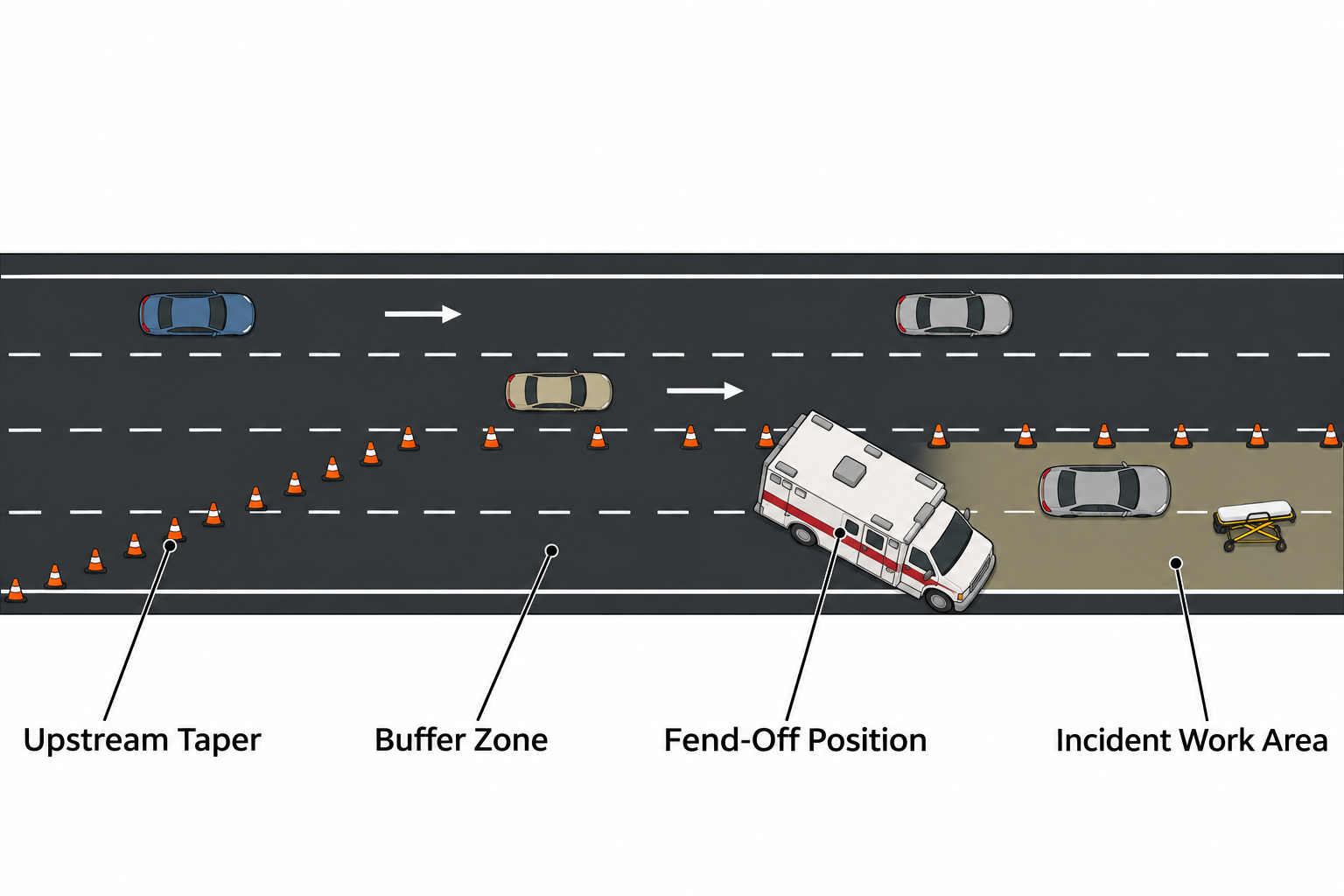
The critical care ground ambulance arrives at a multi-vehicle highway crash site. According to emergency vehicle lighting standards, which visual warning configuration should the driver select once the vehicle is safely parked across traffic lanes to protect responders?
Answer and explanation
Correct answer: D
Stationary scene lighting reduces blinding glare and disorienting strobe patterns while clearly marking the obstruction to oncoming traffic.
Q6Question 6
Intermediate
General Principles of Ground Transport Nursing Practice · EMTALA
A rural community hospital emergency department physician contacts a specialized tertiary medical center to transfer an unstable patient with acute aortic dissection. The receiving tertiary facility accepts the patient but states that transfer acceptance is strictly conditional on utilizing the receiving facility's own contracted rotor-wing service rather than the referring hospital's dedicated critical care ground transport team. Under EMTALA regulations, how must this situation be handled?
Answer and explanation
Correct answer: D
Under EMTALA, the transferring physician dictates the appropriate mode and personnel to minimize transit risk; an accepting facility cannot mandate a specific carrier.
Register free for 6 more questions
Or unlock all 154 CTRN questions with explanations, timed mode and flashcards.