

ASE Medium-Heavy Truck Certification Tests (T1-T8) Free Sample Questions

12 free sample questions151 in the full practice test

Try simulator

T1-T8 Sample Questions

  1. Question 1

    Intermediate

    Gasoline Engines · General Engine Mechanical, Vacuum, and Cylinder Leakage Diagnosis

    A technician performs a cylinder leakage test on a Class 4 gasoline delivery truck engine. Compressed shop air is introduced to cylinder 3 while held at top dead center (TDC) on the compression stroke. Air bubbles immediately begin churning out of the open radiator neck. What component defect does this test result identify?

    Answer and explanation

    Correct answer: D

    Air bubbles in the radiator during a cylinder leakage test confirm combustion pressure is escaping directly into the cooling jacket via a blown head gasket or cracked cylinder/head. Intake valve leaks exhaust out the throttle body.
  2. Question 2

    Beginner

    Gasoline Engines · Cylinder Head and Valve Train Diagnosis and Repair

    A gasoline-powered medium-duty utility truck exhibits an engine misfire under load. A cylinder compression test produces the following gauge readings across the bank: Cylinder 1: 155 psi; Cylinder 2: 150 psi; Cylinder 3: 20 psi; Cylinder 4: 25 psi; Cylinder 5: 152 psi; Cylinder 6: 155 psi. What is the most probable cause of this compression profile?

    Answer and explanation

    Correct answer: C

    Drastically depressed compression readings isolated to two adjacent cylinders indicate the cylinder head gasket has burned or blown between their combustion chambers, allowing pressure to vent into the adjoining cylinder.

  3. Question 3

    Intermediate

    Gasoline Engines · Engine Block Diagnosis and Repair

    When assembling a gasoline truck engine crankshaft during a major overhaul, what is the approved method for measuring main bearing oil running clearance?

    Answer and explanation

    Correct answer: C

    Plastigage compressed between journal and bearing shell without crankshaft rotation measures radial oil clearance accurately. Feeler gauges gouge precision bearing babbitt and cannot measure radial oil clearance across the journal.

  4. Question 4

    AdvancedMultiple answers

    Gasoline Engines · Fuel, Air Induction, and Exhaust Systems Diagnosis and Repair

    A gasoline-powered medium-duty truck utilizing a return-type fuel injection system exhibits abnormally high fuel pressure at idle. Which TWO of the following conditions can cause this high fuel pressure? (Select TWO)

    Answer and explanation

    Correct answers: D, E

    Without intake manifold vacuum pulling against the regulator spring at idle, the regulator defaults to maximum unreferenced fuel rail pressure. A restricted fuel return line blocks discharge to the tank, forcing rail pressure upward.

    A restriction in the return line creates backpressure downstream of the regulator valve, which prevents bypassed fuel from returning to the tank and drives operating rail pressure above specification.

  5. Question 5

    Intermediate

    Diesel Engines · Fuel System Diagnosis and Repair

    A Class 7 truck equipped with a hydraulic electronic unit injector (HEUI) diesel engine cranks at normal cranking speed but fails to start. Scan tool diagnostics confirm active engine RPM synchronization, but Injection Control Pressure (ICP) reaches only 210 psi during cranking against a commanded value of 1,100 psi.

    Based on HEUI operational requirements, what is the reason for this engine no-start condition?

    flowchart TD A[Engine Cranks] --> B{RPM Sync Confirmed?} B -->|Yes| C[Check ICP Pressure] B -->|No| D[Check Cam/Crank Sensors] C --> E{ICP >= Threshold?} E -->|No: 210 psi| F[Inhibit Injector Firing] E -->|Yes: > 500 psi| G[ECM Enables Injection Pulses]
    Answer and explanation

    Correct answer: D

    HEUI systems require approximately 500 psi of hydraulic injection control pressure (ICP) to overcome the injector internal intensifier spring before the ECM will command fuel injection. 210 psi prevents injection actuation.

  6. Question 6

    Intermediate

    Diesel Engines · Engine Block Diagnosis and Repair

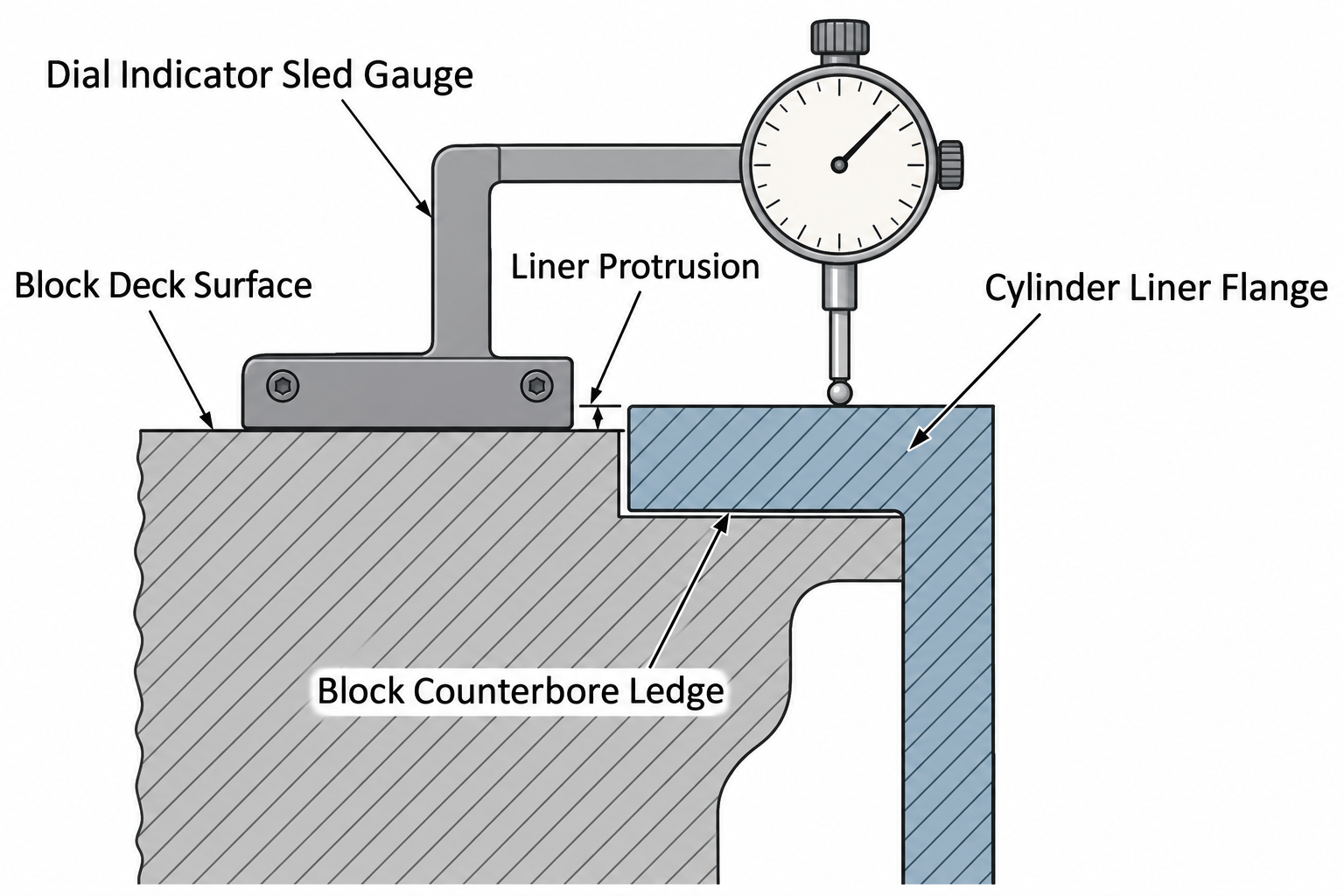
    A diesel technician is installing wet cylinder liners into a heavy-duty engine block during an in-frame rebuild. Using a dial indicator sled gauge, the technician measures liner protrusion above the engine block deck to be 0.001 in., which is below the OEM specification of 0.003–0.005 in. How should the technician adjust the cylinder liner protrusion to specification?

    Question 6 image
    Answer and explanation

    Correct answer: A

    Wet cylinder liner protrusion is adjusted by selecting and placing precision metal shims of the required thickness underneath the liner seating flange in the engine block counterbore. Head gaskets do not adjust liner-to-deck protrusion.

Register free for 6 more questions

Or unlock all 151 T1-T8 questions with explanations, timed mode and flashcards.