
ACE-L3-DCENG Exam Sample Questions: What the Live Test Actually Covers
If you're hunting for ace-l3-dceng sample questions, you probably want one thing above all else: certainty that the practice material you study actually matches what Arista throws at you in the live exam. The ACE-L3-DCENG—officially the Arista Certified Engineer Level 3 Specialist in Data Center Engineering—sits at a tricky spot in the certification ladder. It is not a multiple-choice trivia test you can guess your way through. It is a four-hour, hands-on lab exam that tests whether you can build, validate, and troubleshoot a leaf-spine fabric using EOS and CloudVision. That reality changes everything about how you should evaluate sample questions and how you should use them.
This article answers the questions candidates actually ask when they search for practice material: what the live exam covers, how sample questions map to that reality, where free samples fall short, and how to spot legitimate practice content that will move the needle on exam day.
What Format Is the ACE-L3-DCENG Exam, Really?
The most important fact to absorb early: the ACE-L3-DCENG is a practical lab exam, not a standardised test with multiple-choice items. As one recent candidate described the Arista DC Engineering L3 Exam, the experience is "no-nonsense, to the point and all about testing your ability to deliver their solution." You get four hours in a pure lab environment. There are no trick multiple-choice questions, no complexity added for its own sake, and the exam is open-book—you can reference notes, documentation, and even search the web, though AI assistance is not permitted.
This format fundamentally shapes what useful ace-l3-dceng sample questions look like. Any practice material that presents only multiple-choice items about theory is preparing you for a different kind of test. The live exam asks you to configure BGP sessions, validate VXLAN overlays with EVPN control-plane behaviour, verify route-target and route-distinguisher correctness, and confirm MAC/IP learning across fabric devices. Sample questions that mirror this format will present scenario-based configuration tasks, troubleshooting traces, or verification commands rather than abstract knowledge checks.
The open-book aspect also matters for your study strategy. Because you can reference Arista documentation during the exam, rote memorisation of command syntax matters less than knowing where to find information quickly and how to apply it under time pressure. Good practice material should train that skill, not just test recall.
Which Topics Show Up Most Often in Live Scenarios?
The exam blueprint, as described by authorised training partners, evaluates several core competencies. You will be tested on implementing and validating leaf-spine building blocks using EOS and CloudVision, including correct provisioning, state validation, and consistency across fabric devices. BGP and other routing protocols appear for both underlay and overlay scenarios, with emphasis on session establishment, route propagation, and policy behaviour.
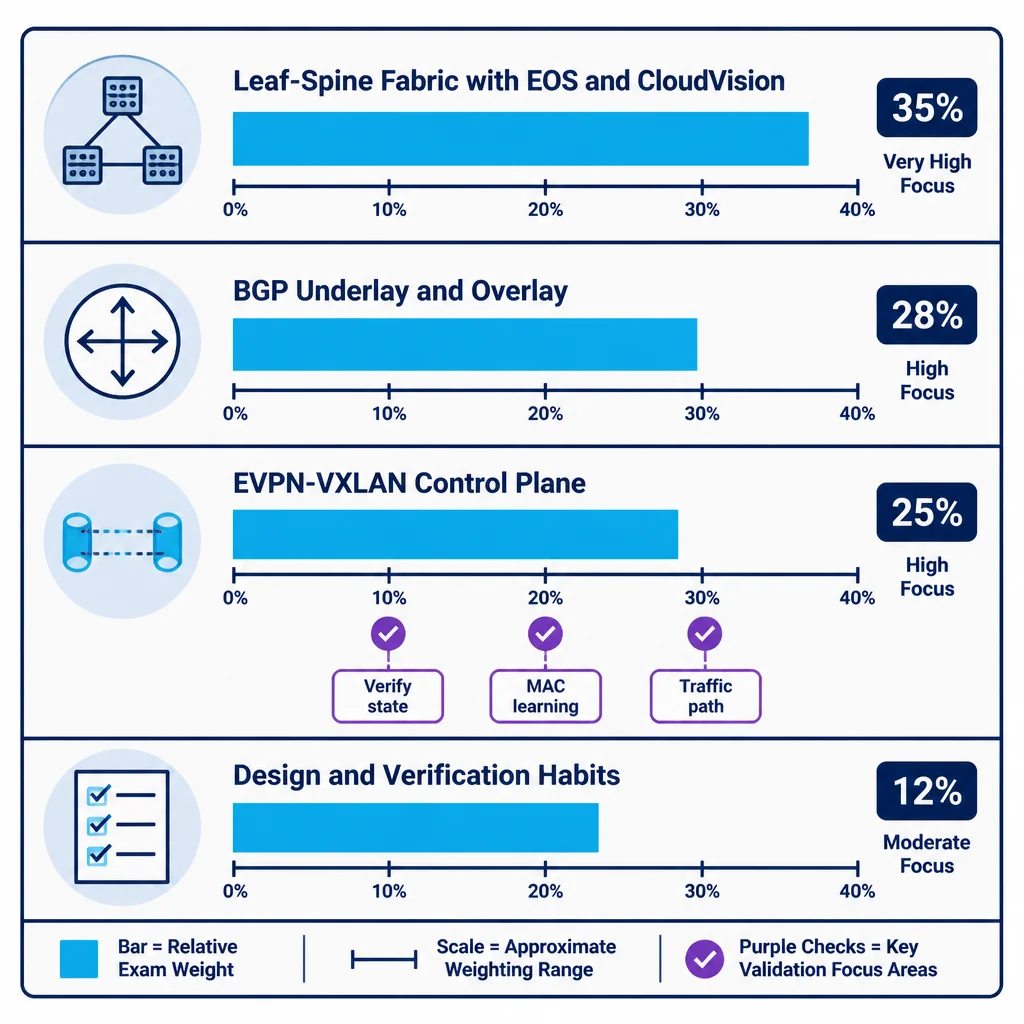
VXLAN overlays with EVPN control-plane feature heavily. This includes route-target and route-distinguisher configuration, MAC/IP learning verification, and traffic validation. Best-practice design habits round out the evaluation: MTU sizing, redundancy and multihoming, staged validation, and clear documentation of your verification steps.
When you evaluate ace-l3-dceng sample questions, check whether they distribute practice scenarios across these domains proportionally. A common flaw in free or outdated material is over-weighting basic BGP theory while under-testing EVPN-VXLAN integration—the exact area where candidates most often stumble in the live environment. One candidate noted that "the number of variables even with a single pod topology is overwhelming," which suggests that multi-step, multi-protocol scenarios are the norm, not the exception.
How Do Free Online Samples Compare to the Real Blueprint?
Free samples found through search engines or forums vary dramatically in quality and relevance. The core problem is alignment: many sample questions pre-date Arista's 2021 certification revamp, when the ACE program shifted from a single Associate level to multi-level specialisations. Material from before that change targets retired exam objectives and may reference deprecated topologies or commands.
Even current free samples often exhibit predictable weaknesses. They tend to isolate single concepts rather than integrating them. A question might test your knowledge of VXLAN encapsulation without requiring you to verify that EVPN correctly distributes the corresponding Type-2 routes. The live exam, by contrast, forces you to connect these pieces. Free samples also rarely include the low-resolution diagrams and scenario documentation that candidates report encountering, which means you miss practice in parsing the exact visual format the exam uses.
Another gap is time pressure. The four-hour window sounds generous until you account for the number of tasks, the verification steps required, and the documentation you must produce. Sample questions without timed simulation or without requiring full configuration-and-verify workflows do not train this dimension.
That said, free samples can serve a purpose early in your study cycle. They help you identify knowledge gaps in specific protocols or EOS features. Just do not mistake them for exam-ready preparation. For that, you need scenario-based practice that forces integrated troubleshooting and validation.
What Makes Legitimate Practice Material Different from Outdated Content?
Legitimate, current practice material for the ACE-L3-DCENG shares several distinguishing characteristics. First, it is explicitly aligned with the post-2021 certification structure. Arista revamped its program to include levels 1 through 7 plus specialist certifications; the L3-DCENG sits within this modern framework. Material that still references the old "ACE Associate" designation is immediately suspect.
Second, quality practice includes detailed explanations that go beyond correct answers to address why incorrect approaches fail. In a lab exam, understanding the failure mode matters as much as knowing the right configuration. If your sample questions merely state "B is correct" without explaining why A, C, and D would break routing or overlay learning, you are not getting the analytical depth the exam demands.
Third, legitimate providers update content to reflect current EOS versions and CloudVision capabilities. Arista's software evolves, and exam scenarios track those changes. Questions referencing features or syntax from EOS versions several years old may still test relevant concepts but can mislead you about current command structures or default behaviours.
Finally, trustworthy material respects the exam's practical nature. It presents configuration tasks, verification sequences, and troubleshooting scenarios rather than pure theory. When browsing ACE-A1.2 sample questions for comparison, you can see how Arista's broader certification family maintains this hands-on emphasis across levels.
How Should You Build a Study Plan Around Sample Questions?
Given the lab format, your study plan needs to progress through distinct phases rather than repeating the same question bank endlessly. Start with protocol fundamentals: ensure you can configure BGP, EVPN, and VXLAN independently before attempting integrated scenarios. Use basic sample questions or lab exercises to confirm this foundation.
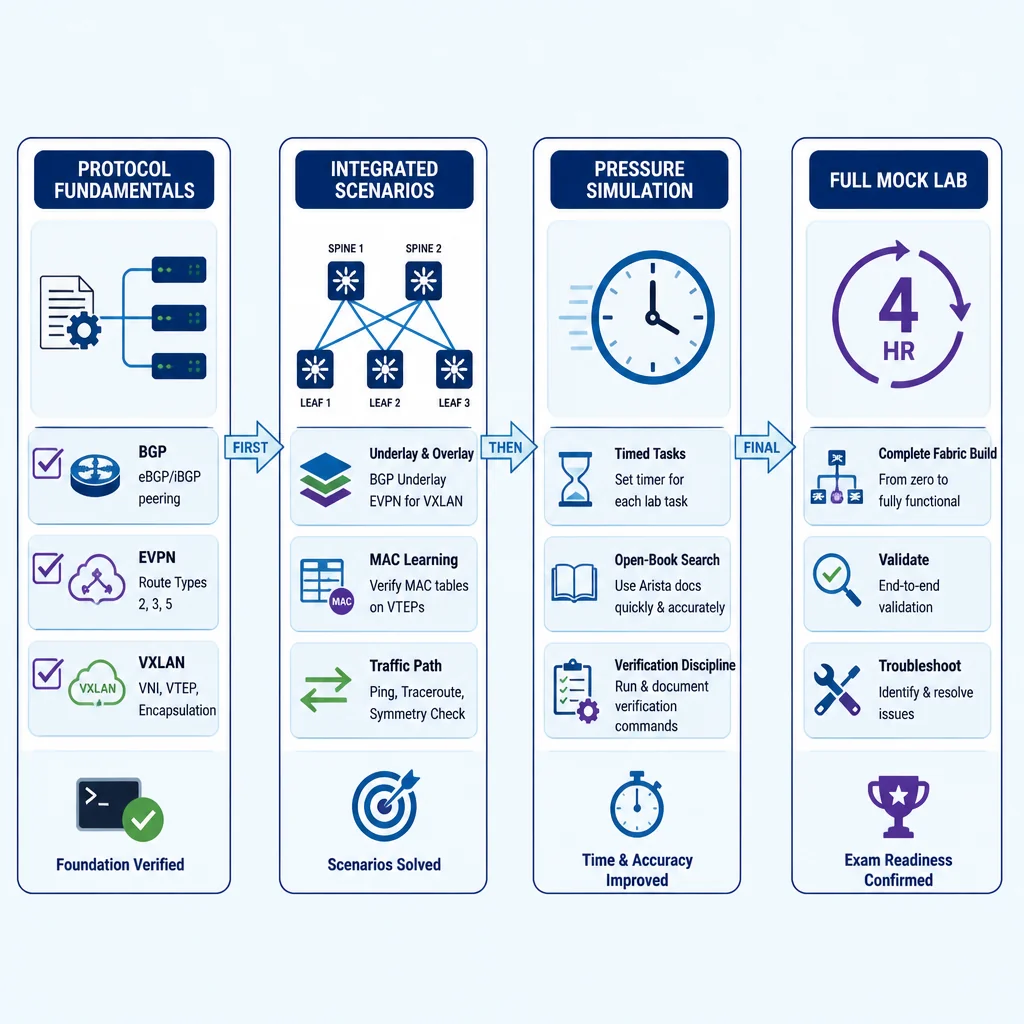
Next, move to integrated scenarios that combine multiple technologies. This is where well-designed ace-l3-dceng sample questions prove their value. Work through tasks that require you to establish BGP underlay, overlay EVPN for VXLAN, verify MAC learning, and validate traffic paths. Time yourself. Document your verification commands as you go—the exam evaluates this habit explicitly.
Then introduce pressure simulation. The open-book format means you should practice locating information in Arista documentation quickly, not relying on memorised syntax. Set a timer, allow yourself access to official docs, and measure how long it takes to complete multi-step tasks. One candidate's observation that exam diagrams are "low resolution making it difficult to read some text" suggests you should also practice working with imperfect reference materials.
Finally, schedule full mock labs that replicate the four-hour window as closely as possible. This builds stamina and reveals whether your pace sustains across the entire exam. If you exhaust yourself in the first two hours, you need to adjust your approach before the live attempt.
What Common Traps Do Candidates Miss in Sample Questions?
Several subtle traps appear in both low-quality sample material and live exam scenarios. The first is assuming that because the exam is open-book, you do not need deep preparation. The time cost of looking up every command or concept is prohibitive. You need fluent knowledge of routine configurations so that your documentation lookups handle only edge cases or verification specifics.
The second trap is neglecting verification as a separate skill. The exam tests "correct provisioning, state validation, and consistency across fabric devices." Many candidates configure competently but verify poorly, missing that a BGP session is established but routes are not propagating as policy intends, or that EVPN routes are present but MAC learning is incomplete. Quality sample questions force you to demonstrate both configuration and validation.
The third trap is underestimating the scenario documentation. Candidates report that exam diagrams and descriptions can be dense and occasionally ambiguous. Practice with material that presents realistic, somewhat messy scenario descriptions rather than clean, idealised problem statements. This trains you to extract requirements under uncertainty.
A fourth trap specific to sample questions themselves: over-reliance on material that tests isolated facts. If your practice shows you a diagram and asks "what routing protocol should run between leaf and spine," that is useful but insufficient. The live exam will present that same topology and ask you to configure it, verify neighbour relationships, ensure route advertisement policies match requirements, and confirm end-to-end reachability through the overlay.
How Does This Exam Fit Within Arista's Broader Certification Path?
Understanding where ACE-L3-DCENG sits helps you evaluate whether you are even ready for this level of practice. Arista's current program runs from Level 1 (entry) through Level 7 (expert), with specialist certifications alongside. The L3-DCENG is a specialist-level credential focused specifically on data center engineering. There is no formal prerequisite, which means candidates sometimes attempt it before building adequate foundational skill.
If you are early in your Arista journey, sample questions for this exam may frustrate you more than help. The Arista Certification ACE track description from authorised training sources emphasises that this exam evaluates production-ready implementation skills. Candidates who have not yet worked through Level 1 and Level 2 material, or who lack hands-on data center networking experience, often find the jump too large.
For those at the right stage, the specialist focus is an advantage. Unlike broader certifications that spread across campus, WAN, and data center topics, ACE-L3-DCENG goes deep on one domain. Your sample questions and practice labs can target that domain exclusively, making preparation more efficient than for sprawling generalist exams.
What Should You Look for in a Practice Test Provider?
When you purchase practice material, several quality indicators separate worthwhile investment from wasted money. Update frequency matters most for a relatively new specialist exam like this one. Ask when the content was last revised against current exam objectives. Providers who cannot specify a recent date are likely selling stale material.
Explanation depth is the next filter. Every practice task should include not merely the correct configuration but the reasoning behind design choices, common misconfigurations that produce subtle failures, and the specific verification commands that confirm correct operation. This mirrors how you need to think in the live lab.
Scenario realism counts too. The practice exam vs real exam distinction is especially sharp for hands-on tests. A provider whose scenarios feel like textbook exercises rather than production deployments is not preparing you for the decision-making pressure of the live environment.
Finally, check whether the provider offers timed simulation and performance tracking. Knowing that you completed a task correctly is useful; knowing that you took 45 minutes when the exam allows 20 is critical information. Good platforms track your pace across attempts and highlight improving or degrading areas.
What Candidates Ask Before Booking Their Exam
Do I need to take lower-level Arista exams before attempting ACE-L3-DCENG?
No formal prerequisite exists. However, the exam assumes you can implement and validate production data center networks. If your experience is thin, start with foundational levels or extensive lab practice before attempting this specialist exam.
Is the exam really open-book?
Yes, with clear limits. You may reference notes, documentation, and web search. AI assistance is prohibited. The open-book policy rewards candidates who know how to find and apply information quickly, not those who need to look up basic syntax for every step.
How current must my practice material be?
Aim for content updated within the last 12-18 months, or explicitly aligned with the post-2021 certification structure. Arista's exam scenarios track current EOS and CloudVision capabilities; outdated material can teach you commands or defaults that no longer apply.
Can I pass using only free sample questions?
Unlikely. Free samples help identify knowledge gaps and provide early exposure to question formats. They rarely offer the integrated scenarios, timed pressure, or verification depth that the four-hour lab demands. Consider free material a supplement, not a primary preparation strategy.
What is the best way to verify my readiness?
Complete a full mock lab under timed conditions using current practice material. If you can configure, validate, and document a multi-protocol leaf-spine fabric in under four hours with consistent accuracy, you are approaching exam readiness. If you struggle with time or verification steps, continue building those specific skills.
References
- Exam review on Arista ACE — Exam review on Arista ACE-L3 Cloud Engineer ... ista ACE- ... # Exam review on Arista ACE-L3 Cloud Engineer ... It’s time for another IT certification review sharing content. This
Sharpening Your Approach to ACE-L3-DCENG Prep
- How to pass certification quizzes
- Vet a practice exam before purchasing
- CCNA practice exams blueprint alignment techniques

Discussion
Question Comments
0 comments·0 participantsSign in to leave a comment and access more free questions.