

AWS Solutions Architect Associate: How Udemy Courses Stack Up
Every month, thousands of cloud engineers search for aws certified solutions architect associate udemy hoping to find a single course that will carry them through the SAA-C03 exam. The promise is seductive: dozens of hours of video, a practice test or two, and a certificate of completion to post on LinkedIn. But the gap between finishing a video course and passing the actual exam is wider than most candidates expect. This whitepaper maps what Udemy's most popular SAA-C03 courses actually cover, where they fall short against the current exam blueprint, and how to build a preparation stack that closes those gaps without wasting study time.
The Exam You're Actually Preparing For
The AWS Certified Solutions Architect — Associate (SAA-C03) exam is not a trivia test. AWS designed it to assess whether you can make architectural decisions under constraints: security requirements, cost limits, resilience targets, and performance demands. The blueprint weights four domains heavily toward design scenarios rather than service memorization.
| Domain | Weight | Core Focus |
|---|---|---|
| Design Secure Architectures | 30% | IAM, VPC, encryption, least-privilege patterns |
| Design Resilient Architectures | 26% | Multi-AZ, auto-scaling, disaster recovery |
| Design High-Performing Architectures | 24% | Caching, CDN, database optimization, compute selection |
| Design Cost-Optimized Architectures | 20% | Storage tiers, reserved capacity, right-sizing |
This distribution matters because it shapes what "prepared" actually means. A candidate who can recite S3 storage classes but cannot select between them based on access patterns and budget constraints will struggle on exam day. The SAA-C03 tests decision-making, not recall.
AWS last refreshed the exam blueprint in 2022, and the current SAA-C03 version remains valid through 2026. However, service updates, new regions, and pricing model changes roll out continuously. Any course last updated before mid-2025 risks teaching patterns that AWS has superseded.
What Udemy's Top Courses Deliver
Udemy's marketplace model means quality varies dramatically. The platform's search algorithm surfaces courses with high review counts and recent enrollment, not necessarily the most exam-relevant content. Three course archetypes dominate the SAA-C03 catalog.
The Comprehensive Video Course
The Ultimate AWS Certified Solutions Architect by Stéphane Maarek represents the gold standard for depth. At 27+ hours, it covers services exhaustively, includes hands-on labs, and was last updated August 2026. Maarek's approach emphasizes architectural reasoning: why you would choose Aurora over RDS in a specific scenario, not merely what Aurora does. The course includes a single practice exam, which the instructor notes is intended as a "knowledge check" rather than full simulation.
This model works well for learners building foundational knowledge from limited AWS experience. The pacing allows time to absorb networking concepts, IAM policy evaluation, and storage patterns. For candidates with some cloud background, the early sections on basic EC2 and S3 operations may feel slow.
The Exam-Focused Accelerator
Know Direct's AWS Certified Solutions Architect — Associate (SAA-C03) Exam course positions itself as blueprint-aligned and efficient. Published June 2026, it targets candidates who want structured domain coverage without the marathon runtime. The course explicitly maps each section to the four exam domains and emphasizes "real-world design patterns."
Shorter courses carry inherent trade-offs. Complex topics like VPC peering, transit gateways, and hybrid DNS resolution get compressed. Candidates without prior networking experience may find the accelerated pace leaves gaps that only surface during practice testing.
The Practice-Heavy Bank
Several Udemy offerings, including newer 2026 releases, structure themselves around large question banks rather than video instruction. One prominent example advertises 1,019 questions with monthly additions but explicitly notes that "individual written explanations" are limited due to the volume. These courses serve candidates who have already studied and need repetition to build speed and pattern recognition.
The limitation is substantial. Without detailed explanations of why an answer is correct and why distractors are wrong, candidates risk reinforcing misconceptions. The SAA-C03's scenario-based questions often have multiple "plausible" answers; understanding AWS's preferred architectural approach requires more than seeing the keyed response.
Where Video-First Preparation Breaks Down
Udemy courses excel at knowledge transfer. They struggle at three specific tasks that determine exam outcomes.
Timed pressure adaptation. The SAA-C03 allows 130 minutes for 65 questions, many with lengthy scenario descriptions. Reading comprehension speed matters as much as technical knowledge. Video courses have no mechanism to train this. You cannot pause an exam.
Distractor resistance. AWS writes exceptionally deceptive wrong answers. A distractor might describe a valid service configuration that solves 90% of the scenario but introduces a security flaw, violates a cost constraint, or fails a resilience requirement. Recognizing these near-misses requires repeated exposure to exam-style question writing, not conceptual explanation.
Confidence calibration. Many candidates finish video courses feeling prepared because they understood the lectures. Understanding architecture in theory differs from selecting the correct option under uncertainty. Without performance data from realistic practice conditions, candidates misjudge readiness and schedule the real exam prematurely.
These gaps explain the recurring pattern in certification forums: candidates who completed 30+ hours of video, sometimes multiple courses, yet failed the exam on their first attempt. The knowledge was present; the exam-taking skill was not.
Mapping Course Coverage to Exam Domains
A blueprint-first evaluation reveals specific misalignments between typical Udemy content and SAA-C03 demands.
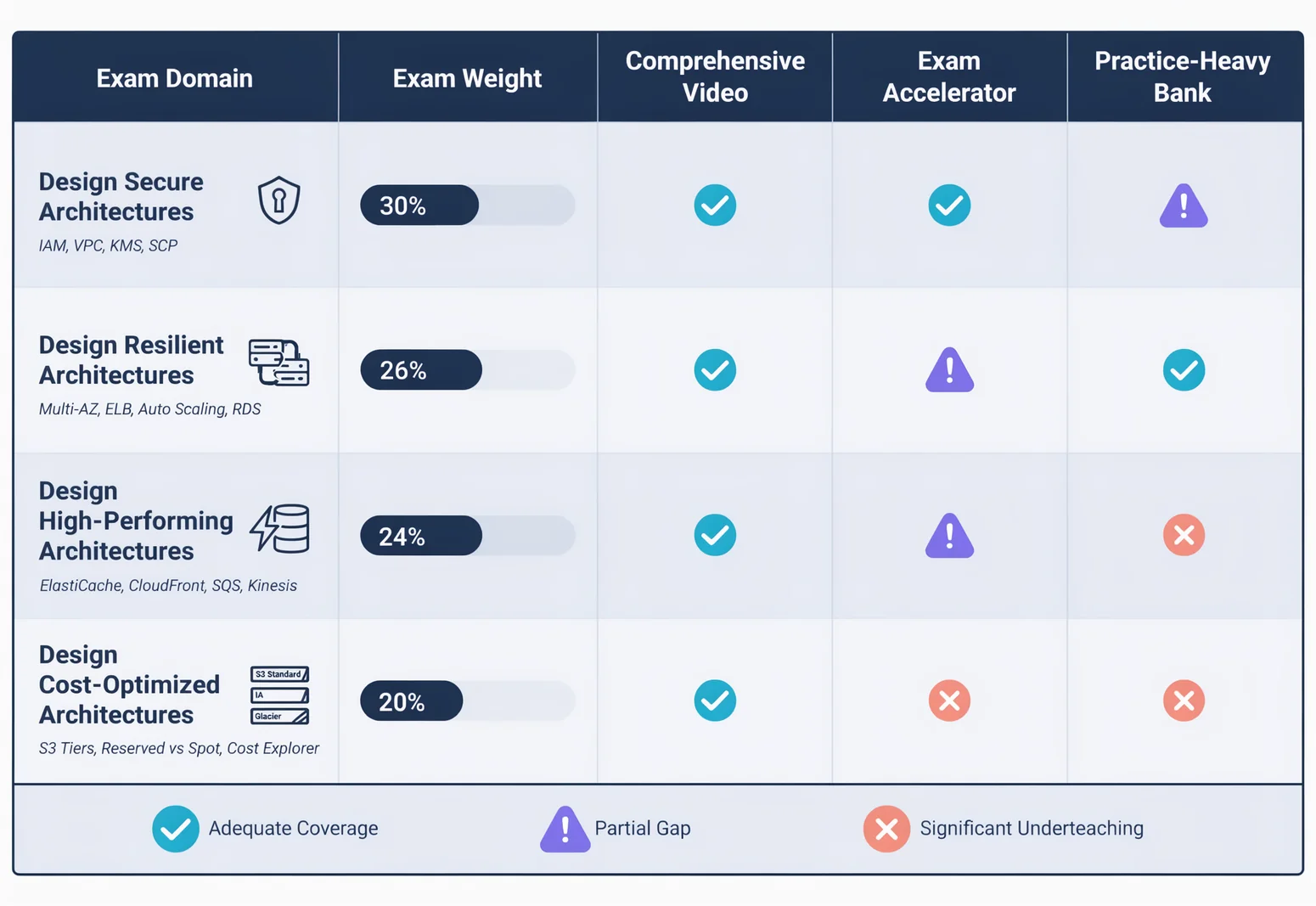
Domain 1: Design Secure Architectures (30%)
Most courses cover IAM fundamentals, KMS encryption, and VPC basics adequately. Fewer address the nuanced scenarios that dominate this domain: designing cross-account access patterns, selecting between resource-based and identity-based policies, or implementing data perimeter controls with AWS Network Firewall and PrivateLink. The August 2026 Maarek update added coverage of newer controls, but candidates relying on older courses or shorter accelerators may encounter unfamiliar question patterns.
Domain 2: Design Resilient Architectures (26%)
High availability and disaster recovery concepts appear in virtually every course. The gap lies in multi-region design decisions: when to use Route 53 failover versus Global Accelerator, how to maintain RPO/RTO targets across regions, or designing DynamoDB global tables versus Aurora Global Database for specific consistency requirements. These are precisely the trade-off scenarios the exam favors.
Domain 3: Design High-Performing Architectures (24%)
Caching strategies, database selection, and compute optimization receive thorough treatment in comprehensive courses. Less consistently covered: EBS volume selection for specific IOPS patterns, ElastiCache cluster mode implications, or the performance characteristics of S3 Transfer Acceleration versus standard multipart upload. The exam objective mapping guide provides a methodology for auditing any course against these specifics.
Domain 4: Design Cost-Optimized Architectures (20%)
This domain is frequently undertaught. Cost optimization questions require calculating trade-offs: Reserved Instances versus Savings Plans, S3 Intelligent-Tiering versus explicit lifecycle policies, or Graviton-based instance migration for workload-appropriate scenarios. Video courses often mention cost factors without the quantitative reasoning the exam demands.
The Currency Problem: Outdated Content Risks
AWS evolves faster than any individual course can update. In 2026 alone, several service changes affect SAA-C03 relevance:
- S3 Express One Zone introduced new performance and cost dynamics for high-frequency access patterns
- AWS Clean Rooms and related data collaboration services expanded the security domain's scope
- Graviton4 instances changed compute optimization calculations
- Updated Well-Architected Framework guidance refined resilience best practices
A course last updated in early 2025 predates these changes. Candidates studying outdated material face a double penalty: they may not know new services that appear in questions, and they may apply superseded patterns to current scenarios.
The Maarek course currency review tracks update frequency for the most popular Udemy offering. Even with diligent maintenance, there is inherent latency between AWS announcements and course revisions. Self-paced learners must supplement with current AWS documentation and release notes.
Building a Complete Preparation Stack
Effective SAA-C03 preparation requires three layers working together. No single Udemy course provides all three optimally.
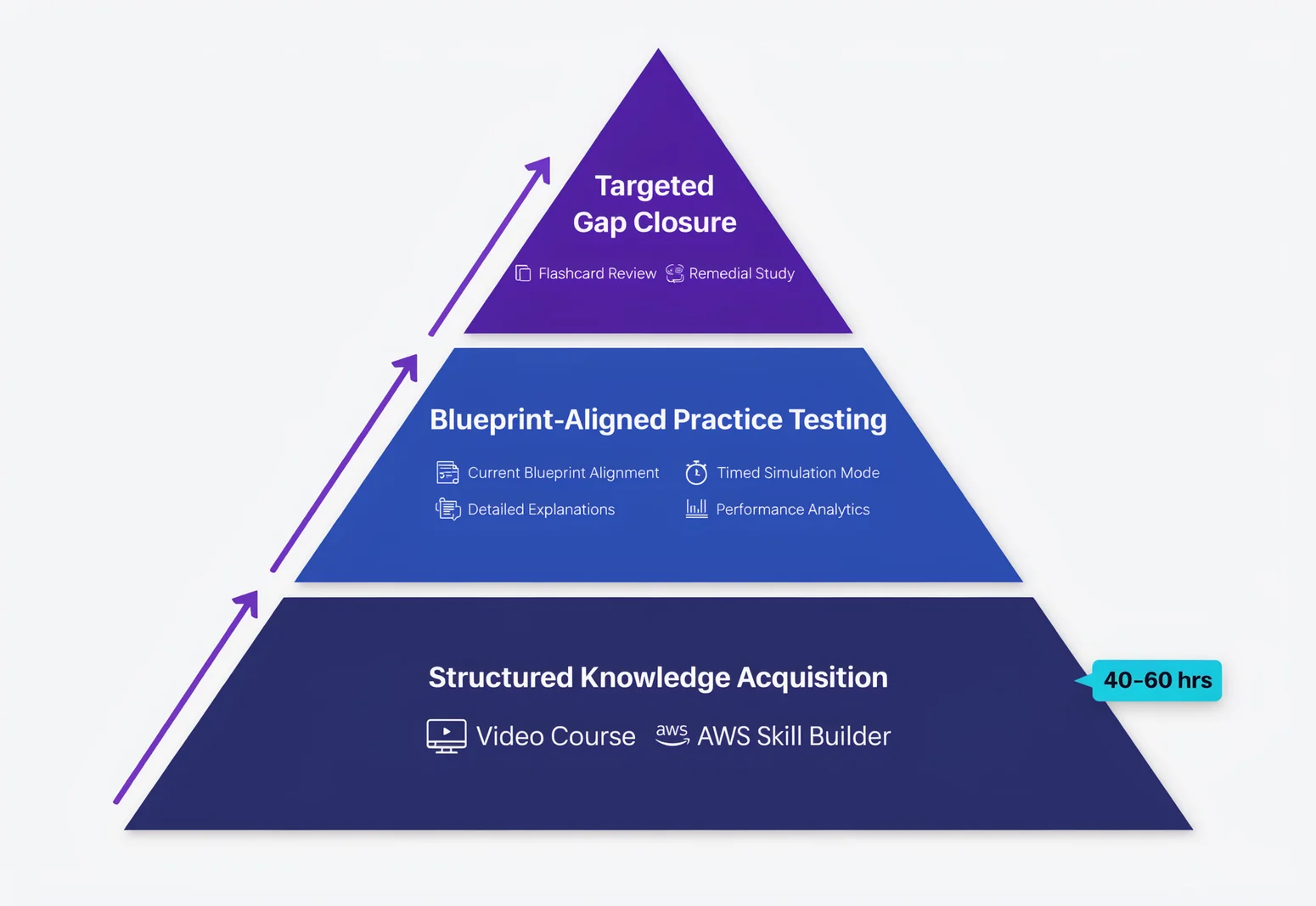
Layer one: structured knowledge acquisition. A comprehensive video course or the AWS Skill Builder official content establishes foundational understanding. This layer answers "what are the services and how do they interact?" Budget 40-60 hours depending on starting experience.
Layer two: blueprint-aligned practice testing. This is where exam readiness is actually built. Quality practice tests must meet four criteria: current SAA-C03 blueprint alignment, detailed explanations for every answer option, timed simulation mode, and performance analytics that identify weak domains. The SAA-C03 exam overview outlines the specific standards PlanetCert applies to its question development.
Layer three: targeted gap closure. Practice test results reveal specific domain weaknesses. Return to video segments, AWS documentation, or hands-on labs for those precise topics. This iterative cycle — test, diagnose, remediate, retest — is far more efficient than rewatching entire courses.
Candidates who complete only layer one enter the exam with theoretical knowledge and untested judgment. Candidates who add layer two but skip layer three repeat mistakes without understanding root causes. The full stack is non-negotiable for first-attempt confidence.
What to Look for in Supplementary Practice Materials
Not all practice tests are equivalent. The certification prep market includes outdated banks, memorization-focused dumps, and AI-generated questions with incorrect answers. Evaluate any practice resource against these standards:
- Blueprint currency: Questions should reference current SAA-C03 domains and recent service capabilities, not retired exam versions
- Explanation depth: Each answer option needs rationale, not merely the correct choice identified
- Scenario authenticity: Questions should present realistic business constraints, not abstract service descriptions
- Performance tracking: Progress metrics by domain enable efficient study prioritization
- Timed simulation: Practice under realistic pressure builds the cognitive stamina the exam requires
PlanetCert's approach centers on expert-verified questions with step-by-step reasoning, timed simulator sessions, and flashcards for rapid review of missed concepts. The platform's question development process explicitly excludes low-quality dump material, aligning with the broader industry push toward legitimate assessment preparation.
A Practical Study Timeline
For candidates with intermediate AWS familiarity, a realistic preparation path might look like this:
Weeks 1-2: Complete a comprehensive video course or equivalent structured learning, taking notes on architectural decision points rather than service facts alone.
Weeks 2-3: Begin practice testing with untimed, domain-focused sessions. Review every explanation thoroughly, even for correct answers. Build a personal error log tracking misconception patterns.
Week 3: Transition to full timed simulations. Analyze results for speed bottlenecks and persistent weak domains. Target remedial study precisely.
Week 4: Alternate timed simulations with rapid flashcard review of missed concepts. Schedule the real exam only when consistent scores exceed the passing threshold with margin for exam-day variation.
The SAA-C03 study plan builder provides a customizable framework for adapting this timeline to individual schedules and starting points.
When Udemy Alone Is Sufficient
Some candidates do pass using only Udemy resources. These cases typically share characteristics: substantial prior AWS experience, strong performance on the included practice exam, and disciplined self-assessment. For a cloud engineer already designing production architectures, video courses may serve primarily as blueprint orientation and gap identification rather than foundational learning.
The risk is overestimating whether you fit this profile. AWS experience does not automatically translate to exam success. The SAA-C03 tests AWS's preferred approaches, which sometimes differ from patterns developed in specific organizational contexts. Practice testing remains the only reliable validation mechanism.
Evaluating Your Current Preparation
Before scheduling the SAA-C03, audit your readiness honestly:
- Can you explain why you would select Aurora Serverless v2 over provisioned Aurora for a specific workload, considering both performance and cost?
- Do you know the current encryption options for EBS, S3, and RDS, and when each is mandatory versus optional?
- Can you calculate the cost difference between 1-year and 3-year Savings Plans for a predictable compute workload?
- Have you completed at least two full timed practice exams under realistic conditions?
- Can you identify the single best answer when multiple options appear technically valid?
Uncomfortable answers to any of these suggest preparation gaps that video courses alone will not close.
Questions Candidates Ask About Udemy and SAA-C03
Do Udemy certificates of completion help with job applications?
Employers value the AWS certification itself, not course completion documentation. The certificate proves you watched videos; the credential proves you passed AWS's assessment. Prioritize exam readiness over completion metrics.
How do I know if my Udemy course is current enough?
Check the last update date in the course description. Verify against recent AWS announcements, particularly service launches and Well-Architected Framework updates. Cross-reference the course outline with the official exam guide's task statements.
Is one comprehensive course better than multiple shorter ones?
Generally yes, for foundational knowledge. A single coherent narrative builds understanding more effectively than fragmented coverage. Supplement with focused resources for weak domains rather than duplicating core content.
Why do I need practice tests if the course includes one?
A single practice test provides a snapshot, not preparation. Building exam skill requires repeated exposure to varied question styles, error analysis, and timed pressure adaptation. Think of it as the difference between watching a sport and training for it.
From Course Completion to Exam Readiness
The search for aws certified solutions architect associate udemy reflects a reasonable instinct: find structured, affordable preparation. Udemy courses fulfill an important role in the certification journey. They are not, by themselves, complete preparation for the SAA-C03's demands.
The exam tests architectural judgment under constraints. Developing that judgment requires not just knowledge acquisition but knowledge application under pressure. Video courses build the first; practice tests build the second. Candidates who integrate both — using courses for foundation and verified practice materials for performance development — position themselves for first-attempt success.
The certification landscape in 2026 continues to evolve. AWS's September 2026 announcements of professional-level exam updates suggest ongoing refinement of their assessment approach. Associate-level candidates should expect the SAA-C03 to maintain its emphasis on scenario-based decision-making rather than shifting toward simpler factual recall.
Your preparation strategy should match the exam you're actually taking, not the one you wish existed. Map your resources to the blueprint. Test your readiness with realistic simulation. Close gaps with targeted study. The path through SAA-C03 is straightforward, but it requires more than passive video consumption to complete successfully.


Discussion
Question Comments
0 comments·0 participantsSign in to leave a comment and access more free questions.