

AWS Certified: Build Your SAA-C03 Study Plan in One Evening
A structured evening of planning eliminates three weeks of scattered studying by mapping domain priorities, time blocks, and validation checkpoints before you open a single training video.
Most candidates fail the AWS Certified Solutions Architect—Associate (SAA-C03) not because they lack technical skill, but because they treat exam prep as a passive consumption activity rather than a targeted performance regimen. An aws certified study plan built in one evening transforms vague intention into executable discipline, aligning your limited hours with the exam's actual domain weighting and your personal knowledge gaps.
Table of Contents
- Topic Map
- Core Concepts
- How It Works
- Main Layers
- Maturity Path
- Real-World Scenarios
- Common Mistakes
- What to Read Next
Topic Map
This guide treats exam preparation as a systems design problem: given fixed time and variable knowledge, how do you architect a study approach that maximizes pass probability? The six interconnected components are domain deconstruction, resource curation, schedule architecture, active validation, weakness targeting, and exam-day simulation. Each layer builds on the previous one. Domain deconstruction tells you what to study. Resource curation determines how you learn it. Schedule architecture forces realistic time allocation. Active validation prevents false confidence. Weakness targeting reallocates effort dynamically. Exam-day simulation builds psychological readiness. Together they form a closed feedback loop that replaces hope with measurable progress.
What Is an AWS Certified Study Plan?
An AWS certified study plan is a time-bound, domain-aligned preparation system for the SAA-C03 exam. The SAA-C03, released in August 2022 and still current as of early 2026, tests your ability to design resilient, high-performing, secure, and cost-optimized architectures on AWS. The AWS Certification Exam guide specifies four domains: Design Resilient Architectures (26%), Design High-Performing Architectures (24%), Design Secure Applications and Architectures (30%), and Design Cost-Optimized Architectures (20%). A proper study plan does not merely list topics to cover; it sequences them by weight and personal proficiency, assigns specific validation checkpoints, and reserves buffer time for remediation.
The SAA-C03 replaced the SAA-C02 with deeper emphasis on serverless, containerization, and multi-account strategies. Candidates who treated the older exam as a memorization exercise found themselves unprepared for scenario-driven questions requiring trade-off analysis. Modern preparation demands active application, not passive video watching.
Core Concepts
Domain Weighting as Priority Function. Not all exam content deserves equal time. Secure Applications at 30% demands proportionally more attention than Cost-Optimized at 20%, yet many candidates distribute hours evenly across domains. Your plan must weight study time by exam percentage, adjusted for personal weakness.
Spaced Repetition Over Cramming. The SAA-C03 covers over 200 distinct services, patterns, and constraints. Cognitive science demonstrates that distributed practice with retrieval testing outperforms massed study by 40-50% for complex material. Your schedule should revisit topics at expanding intervals, not in single blocks.
Active Recall Through Practice Questions. Passively recognizing correct answers differs fundamentally from generating them under pressure. The exam presents 65 questions in 130 minutes, many with lengthy scenario setups. Your preparation must simulate this cognitive load, not just test factual knowledge.
Weakness-Based Reallocation. Fixed schedules fail because they assume uniform progress. A living study plan tracks performance data—practice test scores by domain, question-type error rates, time-per-question trends—and shifts remaining hours toward lagging areas.
Exam Simulation as Skill Transfer. The physical and temporal conditions of test day create unique stress. Practicing under identical constraints—timed sessions, no external resources, identical break policies—builds procedural memory that reduces anxiety-induced errors.
How It Works
The mechanism behind an effective AWS certified study plan resembles load balancing: distribute cognitive effort across domains according to capacity constraints, monitor performance metrics, and reroute traffic when bottlenecks appear. Per Before Testing policies, AWS recommends hands-on experience covering all exam objectives, though no formal prerequisites exist. The JTA (job task analysis) behind each exam samples knowledge across domains rather than testing exhaustive depth, meaning strategic breadth with targeted depth often outperforms encyclopedic memorization.
The workflow proceeds through five phases executed over a typical 3-4 week preparation window. Evening one establishes the architecture: you audit your current knowledge against domain objectives, select primary and secondary resources, block calendar time, and set validation milestones. Week one emphasizes foundational coverage with daily practice question sets. Week two deepens weak domains while maintaining strength areas through spaced review. Week three intensifies simulation—full-length timed exams under exam conditions—with detailed error analysis driving final remediation. The final days before testing focus on pattern recognition and confidence building rather than new material acquisition.
Each phase generates data. Practice test platforms track domain-level accuracy, flagging whether your 85% overall score masks a 60% weakness in secure networking. This telemetry transforms subjective anxiety into objective prioritization.
Main Layer 1: Domain Deconstruction and Self-Assessment
The SAA-C03's four domains subdivide into specific capabilities that map directly to AWS services and architectural patterns. Design Resilient Architectures requires mastery of multi-AZ and multi-region strategies, auto-scaling behaviors, disaster recovery patterns (pilot light, warm standby, hot standby), and backup automation. Design High-Performing Architectures demands understanding of caching hierarchies (CloudFront, ElastiCache), storage tiering (S3 Intelligent-Tiering, EBS volume types), database selection (RDS vs. DynamoDB vs. ElastiCache), and compute optimization (EC2 instance families, Lambda concurrency).
Design Secure Applications and Architectures, the heaviest domain, encompasses IAM policy construction, VPC security (subnets, NACLs, security groups, AWS Network Firewall), encryption at rest and in transit, Secrets Manager rotation, and compliance frameworks. Design Cost-Optimized Architectures tests rightsizing, Reserved Instances and Savings Plans, spot instance strategies, storage lifecycle policies, and architectural simplification.
Your evening planning session begins with the aws certification exam guides.pdf, printing or annotating the detailed content outline. Rate each subtopic 1-4: 1 = unfamiliar, 2 = conceptually understood but not applied, 3 = hands-on experience, 4 = could teach it. This 15-minute audit reveals where your 80% of effort should concentrate.
Consider Maria, a systems administrator with three years of AWS operations experience. Her self-assessment showed 4s across EC2 and auto-scaling, 2s in serverless patterns and DynamoDB optimization, and 1s in Direct Connect and hybrid networking. Rather than reviewing familiar compute material, she allocated 60% of her study hours to serverless and networking, 25% to security domain depth, and 15% to cost optimization edge cases. Her diagnostic precision prevented the common trap of comfortable but inefficient studying.
Main Layer 2-4: Resource Curation, Schedule Architecture, and Active Validation
Resource Curation. The AWS ecosystem offers overwhelming preparation material: official digital training, classroom courses, whitepapers, re:Invent videos, hands-on labs, and third-party practice tests. Your plan selects one primary resource per learning mode—visual, interactive, and evaluative—and explicitly excludes alternatives to prevent resource-hopping procrastination.
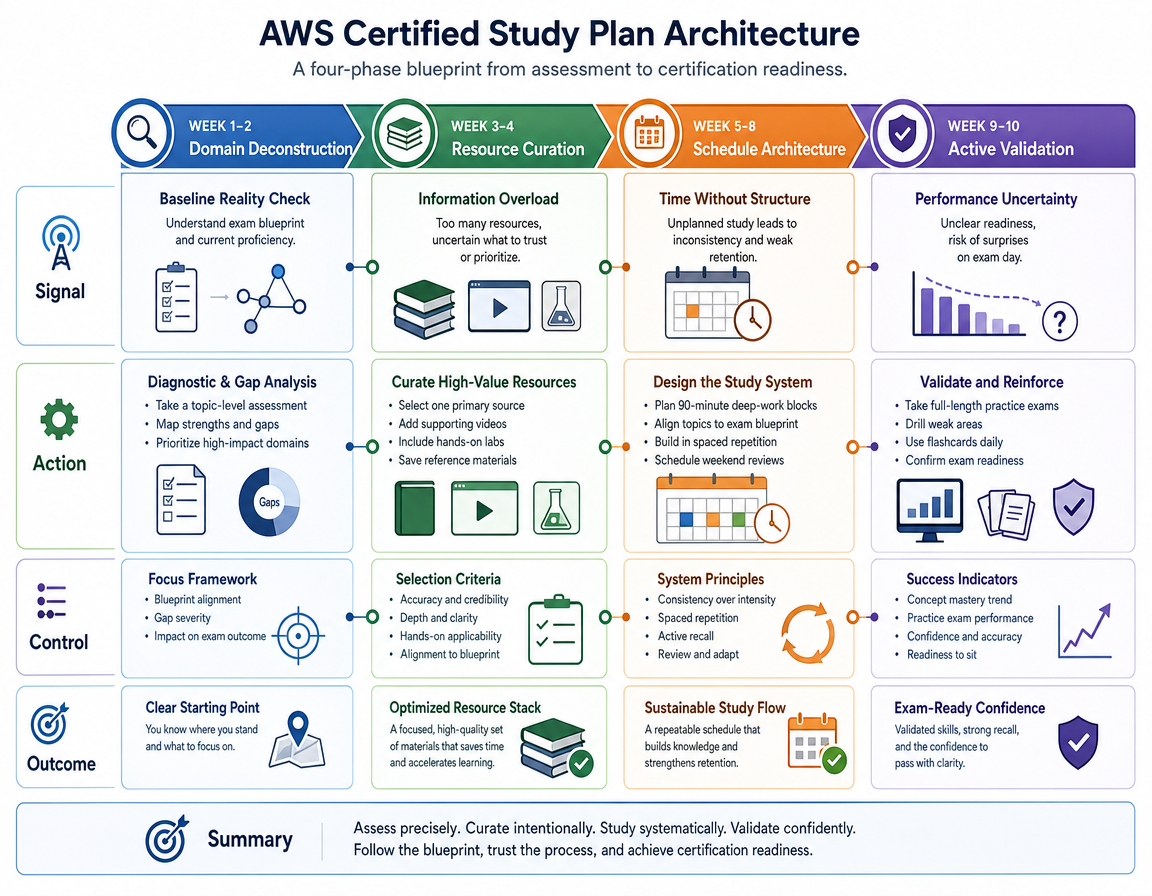
For conceptual foundation, the official exam readiness course or a structured video course provides systematic coverage. For hands-on application, AWS Free Tier experiments or sandbox environments cement abstract knowledge. For evaluation, a quality practice test platform with detailed explanations transforms mistakes into learning events. The study planning guide for tech certification exams offers frameworks for resource selection across vendor ecosystems.
Schedule Architecture. Convert your available hours into protected calendar blocks. A candidate studying 90 minutes daily for four weeks has 42 hours; one with 45 minutes daily has 21. Both can succeed with different depth expectations. The critical discipline is consistency—missed sessions compound faster than extra sessions compensate.
Structure each week with thematic focus: Week 1 covers Resilient and High-Performing architectures; Week 2, Secure Applications; Week 3, Cost Optimization and integration; Week 4, simulation and remediation. Within each week, alternate deep-dive days (new material) with retrieval days (practice questions on prior topics). Reserve one weekend day for extended simulation.
Active Validation. Weekly checkpoint exams—shorter than full tests but domain-specific—prevent the illusion of competence. Score below 75% on any domain, and that domain receives additional blocks before progression. Track not just correct answers but reasoning quality: can you articulate why distractors are wrong? This metacognitive practice builds the analytical speed the exam demands.
Maturity Path
Beginner: Foundation Building. You have limited AWS experience or are new to certification exams. Your plan emphasizes conceptual vocabulary, service categorization, and basic console navigation. Practice questions focus on definition-level recognition. Target: 70% on domain-specific quizzes before advancing.
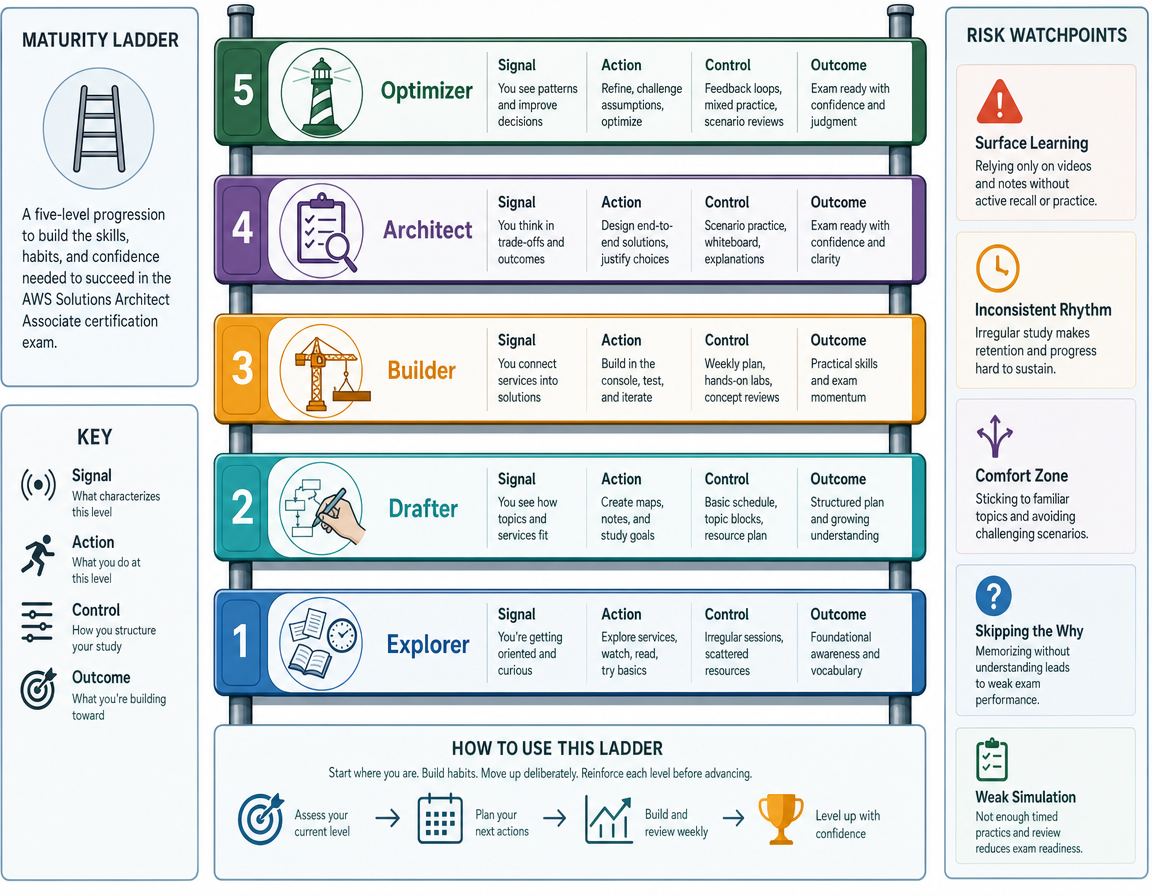
Intermediate: Integration and Application. You have some AWS experience or prior certifications. Your plan stresses cross-service architectures, trade-off analysis, and scenario decomposition. Practice questions feature multi-step reasoning. Target: 80% on mixed-domain quizzes with consistent timing under two minutes per question.
Advanced: Optimization and Examination. You have substantial AWS experience or have attempted the exam previously. Your plan targets edge cases, recent service launches, and examination psychology. Full simulations under strict conditions dominate. Target: 85%+ on consecutive full-length exams with stable performance across all domains.
Progression between stages is data-driven, not calendar-driven. A beginner with strong study discipline may compress timelines; an advanced candidate with exam anxiety may need additional simulation exposure.
Real-World Scenarios
The Career Switcher. James, a network engineer transitioning to cloud roles, had strong VPC and connectivity knowledge but weak serverless experience. His self-assessment revealed a 1-rating on Lambda event sources, API Gateway caching, and Step Functions orchestration. Rather than distributing time evenly, he front-loaded serverless study in week one, built a personal project processing S3 events through Lambda, and validated with practice questions nightly. By week three, his serverless domain scores matched his networking scores. He passed SAA-C03 on his first attempt with a score of 836.
The Retake Candidate. Priya failed her first SAA-C03 attempt with a 712, just below the 720 threshold. Her score report showed strong Resilient Architectures (90%) but weak Cost Optimization (55%) and borderline Security (68%). Her second plan eliminated all Resilient Architecture review, focusing 70% of hours on cost scenarios—Reserved Instance mathematics, S3 storage class transitions, spot fleet allocation—and intensive security policy analysis. She added weekly full simulations to build pacing confidence. Her second attempt scored 864.
The Time-Constrained Professional. David, a senior architect with fifteen years of infrastructure experience, had two weeks before a job requirement deadline. With limited hours, his plan prioritized the 30% Security domain and high-impact quick wins in Cost Optimization, accepting that his existing Resilient and High-Performing knowledge would carry him. He used flashcard sessions during commutes and lunch breaks, reserving evenings for practice tests. His targeted approach yielded a 792 pass with approximately 25 total study hours.
Common Mistakes to Avoid
Mistake 1: Treating Video Completion as Progress. Watching training videos produces satisfying progress bars but minimal retention. Research on learning transfer shows passive consumption achieves 5-10% retention versus 75% for active practice. Your plan must mandate question attempts, hands-on labs, or teaching explanations after every video segment.
Mistake 2: Ignoring Exam Format Familiarity. The SAA-C03 presents multiple-choice and multiple-response questions with lengthy scenario descriptions. Candidates who study content without practicing format waste precious minutes deciphering question structures during the actual exam. Weekly simulation builds automaticity in parsing and strategizing.
Mistake 3: Neglecting Weak Domains. Confirmation bias drives us toward comfortable material. A plan that does not explicitly weight weak domains will drift toward strength areas. Build domain-specific minimum scores into your validation checkpoints.
Mistake 4: Cramming in Final Days. The SAA-C03 rewards pattern recognition and architectural judgment developed over weeks, not last-minute memorization. Final days should emphasize sleep, light review, and confidence-building simulation, not new content exposure.
Mistake 5: Underestimating Hands-On Requirements. AWS explicitly recommends hands-on experience per Before Testing guidance. Console practice transforms abstract service descriptions into operational intuition. Even simple Free Tier experiments—launching an EC2 instance, configuring an ALB, setting up S3 static hosting—cement concepts that pure reading cannot.
How PlanetCert Helps
PlanetCert's SAA-C03 practice test suite integrates directly with the study planning methodology described here. The platform's domain-tagged question banks enable precise weakness identification aligned with the official exam guide's four domains. Detailed explanations for every answer choice reinforce the reasoning patterns the SAA-C03 tests, not just factual recall. The timed simulator replicates exam pressure, while flashcards support spaced repetition during fragmented time. For candidates building their one-evening plan, the diagnostic exam provides the self-assessment data that drives all subsequent scheduling decisions.
Learn more at https://planetcert.com — browse the relevant exam page and purchase a practice test to anchor your preparation with validated, exam-style questions.
What to Read Next
Your SAA-C03 study plan is only as strong as the resources executing it. The articles below extend specific components of this guide into actionable depth.
If you need to understand how practice questions function as learning tools rather than mere assessment devices, read the analysis of real exam questions and certification success. This connects the validation layer of your plan to cognitive science principles.
For candidates comparing preparation platforms before committing resources, the best certification exam platforms comparison evaluates features against study plan requirements like domain tagging, explanation depth, and simulation fidelity.
Those building multi-certification roadmaps beyond SAA-C03 should consult the study planning guide for tech certification exams, which generalizes the evening planning process across vendor ecosystems and exam types.
Related Blog Posts

Discussion
Question Comments
0 comments·0 participantsSign in to leave a comment and access more free questions.