
Common AZ-104 Exam Mistakes That Cost Candidates the Pass
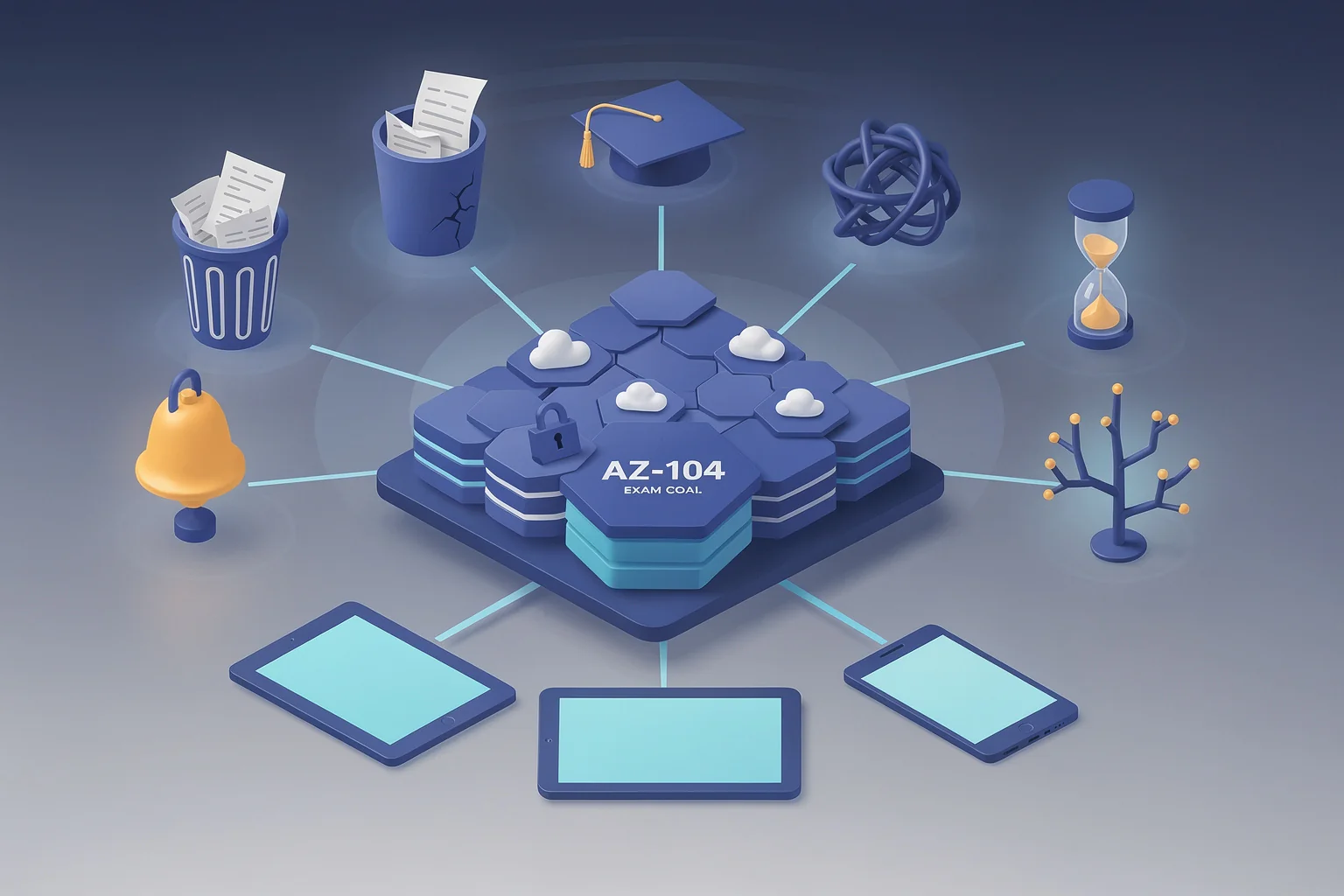
The AZ-104 Microsoft Azure Administrator exam sits at a frustrating intersection. It is broad enough to cover identity, storage, compute, networking, and governance, yet deep enough to punish surface-level knowledge. Most candidates who fail do not fail because they skipped studying entirely. They fail because of how they prepared — predictable errors in study planning, hands-on practice, and scenario interpretation that turn achievable questions into wrong answers.
If you are searching for the top 7 mistakes to avoid when preparing for the AZ-104 exam, you are already ahead of the candidates who walk in cold. The following patterns show up repeatedly in score reports, community forums, and post-exam retrospectives. Each one maps to a concrete fix you can apply before your test date.
Treating AZ-104 Like a Memorisation Exam
Many candidates arrive from the AZ-900 fundamentals exam expecting a similar experience: learn the definitions, recognise the services, pass. The AZ-104 does not work this way. Microsoft designed this as a role-based assessment focused on practical administrative decisions under realistic constraints.
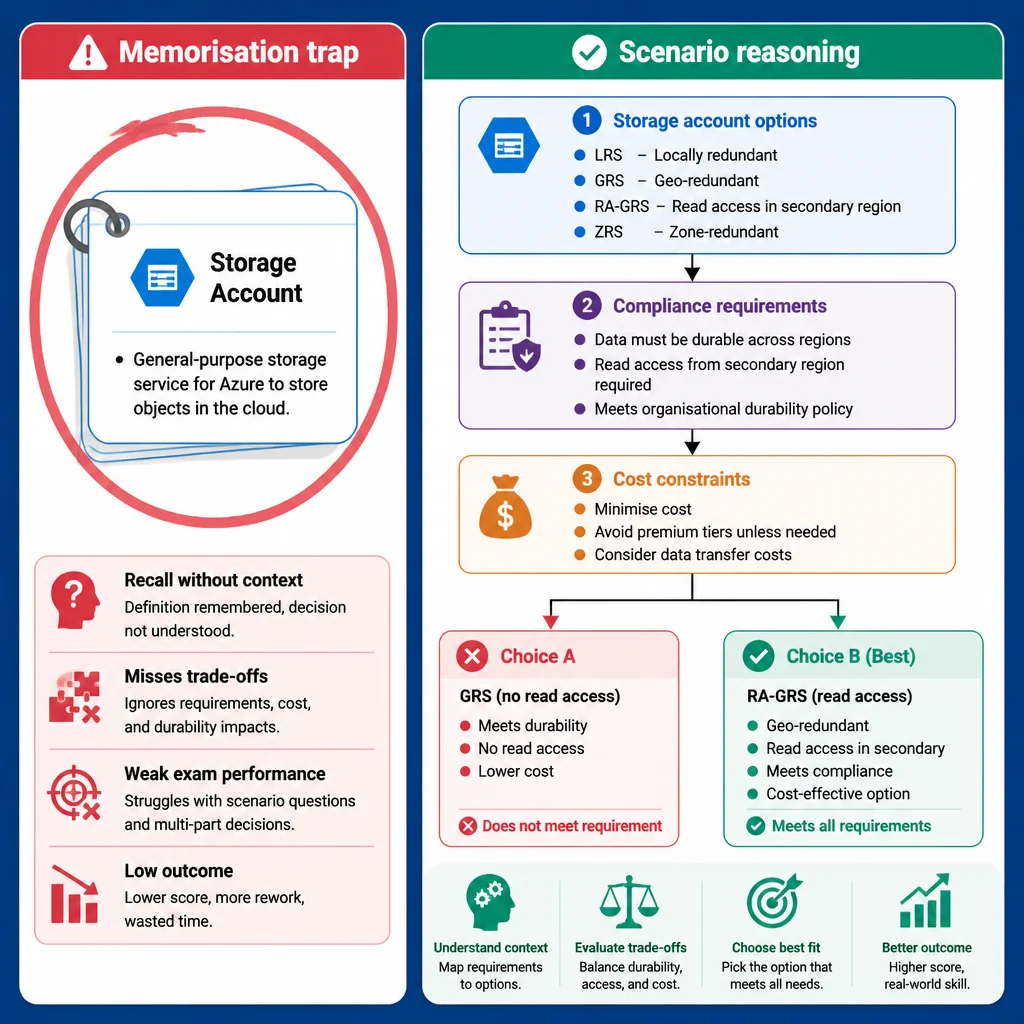
The exam rarely asks "What PowerShell cmdlet creates a storage account?" Instead, it presents a scenario: your company runs three environments with different compliance requirements, Storage Account A needs geo-redundant storage with read access from a secondary region, and you must choose the configuration that meets the requirement while minimising cost. You cannot memorise your way through that. You need to understand when to use geo-redundant storage versus locally redundant storage, when read access to the secondary region matters, and how pricing tiers interact with durability requirements.
The fix is straightforward but demands discipline. For every service you study, ask yourself three questions: What problem does this solve? What are the trade-offs between the available options? In what scenario would I choose one over the other? If you cannot answer all three, you have not studied deeply enough.
Skipping the Official Skills Measured Document
Microsoft publishes its skills measured outline for AZ-104, and it is not a marketing document. It lists every testable objective with explicit weightings. Yet a surprising number of candidates rely entirely on third-party courses or books without cross-referencing against the official source.
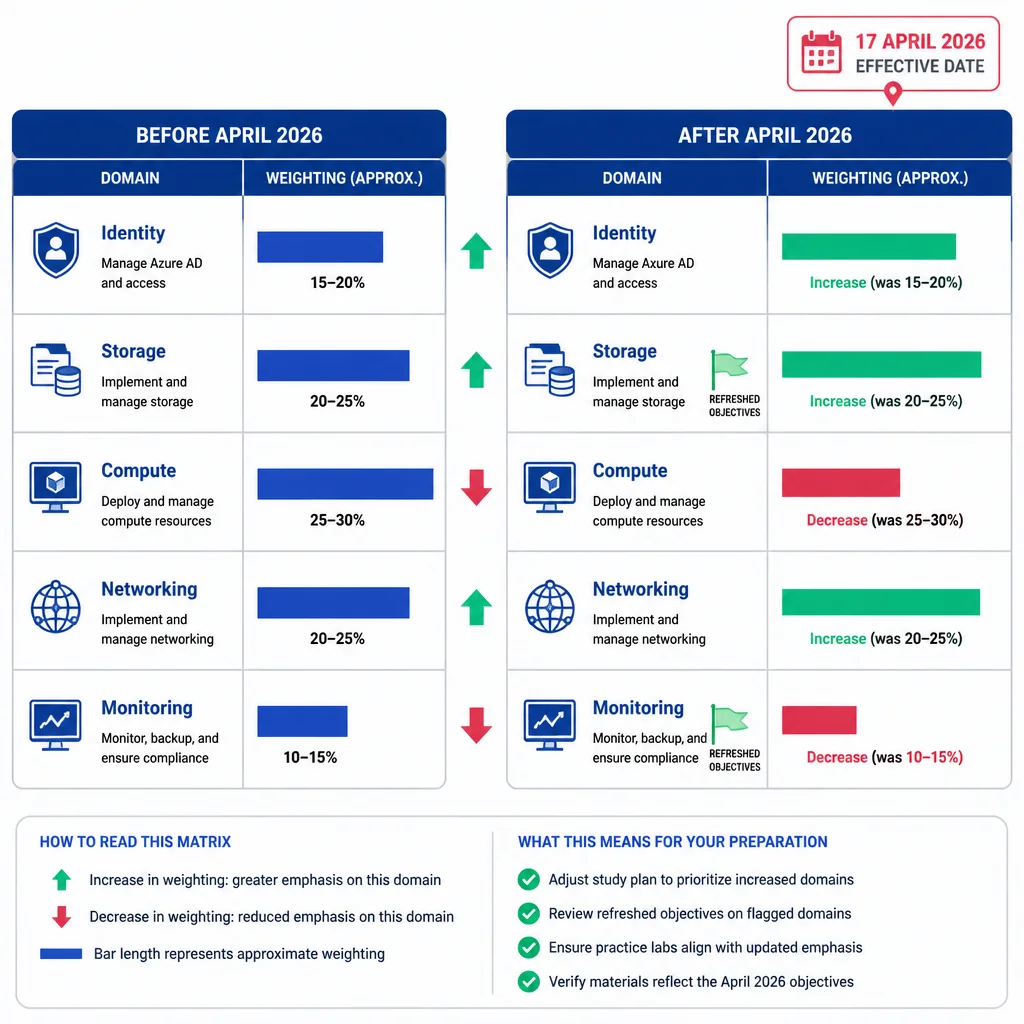
The April 2026 exam update shifted domain weightings, and every update catches people off guard. The breadth of AZ-104 — networking, identity, storage, compute, and monitoring — means that even a small shift in emphasis can leave you over-prepared in one area and exposed in another.
Before you schedule, download the current skills measured document from Microsoft guidance and use it as your study checklist. Mark each objective as not started, in progress, or confident. Do not book the exam until every item reaches confident. This sounds excessive, but the document exists precisely because candidates underestimate the scope.
Neglecting Hands-On Lab Practice
Reading about Azure and using Azure are different skills. The AZ-104 tests administrative actions: creating virtual networks, configuring NSG rules, deploying VMs with specific extensions, setting up backup policies, and troubleshooting connectivity. You can read about these for weeks and still freeze when the exam presents a scenario requiring a specific sequence of portal clicks or CLI commands.
The most common excuse is cost. A personal Azure subscription can accumulate charges quickly, especially with VMs running overnight. This is a solvable problem. Use the Azure free tier for eligible services, set spending limits and alerts on your subscription, and tear down resources immediately after each lab session. Microsoft Learn also provides sandbox environments for many modules, though these have time limits that force you to work efficiently — itself good practice for exam conditions.
Schedule dedicated lab time at least twice weekly. Do not follow tutorials passively. Instead, set yourself a task — deploy a three-tier application with a web tier, application tier, and database tier, then configure network security so only the web tier is publicly accessible — and work through it without step-by-step help. The struggle is where learning happens.
Relying on Outdated Study Materials
Azure changes constantly. New services enter general availability, existing ones gain features, and portal interfaces evolve. A course recorded eighteen months ago may still teach valid concepts, but it will miss critical updates that appear on the current exam.
The April 2026 AZ-104 update is a concrete example. Microsoft adjusted domain weightings and refreshed several objectives to reflect current Azure capabilities. Candidates using pre-update materials studied for a slightly different exam without knowing it.
Verify the publication or last-updated date on every resource you use. Prioritise materials from Microsoft Learn, which updates in sync with product changes. For third-party content, check whether the provider issues update notes or version tracking. If a course does not mention the current exam version explicitly, treat it with suspicion.
Cramming Instead of Spacing Your Study
The AZ-104 covers too much ground for effective cramming. Candidates who compress their preparation into one or two weeks before the exam typically retain surface knowledge that evaporates under test pressure. The exam's scenario-based questions require working memory of details — which NSG rule takes precedence, which backup retention policy applies — that do not stick from rushed review.
Research on learning consistently shows that spaced repetition outperforms massed practice. Study for ninety minutes daily over four weeks rather than six hours daily for one week. The distributed approach lets you sleep on new material, which consolidates memory, and gives you time to identify weak areas that need revisiting.
Build your schedule backwards from your target exam date. Allocate one week per major domain, with buffer time for review and practice tests. If you cannot fit this timeline, postpone the exam. The retake fee is $165, and the 24-hour waiting period between attempts does not help if your preparation method is unchanged.
Taking Too Few Realistic Practice Tests
Practice tests serve two purposes: they identify knowledge gaps, and they build exam stamina. Many candidates take one or two practice exams, review the correct answers, and assume they are ready. This misses half the value.
The AZ-104 exam runs approximately 120 minutes with 40-60 questions. Some questions are complex scenarios with multiple correct options where you must select all that apply. Others present case studies with multiple sub-questions referencing a shared environment diagram. The cognitive load is substantial, and time pressure compounds it.
You need timed practice sessions that replicate these conditions. An AZ-104 practice test in a simulator environment helps you calibrate your pace and exposes you to the question formats Microsoft actually uses. Review every incorrect answer in detail, but also review correct answers where you guessed or felt uncertain. The goal is not a high practice score; it is thorough understanding of every question you encounter.
Plan at least four full-length timed simulations before your exam, with your final one at least three days before test day. This spacing gives you time to close any remaining gaps without last-minute panic.
Misreading Scenario Questions Under Pressure
Even well-prepared candidates lose points to misreading. AZ-104 scenarios often contain subtle constraints — budget limitations, existing infrastructure that cannot change, compliance requirements that eliminate certain options — that determine the correct answer. Under time pressure, it is easy to lock onto a familiar keyword and select the option that looks right without verifying it fits all constraints.
One common pattern: a question asks you to minimise cost while meeting a performance requirement. Two options satisfy the performance requirement, but only one is cheaper. Candidates who recognise the service but miss the cost constraint choose the expensive option and lose the point.
Develop a systematic reading habit. For each scenario question, identify explicitly: what is the current state, what is the desired outcome, what constraints apply, and what is the evaluation criteria (cost, performance, security, availability). Only then evaluate the options. This takes seconds but prevents expensive misreads.
During practice tests, note every question you missed due to misreading rather than knowledge gaps. If this number is high, you have a test-taking problem, not a content problem. Slow down and verify your reading discipline before the real exam.
What the April 2026 Update Means for Your Preparation
Microsoft confirmed the AZ-104 exam update effective 17 April 2026. While the core domains remain stable, weightings shifted and several objectives were refreshed to reflect current Azure capabilities. If you are mid-study, verify whether your materials cover the updated objectives.
The update reinforces a broader trend in IT certification: exams increasingly test practical application over memorisation. As one industry observer noted, hiring based on demonstrable skills is sparking a shift with vendors reworking testing environments to better reflect the modern world. Microsoft has followed this direction for several years, and AZ-104 exemplifies it.
Check the Microsoft guidance for the current skills measured document, and cross-reference your study plan against it. If you prepared under the previous version, focus your review on the changed weightings to ensure you are not caught off guard.
Building a Study Plan That Actually Works
A workable AZ-104 study plan balances depth, breadth, and practice. Here is one approach that addresses the mistakes above:
Start with the skills measured document. Mark every objective and estimate your current confidence. Spend your first two weeks on weak domains, combining Microsoft Learn modules with hands-on labs. Weeks three and four add spaced review and practice tests, with lab time maintained for complex objectives like networking and identity.
Schedule your first full practice test at the halfway point. Use the results to redirect remaining study time. Your final week should emphasise timed simulation and review of persistent weak areas, not new material. The night before the exam, review your summary notes and sleep. Cramming at this stage creates anxiety without adding retention.
If you are unsure where to start with practice materials, an online practice test warm-up can help you establish a baseline and build early momentum without overwhelming your schedule.
Questions Candidates Still Ask
How long should I prepare for AZ-104?
Most successful candidates report 4-8 weeks of dedicated study, assuming some prior Azure exposure. Complete beginners may need 10-12 weeks. The key variable is not total hours but distribution — daily study with hands-on practice outperforms compressed cramming.
Is AZ-104 harder than AZ-900?
Yes, noticeably so. AZ-900 tests recognition and basic concepts. AZ-104 tests application and decision-making under constraints. Many candidates who found AZ-900 straightforward are surprised by AZ-104's depth.
Can I pass AZ-104 without Azure work experience?
Yes, but it requires compensatory lab practice. Build and break environments in a personal subscription until administrative actions feel automatic. The exam assumes familiarity that only repetition provides.
What score do I need to pass?
Microsoft uses scaled scoring from 1-1000, with 700 as the passing threshold. Because scoring is scaled, 700 does not equal 70% of questions correct. Difficulty is normalised across question pools, so focus on thorough preparation rather than percentage targets.
How do I avoid running out of time?
Practice under timed conditions until you finish with 10-15 minutes remaining. If you consistently run long, identify whether the problem is reading speed, calculation time, or indecision between options. Each requires a different fix.
From Mistake Patterns to Passing Scores
The candidates who fail AZ-104 rarely lack intelligence or effort. They lack precision in their preparation. They study the wrong depth, use outdated materials, skip hands-on practice, or misread questions they could have answered correctly. Each of these errors is preventable with deliberate habits.
The exam itself is fair. It tests what an Azure Administrator actually needs to know. Your task is to align your study method with that reality: scenario-based thinking, current objectives, repeated hands-on practice, and calibrated exam simulation. Get these right, and the pass becomes a natural outcome rather than a gamble.
References
- Why Do People Fail AZ — here’s ... brutal truth I’ve learned from coaching hundreds of ... -104 ... ’t about being unlucky or unprepared. They’re about making specific ... I’m going to show you the seven
More AZ-104 Resources Worth Your Time

Discussion
Question Comments
0 comments·0 participantsSign in to leave a comment and access more free questions.