

How to Prepare for the AWS Solutions Architect Professional Exam
Most candidates who fail the SAP-C02 exam don't lack AWS experience—they lack a structured preparation plan that matches the exam's actual demands. The AWS Certified Solutions Architect - Professional certification validates advanced skills in designing complex, optimized solutions across the AWS Well-Architected Framework. This guide gives you a concrete 8-12 week path from initial assessment through exam day, with specific resources, time allocations, and validation checks at each stage.
Know What the Exam Actually Tests
Before opening a study guide, understand the four domains and their weights. The AWS Certified Solutions Architect exam breaks down as follows:
- Design Solutions for Organizational Complexity (26%): Multi-account strategies, hybrid connectivity, security controls across large environments
- Design for New Solutions (29%): Greenfield architecture, cost optimization, serverless and container strategies
- Continuous Improvement for Existing Solutions (25%): Migration, modernization, performance tuning of running workloads
- Accelerate Workload Migration and Modernization (20%): Large-scale migration planning, cutover strategies, operational readiness
Notice the emphasis: this is not a services trivia test. Roughly 55% of scored content involves designing or improving solutions in complex organizational contexts. You need to reason through trade-offs, not recite feature lists.
The exam allows 180 minutes for 75 questions, a mix of multiple-choice and multiple-response. There are no labs. The pass/fail threshold is set by AWS certification professionals and not disclosed publicly.
Confirm You Have the Right Foundation
AWS recommends two years of hands-on experience before attempting this exam. More specifically, you should already be comfortable with:
- VPC design including peering, Transit Gateway, and hybrid DNS
- IAM policies, cross-account roles, and SCPs
- Auto Scaling, load balancing, and multi-AZ deployments
- S3 storage classes, lifecycle policies, and replication
- RDS, DynamoDB, and when to choose each
If those topics feel unfamiliar, start with the Solutions Architect - Associate (SAA-C03) instead. The Professional exam assumes this knowledge and builds complexity on top of it. Candidates who skip the Associate level often struggle with the pace and depth of scenario-based questions.
Consider Marcus, a systems administrator with three years of on-premises VMware experience who jumped straight to SAP-C02 after a brief AWS console tutorial. He recognized individual services in questions but couldn't trace how VPC flow logs, IAM conditions, and S3 bucket policies interacted in a multi-account security audit scenario. After failing with a score below 700, he completed SAA-C03, returned six months later, and passed comfortably. The Associate credential filled the gap between theoretical knowledge and integrated architectural thinking.
Build Your Study Resource Stack
Quality matters more than quantity. Select 2-3 primary resources and use them deeply rather than sampling ten sources superficially.
Official AWS documentation and whitepapers
The SAP-02 In-Scope Services page lists every service category that may appear. Review this monthly during your study period, as AWS updates it. The Technologies and Concepts page covers the architectural patterns you must understand: disaster recovery strategies, high availability design, microservices decoupling, and serverless principles.
Critical whitepapers to read fully:
- AWS Well-Architected Framework (all six pillars)
- AWS Security Pillar whitepaper
- AWS Reliability Pillar whitepaper
- AWS Cost Optimization Pillar whitepaper
- Multi-Account Strategy and AWS Control Tower
Structured training (optional but helpful)
AWS Skill Builder offers official exam prep courses. Third-party platforms like A Cloud Guru and Linux Academy provide structured video paths. Choose based on your learning style—videos help some candidates absorb patterns faster, while others prefer reading and lab work.
Hands-on practice
Build at least three multi-service architectures in your own AWS account:
- A three-tier web application with auto-scaling, RDS Multi-AZ, and CloudFront
- A hybrid connectivity scenario with Site-to-Site VPN and Direct Connect failover
- A serverless event-driven pipeline using API Gateway, Lambda, SQS, and DynamoDB
These labs cement the service interactions that exam scenarios assume you know. When you build the three-tier application, deliberately break it: fail an AZ and observe how Route 53 health checks and Auto Scaling respond. Misconfigure an IAM policy and read the CloudTrail logs. These failures teach more than successful deployments because the exam tests your ability to identify and prevent problems, not just implement features.
Practice tests with detailed explanations
This is where most candidates separate pass from fail. The SAP-C02 requires reasoning through nuanced scenarios, and textbook knowledge alone won't train that skill. PlanetCert's SAP-C01 practice questions include detailed explanations that map wrong answers back to specific architectural principles—critical for understanding why an option fails, not just which option passes.
Follow an 8-12 Week Study Timeline
Weeks 1-2: Assessment and gap closure
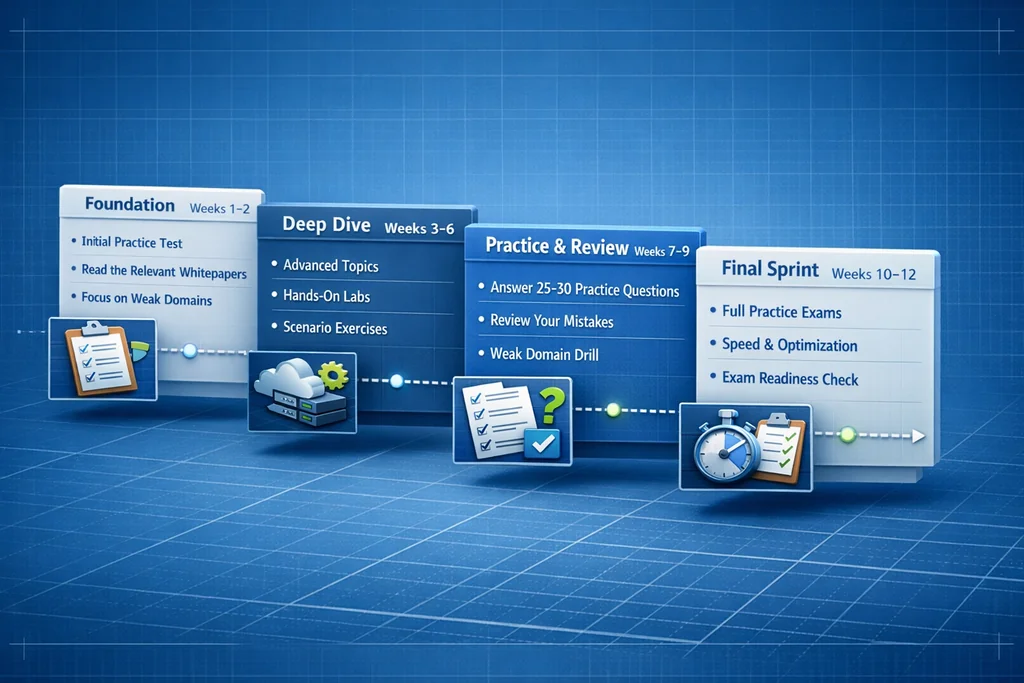
Take a diagnostic practice test cold. Score it by domain, not just overall. Identify your weakest two domains and spend these weeks on foundational review for those areas. Do not take another full practice test yet.
Be specific in your gap analysis. "Weak in networking" is too vague. "Confused about when to use Transit Gateway vs. VPC peering vs. PrivateLink in multi-account scenarios" gives you an actionable target. Document five to seven specific knowledge gaps, then map each to a whitepaper section or documentation page.
Weeks 3-5: Deep domain study
Spend one week per domain, in weight order: New Solutions, Organizational Complexity, Continuous Improvement, Migration/Modernization. For each domain:
- Read the relevant AWS whitepapers
- Build or extend a hands-on lab that exercises those patterns
- Answer 25-30 practice questions focused on that domain
- Document your mistakes in a structured log: what you chose, why, what the correct answer requires
For the New Solutions domain, pay special attention to cost optimization patterns. The exam frequently presents scenarios where multiple architectures technically satisfy requirements, but only one meets budget constraints. Practice calculating Reserved Instance savings, Spot Instance trade-offs, and S3 Intelligent-Tiering lifecycle costs quickly.
Weeks 6-8: Integration and scenario practice
Shift from isolated domain study to mixed-scenario practice. Full practice tests become your primary tool. Take one every 4-5 days under timed conditions. Review every question you miss or guess on, including those you got right for wrong reasons.
Aim for consistent scores above 80% before scheduling your exam. The real exam's scenario complexity often feels harder than practice tests, so build a buffer.
During this phase, simulate exam conditions precisely. Use the same time limit, take breaks only at the halfway point, and avoid reference materials. If you work from home, schedule practice tests during your actual exam slot to align your circadian rhythm.
Weeks 9-10: Weak area targeting
Return to your mistake log. Identify the top three error patterns—maybe you confuse Direct Connect gateway types, or you default to multi-AZ when multi-region is required. Target these with focused question sets and whitepaper re-reads.
Create mini-scenarios for your error patterns. If you consistently miss disaster recovery questions, write three original scenarios: one requiring RPO under 1 hour, one requiring RTO under 15 minutes, one with regulatory constraints preventing cross-region replication. Design architectures for each, then compare against AWS documentation.
Weeks 11-12: Exam simulation and scheduling
Take two final full-length practice tests in the final week. If both scores stay above 80%, schedule your exam within 7 days while the patterns are fresh. If scores drop, extend by one week and return to weak-area targeting.
The scheduling decision carries psychological weight. Some candidates freeze here, endlessly retaking practice tests seeking certainty. Recognize that 80% on quality practice tests indicates readiness; chasing 95% wastes time and erodes confidence.
Use Practice Tests as Diagnostic Tools, Not Just Scores
Many candidates treat practice tests as progress meters. Use them as learning instruments instead.
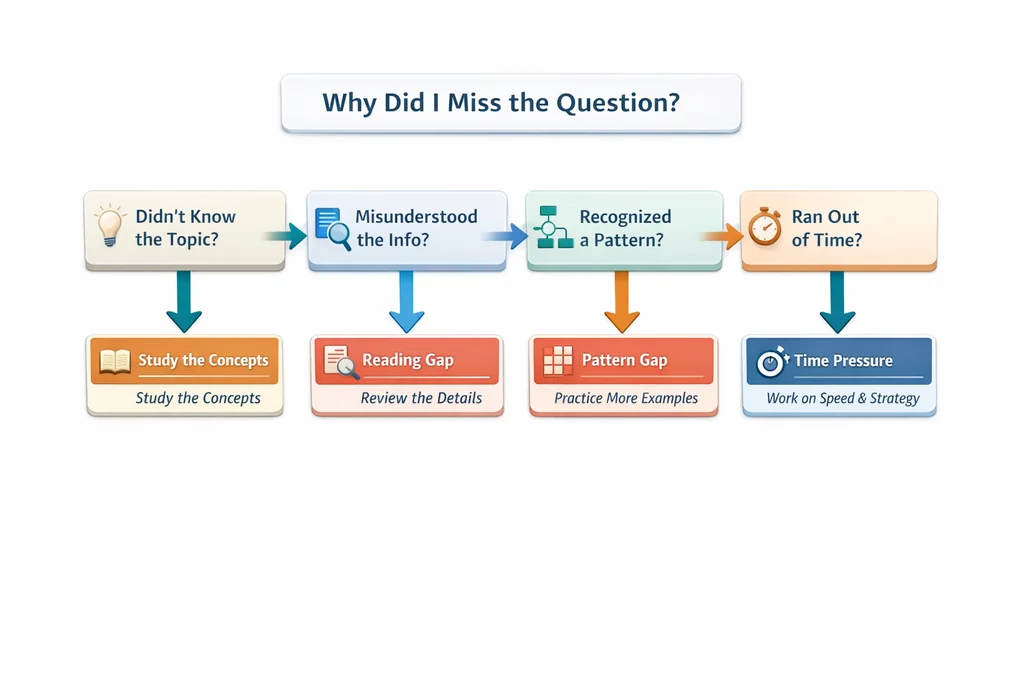
After each test, sort your misses by root cause:
- Knowledge gap: You didn't know the service or feature
- Pattern gap: You knew the services but missed the architectural pattern
- Reading gap: You misread the scenario constraints or question stem
- Time pressure: You rushed and missed details
Knowledge gaps require whitepaper or documentation study. Pattern gaps respond to hands-on labs and explanation review. Reading gaps improve with deliberate pacing—on the real exam, spend 90 seconds reading the scenario before looking at answer choices. Time pressure indicates you need more timed practice to build rhythm.
When Elena, a cloud engineer at a mid-sized SaaS company, first scored 62% on her diagnostic, her mistake log showed 40% pattern gaps and 35% reading gaps. She stopped taking full tests for two weeks and instead worked through 150 domain-specific questions, forcing herself to write a one-sentence justification for every answer before checking. Her next full test jumped to 78%, and she passed the real exam three weeks later with a comfortable margin.
The justification technique matters more than the volume. Writing "I chose B because..." forces explicit reasoning. When Elena's justifications contradicted the correct answer, she could identify whether she missed a constraint, applied the wrong priority, or misunderstood a service interaction. This metacognitive layer transforms passive question review into active skill building.
Master the Exam's Scenario Structure
SAP-C02 questions follow a predictable anatomy. Each presents:
- A business context (company size, regulatory requirements, existing infrastructure)
- A technical constraint (budget, latency target, data residency, team size)
- A change driver (merger, new product launch, cost reduction mandate)
- Four or five answer choices with subtle differences
The wrong answers are rarely impossible—they're suboptimal. One might work but cost 3x more. Another might meet requirements but create operational risk. The correct answer balances all constraints.
Train yourself to identify the primary constraint in each scenario before evaluating options. Is this a cost optimization scenario? A compliance scenario? A performance scenario? The constraint hierarchy determines which pillar of the Well-Architected Framework takes priority.
Develop a quick triage method. After reading the scenario, ask three questions in order:
- What is the business outcome required?
- What is the non-negotiable constraint (cost, compliance, latency, availability)?
- What existing infrastructure must this integrate with?
Only then examine the answer choices. Candidates who read options first often anchor on a plausible-sounding service and force-fit it to the scenario.
Recognize Common Trap Answers
AWS exam writers reuse certain trap patterns. Recognizing them saves points and time.
The "technically correct but operationally terrible" option: An answer that deploys a working architecture but requires 24/7 manual intervention or lacks monitoring. The Well-Architected Framework prioritizes operational excellence; automation and observability matter.
The "over-engineered gold-plated" option: Every AWS service in the answer, maximum redundancy, enterprise features unused by the scenario. If the company described has 50 employees and a $10,000 monthly AWS budget, a multi-region active-active design with Global Accelerator and Aurora Global Database is probably wrong.
The "Associates-level right answer" option: A valid architecture that ignores the Professional-level complexity. If the scenario involves 200 accounts and centralized logging, an answer with per-account CloudWatch dashboards misses the organizational scale.
The "ignores the constraint" option: An answer that satisfies every requirement except the explicitly stated primary constraint. These trap candidates who read too quickly.
Practice identifying these patterns in your question review. Label each wrong answer you consider with its trap type. This builds pattern recognition that activates during the exam.
Schedule Strategically and Manage Exam Day
Book your exam 2-3 weeks in advance during your final preparation phase. This creates productive urgency without panic. Choose a morning slot if you're sharper early, or afternoon if you need time to settle.
Verify your technical setup 48 hours before a remote proctored exam. Test your internet stability, webcam angle, and room lighting. The exam software requires a clear desk scan; remove monitors, notes, and even water bottles before starting. Proctors have rejected candidates for phones visible in pockets or wall posters with technical diagrams.
The night before, stop studying. Review your mistake log lightly, then sleep. The exam rewards clear reasoning more than last-minute cramming.
During the exam:
- Flag complex questions and return to them; answer easier ones first to build confidence
- Watch the time: 180 minutes for 75 questions means roughly 2.4 minutes per question
- For lengthy scenarios, read the question stem first, then scan for relevant constraints
- When stuck between two answers, ask which better satisfies the primary constraint
If you finish with time remaining, review only flagged questions. Do not second-guess answers you felt confident about initially; first instincts are usually more reliable than fatigue-influenced reconsideration.
Plan for the Possibility of Retake
Despite solid preparation, some candidates fail on the first attempt. The SAP-C02 retake policy requires a 14-day waiting period and full exam fee payment. Build this possibility into your timeline and budget.
If you do fail, request your score report immediately. AWS provides domain-level performance, which reveals whether you were uniformly weak or collapsed in one area. Candidates who fail by narrow margins often had one domain below 50%; targeted study there frequently converts a retake into a pass.
Consider whether your preparation genuinely matched the exam's demands. Candidates who relied heavily on video courses without hands-on practice often fail the integration-heavy scenarios. Those who memorized service features without understanding trade-offs struggle with the optimization questions. Adjust your approach based on this diagnosis, not just your study hours.
Further Reading
- Why Choose AWS Certified Solutions Architect
- AWS Solutions Architect Exam Cost in 2026
- Premium Amazon Practice Tests
Ready to validate your preparation? Browse the SAP-C01 practice questions at PlanetCert to test your knowledge against exam-style scenarios with detailed explanations that strengthen your architectural reasoning.

Discussion
Question Comments
0 comments·0 participantsSign in to leave a comment and access more free questions.