

Preparing for PCEP-30 in four weeks means giving each study session a clear job: learn a concept, write a small programme, check your reasoning and revisit mistakes. This plan divides your preparation into Python fundamentals, control flow, collections, and functions with exceptions. You’ll finish with mixed timed practice and a readiness check.
I’d treat four weeks as a planning window, with room to adjust. If you already understand basic programming, you can spend more time tracing unfamiliar code. If Python is your first language, use the weekly checkpoints to decide whether you need extra days.
1. Match your study calendar to your booked exam
Your PCEP preparation should begin with the syllabus for the exact version you intend to take. Confirm the version, objectives and candidate instructions through the exam provider before choosing study materials.
Gather a small set of working materials
You need a Python 3 environment, a syllabus checklist, one main learning resource and practice material with explanations. A local interpreter or browser-based environment is enough for the short programmes in this plan.
Create a working folder with one file per topic. Keep an error log alongside it. For each mistake, record:
- The syllabus objective involved.
- What you expected the code to do.
- What actually happened.
- The Python rule that explains the difference.
- A small variation to attempt later.
Use four study groups to organise your calendar: fundamentals, control flow, collections, and functions with exceptions. These groups make scheduling easier; the current syllabus remains your coverage checklist.
Take a short diagnostic before studying. Work without notes, then separate unfamiliar topics from careless mistakes. Avoid treating a remembered answer as evidence of understanding.
Reserve time you can realistically protect
For this plan, reserve five 60-minute weekday sessions and one 90-minute weekend block. That gives you about six and a half hours each week. Keep the remaining day available for rest or catch-up.
Divide a typical weekday session into:
- Ten minutes recalling yesterday’s rules without notes.
- Twenty minutes studying one objective.
- Twenty minutes writing and tracing code.
- Ten minutes correcting errors and scheduling a revisit.
These are suggested study allocations, not an estimate of how long everyone needs. If your diagnostic reveals unfamiliar material throughout the syllabus, extend the calendar.
For a digital tracker, an interactive checklist with filters for topic, confidence and next review date can help you choose the next session.
2. Week one: make Python fundamentals predictable
The first week should leave you comfortable reading short Python programmes and explaining how values move through them. Use your syllabus to check the exact fundamentals you need.
Spend days one to five writing small programmes
Start with variables, basic data types, literals, arithmetic and input/output. Write short examples yourself rather than copying complete solutions.
For every example, predict the result before running it. Then change one detail and predict again. Changing one operator or value makes the cause easier to see.
Pay particular attention to distinctions such as:
- A numeric value versus a string containing digits.
- Division with
/versus floor division with//. - Assignment with
=versus comparison with==. - Operator precedence versus an expression controlled by parentheses.
- A conversion that succeeds versus one that raises an exception.
Keep the examples small enough to trace on paper. A five-line programme you can explain is useful evidence of progress.
By the fifth day, write a short programme from a plain-English description. For example, accept a quantity, convert it to an appropriate numeric type and calculate a total. Explain each conversion and operator choice.
Use the weekend to check your reasoning
Choose a small set from PlanetCert’s Python certification sample questions to check whether you can apply the material.
Start untimed. Write down your reasoning before checking an explanation. Afterwards, attempt a short timed set using questions you haven’t just reviewed.
For each error, write a new example that changes the values while keeping the underlying rule. Your checkpoint is complete when you can explain the corrected behaviour and reproduce it without notes. Carry unresolved objectives into the next week’s recall sessions.
3. Week two: trace decisions and loops accurately
Your second week should focus on following a programme’s execution through conditions and repeated steps. Concentrate on what changes, when it changes and what ends the loop.
Trace conditions before increasing complexity
Spend the first two sessions on comparisons, Boolean expressions and conditional branches. Work through each condition in execution order.
Practise boundary values deliberately. If a condition uses score >= 10, test values below, equal to and above 10. This makes the effect of the comparison visible.
Then move to loops and the control statements listed in your syllabus. Keep a trace with the current iteration, variable values and any output.
Consider this teaching example:
total = 0
for number in range(1, 5): if number % 2 == 0: total += number
print(total)
Before running it, list the values produced by range(1, 5). Identify which values satisfy the condition and update total after each iteration. The printed result is 6.
Now change the range endpoint or the condition. Predict the new result before running the variation.
Check boundaries and loop exits
Use the remaining weekday sessions for loop boundaries, nested blocks and control statements. Test one change at a time.
For a while loop, identify the starting value, continuation condition and update. Trace those parts before executing unfamiliar code. This helps you spot a loop whose condition never becomes false.
At the weekend checkpoint, attempt a mixed set containing both fundamentals and control flow. Give yourself a fixed practice window, then review every uncertain answer.
If your errors cluster around endpoints, write three fresh endpoint variations before returning to mixed practice. If indentation caused the error, redraw the block structure and trace the code again.
4. Week three: follow collections and their changes
During week three, organise your collection practice around access, updates, iteration and the relationships between variables. Keep checking the syllabus so that familiar topics don’t crowd out untouched objectives.
Practise one collection operation at a time
Work through the required material on lists, tuples, dictionaries and strings. For each type, write examples that access an element, inspect its contents and perform the operations relevant to your objectives.
For indexing and slicing, write out the positions first. Test positive and negative indices, then vary slice boundaries. Add a step only after you can explain the simpler examples.
When practising dictionaries, keep keys and values distinct in your notes. For strings, check what an operation returns and whether you assign that result anywhere.
Avoid turning these sessions into a large project. Small examples let you isolate the exact behaviour you need to understand.
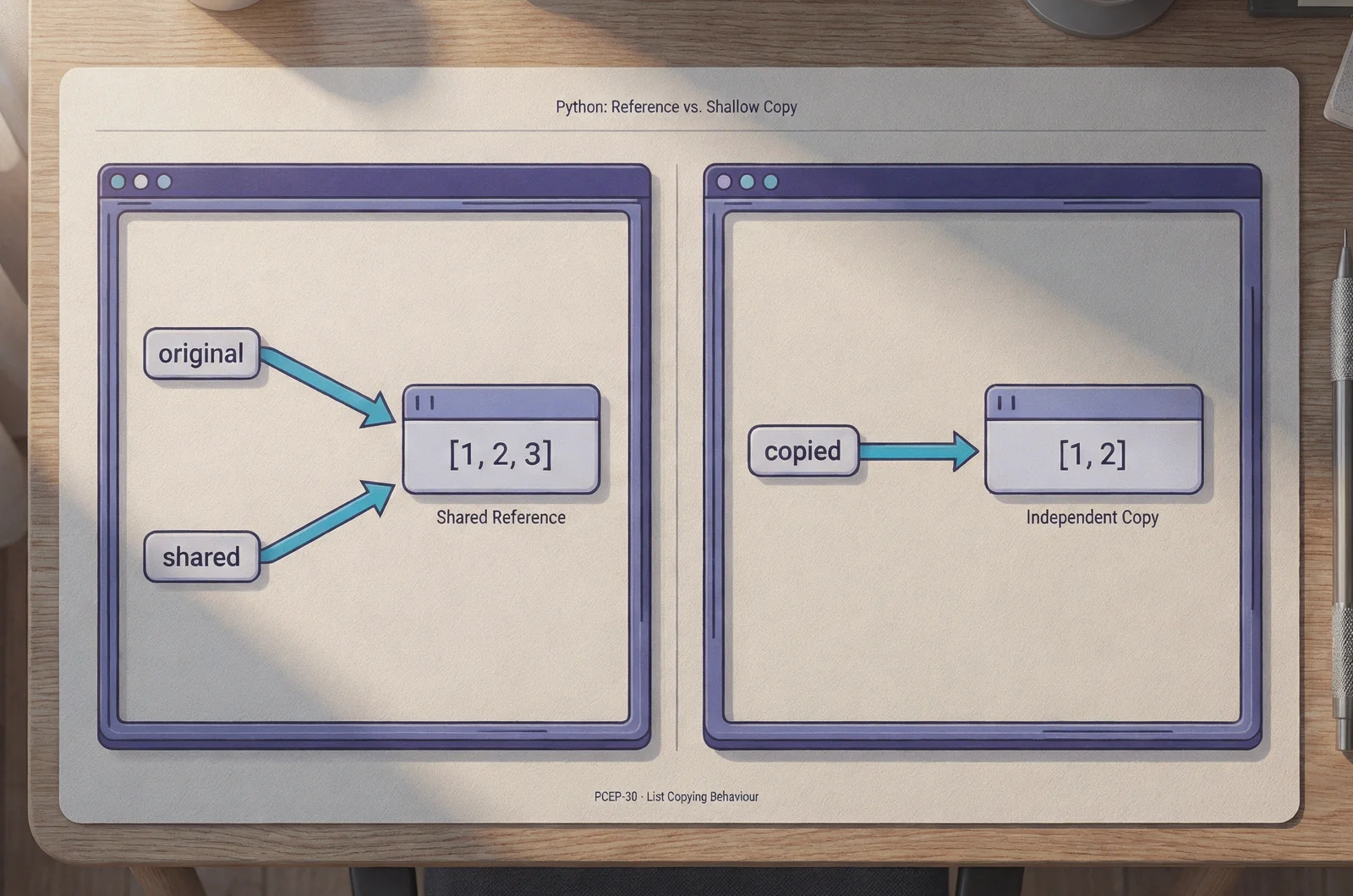
Check whether a variable shares or copies a list
List behaviour deserves a separate tracing session. Examine this example:
original = [1, 2]
shared = original
copied = original[:]

shared.append(3)

print(original)
print(copied)
The first output is [1, 2, 3]; the second is [1, 2]. Here, shared refers to the same list as original, while the slice creates a separate list.
Draw the two list objects and connect each variable name to the appropriate one. Then replace shared.append(3) with copied.append(3) and predict both outputs again.
Finish the week with cumulative practice across all three study groups. If your practice tool records results, use them to locate repeated errors. The exam simulator analytics guide can help you organise that review.
Check confident mistakes first. Each one needs a written explanation and a fresh variation before you mark the objective as secure.
5. Week four: connect functions, exceptions and timed practice
The final week needs protected time for both the remaining objectives and cumulative review. Keep the first sessions focused on functions and exceptions, then reserve separate blocks for timed attempts and corrections.
Make calls and return values explicit
For functions, practise defining, calling and tracing the examples required by your syllabus. Follow argument values into the function, then follow the returned value back to the caller.
Pay attention to the difference between printing and returning. A function can display text without returning that text to its caller.
Write a short function that returns a calculation. Call it, store the result and use that result in another expression. Then write a version that only prints the calculation.
Check what each call produces. A function that reaches its end without an explicit return value returns None.
Review parameter behaviour and variable scope against your objectives. If a trace becomes confusing, draw separate boxes for the caller and function, then record the values visible in each.
Trace the path through an exception handler
Build short examples that raise exceptions, then trace which statements execute. Compare a successful operation with an operation that fails inside a try block.
For each example, explain:
- Which statement raises the exception.
- Whether an available handler matches it.
- Which statements the programme skips.
- Where execution continues afterwards.
Keep the examples focused on the exception behaviour listed in your syllabus. Add objectives you haven’t covered to your remaining study blocks before scheduling a final readiness attempt.
Run mixed attempts under controlled conditions
Reserve two separate sessions for cumulative timed practice. If you use a PlanetCert simulator, set its timing to match the verified instructions for your booked exam.
Keep each attempt uninterrupted, with notes and your interpreter closed. Review afterwards; use a separate study block if necessary.
The guide to timed practice simulators can support your practice setup, but your preparation still needs time for error correction.
After the first attempt, choose the two weakest objectives and write fresh examples for them. Use a different question set for the second attempt. Record correct guesses as unresolved topics until you can explain them.
6. Make your readiness decision from fresh evidence
Your final PCEP review should answer a practical question: can you apply the required concepts independently within the verified exam time?
Use several checks together:
- Every syllabus objective has been studied and checked.
- You can trace short programmes without running them first.
- You can explain why an answer works.
- Repeated error types have decreased across fresh practice.
- You can complete mixed practice within the applicable time limit.
- Correct guesses have received follow-up practice.
I’d also ask whether you can explain your most recent mistakes in plain language. “I misread it” is often too vague. “I treated the range endpoint as included” identifies something you can practise.
If one topic still causes repeated errors, assign another focused session and retest it with unfamiliar examples. A higher score on an unchanged question set gives you limited evidence about that gap.
For the final day, use short recall sessions and a light review of your error log. Avoid starting a large new course.
Check your booking instructions separately, including identification, timing and any technical requirements that apply to your delivery method. Complete those checks early enough to resolve a problem before the appointment.
Adjusting the four-week plan to your starting point
The same PCEP study sequence can fit different starting points, but your checkpoints should control how quickly you move through it.
Can a complete beginner finish in four weeks?
Four weeks can be a starting schedule, but you should leave room to extend it. Use the first weekend checkpoint to judge your pace.
If basic types, expressions and input conversion still feel unfamiliar, repeat the relevant sessions before adding more topics. Keep the study routine and move the target date if your coverage checks show you need more time.
What should you do when practice scores stop improving?
Group recent mistakes by objective and error type. Then replace one mixed practice session with focused work on the largest recurring gap.
For example, if several mistakes involve list slicing, write fresh slices with different boundaries and predict each result. Return to mixed practice after you can explain those variations.
How should you adapt the plan if you already programme?
Use the diagnostic to shorten familiar sessions, while retaining every syllabus checkpoint. Put the recovered time into Python behaviour that differs from languages you know.
Be careful when an answer feels obvious. Write down the rule you used, then verify it with a small programme. Reserve the final timed attempts for questions you haven’t already memorised.
Practice resources for your four-week study schedule


Discussion
Question Comments
0 comments·0 participantsSign in to leave a comment and access more free questions.