

Exam simulator analytics for weak domains help you turn a practice result into a useful revision decision. For an IT certification candidate, the question is whether a low domain score reflects missing knowledge, rushed answers or a small sample of difficult questions. Those problems need different responses.
A dashboard records your answers and may group them by topic, session and time spent. Your task is to interpret that evidence. I’d start with the question count behind each percentage, then check whether the same difficulty returns in comparable sessions. That gives you a clearer basis for deciding what to study before your exam date.
A domain percentage starts with question tags
A domain score measures performance on questions assigned to a particular category. Its meaning depends on the tags, the scoring rules and the questions you received.
In a report using simple right-or-wrong scoring, domain accuracy is the number of correct answers divided by the number of scored questions in that domain. Suppose a hypothetical networking section contains ten questions and you answer seven correctly. Its accuracy is 70%.
That result describes those ten responses. It does not establish that you understand exactly 70% of networking. The questions may cover only part of the domain, and several may test the same concept.
The denominator matters
Consider two hypothetical results: eight correct answers out of ten, and four correct answers out of five. Both display 80%.
One additional error would move the first result to 70% and the second to 60%. The smaller sample moves more sharply.
Before reacting to a coloured dashboard tile, look for:
- The number of questions contributing to the result.
- The range of objectives those questions cover.
- Whether the result includes repeated questions.
- Whether unanswered questions count as incorrect.
A category with few responses needs more investigation. Keep its question count beside its percentage when you record results.
The scoring rule matters too
Check how the simulator handles multi-part questions, partial credit and questions tagged to several topics. These choices affect what a reported percentage represents.
A practice percentage also cannot be assumed to equal an official scaled score. Treat any conversion as unsupported unless the relevant scoring documentation explains it.
When assessing timed exam simulator practice tests, look for reports whose calculations you can understand. If the scoring method is unclear, use the individual answer review to identify gaps.
A weak domain needs a pattern across sessions
A low domain score becomes more persuasive when the same difficulty appears across different questions under comparable conditions.
One poor session gives you a reason to investigate. Fatigue, interruptions, unfamiliar wording or an uneven question mix could explain part of the result. Repeated errors on the same objective provide more specific evidence.
Compare sessions with similar conditions
An untimed quiz with explanations visible measures something different from a closed-book, full-length simulation.
For a useful trend, record the conditions alongside the score: timed or untimed, mixed or targeted questions, fresh or repeated items, and whether you used notes. A brief entry is enough.
Suppose your hypothetical identity scores are 55%, 70% and 85%. That looks encouraging. However, if the final session reused questions you had reviewed, the improvement could partly reflect answer recall.
A session using fresh questions under the original conditions gives you a better comparison. Keep the repeated-question result, but label it separately.
Look for the same underlying error
A broad domain can contain several unrelated tasks. Two low scores may therefore have different causes.
Read the missed questions and identify what each required. In a hypothetical cloud exam, errors about permission inheritance, role scope and identity type might point towards a shared access-control gap.
By contrast, unrelated mistakes scattered across a domain may need several small repairs. A single domain label would hide that distinction.
Record the underlying task beside each error. Use wording such as “choose the correct permission scope” so your revision target is specific enough to practise.
Timing helps separate knowledge gaps from exam technique
Timing data adds context to an answer, but speed alone cannot explain why it was correct or incorrect.
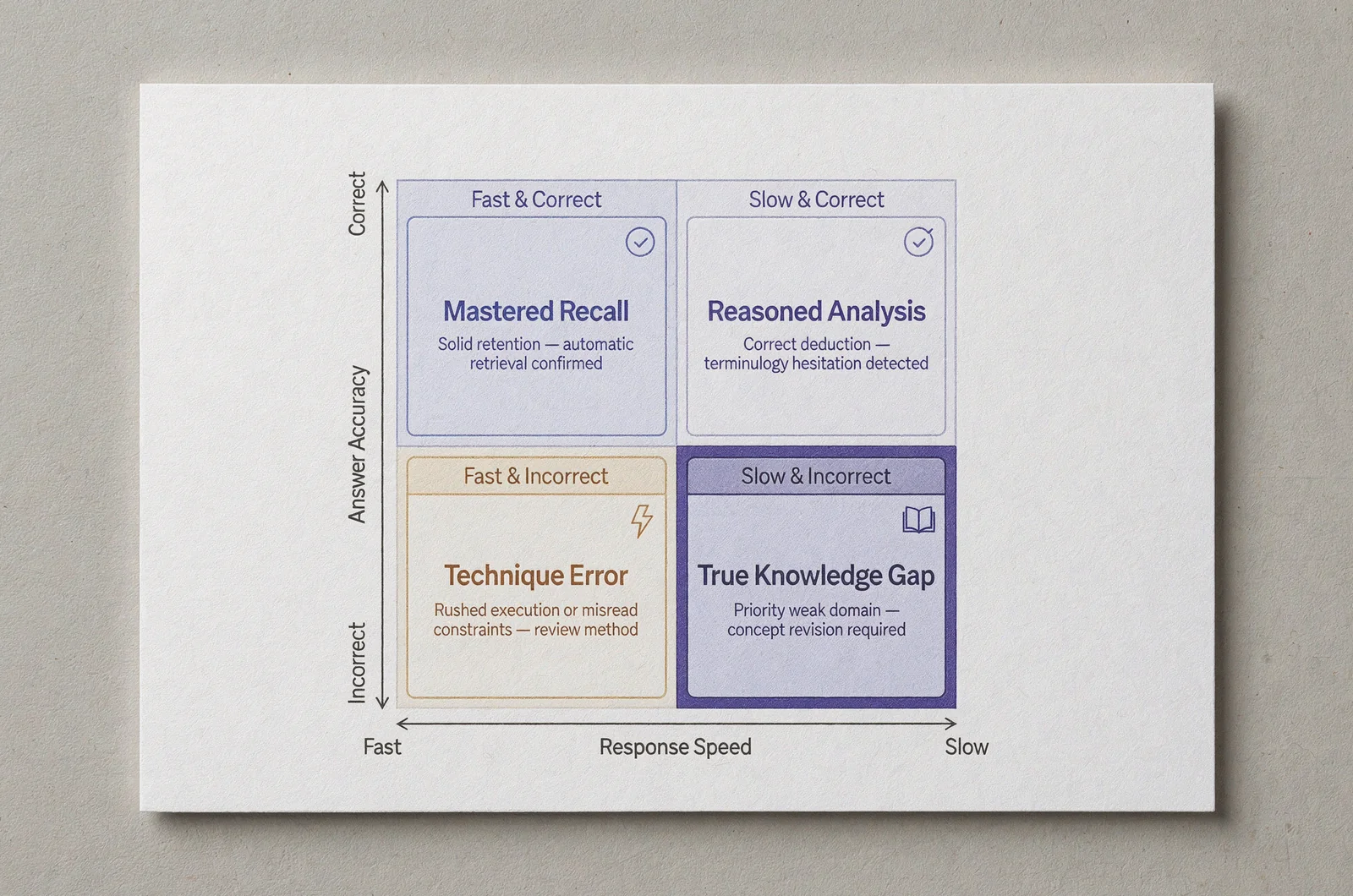
A slow response may reflect careful reasoning, unfamiliar terminology or uncertainty. A fast error may come from misreading a constraint or confidently applying the wrong rule.
The useful unit of review is the answer, its explanation and the time spent together.
Read speed alongside accuracy
These hypothetical patterns suggest different questions to investigate:
| Response pattern | Possible explanation | Useful check |
|---|---|---|
| Correct, unusually slow | Understanding exists, but recall or reasoning takes time | Solve a fresh variation under a time limit |
| Incorrect, unusually fast | A missed constraint or confident misconception | Identify which detail rules out your answer |
| Incorrect, unusually slow | Uncertainty between plausible choices | Explain the difference between the final two options |
| Correct, unusually fast | Fluent recall or familiarity with the item | Check the concept using unfamiliar wording |
Each row is a hypothesis. Question length and format can change the time a reasonable answer takes.
Compare similar question types where possible. A lengthy scenario and a short definition question make poor timing counterparts.
Treat correct guesses as unfinished work
A correct answer contributes to accuracy even when you guessed. If confidence is absent from the report, add a short note yourself.
Try explaining why the chosen option fits and why the alternatives fail. Difficulty doing that gives you a revision task despite the recorded mark.
PlanetCert’s question explanations and flashcards can support this review: use explanations to resolve the reasoning gap, then flashcards to practise the distinction.
For a worked preparation approach, the guide to CCNA practice exam review provides another reading path. Keep an uncertain correct answer on your revision list until you can justify it.
Match report categories to your exact exam objectives
Domain analytics become useful study guidance when the report categories connect to the objectives for your intended exam.
A broad label such as networking, security or administration leaves room for interpretation. You need to know which examinable task the missed question represents.
Check the exam code and objective version
Start with the exact certification exam code you intend to sit. Then compare the practice material’s stated coverage with the relevant vendor objective document.
If you’re using PlanetCert’s exam simulator, check the selected exam and its objective coverage before interpreting a domain breakdown. A similar certification name is insufficient evidence that two resources cover the same syllabus.
The supplied information does not establish the exact tagging scheme or readiness calculation in every report. Avoid assuming that a dashboard category matches an official domain word for word.
For Microsoft preparation, the guide to the role-based exam format is useful background. Keep the objective version beside your session notes so you can recognise results produced against different coverage.
Move from a domain to an examinable task
Some diagnostic reporting separates broad subjects from individual topics. MockPreps describes this distinction in its subject and topic diagnostics.
The distinction helps you narrow the repair. A hypothetical low networking score could conceal one recurring problem with route selection, while your other networking answers remain sound.
For each missed item, connect three things: the report category, the question’s required task and the matching objective. When the connection is uncertain, flag it for review rather than forcing a match.
The discussion of AD0-E208 exam objectives explores the relationship between sample questions and syllabus coverage. Write your revision target using the objective’s task wording, such as configure, troubleshoot or distinguish.
Spend revision time where it can change the result
The lowest percentage is a starting point for prioritisation. Exam weighting, breadth of coverage and the cause of the errors also deserve attention.
Your available study time matters. With an exam approaching, a specific misunderstanding you can repair may deserve attention before a broad topic you have barely begun.
Use weightings without pretending to predict a score
Consider a hypothetical exam with two domains. One represents 40% of its published coverage, and your practice accuracy is 60%. Another represents 10%, and your accuracy is 40%.
The second percentage looks worse. The first domain covers more of the exam, so improving it could have a larger effect on your preparation.
For a rough revision comparison, multiply the domain weighting by the remaining accuracy gap. In this example, the figures are 40% × 40% = 16%, and 10% × 60% = 6%.
These are hypothetical planning estimates. They are neither predicted marks nor an official scoring formula. Their usefulness depends on how representative the practice questions are.
A simple interactive revision-priority calculator could accept domain weighting, accuracy and question count. It could rank areas for review and flag thin samples. Its output should remain a study aid rather than a pass prediction.
Choose a repair that matches the error
Read the explanation before selecting the study activity. Different error patterns call for different work:
- Missing terminology calls for short recall practice.
- Confusion between similar technologies calls for comparing their conditions and limits.
- Configuration uncertainty calls for working through the relevant task.
- Missed scenario constraints call for identifying the requirement before selecting an answer.
After that repair, attempt fresh questions addressing the same objective. Record whether the error returns and whether you can explain your choice.
Keep the task small enough to complete in a planned study session. “Explain route selection, then answer fresh scenarios” gives you a clearer finish than “revise networking”.
Read readiness indicators as evidence with limits
A readiness indicator compresses several observations into a convenient label or number. Its value depends on the calculation behind it.
Check whether it uses recent attempts, all attempts, domain coverage, timing or repeated questions. If the method is unavailable, give more weight to the answer reviews and session history you can inspect.
Fresh questions give a stronger check
Repeated questions are useful for revisiting an explanation. They are less informative about whether you can solve an unfamiliar scenario.
A hypothetical score rising from 65% to 90% on the same set could reflect improved understanding, remembered answers or both. You need another check to separate those possibilities.
Use fresh questions covering the repaired objective. Explain the reasoning before opening the feedback, and mark any correct guess as uncertain.
The article on AZ-104 practice test coverage addresses a related preparation question. A high result on limited material leaves objectives outside that material unmeasured. Track coverage alongside accuracy.
Look for repeatable performance under time limits
A more useful readiness picture combines performance across objectives with the ability to finish under the intended practice conditions.
Look for unresolved gaps, recurrent errors and a pace you can sustain. If your total rises while one heavily weighted domain remains weak, investigate that domain before treating the overall trend as reassurance.
There is no universal practice percentage in the supplied evidence that guarantees an official exam pass. Different question banks, scoring rules and exam formats prevent that shortcut.
Use the report to define your next evidence-gathering task. For example: complete a fresh timed set, finish within the limit and explain answers on the previously weak objective.
Questions to ask after a weak-area report
A report should influence your next revision session. Changing your exam date needs broader evidence about coverage, repeated performance and the time available to address gaps.
How many sessions confirm a weakness?
There is no fixed number that works for every question bank. Question count, objective coverage and repeated items all affect the strength of the pattern.
Repeated difficulty across fresh questions gives you a better basis for action than a single percentage. Investigate the error as soon as it appears, then retest after revision.
Can a high total hide a weak domain?
Yes. Strong results elsewhere can compensate for a low domain percentage in an overall practice result.
Check the domain breakdown, its question counts and objective coverage before relying on the total. If the weak category contains few questions, gather more evidence there.
Should I delay the exam after one poor result?
One poor session alone provides limited grounds for changing the date. First check its conditions and review the errors.
Repeated difficulty on fresh questions, incomplete objective coverage or difficulty finishing timed sessions deserves more attention. Match the remaining repair work to your available study hours before making the scheduling decision.
Connect your results to an exam-specific study plan


Discussion
Question Comments
0 comments·0 participantsSign in to leave a comment and access more free questions.