
Microsoft Exam Format: How Role-Based Tests Actually Work
Most candidates who fail Microsoft certification tests know the material. They understand Azure networking, can write KQL queries, and have deployed resources through the portal. What trips them up is the exam itself—the timing pressure, the lab tasks that appear without warning, the case studies that bury critical details three screens deep, and the scoring system that does not reward partial answers. If you are preparing for a Microsoft exam in 2026, understanding how these tests are built is as important as mastering the objectives. This article breaks down the actual architecture of current Microsoft role-based exams, using 2026 objective updates as fresh evidence, so you can study with the format in mind rather than discovering it on test day.
What Changed in 2026
Microsoft's certification program underwent its largest restructuring since the 2019 shift to role-based credentials. Several familiar exams retired in mid-2026: Azure AI Engineer Associate (AI-102) and Azure AI Fundamentals (AI-900) both went dark on June 30, while Azure Data Scientist Associate (DP-100) retired on June 1. Azure Developer Associate (AZ-204) followed on July 31. These were not mere renames. Microsoft replaced them with credentials built around newer services—Foundry for AI development, agentic AI tracks with exams AB-100 and AB-620, and refreshed security paths like SC-500.
This matters for format because new exams often introduce adjusted question weightings, revised lab interfaces, or different case study structures before Microsoft documents them fully. The Azure certification path guide tracks these structural evolutions across the full portfolio. When an exam enters beta, as AI-200 and SC-500 did in early 2026, the question mix can still shift before general availability. Beta takers sometimes report more labs than the final version contains, or fewer case studies, as Microsoft calibrates difficulty.
The retirement wave also means many candidates are taking exams under older formats while studying with materials designed for newer ones. Always verify your exam code against Microsoft's current list before purchasing practice tests. A simulator that replicates the PL-300 interface will not help if you are sitting AI-102's replacement.
Question Types You Will Encounter
Microsoft does not publish an exact inventory of question types for any given exam. According to Microsoft guidance, this protects exam security and certification value. However, the exam sandbox—available for both fundamentals and role-based exams—lets you interact with the actual interface before test day. You should use it. It includes the same introductory screens, help information, and candidate agreement you will see later.
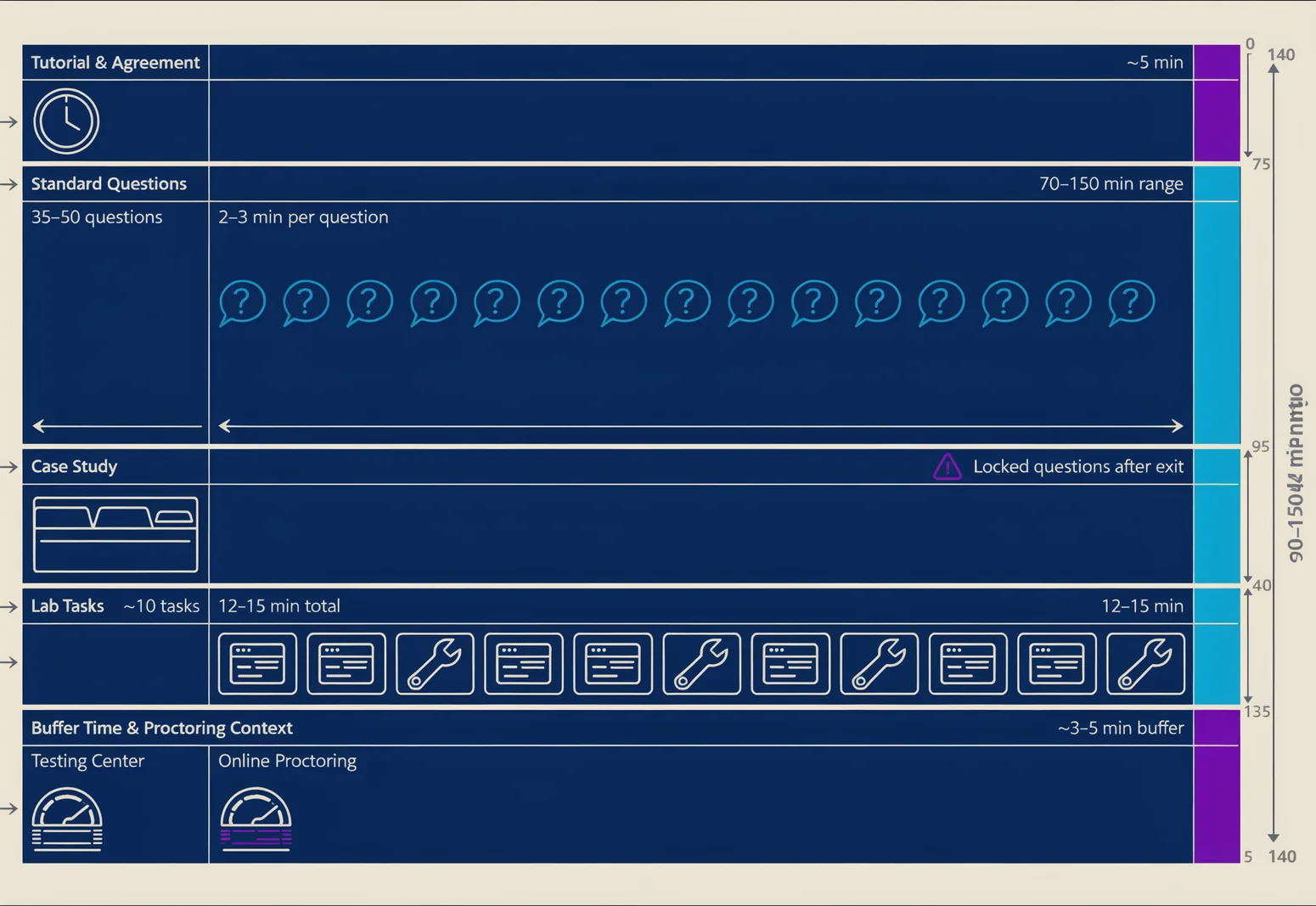
Most role-based exams contain 35 to 50 questions, though this varies between attempts because Microsoft updates exams continuously to reflect technology changes. The question types fall into several categories:
Multiple choice and multiple response. These remain the backbone. Multiple response questions explicitly state how many answers to select—"Choose two" or "Choose three." There is no partial credit. Select too many or too few, and the entire question is wrong.
Drag-and-drop and matching. These test relationships between components: matching Azure services to capabilities, ordering migration steps, or pairing security controls with threats. The interface is finicky on smaller screens, so practice in a simulator that replicates the exact drag behavior.
Hot area and active screen. You click directly on a diagram, portal screenshot, or code snippet to identify the correct element. These reward familiarity with the Azure portal's actual layout. If you have only used CLI or ARM templates, you may struggle to locate the correct blade quickly.
Build list and reordering. You assemble a sequence from scattered options. These appear frequently in migration and deployment scenarios where order matters.
Case studies. These present a detailed business scenario across multiple tabs—requirements, existing environment, constraints—and ask several questions that reference the same data. You can revisit the scenario while answering, but you cannot change answers after leaving the case study section. Time management is critical here; candidates often over-invest in reading the scenario and rush the questions.
Hands-on labs. Not every exam includes them, but those that do place them at the end. You are informed during the exam introduction if labs are present. The PL-300 exam format breakdown illustrates how Power BI-specific labs integrate with case studies and standard questions in a single assessment.
How Labs Actually Work
Labs are where most format-related failures occur. According to Microsoft guidance, role-based exams with labs allocate 120 minutes for questions and lab tasks, plus 20 minutes for instructions, comments, and score reporting. Exams without labs give 100 minutes for questions plus the same 20-minute overhead. The seat duration—the total time you are at the testing center or in online proctoring—is 140 minutes for lab exams and 120 minutes for non-lab exams.
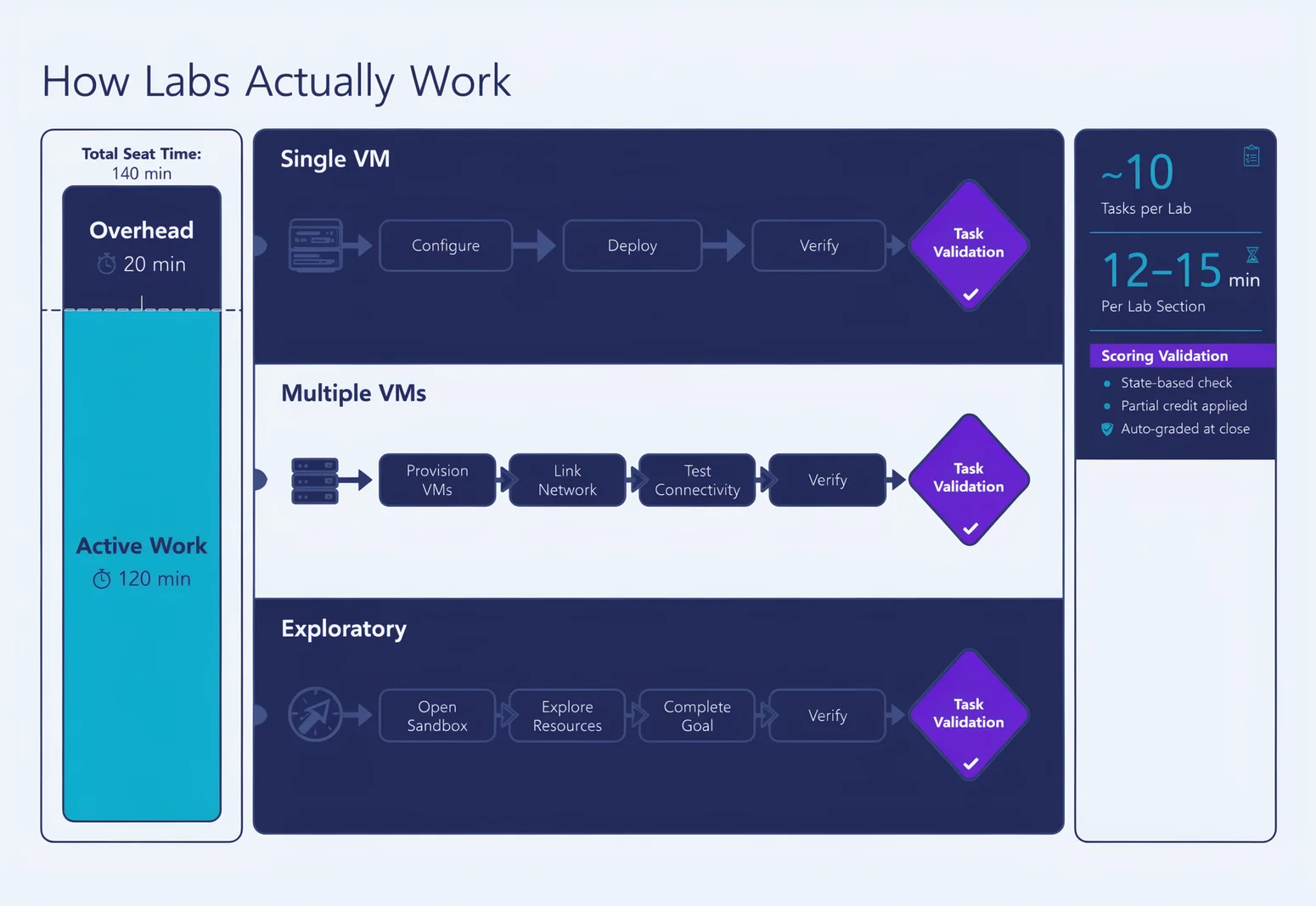
Each lab contains approximately 10 tasks. You complete them in one of three configurations: a single virtual machine, multiple VMs, or an exploratory lab where you investigate resources and answer questions that require understanding what you find. The third type is particularly challenging because it blends lab work with case-study-style questioning. You might explore a configured Azure environment, identify misconfigurations, then select answers based on your investigation.
Labs are scored automatically. Each task has specific validation criteria—create a resource group with this name, configure this NSG rule, deploy this template. Partial completion usually earns nothing. If a task requires three steps and you complete two, you likely receive zero points for that task. This all-or-nothing scoring makes labs high-risk, high-reward sections.
Lab availability depends on unpredictable factors including Azure outages and maintenance windows. If a lab cannot load, Microsoft has fallback procedures, but these may involve rescheduling or substituting alternative questions. You cannot control this, so build contingency time into your schedule. Do not book your exam on the last day before a certification retirement, when lab infrastructure strain is highest.
Case Studies: The Hidden Time Sink
Case studies simulate professional decision-making by presenting complex scenarios and testing your ability to extract relevant information. As Microsoft guidance explains, subject matter experts external to Microsoft define the skills measured—the "objective domain"—and the blueprinting process allocates more questions to critical, frequently performed skills. Case studies concentrate these high-weight skills into dense narrative packages.
A typical case study presents:
- A business overview (company size, industry, strategic goals)
- Technical requirements (performance targets, compliance needs, integration constraints)
- Existing environment (on-premises infrastructure, current cloud footprint, network topology)
- Proposed changes (migration plan, new application architecture, organizational restructuring)
Questions then ask you to recommend solutions, identify risks, or optimize configurations based on this data. The correct answer often depends on a constraint buried in the "existing environment" tab—something you might skip if you rush.
The critical mechanic: once you leave a case study, you cannot return to modify your answers. You can still review the scenario text while answering questions within it, but the questions themselves lock after you proceed. This means you should answer all case study questions before moving on, even if uncertain. Flagging for later review is not an option within a case study block.
Case studies appear at fixed points in the exam, not randomly distributed. Microsoft does not publish their exact placement, but candidate reports suggest they typically occur in the middle third. This placement affects stamina management—you may face a dense case study after already answering 15-20 standard questions.
Scoring Mechanics and What 700 Means
Microsoft exams are scaled to 1,000 points, with 700 as the passing threshold. This does not mean 70%—the scaling algorithm adjusts for question difficulty, so a "700" represents consistent performance at the competency level Microsoft defines for that role. Some questions contribute more to your score than others based on the blueprinting process. Skills deemed critical or frequently performed carry higher weight.
Labs and case studies typically contribute disproportionately to the final score because they assess multiple objectives simultaneously. A single lab task might validate three distinct skills from the objective domain. Failing a lab section therefore damages your score more than missing an equivalent number of multiple-choice questions.
Microsoft does not publish exact scoring breakdowns per section. You receive only a pass/fail result and a high-level performance chart showing whether you were strong, moderate, or weak in each measured skill area. This opacity frustrates candidates who want to calculate exactly how many questions they can afford to miss. The practical implication: you must perform consistently across all domains rather than excelling in some and compensating in others.
The AZ-800 skills measured page shows how Microsoft structures these performance domains for a specific exam, with percentages indicating approximate weightings. Use these published weightings to allocate study time, but remember that the actual exam may vary slightly due to continuous updates.
Time Management Tactics
The seat duration includes tutorial time, surveys, and comments. Do not treat 140 minutes as pure question-answering time. For a lab exam, you have roughly 120 minutes of active work. With 35-50 questions plus a 10-task lab, this breaks down to approximately 2-3 minutes per standard question and 12-15 minutes for the lab section.
Case studies require a different approach. Read the scenario once quickly to grasp the context, then read questions before deep-diving back into specific tabs. This prevents over-reading irrelevant details. Many candidates waste five minutes memorizing IP ranges that never appear in questions.
For labs, scan all tasks before starting. Some tasks depend on others—creating a VM before configuring its extensions, for example. If you get stuck on one task, mark it mentally and move on. Lab time is contiguous; you cannot pause and return later.
The online proctored exam adds interface friction. The secure browser may lag, screen sharing consumes bandwidth, and the chat-based proctor communication interrupts flow. Practice in conditions as close to test-day as possible. PlanetCert's simulator includes timed modes that replicate these pressure constraints, not just the question content.
Why Realistic Format Replication Matters
Understanding exam mechanics intellectually differs from performing under them. A multiple-choice question about NSG rules tests knowledge. A hot-area question asking you to click the correct blade in a portal screenshot tests knowledge plus interface familiarity. A lab task requiring you to deploy an ARM template through Cloud Shell tests knowledge plus typing accuracy under time pressure plus Azure CLI syntax recall.
This is why practice tests that merely present questions miss half the preparation. You need exposure to the question formats, the navigation patterns, the time pressure, and the cognitive load of switching between discrete questions, case studies, and labs. The AZ-900 practice tests demonstrate how timed explanations help close knowledge gaps while building format familiarity.
Microsoft's own practice assessments, available free on exam detail pages, provide official question samples but limited format variety. They are useful for content checking, not stamina building. Third-party simulators fill this gap by replicating the full exam experience including lab interfaces where applicable.
Common Format-Related Mistakes
Assuming all exams have labs. Many candidates over-prepare for hands-on tasks that their specific exam does not include, neglecting case study practice. Verify your exam code's current format before finalizing your study plan.
Ignoring the sandbox. Microsoft provides the exam sandbox specifically to reduce test-day anxiety. Candidates who skip it often report losing two to three minutes understanding the interface during the actual exam—time they cannot afford.
Mismanaging case study transitions. The inability to return to case study questions catches many test-takers. Practice deciding on answers before advancing, even when uncertain.
Underestimating lab scoring. Because labs are all-or-nothing per task, a small configuration error—wrong resource group name, incorrect SKU—eliminates all points for that task. Double-check naming conventions and required parameters.
Booking during retirement windows. When exams retire, testing infrastructure experiences peak load. Labs fail more frequently, rescheduling options narrow, and stress compounds. Schedule at least two weeks before any retirement date.
How 2026 Updates Affect Your Preparation
The SC-401 2026 exam changes illustrate how format and content evolve together. When Microsoft replaces Log Analytics with Sentinel KQL in an exam's objectives, the question types may shift toward more interactive query validation and fewer theoretical multiple-choice items. Newer exams increasingly emphasize applied skills over memorization, which generally means more labs and case studies relative to pure knowledge questions.
The introduction of Microsoft Pro Badges and expanded Applied Skills credentials also signals a broader trend: shorter, more focused assessments that validate specific tasks rather than comprehensive role knowledge. These use different formats entirely—interactive lab-based assessments rather than traditional exams. Do not confuse them with the certification exams discussed here, but recognize that Microsoft's assessment philosophy is moving toward demonstrated capability over tested recall.
For role-based certifications specifically, the trend is toward deeper integration with current services. An exam that previously tested generic Azure storage concepts now tests specific Data Lake Gen2 configurations with current portal interfaces. This makes older practice materials less useful even when the underlying concepts remain valid.
Questions Candidates Ask About Microsoft Exam Format
Do all Microsoft exams now include labs? No. Fundamentals exams like AZ-900 and AI-900 do not include labs. Associate and expert exams may or may not, depending on the specific exam and its current version. Check the exam details page for your specific code.
Can I review answers after completing a case study? No. Once you advance past a case study section, those questions lock. You can still review the scenario text while answering questions within it, but not after leaving.
What happens if my lab fails to load? Microsoft has fallback procedures, but these may involve rescheduling or alternative question substitution. Report the issue immediately through the exam interface. Do not close the browser or lose connection.
Is the 700 passing score exactly 70%? No. The 700 is a scaled score, not a percentage. The scaling algorithm accounts for question difficulty, so raw percentage and scaled score do not map directly.
How often does Microsoft update exam formats? Continuously. Microsoft updates exams to reflect technology changes without announcing every revision. Major structural changes—new question types, lab additions—typically coincide with exam retirement and replacement cycles.
Read More on Microsoft Certification Preparation

Discussion
Question Comments
0 comments·0 participantsSign in to leave a comment and access more free questions.