

AWS vs Azure Certification Salary Premium: 2026 Survey Comparison
The gap between AWS and Azure certification pay is narrowing faster than most candidates expect. Fresh 2026 survey data shows AWS still commands a slight edge at every level, but the margin has shrunk from 8–12% in 2023 to roughly 2–4% today. For anyone weighing which cloud path to study next, this shift matters: the salary advantage that once justified AWS as the default choice is now thin enough that employer stack, local job density, and exam version currency should drive the decision instead.
This article breaks down what changed in the latest salary surveys, which exam updates are already affecting hiring filters, and how to read the numbers without falling for headline figures that ignore role context.
What the 2026 Surveys Actually Show
Multiple industry sources released updated cloud salary data in the first half of 2026. The picture they paint is more nuanced than "AWS pays more."
The shrinking premium
ExamCert's March 2026 analysis, drawing on Glassdoor, Levels.fyi, LinkedIn salary insights, and the 2025 Global Knowledge IT Skills & Salary Report, found AWS certified professionals earning 2–4% more than their Azure counterparts at equivalent levels in 2026. That is down sharply from the 8–12% gap recorded in 2023. The breakdown by certification tier:
| Certification Level | AWS Average | Azure Average | Difference |
|---|---|---|---|
| Foundational | $85,000 | $82,000 | AWS +3.6% |
| Associate | $142,000 | $137,000 | AWS +3.6% |
| Professional/Expert | $172,000 | $168,000 | AWS +2.4% |
| Specialty | $165,000 | $160,000 | AWS +3.1% |
At every tier, AWS holds a lead. But the direction of travel is clear: Azure is catching up. The 2–4% figure sits within the noise of regional variation, bonus structures, and equity differences at many employers.
Premium over non-certified peers
Raw cloud-to-cloud comparisons tell only half the story. CertEmpire's 2026 analysis of industry surveys found that AWS certification boosts salary by an average of 25.9% compared to non-certified peers, while Azure certification delivers an 18.1% premium. Both figures represent substantial returns on exam investment, but the AWS advantage here is more pronounced than in the head-to-head comparison.
This suggests that while Azure-certified professionals are closing the gap with AWS-certified colleagues, both groups remain well ahead of uncertified competition. The certification itself still moves the needle; the provider choice moves it slightly less than it used to.
Regional reality checks
EITT Academy's March 2026 analysis of Polish job adverts found even narrower differences. AWS Solutions Architect Associate roles averaged approximately 18,000 PLN monthly, against 17,000 PLN for Azure Administrator Associate. At Professional/Expert level, the gap practically vanished: 26,000 PLN for AWS Solutions Architect Professional versus 25,000 PLN for Azure Solutions Architect Expert.
EITT's conclusion: "The certification level (Associate vs Professional) matters more than the choice of provider (AWS vs Azure)." This pattern appears consistent across multiple European markets, where Azure's deep enterprise integration has eroded AWS's early salary lead.
Role-by-Role: Where Azure Surprises
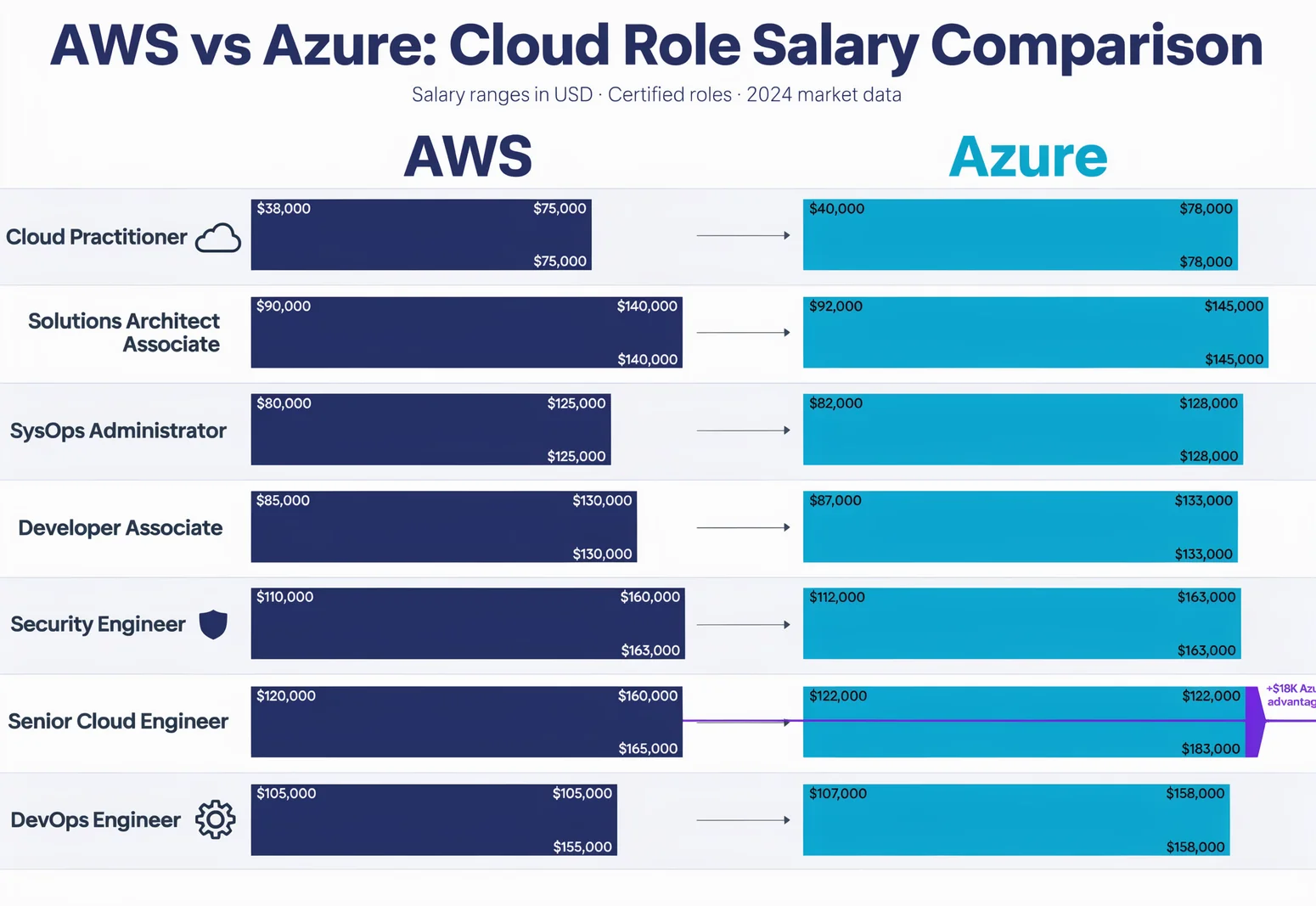
Aggregate figures hide important role-specific variations. CertEmpire's role-level data shows Azure pulling ahead or matching AWS in several senior enterprise positions:
| Role | AWS Salary Range | Azure Salary Range |
|---|---|---|
| Cloud Practitioner / AZ-900 level | $60,000–$85,000 | $60,000–$80,000 |
| Solutions Architect Associate / AZ-104 | $110,000–$145,000 | $88,000–$130,000 |
| Solutions Architect Professional / AZ-305 | $140,000–$185,000 | $130,000–$180,000 |
| DevOps Engineer | $125,000–$165,000 | $120,000–$160,000 |
| Security Specialist | $130,000–$175,000 | $115,000–$155,000 |
| Senior Cloud Engineer | $145,000–$200,000 | $145,000–$218,000 |
| Cloud Architect | $150,000–$210,000 | $130,000–$185,000 |
The Senior Cloud Engineer figure stands out: Azure's upper bound exceeds AWS by $18,000. This reflects Microsoft's dominance in large enterprise environments where senior engineers negotiate packages tied to complex hybrid and multi-cloud transformations. For candidates targeting Fortune 500 employers or heavily Microsoft-oriented organizations, Azure certification may now offer the stronger long-term ceiling.
Security roles, by contrast, still favor AWS more decisively. The AWS Security Specialty's $130,000–$175,000 range against Azure's $115,000–$155,000 suggests that AWS's earlier investment in granular security certifications continues to command employer recognition.
Why the Gap Is Closing: Three Forces
Three interconnected trends explain the narrowing premium.
Enterprise Azure adoption accelerated
Microsoft's cloud revenue growth has consistently outpaced AWS in percentage terms from a smaller base, with Azure deeply embedded in existing enterprise licensing agreements. As more organizations standardize on Microsoft 365, Entra ID, and Azure Arc, the pool of Azure-certified talent has not kept pace with demand. Basic supply dynamics push salaries up.
The Azure Arc exam skills now tested in updated Microsoft certifications reflect this hybrid reality. Employers increasingly filter for candidates who can manage workloads across on-premises, edge, and Azure environments.
AWS certification saturation at entry level
AWS's earlier certification program maturity created a larger certified population, particularly at Cloud Practitioner and Solutions Architect Associate levels. With more certified candidates competing for roles, entry-level AWS salaries face downward pressure relative to scarcer Azure-certified alternatives.
This does not mean AWS certifications have become worthless. The 2026 AWS Cloud Practitioner changes and updated Solutions Architect Professional objectives aim to restore differentiation by raising the bar. But the market adjustment takes time.
Pay premium index divergence
Foote Partners' Q1 2026 data, cited by LastRound AI, captured a striking split: certified-skill pay premiums rose 1.8% in the quarter, their strongest single-quarter gain in roughly a decade, while non-certified skill pay fell 2.2%. This widened the certified-uncertified gap to its largest recorded level.
Within that trend, cloud certifications behaved unevenly. The Global Knowledge IT Skills and Salary Report found certified cloud professionals earning $11,000–$35,000 more than non-certified peers, but the distribution shifted toward Azure in enterprise-heavy samples. Cloud certifications' value is rising overall; which vendor benefits most depends on employer composition.
Exam Version Changes Already Affecting Hiring Value
Salary surveys measure historical data. Forward-looking candidates need to track which exam versions employers are already filtering for, since outdated certifications can discount even strong salary averages.
AWS updates for late 2026
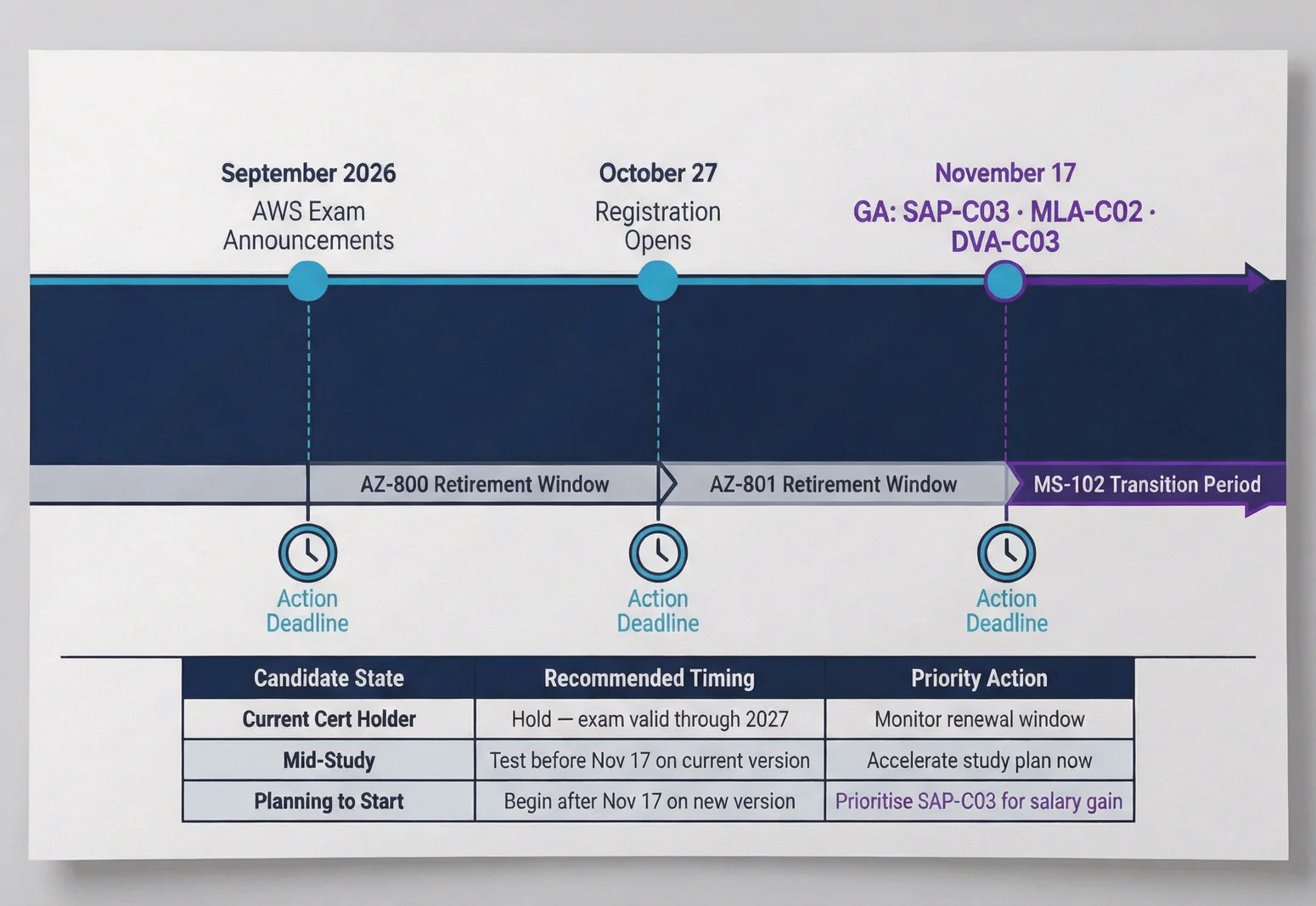
AWS announced three exam updates in September 2026, with registration opening October 27 and general availability beginning November 17:
- AWS Certified Solutions Architect – Professional (SAP-C03) replaces SAP-C02, with the last day for the current version November 16, 2026
- AWS Certified Machine Learning Engineer – Associate (MLA-C02) updated to reflect evolving ML operations roles
- AWS Certified Developer – Associate (DVA-C03) refreshed for modern application patterns
The AWS Solutions Architect Pro changes are particularly significant because this certification anchors many of the highest salary figures in survey data. Candidates holding SAP-C02 should plan transition timing carefully; employers posting roles in Q4 2026 and Q1 2027 will increasingly specify SAP-C03 or "current version required."
Microsoft retirements and replacements
Microsoft has scheduled several exam retirements that affect which Azure certifications signal current competence:
- AZ-800 and AZ-801 retiring September 30, 2026
- MS-102 retiring November 30, 2026
These dates matter for salary negotiation. A candidate presenting AZ-800 after October 2026 may face questions about skills currency, even if the underlying knowledge remains relevant. The Microsoft role-based certification changes and MCSA retirement impact have already shifted how employers interpret Microsoft credentials.
AI-900 and emerging specializations
Both vendors are expanding AI-focused certifications. Microsoft's AI-900 (Azure AI Fundamentals) and AWS's AI Practitioner track represent new salary data points that 2026 surveys have only begun to capture. Early indicators suggest these specializations command premiums above generalist cloud credentials, but sample sizes remain small.
The best AWS certification courses 2026 including AI and machine learning specializations, may offer the strongest near-term salary growth for candidates willing to bet on AI infrastructure demand.
How to Read Salary Survey Methodology
Not all "salary data" is equally useful. The variance in reported figures across sources reflects real methodological differences that candidates should understand before making study decisions.
Sample composition
Global Knowledge's IT Skills and Salary Report historically draws from North American IT professionals with substantial experience. Figures like $172,000 for AWS Professional-level certification reflect mid-career respondents, not entry-level hires. Candidates with two years of experience should expect lower starting points.
Glassdoor and LinkedIn salary insights include broader experience ranges and more international data, which typically pulls averages down. The 2–4% AWS premium appears consistently across sources, but absolute dollar figures vary significantly.
Total compensation vs. base salary
Some surveys report base salary only; others include bonus and equity. The johal.in April 2026 benchmark found cloud-certified senior engineers earning a median 42% premium over non-certified peers in total compensation, with top-tier AWS and Azure certifications crossing $250,000 base for the first time. But "total compensation" figures from US tech hubs do not translate directly to regional markets or non-tech industries.
Job posting vs. verified pay
EITT Academy's Polish data derived from advertised ranges, not verified salaries. Advertised ranges often exceed actual offers, particularly in competitive markets where employers inflate listings to attract applicants. Verified pay data from payroll platforms or anonymous submissions tends to run 10–15% lower.
Practical Decision Framework for 2026
Given the narrowing gap, how should candidates choose?
Study your local job market first. The 2–4% AWS premium is a global average. In markets with heavy Microsoft enterprise presence, Azure may already pay equivalently or better. Search job boards for your target role and location, noting which certification appears in requirements more frequently.
Weight employer stack over vendor salary headlines. A $5,000 AWS premium means little if your target employers run Azure. The cloud practitioner pay data shows that first-year outcomes depend heavily on role fit, not just certification choice.
Prioritize certification level over vendor. The data consistently shows Associate-to-Professional progression adding more salary value than AWS-to-Azure switching at the same level. A well-timed Azure Solutions Architect Expert upgrade likely outperforms adding a second vendor's Associate certification.
Track exam version currency. With SAP-C03 launching November 2026 and Microsoft retirements scheduled through year-end, holding the current exam version increasingly affects interview filtering. Budget retake or upgrade time in your study plan.
Consider specialization premiums. Security and AI specializations show wider pay spreads than generalist credentials at equivalent levels. The SC-401 exam 2026 changes reflect Azure's security specialization evolution; AWS's Security Specialty remains a consistent high-performer in salary data.
What to Watch in Q4 2026
Several developments could shift these figures before year-end:
- First SAP-C03 salary data emerging in Q1 2027 job postings
- Microsoft certification restructuring following role-based cert phase-out
- Foote Partners' Q3 and Q4 premium index updates
- AI certification sample sizes growing large enough for reliable salary benchmarking
The SAA-C03 exam objective mapping remains relevant for candidates pursuing the Solutions Architect Associate, which continues to appear in more job requirement lists than any other single cloud certification according to Citadel Cloud Management's June 2026 analysis.
Questions Candidates Are Asking
Does AWS still pay more than Azure in 2026?
Slightly. AWS certified professionals earn 2–4% more on average at equivalent levels, down from 8–12% in 2023. The gap is narrow enough that role, location, and employer stack should drive your choice.
Which cloud certification has the highest ROI?
The AWS Solutions Architect Associate (SAA-C03) consistently shows the strongest documented salary uplift relative to its $150 exam cost, with average increases around $26,000 according to 2025–2026 Global Knowledge data. Azure's AZ-104 offers comparable ROI in Microsoft-heavy environments.
Will the SAP-C03 update affect my salary prospects?
Employers posting roles from late 2026 onward increasingly specify current exam versions. Holding SAP-C02 after November 16, 2026 does not invalidate your certification, but some hiring filters may prefer SAP-C03. Plan upgrade timing based on your job search schedule.
Is it worth getting both AWS and Azure certified?
Multi-cloud credentials command a premium: ExamCert's data shows multi-cloud certified professionals earning 15–20% more than single-cloud certified peers. But the second certification adds value only with practical experience on both platforms. Certification stacking without hands-on work rarely delivers advertised premiums.
How quickly do certification salary premiums appear after passing?
Most survey data reflects pay for professionals who have held certifications for one or more years. Immediate post-certification salary jumps are less common than gradual advancement as candidates move into roles that require the credential. The certification opens doors; demonstrated skill in interviews closes the offer.
References
- AWS vs Azure Salary Comparison — You know what's not useless? Actual salary data. So I pulled numbers from Glassdoor, Levels.fyi, LinkedIn salary insights, and the 2025 Global Knowledge IT Skills & Salary Report.
- AWS vs Azure Certification: Which — Recent industry surveys show that getting an AWS certification can boost a professional’s salary by an average of 25.9 percent compared to non-certified peers. Similarly, Azure
Cloud Paths Worth Exploring


Discussion
Question Comments
0 comments·0 participantsSign in to leave a comment and access more free questions.