

AWS Solutions Architect Pro 2026 Objectives Just Changed
AWS refreshed the SAP-C02 exam guide in early 2026 with adjusted domain weightings and expanded coverage of generative AI, sustainability, and multi-region resilience. If you are sitting for the aws certified solutions architect professional certification this year, the materials you bought six months ago may not reflect what the test actually covers now.
This update matters because AWS does not always announce exam changes with fanfare. The AWS Certified Solutions Architect page still lists the same four content domains, but the underlying task statements and technology lists have shifted. Candidates who rely on outdated practice questions risk studying the right services for the wrong scenarios.
What AWS Changed and When
The current SAP-C02 exam guide carries a 2026 copyright date and reflects changes that began appearing in AWS Skill Builder materials around late April 2026. The AWS Training and Certification Blog noted new digital training products that month, including localized exam prep for other certifications, but the Solutions Architect Professional updates were rolled into the existing exam guide rather than announced as a separate launch.
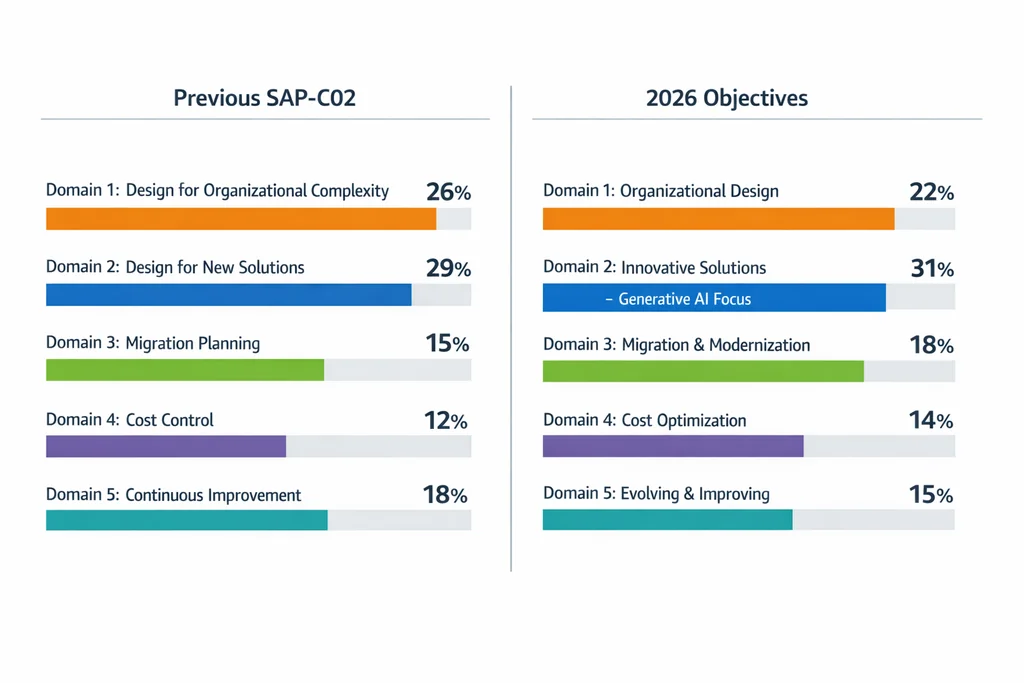
The most visible change is in the content domain distribution. The previous guide weighted the domains roughly evenly. The current version assigns:
- Domain 1: Design Solutions for Organizational Complexity — 26% of scored content
- Domain 2: Design for New Solutions — 29% of scored content
- Domain 3: Continuous Improvement for Existing Solutions — 25% of scored content
- Domain 4: Accelerate Workload Migration and Modernization — 20% of scored content
Domain 2 now carries the heaviest weight, up from its previous position. Domain 4 dropped to the lowest share. This shift signals AWS wants candidates to spend more time on greenfield architecture and less on lift-and-shift migration mechanics.
The Solutions Architect Professional 02.Pdf also expands the list of technologies and concepts that may appear on the exam. The Technologies and Concepts page now explicitly includes generative AI, sustainability optimization, and advanced observability patterns alongside the traditional compute, storage, and networking staples.
How the Domain Shifts Affect Your Study Plan
A 3-percentage-point swing between domains sounds minor until you remember this is a 75-question, 180-minute exam where passing margins are tight. Three or four additional questions on new solution design, drawn from services like Amazon Bedrock, AWS App Composer, or advanced EventBridge patterns, can separate a pass from a fail if your prep materials predate the update.
Domain 2's expanded scope now covers:
- Designing generative AI applications using Amazon Bedrock and SageMaker
- Architecting event-driven systems with Step Functions, EventBridge, and Lambda
- Building multi-account landing zones with AWS Control Tower and Organizations
- Implementing API-first strategies with API Gateway, AppSync, and private integrations
Domain 4's reduced weight does not mean migrations disappeared. It means the exam expects less rote knowledge of AWS Migration Hub or Application Discovery Service and more judgment about when to modernize versus replatform. Candidates still need to know Server Migration Service and Database Migration Service, but the questions now test tradeoff decisions rather than tool selection.
For someone like Marcus, a cloud engineer who passed his Associate exam in 2024 and scheduled his Professional test for June 2026, this change meant a painful realization. He had spent three weeks drilling migration patterns from a 2024 video course only to discover, ten days before his exam, that his weakest area was now the highest-weighted domain. He rescheduled, bought updated practice tests, and passed on his second attempt two weeks later. The delay cost him a project lead role that went to a certified colleague instead.
New and Expanded Services to Know
The updated Technologies and Concepts list reflects AWS's 2026 product priorities. Several additions stand out for candidates upgrading from older study materials.
Generative AI and machine learning now appear as first-class architecture concerns, not specialty-exam trivia. You should understand when to use Amazon Bedrock versus SageMaker, how to design retrieval-augmented generation pipelines with Knowledge Bases, and what guardrails look like in a production generative AI workload. The exam does not expect you to train models, but it does expect you to select the right service for a given latency, cost, and privacy constraint.
Sustainability joins cost optimization and security as an explicit Well-Architected pillar consideration. Questions may ask you to compare instance types by carbon impact, design for Graviton4 migration, or use AWS Customer Carbon Footprint Tool data in architecture decisions. This aligns with AWS's public commitments and reflects real enterprise RFP requirements.
Advanced networking now includes IPv6-only architectures, AWS Cloud WAN, and private 5G integration patterns. The exam has always tested hybrid connectivity, but the scenarios now assume larger scale: hundreds of VPCs, multiple AWS Regions, and third-party network appliances running on Outposts or Wavelength.
Observability and operations expanded beyond CloudWatch and X-Ray to include OpenTelemetry, AWS Managed Grafana, and cross-account anomaly detection. The Professional exam has long tested operational excellence; the update makes the tooling more current.
What Still Works from Older Materials
Not everything changed. The core architectural patterns that define the Professional exam remain stable. You still need deep knowledge of:
- Multi-AZ and multi-Region failover with Route 53, Aurora Global Database, and DynamoDB Global Tables
- Identity and access management at scale with IAM, STS, and AWS Identity Center
- Data lake and warehouse design with S3, Glue, Redshift, and Athena
- Container and serverless orchestration with ECS, EKS, Fargate, and Lambda
If your existing course or book covers these thoroughly, it is not worthless. The risk lies in the gaps: services that did not exist when the material was produced, or weightings that no longer match the current exam. A 2024 course that spends 40% of its time on migration tools and 10% on generative AI has the proportions backwards for the 2026 test.
The exam format also remains unchanged. You still face 65 scored questions plus 10 unscored, with multiple choice and multiple response formats. The 180-minute time limit and $300 USD price have not moved. What has changed is what those 65 questions ask and which services they reference.
How to Verify Your Study Materials Are Current
Before you commit to a study schedule, check three things on any course, book, or practice test you plan to use.
First, look for an explicit SAP-C02 alignment date. Materials that say "updated for SAP-C02" without a year may predate the 2026 guide changes. Look for "2026 exam guide" or "updated April 2026" in the description.
Second, scan the table of contents for the four domains in their current order and weighting. If Domain 2 is not the largest section, or if generative AI and sustainability do not appear in the index, the material is likely outdated.
Third, verify the service lists against the current Technologies and Concepts page. Missing Bedrock, Graviton4, or Cloud WAN is a red flag. So is heavy coverage of services AWS has deprecated or repositioned, like AWS OpsWorks or the original AWS CodeCommit feature set.
For practice tests specifically, the question style matters as much as the content. The Professional exam uses long, complex scenarios with multiple valid answers where you must select the best option. Tests that ask simple "which service does X" questions at the Associate level will not prepare you for the decision-making pressure of the real exam.
A Recalibrated Timeline for June and July Test-Takers
If your exam date falls within the next eight weeks, you need a focused adjustment rather than a full restart. Here is a practical sequence.
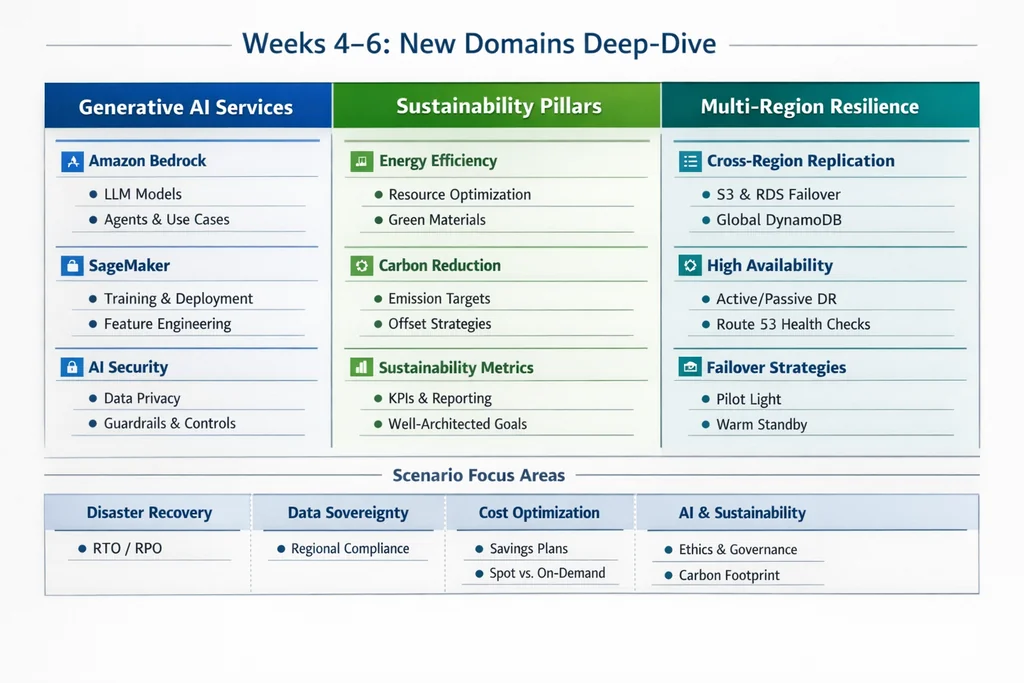
Week 1: Audit your current materials against the 2026 exam guide. Identify the gaps: missing services, underweighted domains, and outdated migration content. Do not reread what you already know well.
Week 2: Deep-dive Domain 2 with updated resources. Spend time on Bedrock architecture, event-driven patterns, and multi-account design. Use AWS's own workshops and the AWS Certified Solutions Architect documentation to build mental models, not just service lists.
Week 3: Refresh Domain 4 at the new, lighter weight. Focus on modernization decision frameworks: when to containerize, when to use Lambda, when to keep EC2. Skip deep dives into legacy migration tooling unless you have specific weaknesses.
Week 4: Run timed practice exams that mirror the current domain distribution. Review every explanation, not just the wrong answers. The goal is pattern recognition: how does AWS frame tradeoffs between cost, performance, security, and sustainability?
For candidates with more time, a 10-12 week plan starting from scratch remains viable. The key is building the foundation with current materials rather than discovering gaps three weeks before the test. Sarah, a network administrator transitioning to cloud architecture, started her SAP-C02 prep in February 2026 with a course that explicitly aligned to the updated guide. She passed in May on her first attempt, attributing her success to never having to unlearn outdated migration content.
What to Watch for Next
AWS typically updates exam guides annually, with minor refreshes between major revisions. The current SAP-C02 guide is stable enough that a scheduled test in late 2026 should not face another mid-year surprise, but candidates for 2027 should check for announcements in the first quarter.
Two trends suggest future changes. First, AWS continues to expand its generative AI portfolio. If Bedrock gains significant new capabilities or if new model hosting options launch, the exam will eventually reflect them. Second, sustainability requirements are hardening across enterprise procurement. The current exam's light touch on carbon measurement and Graviton migration will likely deepen in future versions.
The broader certification market is also shifting. Cisco's 2026 CCNA and CCIE updates explicitly added AI and automation modules, as Network World reported. Microsoft's retirement of twelve role-based certifications between June and August 2026, including AI-102 and AZ-204, shows how quickly vendor priorities can rewrite exam value. AWS has been more gradual, but the direction is the same: cloud certifications now test AI integration, sustainability, and operational judgment as core skills, not electives.
FAQ
Did the exam code change from SAP-C02?
No. AWS kept the SAP-C02 designation for this update. The changes are to the guide content and domain weightings, not the exam identifier. Verify you are registering for the correct test, but do not expect a new code until a more substantial revision.
Will my existing SAP-C02 practice tests still help?
They help for core services and architectural patterns that have not changed. They will not cover generative AI, sustainability tradeoffs, or the current domain weighting. Use them as a supplement, not your primary preparation.
How much does the exam cost in 2026?
The SAP-C02 exam remains $300 USD. Retakes cost the full price. AWS occasionally offers discounted vouchers through events or training partners, but the standard pricing has not changed with this guide update.
Do I need hands-on experience with Amazon Bedrock to pass?
No. The exam tests architectural knowledge, not implementation skill. You need to know when Bedrock fits, how to secure it, and what alternatives exist. You do not need to have deployed a production Bedrock application.
When should I schedule if I am using older materials?
Add two to three weeks to your timeline for gap-filling on Domain 2 and the new service list. Rushing to beat an imagined deadline with outdated content is the fastest path to a retake fee.
Further Reading

Discussion
Question Comments
0 comments·0 participantsSign in to leave a comment and access more free questions.