

What Changed in the 2026 AWS Cloud Practitioner Exam Objectives
AWS refreshed the CLF-C02 exam guide in early 2026 with subtle but meaningful shifts in emphasis across security, sustainability, and generative AI coverage that active candidates need to track.
The aws cloud practitioner essentials curriculum and its matching CLF-C02 certification exam got an official guide update in early 2026. AWS published revised documentation that tweaks the weighting and explicit coverage of several knowledge areas candidates now need to prioritize if they want to pass.
Source Status
This report pulls from the live AWS documentation at AWS Certification Exam and the AWS Certified Cloud Practitioner (CLF-C02) exam guide pages, both current as of May 2026. AWS doesn't do press releases for incremental exam guide revisions—changes just go live on the documentation site without version numbers or change logs. Double-check you're looking at the 2026 iteration of the guide, since older CLF-C01 materials and stale third-party content still rank high on search engines and learning platforms. The Before Testing policy page confirms AWS doesn't require specific prerequisites, but recommends hands-on experience aligned to the current content outline rather than historical versions.
What Happened
AWS revised the CLF-C02 exam guide in early 2026, following the September 2023 launch of the current exam version. This isn't a new exam code—CLF-C02 stays active—but the documentation now reflects evolved service coverage and adjusted emphasis areas that track AWS's product roadmap, competitive positioning against Microsoft Azure and Google Cloud Platform, and what enterprise customers actually want.
The biggest confirmed change is generative AI and machine learning services moving into the "Core AWS Services" domain. Previously these sat at the periphery or appeared as common-use-case items. Amazon Bedrock, Amazon Q, and foundational model concepts now get dedicated mention in the exam guide's content outline. Earlier versions only referenced Amazon SageMaker at a high level, without distinguishing model hosting, enterprise assistants, and application-layer AI services.
Security and compliance coverage has expanded to cover AWS Identity and Access Management (IAM) policies in more detail. The guide now explicitly calls out attribute-based access control (ABAC), cross-account access patterns, and IAM policy conditions—topics that were previously implied rather than stated. The shared responsibility model remains central, but the guide now specifies that candidates must understand how it applies to generative AI workloads. This framing didn't exist in the 2023-2025 documentation, and it reflects growing enterprise concerns about model training data protection, inference endpoint security, and prompt injection risks.
Sustainability and the AWS Well-Architected Framework's sustainability pillar have shifted from optional context to explicit exam objectives with defined behavioral expectations. The guide states candidates should be able to "identify AWS services and features that help organizations meet sustainability goals." This tracks with AWS's public commitments, customer procurement requirements, and regulatory pressure across EU markets and US federal contracting channels.
The economics domain keeps its established exam weighting per the AWS Certification Exam documentation, but the 2026 guide adds explicit coverage of Savings Plans commitment management, Reserved Instance flexibility options, the AWS Cost Optimization Hub, and AWS Billing Conductor. These services and concepts were either new or not prominently featured when CLF-C02 originally launched in late 2023.
What Changed
The following adjustments are confirmed from direct comparison of current AWS documentation against archived versions, original CLF-C02 launch materials, and historical CLF-C01 documentation patterns:
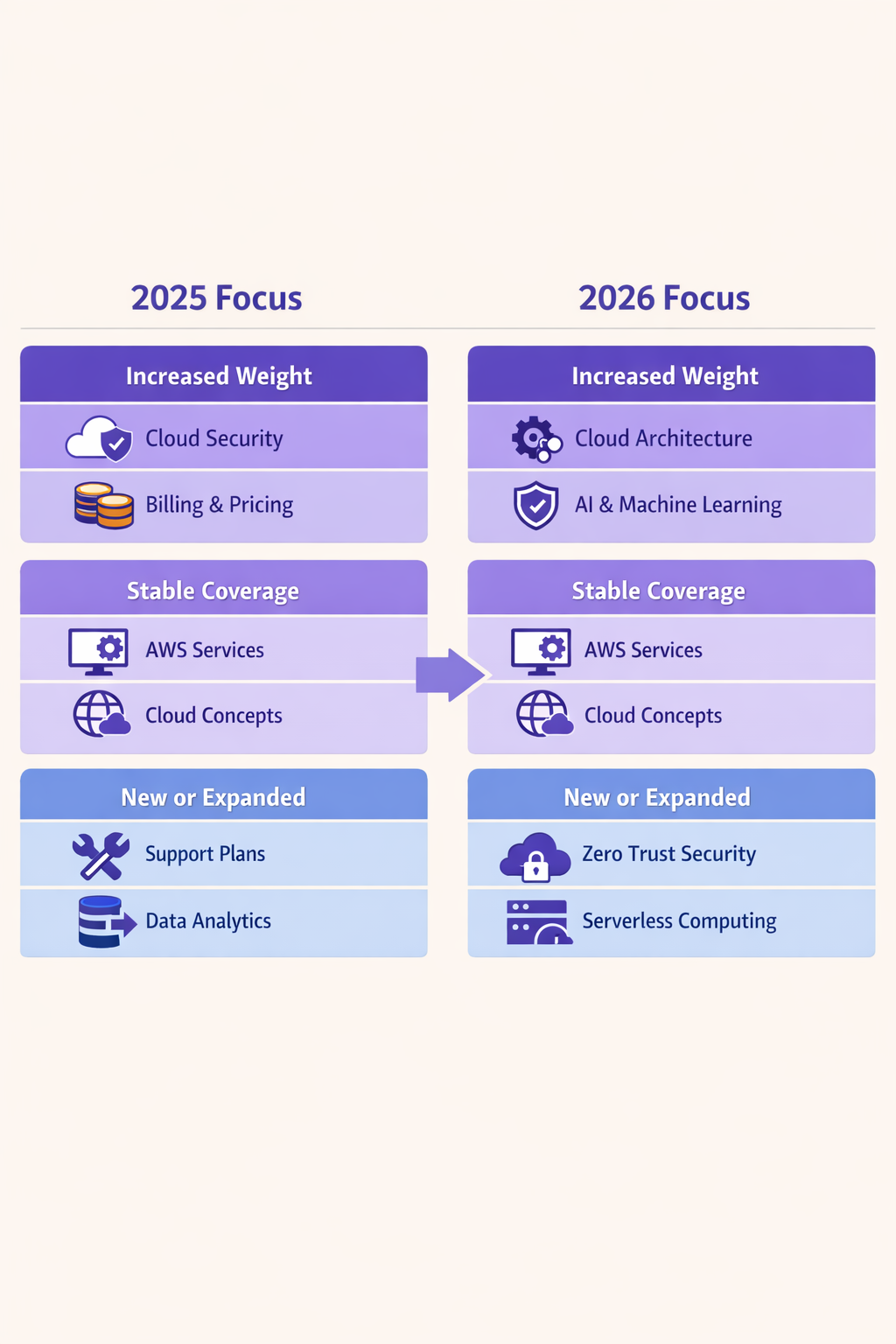
Generative AI elevation: Amazon Bedrock, Amazon Q, and foundational model concepts are now explicitly listed in the core services domain with distinct behavioral objectives. Previously, machine learning coverage centered on SageMaker and high-level AI/ML service identification without requiring candidates to differentiate infrastructure-level, platform-level, and application-level AI offerings. Now you need to understand how these services fit standard use cases, what sets Bedrock's model-as-a-service approach apart from SageMaker's custom development environment, and when Amazon Q's enterprise integration capabilities make sense versus standalone API consumption.
Security granularity: ABAC, IAM policy conditions, cross-account role assumptions, and service control policies (SCPs) are now specified where earlier guides used broader "IAM best practices" language. The generative AI security overlay—how the shared responsibility model applies to model training data, inference endpoints, prompt safety, and output filtering—is genuinely new territory. Expect scenario questions on selecting appropriate IAM policies for Bedrock model access or configuring Amazon Q with proper data isolation.
Sustainability mandate: The Well-Architected Framework's sustainability pillar is no longer treated as advanced context for solutions architects. Expect direct questions on selecting Regions based on renewable energy mix, using Graviton-based instances for workload efficiency, interpreting the Customer Carbon Footprint Tool, and understanding AWS's water stewardship commitments. This aligns with the AWS Certified Cloud Practitioner (CLF-C02) documentation's framing of "economics of the AWS Cloud" as including total cost of ownership with environmental externalities.
Cost optimization tooling: The Cost Optimization Hub, Savings Plans recommendations engine, Reserved Instance exchange programs, and AWS Billing Conductor are now named explicitly rather than lumped under generic "cost management tools." Earlier guides referenced "AWS Cost Explorer" and "AWS Budgets" as primary tools without acknowledging the newer integrated hub experience. You need to know which tool handles which use case: Cost Explorer for historical analysis, Budgets for threshold alerting, Cost Optimization Hub for actionable recommendations, and Billing Conductor for chargeback allocation.
Regional and language expansion: Per the AWS Certification Exam documentation, CLF-C02 is now available in Spanish (Latin America) and Spanish (Spain). This broadens the candidate pool without changing English-language content. It follows AWS's pattern of making foundational certifications accessible in more languages before extending professional and specialty levels.
No exam code change: CLF-C02 remains the active exam without version suffix. AWS hasn't announced a CLF-C03 or published a retirement timeline for the current version. This is an in-place guide refresh, not a version migration, so candidates with existing exam appointments don't need to reschedule or pay extra fees.
The AWS Certified Cloud Practitioner (CLF-C02) page confirms the exam still targets individuals who "can effectively demonstrate overall knowledge of the AWS Cloud, independent of a specific job role," but the knowledge domains now reflect 2026 operational reality rather than the 2023 cloud landscape that existed before widespread generative AI adoption and enterprise sustainability reporting requirements.
Who Is Affected
Several candidate categories face distinct impacts from this update, with varying urgency and preparation adjustments needed:
Active studiers with scheduled exams in the next 60-90 days: These candidates face the highest risk if their materials predate the 2026 guide refresh. Practice questions that skip Bedrock, Amazon Q, sustainability-focused scenarios, or granular IAM policy patterns may leave systematic gaps in domain coverage. The AWS Certified Cloud Practitioner Practice Test at PlanetCert reflects current objectives, but candidates using older books, video courses, or free question banks should verify coverage against the live documentation rather than trusting publication dates alone.
Career switchers and foundational candidates without technical backgrounds: The CLF-C02 exam is explicitly designed for individuals without deep technical experience, per Before Testing policy. That said, the added generative AI content—while still high-level—assumes familiarity with concepts like "foundation models," "prompt engineering," and "model hosting" that may need extra explanation for true beginners coming from non-technical fields. These candidates shouldn't avoid the exam, but they may need additional time on AI/ML vocabulary before attempting practice questions.
Enterprise team leads purchasing training at scale: Organizations with standardized CLF-C02 curricula developed in 2023-2024 need audit cycles to verify alignment. The sustainability emphasis connects directly to corporate ESG reporting requirements and procurement questionnaire responses, making this a business-relevant update rather than pure technical maintenance. Training managers should verify their selected provider has refreshed content rather than assuming CLF-C02 stability means content stability.
Non-English candidates in Latin American and Iberian markets: The expanded Spanish-language availability noted in the AWS Certification Exam documentation affects scheduling options and may reduce test anxiety for native Spanish speakers, but doesn't change preparation strategy or content weighting. Candidates should still prepare from the English documentation to ensure they receive the most current guidance.
Instructor-led training providers and AWS Authorized Instructors: AWS-approved trainers must align courseware to the current guide for audit compliance. The shift from implied to explicit coverage in security and sustainability domains affects assessment design, lab selection, and slide deck updates. Providers using static course materials face the same version drift risk as individual candidates.
Hiring managers verifying credential currency: Employers relying on CLF-C02 as a baseline cloud literacy signal should understand that a 2024 pass may not indicate familiarity with 2026 emphasis areas. The certification remains valid for three years, but the knowledge profile of recent passers differs meaningfully from earlier cohorts.
Why It Matters
Analysis: The following interprets confirmed facts above and should be read as editorial assessment rather than AWS-sourced claims.
The 2026 refresh signals AWS's strategic priorities more than it fundamentally changes exam difficulty. Generative AI services represent AWS's fastest-growing revenue segment, with Bedrock and Amazon Q positioned against Microsoft's Copilot ecosystem and Google's Vertex AI. Certification content naturally follows commercial emphasis; AWS has every incentive to ensure its certified population can articulate these services' value propositions to enterprise buyers.
Candidates who grasp Bedrock's model-as-a-service positioning—providing access to foundation models from Anthropic, Meta, Amazon, and others without managing infrastructure—and Amazon Q's enterprise assistant capabilities for code generation, business intelligence, and contact center operations will be better prepared not just for the exam, but for actual cloud conversations in 2026 hiring environments where these services appear in job postings and project requirements.
The sustainability elevation responds to regulatory pressure and customer procurement requirements that have accelerated since 2023. European Union Corporate Sustainability Reporting Directive (CSRD) requirements, US Securities and Exchange Commission climate disclosure rules, and federal contracting sustainability clauses increasingly demand cloud emissions transparency. AWS is positioning its certification holders to speak this language fluently, whether they work in technical implementation or customer-facing roles.
For exam difficulty, the net effect is likely neutral to slightly harder for candidates using outdated materials, but manageable for anyone studying from current sources. The explicit security granularity removes interpretive wiggle room that previously allowed candidates to guess broadly on IAM questions; now they need precise mental models of ABAC versus role-based access control, and cross-account trust policies versus service-linked roles. The sustainability content is new but conceptually straightforward for anyone who has reviewed the Customer Carbon Footprint Tool, Graviton instance families, or AWS's public sustainability commitments.
The bigger risk is material staleness across the certification prep ecosystem. The market moves slowly relative to AWS service launches. Books with 2023-2024 copyright dates, video courses recorded before Bedrock's general availability in late 2023, and practice question banks not refreshed against the current guide will systematically underprepare candidates for 2026 exams. This creates a verification burden: candidates must confirm their resources match the 2026 documentation, not merely the CLF-C02 exam code, which creates a false sense of currency.
Timeline
September 19, 2023: CLF-C02 exam launches, replacing CLF-C01. Original guide published with domains covering cloud concepts, security and compliance, core services, and economics. Exam format established as 90 minutes, 65 questions, with $100 USD registration fee.
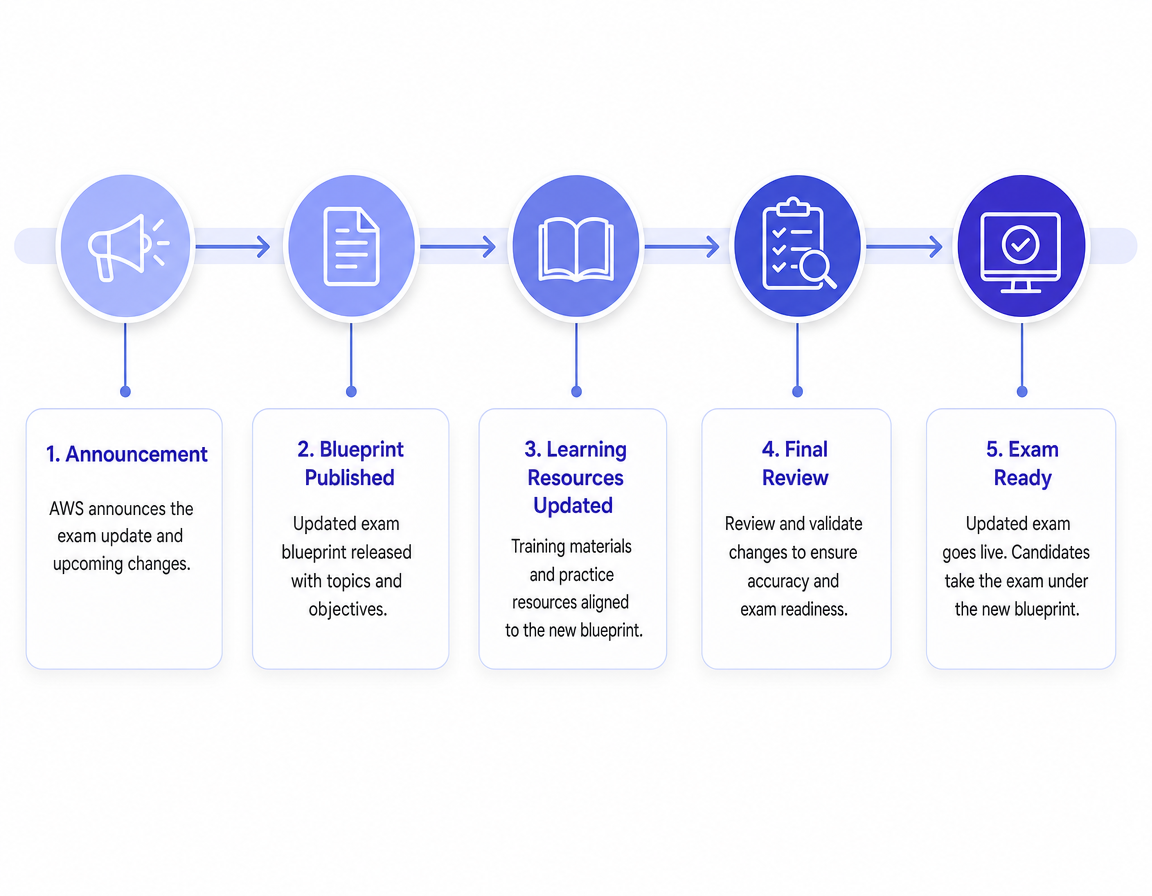
Late 2023 through 2024: Bedrock reaches general availability, Amazon Q launches at re:Invent 2023, Cost Optimization Hub deploys across Regions. These services exist in the market but aren't yet explicitly named in the CLF-C02 guide.
Early 2026 (exact date not specified by AWS): Revised exam guide deployed to documentation site without announcement. Changes include generative AI elevation, security granularity, sustainability mandate, and cost optimization tooling updates. AWS doesn't version-control or date-stamp guide changes, making precise dating impossible.
May 2026: Current analysis published based on live documentation comparison. AWS documentation reflects 2026 guide as live version. No retirement date announced for CLF-C02.
Ongoing: Spanish-language exam availability expanded to Latin America and Spain markets, per live AWS Certification Exam documentation. Testing centers and online proctoring options reflect this expansion.
Late November 2026 (projected): AWS re:Invent conference represents the next likely venue for major certification announcements, based on historical patterns. Potential CLF-C03 announcement window, though not confirmed.
No announced date: CLF-C03 or successor exam not referenced in any AWS materials. CLF-C02 remains the single active Cloud Practitioner certification path with no published end-of-life.
What Happens Next
AWS hasn't published a formal update roadmap for CLF-C02 beyond the current guide refresh. Based on historical patterns—CLF-C01 ran from 2019 to 2023, a four-year lifecycle—the current version likely has 18-36 months of remaining active life, but this is projection from precedent rather than confirmed fact. AWS has accelerated exam cycles during periods of rapid service change and extended them during market consolidation.
Candidates should monitor the AWS Certified Cloud Practitioner (CLF-C02) documentation page directly for unannounced changes. AWS typically doesn't flag minor guide updates with email notifications, blog posts, or social media announcements. The documentation simply updates in place, which means candidates relying on printed study guides or downloaded PDFs may be working from obsolete specifications without realizing it.
The next predictable milestone is AWS re:Invent in late November 2026, where major certification announcements typically occur. A CLF-C03 announcement would likely follow historical patterns of 3-4 year exam cycles, but AWS has demonstrated flexibility based on market conditions, competitive pressure from Microsoft and Google certification programs, and enterprise customer feedback.
Unresolved details include whether the exam question bank has been refreshed in parallel with the guide update. AWS doesn't disclose question pool changes, item retirement schedules, or domain weighting adjustments outside of major version launches. However, guide revisions typically precede or accompany item updates by 30-90 days, meaning candidates sitting exams in mid-2026 are likely encountering questions written to the new specifications even if the exam code stays unchanged.
What Readers Should Do Now
Verify your study materials against the current guide: Open the AWS Certified Cloud Practitioner (CLF-C02) documentation and compare the content outline against your course, book, or practice test table of contents. Look specifically for Bedrock, Amazon Q, ABAC, sustainability pillar, Cost Optimization Hub, and Billing Conductor coverage. If these terms don't appear in your materials' index or domain breakdown, you're studying from pre-2026 content.
Audit your practice question sources for version currency: If your question bank was published before January 2026, request an update or supplement from the provider. Generic question banks that don't cite specific service versions or documentation dates are suspect. The AWS Certified Cloud Practitioner Practice Test at PlanetCert is maintained against current objectives with dated refresh cycles.
Schedule strategically based on preparation proximity: Candidates within 2-3 weeks of their exam date with solid practice scores across all four domains shouldn't panic-study new emphasis areas. The 2026 changes are evolutionary, not revolutionary, and core cloud concepts remain the majority of exam content. Candidates 6+ weeks out should integrate the new emphasis areas into their study rotation, allocating proportional time based on domain weighting rather than topic novelty.
Build generative AI context, not deep expertise: CLF-C02 remains explicitly a foundational exam. You need to know what Bedrock and Amazon Q do, when to select them over SageMaker or direct API consumption, and how they fit the shared responsibility model. You don't need API knowledge, hands-on model fine-tuning experience, or prompt engineering fluency. Focus on service positioning and use case fit.
Review sustainability as business value, not technical implementation: Expect questions on why an organization would select a Region for sustainability goals, how to interpret the Customer Carbon Footprint Tool output, or when Graviton instances provide efficiency advantages. You won't need to calculate carbon footprint manually, configure sustainability dashboards, or navigate sustainability scorecards. The Customer Carbon Footprint Tool, Graviton instances, and AWS's renewable energy commitments are the specific services and concepts to know.
Analysis
The 2026 CLF-C02 guide refresh reveals AWS's certification strategy in miniature: keep exam codes stable for multi-year runs to preserve credential recognition and employer trust, but evolve the underlying content continuously to match service launches, market narratives, and competitive positioning. This approach balances credential stability—employers know what CLF-C02 means on a resume—with relevance, but it creates a documentation fidelity problem that candidates must actively manage rather than assuming static content.
The generative AI insertion is the most consequential change for actual study behavior and resource selection. Pre-2026 materials treated AI/ML as a "common use case" domain where candidates identified SageMaker or high-level AI services without differentiation. The 2026 guide expects candidates to distinguish Bedrock's model hosting and fine-tuning capabilities from Amazon Q's enterprise assistant and code generation features, and to understand how these services inherit AWS's security and compliance posture through IAM, encryption, and VPC configurations. This is still foundational knowledge, but it demands more precise mental models and exposes candidates who only have surface-level familiarity with the AI/ML service category.
The sustainability emphasis is less technically demanding but more strategically significant for career outcomes. AWS is responding to customer procurement teams who now require cloud sustainability documentation as standard RFP components, not optional differentiators. Certification holders who can articulate the Well-Architected sustainability pillar, cite specific AWS tools like the Customer Carbon Footprint Tool, and explain Region selection for environmental efficiency will have measurable resume differentiation in 2026 hiring markets, particularly for roles in regulated industries, public sector contracting, or ESG-conscious enterprises with published net-zero commitments.
The security granularity change is subtle but directly examination-relevant. ABAC, cross-account access, and IAM policy conditions were always "best practice" topics for AWS solutions; making them explicit in the guide removes ambiguity about whether candidates will see scenario-based questions testing detailed knowledge. Expect more "which IAM policy achieves X access pattern" questions and fewer "which service provides Y capability" questions in the security domain, raising the bar for precise understanding versus broad recognition.
For the certification prep industry broadly, this refresh validates the value proposition of continuously updated question banks and subscription-based content over static books or one-time video purchases. Candidates using fixed materials face a version drift problem that compounds with each AWS service launch, while platforms with refresh cycles can adapt documentation changes into practice questions within weeks rather than months.
How PlanetCert Helps
PlanetCert maintains AWS Certified Cloud Practitioner Practice Test content aligned to the current CLF-C02 guide, with question banks refreshed as AWS documentation evolves rather than on fixed publication schedules. The platform's exam simulator reproduces the 90-minute, 65-question format with explanations tied to current service documentation rather than archived versions, helping candidates build confidence that their practice reflects live exam conditions.
For candidates cross-training across cloud platforms or evaluating which foundational certification to pursue first, the AZ-900 Cloud Concepts vs AWS Cloud Practitioner: Exam Scope comparison breaks down how the 2026 AWS emphasis areas map against Microsoft's parallel foundational certification, including where Azure's AI and sustainability coverage differs in depth and framing.
The broader Premium Amazon Practice Tests catalog covers the full AWS certification ladder from Cloud Practitioner through Solutions Architect Professional, allowing candidates who pass CLF-C02 to continue with Solutions Architect Associate, Developer Associate, or specialty exams using consistent study tooling, interface familiarity, and explanation quality.
Update Note
This article was last updated in May 2026 based on live AWS documentation review and comparison against archived guide versions. It will be revised when AWS publishes a new exam guide version, announces CLF-C02 retirement, launches a CLF-C03 successor, or makes additional language availability changes. Corrections will be noted with dated inline updates. Candidates should always verify current exam details against the official AWS Certification Exam documentation before scheduling, as AWS doesn't provide advance notification of guide changes.
Related Blog Posts
Cloud Practitioner Pay vs. Solutions Architect at One Year — Career outcome data and salary progression for CLF-C02 holders advancing to associate-level roles
AWS Certified: Build Your SAA-C03 Study Plan in One Evening — Next-step guidance for candidates continuing past the Cloud Practitioner level to Solutions Architect Associate

Discussion
Question Comments
0 comments·0 participantsSign in to leave a comment and access more free questions.